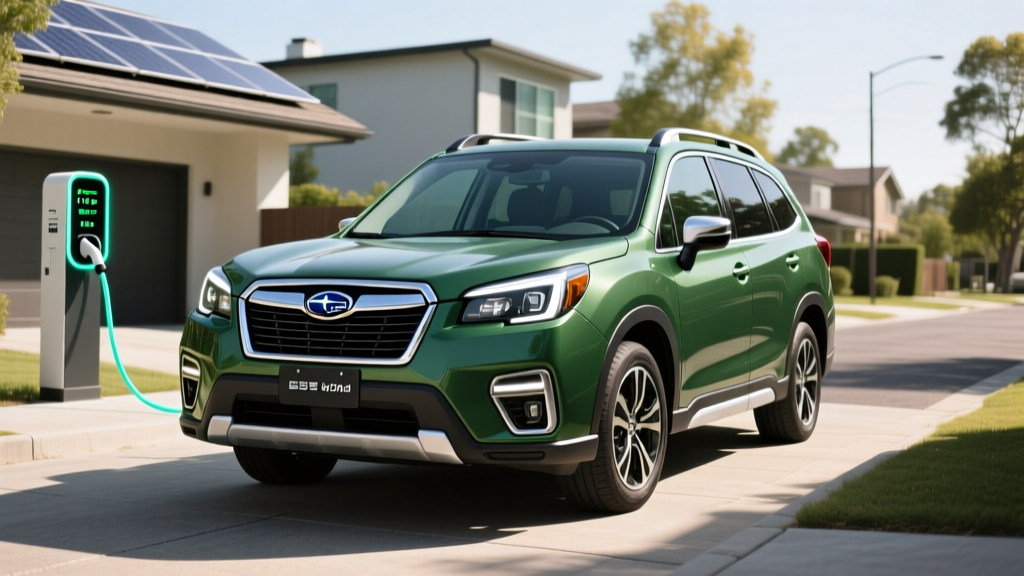
The 2025 Subaru Forester Hybrid arrives as a conventional hybrid electric vehicle (HEV) — not a plug-in — filling a gap Subaru left when the previous Forester Hybrid was discontinued after the 2024 model year. For buyers who want the standard Forester's standard all-wheel drive, excellent outward visibility, and strong safety ratings but with improved fuel economy, this HEV variant targets a specific sweet spot: better city MPG without ever plugging in.
This guide breaks down exactly what the 2025 Forester Hybrid delivers in efficiency, powertrain output, pricing, and long-term ownership costs — with real-world expectations paired against EPA sticker numbers.
HEV vs PHEV: What the 2025 Forester Hybrid Actually Is
Before examining specs, it's critical to understand what this vehicle is not. The 2025 Subaru Forester Hybrid is a conventional hybrid (HEV), meaning it charges its small battery pack through regenerative braking and the gasoline engine. You never plug it in. There is no electric-only driving range to speak of — the electric motor assists the engine but cannot propel the vehicle for meaningful distances on battery alone.
| Feature | HEV (Forester Hybrid) | PHEV (e.g., Toyota RAV4 Prime) |
|---|---|---|
| Plugs in? | No | Yes |
| Electric-only range | ~0.5 mi at low speed | 25-42 mi typical |
| Battery size | ~1.1 kWh (small buffer) | 18-22 kWh usable |
| Federal tax credit (§30D) | Not eligible | Up to $7,500 if eligible |
| Best for | No home charging access, want simple MPG gains | Home charging available, short commutes |
If you're hoping for a plug-in Forester that can handle a 20-mile electric commute, Subaru does not currently offer that. The Forester Hybrid operates more like the Toyota RAV4 Hybrid or Honda CR-V Hybrid — a gas engine supplemented by an electric motor for efficiency gains.
Fuel Economy: EPA MPG and Real-World Expectations
The headline reason to choose the Forester Hybrid over the standard gas Forester is fuel economy. Based on Subaru's published specifications and EPA data at fueleconomy.gov, here is what to expect:
| Trim / Configuration | City MPG | Highway MPG | Combined MPG |
|---|---|---|---|
| 2025 Forester Hybrid (AWD) | 35 | 34 | 35 |
| 2025 Forester Gas (AWD, baseline) | 26 | 33 | 29 |
| Toyota RAV4 Hybrid (AWD, competitor) | 41 | 38 | 39 |
The hybrid powertrain delivers roughly a 6 MPG combined improvement over the standard Forester — a meaningful 20% gain. The city improvement is especially notable, as hybrids recover energy during stop-and-go driving through regenerative braking.
Real-World MPG vs EPA Sticker
Conventional hybrids frequently exceed their EPA city estimates in real-world driving because city conditions maximize regenerative braking. Highway driving is where hybrids lose their advantage, as the gasoline engine does most of the work at sustained speeds.
Expect the 2025 Forester Hybrid to deliver:
- City driving: 34-38 MPG (matches or slightly exceeds EPA)
- Highway (70+ mph): 30-33 MPG (slightly below EPA highway rating)
- Cold weather (below 30°F): 28-32 MPG combined (engine runs more to heat the cabin and warm the catalytic converter)
- Mixed daily driving: 33-36 MPG combined
These figures make the Forester Hybrid competitive with the Honda CR-V Hybrid but still a few MPG behind the class-leading RAV4 Hybrid. Subaru's standard symmetrical AWD system adds drivetrain friction that slightly reduces efficiency compared to FWD-biased competitors.
Powertrain Specs: Engine, Motor, and Combined Output
| Specification | Detail |
|---|---|
| Engine | 2.5L flat-4 (Boxer) gasoline |
| Electric motor | Integrated AC synchronous motor |
| Combined system horsepower | 194 hp (est.) |
| Transmission | Lineartronic CVT |
| Drivetrain | Symmetrical AWD (standard) |
| 0-60 mph | ~7.8 seconds (est.) |
| Towing capacity | 1,500 lbs |
| Battery type | Lithium-ion, ~1.1 kWh |
The 2.5-liter Boxer four-cylinder is a carryover from Subaru's familiar engine family, now paired with an electric motor sandwiched between the engine and CVT. Combined output of approximately 194 horsepower gives the Forester Hybrid adequate acceleration for merging and passing — a step up from the standard Forester's 180 hp.
The CVT is tuned for efficiency rather than sportiness. Expect smooth, linear acceleration without the rubber-band feeling some CVTs produce. Subaru's e-Boxer hybrid system prioritizes seamless transitions between electric assist and gasoline power — in normal driving, you won't feel the system switching modes.
Pricing, Trims, and Tax Credit Eligibility
The 2025 Forester Hybrid is offered across multiple trim levels. Pricing starts with a modest premium over equivalent gas-only trims:
- Hybrid Premium: ~$33,495 MSRP (including destination)
- Hybrid Sport: ~$36,495 MSRP
- Hybrid Limited: ~$39,495 MSRP
- Hybrid Touring: ~$42,495 MSRP
The hybrid premium over an equivalent gas trim typically runs $1,500-$2,000. At current fuel prices (~$3.40/gallon national average), that premium pays back in roughly 3-4 years for a driver covering 12,000 miles annually.
Federal and State Tax Credits
Because the Forester Hybrid is a conventional HEV — not a plug-in — it does not qualify for the federal §30D Clean Vehicle Credit of up to $7,500. That credit is reserved for BEVs and PHEVs with sufficient battery capacity and compliant sourcing. You can verify current rules at IRS.gov §30D guidelines.
Some states offer modest hybrid incentives or HOV lane access, but these vary by jurisdiction. Check your state's DMV or energy office for current programs. Do not count on any tax credit when budgeting for this vehicle.
Battery Warranty, Lifespan, and Replacement Cost
Hybrid Battery Warranty: Subaru covers the Forester Hybrid's lithium-ion battery pack for 8 years / 100,000 miles (10 years / 150,000 miles in CARB states including California, New York, Massachusetts, and others that follow California emissions standards).
Warranty threshold: Coverage applies if battery capacity drops below approximately 70% of original capacity or if the battery fails outright.
How Long Will the Battery Last?
Modern hybrid batteries are engineered for the life of the vehicle. Toyota's hybrid batteries (a useful benchmark since Subaru's e-Boxer system shares hybrid architecture concepts) routinely last 150,000-200,000+ miles with minimal degradation. The Forester Hybrid's smaller battery cycles less aggressively than a PHEV or BEV battery, reducing wear.
Real-world data from the previous-generation Forester Hybrid and Subaru's other hybrid models (Crosstrek Hybrid, which was a PHEV) suggests battery failures are rare within the first 10 years of ownership.
Replacement Cost if Out of Warranty
If the hybrid battery does require replacement after the warranty period, expect:
- New OEM battery pack: $2,500-$4,000 (parts and labor)
- Refurbished/remanufactured pack: $1,500-$2,500
These costs are significantly lower than full EV battery replacements ($8,000-$20,000+) because the hybrid battery is small (~1.1 kWh vs 60-100 kWh in a BEV). For most owners, this is a non-issue — the battery will outlast the vehicle's useful life.
Reliability and Safety Ratings
Subaru's reliability record is mixed in recent years, with some models drawing criticism for CVT durability and infotainment bugs. However, the Forester platform itself has been solid, and the hybrid system adds components (electric motor, battery) that have proven reliable across the industry.
The 2025 Forester (gas model) earned top marks from the IIHS, including a Top Safety Pick+ designation when equipped with specific headlights. The hybrid variant shares the same body structure and safety systems, so expect equivalent crash-test performance. Subaru's EyeSight driver-assistance suite (adaptive cruise control, lane-keeping assist, pre-collision braking) is standard across all trims.
For the latest NHTSA ratings once testing is complete, check NHTSA.gov.
Who Should Choose the Forester Hybrid vs EV or Gas?
Choose the Forester Hybrid if:
- You cannot install a home charger (apartment, street parking, no garage)
- You want AWD standard for snow/rain without an efficiency penalty
- Your daily driving includes heavy city stop-and-go traffic
- You want a simple ownership experience — no charging apps, no plug-in routines
- You value Subaru's visibility, ground clearance (8.7 in), and safety reputation
Look at a PHEV or BEV instead if:
- You have home charging and a short commute (a PHEV like the RAV4 Prime covers 42 mi on electric)
- You want to maximize fuel savings and qualify for the $7,500 federal tax credit
- You drive mostly in the city and want zero tailpipe emissions on daily trips
- You plan to keep the vehicle 10+ years and want the lowest possible fuel cost
The Decision Framework
Forester Hybrid (HEV): Best for buyers without charging access who want a 6 MPG improvement and standard AWD. No behavior change required — just drive it like a gas car.
PHEV alternative (RAV4 Prime, Tucson PHEV): Best for buyers with home charging who commute under 35 miles. You'll drive on electricity most days and use gas only for road trips. Federal credit may offset the higher MSRP.
Full BEV (Ioniq 5, Model Y, EV6): Best for buyers with home charging who want the lowest per-mile fuel cost, minimal maintenance, and access to the $7,500 federal credit. Requires planning for road trips around DC fast charging.
Hybrid vs PHEV vs EV: Which Fits Your Life?
The 2025 Forester Hybrid occupies a clear lane: it's for drivers who want electrified efficiency without electrified complexity. Here's how the three powertrain types compare for a typical compact SUV buyer driving 12,000 miles per year:
| Factor | HEV (Forester Hybrid) | PHEV (RAV4 Prime) | BEV (Ioniq 5 AWD) |
|---|---|---|---|
| Annual fuel cost | ~$1,170 | ~$650 (mix of electric + gas) | ~$540 (electric only) |
| Home charging needed? | No | Yes, for full benefit | Yes, strongly recommended |
| Federal tax credit | $0 | Up to $7,500 | Up to $7,500 |
| Maintenance cost (5 yr) | ~$2,200 | ~$1,800 | ~$1,100 |
| Road-trip convenience | Excellent (gas stations) | Excellent (gas backup) | Good (requires DC charging planning) |
| Upfront MSRP (base AWD) | ~$33,500 | ~$44,500 | ~$47,000 |
The Forester Hybrid's advantage is its low entry price and zero lifestyle change. You pay less upfront, never think about charging, and still save roughly $300-$500 per year on fuel compared to the gas Forester. The trade-off: you miss out on the larger savings and tax incentives that PHEVs and BEVs offer.
Frequently Asked Questions
How many MPG does the 2025 Subaru Forester Hybrid get?
The EPA rates the 2025 Forester Hybrid at 35 MPG city / 34 MPG highway / 35 MPG combined. Real-world driving typically yields 33-36 MPG combined, with city driving sometimes exceeding the EPA estimate thanks to regenerative braking.
Does the Forester Hybrid need to be plugged in?
No. The 2025 Forester Hybrid is a conventional HEV. It charges its small battery through regenerative braking and the gasoline engine. You fuel it exclusively at gas stations, exactly like a non-hybrid vehicle.
Does the 2025 Forester Hybrid qualify for any tax credit?
No. The federal §30D Clean Vehicle Credit applies only to plug-in vehicles (BEVs and PHEVs) with qualifying battery sourcing. As a conventional hybrid, the Forester Hybrid does not qualify. Some states may offer minor hybrid incentives — check your local programs.
How long will the hybrid battery last and what does replacement cost?
Subaru warranties the hybrid battery for 8 years/100,000 miles (10 years/150,000 miles in CARB states). Modern hybrid batteries routinely last 150,000+ miles. Out-of-warranty replacement runs $2,500-$4,000 for a new OEM pack, significantly less than a full EV battery replacement.
Is the Forester Hybrid slower than the gas Forester?
No — the hybrid is slightly quicker. Combined output of approximately 194 hp exceeds the gas model's 180 hp, and the electric motor provides instant torque at low RPMs. Expect 0-60 mph in roughly 7.8 seconds vs about 8.5 seconds for the gas model.
How does the Forester Hybrid compare to the Toyota RAV4 Hybrid?
The RAV4 Hybrid leads the segment with 39 MPG combined vs the Forester Hybrid's 35 MPG. However, the Forester offers more cargo space behind the rear seats (28.9 cu ft vs 37.6 cu ft in the RAV4), standard EyeSight safety tech, and Subaru's reputation for all-weather capability. Choose the RAV4 for maximum MPG; choose the Forester for visibility, ground clearance, and winter confidence.