Quick Verdict: The Forester Goes Hybrid for 2025
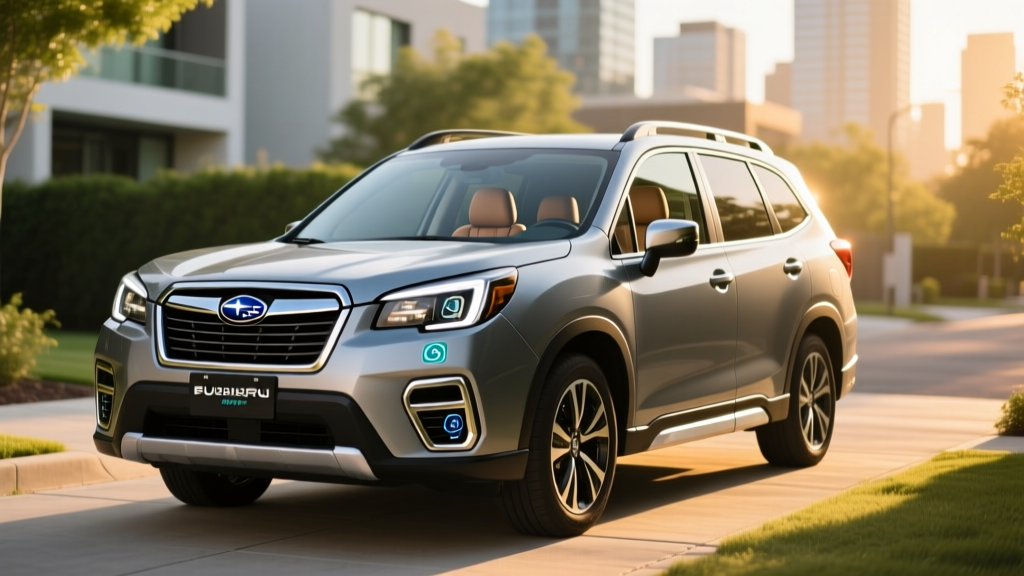
Subaru reintroduced a hybrid powertrain to the Forester lineup for the 2025 model year, and the Forester Hybrid Limited sits near the top of the range. Unlike the previous-generation Forester Hybrid (discontinued after 2022), this new iteration pairs a 2.5-liter boxer four-cylinder with a revised hybrid system producing 194 combined horsepower. The result is a meaningful efficiency bump over the gas-only Forester while retaining the standard symmetrical all-wheel drive that Subaru buyers expect.
This is a conventional hybrid (HEV), not a plug-in hybrid (PHEV). You never plug it in — the battery charges through regenerative braking and the gasoline engine. If you're searching for electric-only driving, you'll need to look at PHEVs like the Toyota RAV4 Prime or a full BEV. But if your goal is straightforward fuel savings without changing your fueling habits, the Forester Hybrid Limited delivers.
HEV vs. PHEV: Where the Forester Hybrid Fits
Before diving into specs, it's critical to understand what this vehicle is and isn't. Subaru does not currently offer a plug-in hybrid Forester.
| Feature | HEV (Forester Hybrid) | PHEV (e.g., RAV4 Prime) |
|---|---|---|
| Plug-in charging | No — gas only | Yes — Level 1/Level 2 |
| Electric-only range | None (motor assists engine) | 25–42 miles typical |
| Battery size | ~1.1 kWh | 13–18 kWh |
| Federal tax credit (§30D) | Not eligible | Up to $7,500 (if eligible) |
| Fueling | Gas station only | Gas + home charging |
| Best for | No home charging access | Home charging + short commutes |
The Forester Hybrid's small battery pack provides torque fill and enables brief low-speed electric assist, but the gasoline engine is always doing the primary work. Think of it as a more efficient gas car rather than an electric car with a backup engine.
Fuel Economy: EPA Ratings and Real-World MPG
The headline number for the 2025 Subaru Forester Hybrid Limited is a significant improvement over the gas-only Forester's 29 MPG combined.
| Driving Cycle | Forester Hybrid (EPA) | Gas Forester Limited (EPA) |
|---|---|---|
| City | 35 MPG | 26 MPG |
| Highway | 34 MPG | 33 MPG |
| Combined | 35 MPG | 29 MPG |
Source: EPA Fuel Economy
Real-World MPG Expectations
Hybrids typically exceed their EPA city estimates in stop-and-go driving because regenerative braking recovers energy that gas cars waste as heat. Expect 36–38 MPG in city commuting during mild weather. Highway driving at 75+ MPH yields closer to 31–33 MPG due to aerodynamic drag — the boxy Forester shape doesn't help here.
Cold weather reduces hybrid efficiency by roughly 10–15%. In sub-freezing temperatures, the engine runs more frequently to maintain cabin heat, reducing city MPG to approximately 30–32. This is less severe than the 25–30% range loss a full EV experiences in winter, but it's a real factor for northern-climate buyers.
Powertrain and Performance Specs
| Specification | Value |
|---|---|
| Engine | 2.5L DOHC 4-cylinder boxer |
| Hybrid system | Series-parallel (e-Boxer) |
| Combined output | 194 hp |
| Transmission | Lineartronic CVT |
| Drivetrain | Symmetrical AWD (standard) |
| 0–60 mph (est.) | ~7.8 seconds |
| Towing capacity | 1,500 lbs |
| Cargo volume (behind rear seats) | 26.9 cu ft |
| Cargo volume (rear seats folded) | 56.3 cu ft |
The hybrid system adds an electric motor integrated between the engine and CVT. Combined output rises to 194 hp compared to the gas Forester's 180 hp — a noticeable improvement in passing acceleration and merging confidence. The electric motor's instant torque also smooths out the CVT's typical rubber-band feel at low speeds.
All-wheel drive is standard on every Forester Hybrid trim. Subaru's system uses a mechanical center differential rather than a dedicated rear electric motor (unlike Toyota's e-AWD system), so there's no electric-only rear-axle drive. The trade-off is proven all-weather capability with fewer electronic components to maintain.
Pricing and Tax Credit Eligibility
The 2025 Subaru Forester Hybrid Limited carries an MSRP of approximately $38,495 (including destination charge). This positions it roughly $2,500 above the gas-only Forester Limited.
Federal Tax Credit Status
The Forester Hybrid does not qualify for the federal §30D clean vehicle tax credit. That credit, which offers up to $7,500, applies only to plug-in electric vehicles (BEVs and PHEVs) meeting specific battery sourcing, MSRP caps, and buyer income limits per IRS guidelines. Conventional hybrids like this Forester are excluded under current law.
Some states offer separate incentives for hybrid purchases, but these vary widely by jurisdiction. Check your state's energy office or department of environmental quality for current programs. No point-of-sale transfer applies here since there's no federal credit to transfer.
Battery Warranty, Reliability, and Replacement Cost
Hybrid Battery Longevity
The Forester Hybrid uses a relatively small nickel-metal hydride (NiMH) or lithium-ion battery pack (approximately 1.1 kWh usable). Because the pack is small and the hybrid system never deeply cycles it — the battery management system maintains a state-of-charge buffer between roughly 40% and 80% — degradation is minimal. Toyota and Subaru hybrid batteries routinely last 150,000–200,000+ miles before any measurable capacity loss affects fuel economy.
Replacement Cost
If the hybrid battery does require replacement outside warranty, expect a dealer-installed replacement to cost $2,000–$3,500 for the Forester Hybrid. This is significantly less than a full EV battery replacement ($8,000–$20,000+) because the pack is small and simpler. Independent hybrid specialists can often refurbish or replace individual cells for $1,000–$1,800.
For context, Subaru's overall reliability reputation is strong. IIHS has historically rated the Forester as a Top Safety Pick, and the hybrid powertrain adds few new failure points — the electric motor has no brushes, the CVT is proven, and the battery management system prevents the deep cycling that causes degradation.
Who Should Buy the Forester Hybrid Limited?
✅ Choose This Hybrid If:
- You want better MPG without changing your fueling routine
- You don't have access to home or workplace charging
- You need standard AWD for snow/rain climates
- You want a compact SUV with strong visibility and cargo space
- You plan to keep the vehicle 10+ years (hybrid reliability advantage)
❌ Look Elsewhere If:
- You want electric-only driving for your commute (consider a PHEV)
- You qualify for the $7,500 federal tax credit on a BEV or PHEV
- You need more than 1,500 lbs of towing capacity
- You prioritize sporty handling over efficiency (the CVT prioritizes smoothness)
- You want a third row (Forester is strictly five-passenger)
Forester Hybrid vs. Full EV vs. Gas: Decision Framework
If you can install a Level 2 home charger and your daily driving is under 40 miles, a PHEV like the Toyota RAV4 Prime (42 miles electric-only, 38 MPG after depletion) or a full EV like the Hyundai Ioniq 5 (300+ miles EPA range) will save more on fuel. But if you live in an apartment without charging, frequently drive 300+ mile trips, or regularly encounter extreme cold, the Forester Hybrid's no-compromise approach — just fill up at any gas station and go — has real practical merit.
The math: At 35 MPG combined vs. the gas Forester's 29 MPG, you'll save roughly $250–$400 per year in fuel costs (assuming 12,000 miles/year and $3.50/gallon). That means the ~$2,500 hybrid premium pays back in 6–10 years at current fuel prices. The payoff accelerates if gas prices rise or if your driving is predominantly city/stop-and-go.
Frequently Asked Questions
How many MPG does the 2025 Subaru Forester Hybrid Limited get?
The EPA rates it at 35 MPG city, 34 MPG highway, and 35 MPG combined. Real-world city driving often yields 36–38 MPG thanks to regenerative braking. Highway driving at sustained high speeds drops to 31–33 MPG.
Does the Forester Hybrid need to be plugged in?
No. This is a conventional hybrid (HEV). The battery charges automatically through regenerative braking and the gasoline engine. You fuel it exclusively at gas stations, exactly like a non-hybrid car.
Does the 2025 Forester Hybrid qualify for any federal tax credit?
No. The federal §30D clean vehicle credit applies only to plug-in electric vehicles (BEVs and PHEVs). Conventional hybrids are not eligible under current IRS rules. Some states may offer separate hybrid incentives — check your local programs.
How long will the hybrid battery last?
Subaru's hybrid batteries are designed to last the life of the vehicle. The battery is warranted for 8 years/100,000 miles (10 years/150,000 miles in CARB states). Real-world data from similar hybrid systems shows 150,000–200,000+ miles before any measurable degradation. Replacement cost, if needed, runs $2,000–$3,500.
Is the Forester Hybrid faster than the gas Forester?
Marginally. The hybrid system adds 14 hp for a combined 194 hp, improving 0–60 mph to approximately 7.8 seconds vs. roughly 8.5 seconds for the gas model. The bigger difference is low-speed responsiveness — the electric motor provides instant torque for smoother city acceleration.
Can the Forester Hybrid drive on electric power alone?
Only at very low speeds (under ~25 MPH) for brief distances, such as creeping through a parking lot. The electric motor is designed to assist the gasoline engine, not replace it. There is no meaningful electric-only range — this is not a plug-in hybrid.
How does the Forester Hybrid compare to the Toyota RAV4 Hybrid?
The RAV4 Hybrid produces 219 hp and achieves 41 MPG combined EPA — both figures exceed the Forester Hybrid. However, the Forester offers standard AWD with a mechanical center differential (superior for sustained snow/mud traction vs. Toyota's electric rear-axle AWD), a more spacious cargo area, and Subaru's EyeSight safety suite. If maximum efficiency is your priority, the RAV4 Hybrid wins. If all-weather capability and outward visibility matter more, the Forester Hybrid is the stronger choice.