Quick Verdict: A Boxed Hybrid That Punches Above Its MPG
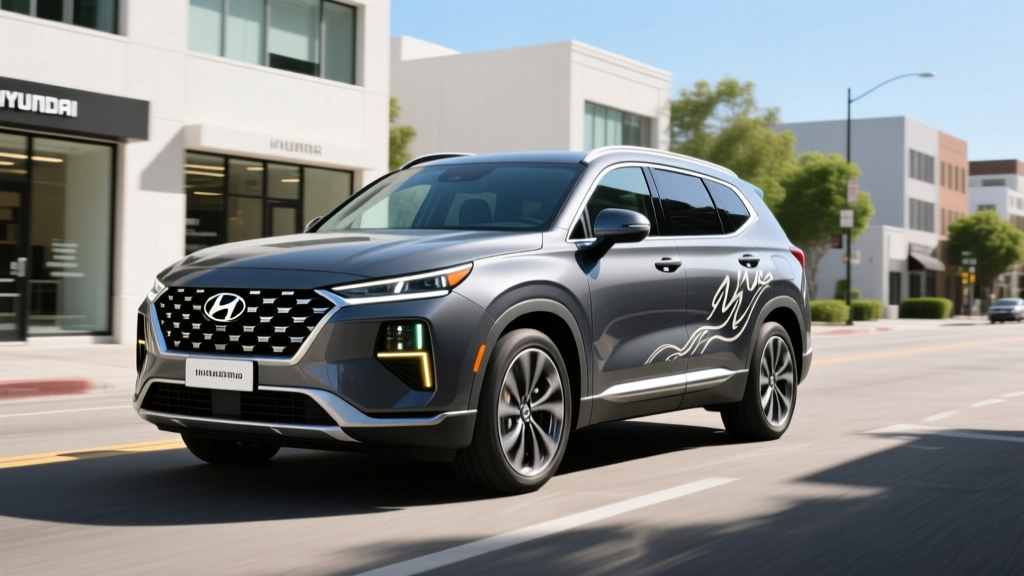
The 2025 Hyundai Santa Fe Hybrid (HEV) is a rarity in the midsize SUV segment: a three-row family hauler with genuinely boxy styling that still returns 36 MPG combined on the EPA cycle. Powered by a 1.6-liter turbocharged inline-four paired with a 47.7 kW electric motor, the Santa Fe Hybrid produces a combined 230 horsepower and 271 lb-ft of torque — enough to move its roughly 4,400-pound curb weight with confidence while sipping fuel at a rate that undercuts most competitors by 5-8 MPG.
This is a conventional hybrid (HEV), not a plug-in. You never plug it in. The 1.49 kWh lithium-ion battery recharges through regenerative braking and the engine. If you want electric-only driving, you're looking at the Santa Fe Plug-in Hybrid (PHEV), which is a separate model with different specs, pricing, and tax-credit eligibility — covered in detail below.
| Specification | 2025 Santa Fe Hybrid (HEV) | 2025 Santa Fe Plug-in Hybrid (PHEV) |
|---|---|---|
| Powertrain | 1.6L Turbo I4 + 47.7 kW motor | 1.6L Turbo I4 + 74 kW motor |
| Combined Horsepower | 230 hp | 261 hp |
| Combined Torque | 271 lb-ft | 271 lb-ft |
| Battery Capacity | 1.49 kWh (Li-ion) | 13.8 kWh (Li-ion) |
| EPA Combined MPG / MPGe | 36 MPG | 79 MPGe / 33 MPG (gas-only) |
| EPA City MPG | 35 MPG | — |
| EPA Highway MPG | 37 MPG | — |
| Electric-Only Range | N/A (not a plug-in) | 30 miles |
| Total Range | ~540 miles | ~430 miles combined |
| Drivetrain | AWD standard | AWD standard |
| 0-60 mph | ~7.8 sec (est.) | ~7.4 sec (est.) |
| Towing Capacity | 2,000 lbs | 2,000 lbs |
| Starting MSRP | $38,915 (SEL Premium) | $42,415 (SEL Premium) |
HEV vs PHEV: Which Santa Fe Hybrid Is Right for You?
Hyundai sells two electrified Santa Fe variants, and confusing them is the most common mistake buyers make at the dealership. Here's the functional difference:
Conventional Hybrid (HEV): The 1.6L turbo engine and electric motor work together seamlessly. The small 1.49 kWh battery charges itself via regenerative braking and engine power. You fuel it like a normal car — no plug, no charging cable, no range anxiety. The electric motor assists acceleration, enables brief low-speed electric-only creep, and allows engine-off coasting, but it cannot sustain electric-only driving beyond a mile or so at low speeds.
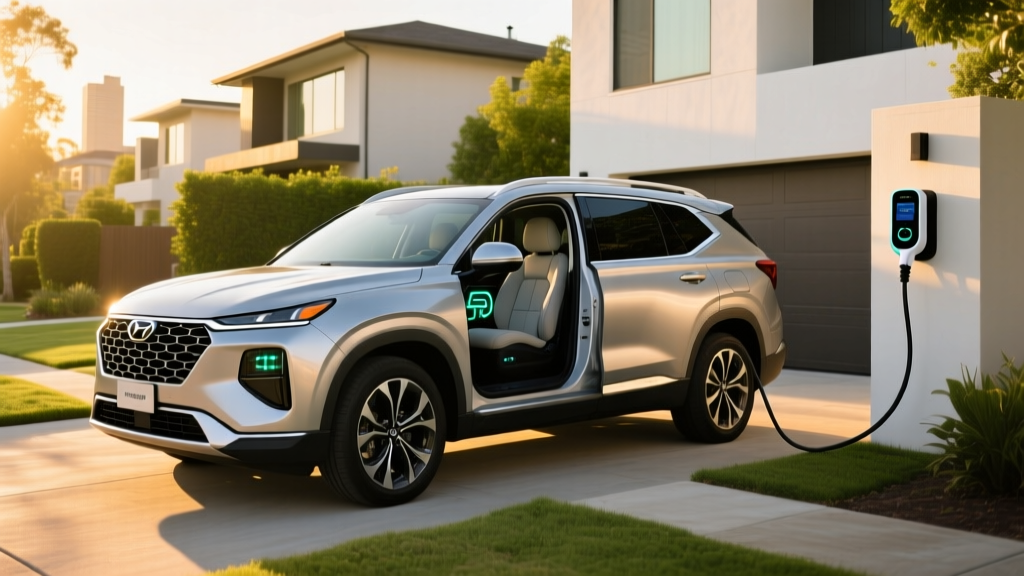
Plug-in Hybrid (PHEV): The larger 13.8 kWh battery can be charged from a wall outlet or Level 2 charger, giving you up to 30 miles of pure electric driving before the gas engine kicks in. Once the battery depletes, it operates as a conventional hybrid at 33 MPG combined. If your daily commute is under 30 miles and you can charge at home overnight, you may go weeks without visiting a gas station.
Choose the HEV if: You lack reliable home or workplace charging access, you drive long highway miles regularly, or you want the lowest purchase price with strong fuel economy and zero plug-in hassle.
Choose the PHEV if: You can install a Level 2 charger at home (or have reliable workplace charging), your daily round-trip commute is under 30 miles, and you want EV-like daily driving with the gas engine as a road-trip safety net.
Fuel Economy: EPA Numbers vs Real-World MPG
| Driving Condition | Santa Fe HEV (EPA) | Santa Fe HEV (Real-World Est.) | Santa Fe PHEV (EPA) |
|---|---|---|---|
| City | 35 MPG | 36-39 MPG | — |
| Highway | 37 MPG | 32-35 MPG | — |
| Combined | 36 MPG | 33-37 MPG | 33 MPG (gas-only mode) |
| MPGe (electric+gas) | N/A | N/A | 79 MPGe |
The Santa Fe Hybrid's EPA ratings of 35 city / 37 highway / 36 combined are competitive for a three-row AWD SUV. For context, the Toyota Highlander Hybrid achieves 35 combined and the Kia Sorento Hybrid (which shares the same powertrain architecture) matches at 36 combined.
Real-world expectations: Hyundai's hybrid system, like most HEVs, tends to slightly exceed EPA city estimates in stop-and-go traffic because regenerative braking recaptures more energy at low speeds. Expect 36-39 MPG in urban driving. Highway fuel economy typically falls short of the EPA sticker — at sustained 75-80 mph, expect 32-35 MPG due to the Santa Fe's boxy aerodynamic profile. The squared-off rear end looks great but creates drag that a sleeker crossover like the Hyundai Tucson Hybrid avoids.
In cold weather (below 32°F), expect a 5-10% MPG reduction. The engine runs longer to heat the cabin and catalytic converter, and battery efficiency drops in freezing temperatures. Owners in northern climates should budget for 31-34 MPG combined in winter months.
Source: fueleconomy.gov — EPA ratings for the 2025 Hyundai Santa Fe Hybrid AWD.
Powertrain Deep Dive: 230 hp From a 1.6L Turbo
The Santa Fe Hybrid uses Hyundai's TMED-II (Transmission-Mounted Electric Device) hybrid system, which positions the electric motor between the engine and the six-speed automatic transmission. This is a parallel hybrid architecture — both the engine and motor can drive the wheels independently or together.
Engine: 1.6-liter turbocharged GDI inline-four producing 178 hp and 195 lb-ft on its own. The turbo helps compensate for the small displacement, delivering torque low in the rev range where you need it for city acceleration.
Electric Motor: 47.7 kW (approximately 64 hp) with 195 lb-ft of torque. Electric motors deliver peak torque instantly from zero RPM, which is why the Santa Fe Hybrid feels punchy off the line despite its modest displacement engine.
Combined Output: 230 hp and 271 lb-ft. Hyundai caps combined output below the simple sum of engine + motor because peak power for each occurs at different RPMs. Still, 230 hp is more than adequate for a family SUV and noticeably quicker than the non-turbo hybrid systems in competitors like the Highlander Hybrid.
The six-speed automatic transmission is a deliberate choice over the CVTs used by Toyota and Honda in their hybrids. The result: more natural-feeling acceleration with defined gear shifts, though a slight efficiency trade-off compared to a CVT's optimized ratio management. Most drivers prefer the conventional automatic's feel.
Haval's AWD system on the Hybrid uses an electronically controlled coupling to send torque rearward when front-wheel slip is detected. It's a torque-on-demand system optimized for rain, snow, and light off-road use — not a dedicated off-roader.
PHEV Charging, Electric Range, and Battery Specs
For buyers considering the plug-in variant, here are the critical charging and range numbers:
Battery: 13.8 kWh lithium-ion pack (usable capacity approximately 11.5 kWh, with the remainder as a protective buffer to prevent deep discharge and extend longevity).
Electric-Only Range: EPA-rated at 30 miles. In real-world mixed driving at moderate temperatures, expect 25-30 miles. Highway-speed driving or cold weather can reduce this to 20-23 miles. If your commute is a 22-mile round trip with home charging, you'll rarely use gasoline on weekdays.
Charging Time:
- Level 1 (120V household outlet): Approximately 11-12 hours for a full charge. Viable for overnight charging if you arrive home with a partially depleted battery.
- Level 2 (240V, home wallbox or public station): Approximately 2 hours 45 minutes from empty to full using a 7.2 kW onboard charger. This is the recommended home-charging method.
- DC Fast Charging: The Santa Fe PHEV does not support DC fast charging. There is no CCS or NACS port. This is standard for most PHEVs in this class — the relatively small battery doesn't justify the added cost and weight of DC fast-charge hardware.
Total Combined Range: Approximately 430 miles (30 miles electric + ~400 miles on gasoline in hybrid mode). The 13.7-gallon fuel tank combined with 33 MPG in hybrid mode provides strong road-trip range even after the battery depletes.
Pricing, Trims, and Tax Credit Eligibility
The 2025 Santa Fe Hybrid is offered in two trims, both with standard AWD:
- SEL Premium: $38,915 MSRP (includes destination). Well-equipped with heated front seats, leatherette upholstery, dual 12.3-inch displays, wireless Apple CarPlay/Android Auto, and Hyundai's full SmartSense ADAS suite.
- Limited: $42,915 MSRP. Adds Nappa leather, ventilated front seats, heated rear seats, head-up display, Bose premium audio, and a panoramic sunroof.
The Santa Fe PHEV starts at $42,415 (SEL Premium) and $46,415 (Limited) — a $3,500 premium over the HEV for the plug-in powertrain and larger battery.
Federal Tax Credit Status (2025)
Santa Fe Hybrid (HEV): Does not qualify for the §30D federal clean vehicle tax credit. The IRS credit applies only to plug-in electric vehicles (BEVs and PHEVs) with sufficient battery capacity and qualifying battery sourcing. Conventional hybrids are excluded.
Santa Fe PHEV: Qualification for the up-to-$7,500 §30D credit depends on several factors that change frequently under current IRS rules:
- MSRP Cap: SUVs must be under $80,000 — the Santa Fe PHEV clears this easily.
- Buyer Income Cap: Modified AGI must not exceed $150,000 (single), $225,000 (head of household), or $300,000 (joint filing).
- Battery Sourcing: Critical minerals and battery components must meet escalating domestic/free-trade-partner sourcing thresholds. As of 2025, many Hyundai/Kia PHEVs face partial or full credit reduction due to battery component sourcing from entities of concern (FEOC rules). Check the latest IRS qualified vehicle list at irs.gov before purchasing.
- Point-of-Sale Transfer: If eligible, you can transfer the credit to the dealer at purchase for an immediate price reduction rather than waiting to claim it on your tax return.
Always verify current eligibility on fueleconomy.gov and consult a tax professional — credit rules are subject to change.
Battery Warranty, Longevity, and Replacement Cost
Hybrid Battery Warranty: Hyundai covers the Santa Fe Hybrid and PHEV battery packs for 10 years or 100,000 miles (whichever comes first) in all 50 states. In states that adopted California's CARB emissions standards (including CA, NY, WA, MA, and others), the warranty extends to 10 years or 150,000 miles.
Hybrid System Components: The electric motor, inverter, and related hybrid system components are covered under the same 10-year/100,000-mile warranty.
General Powertrain Warranty: The 1.6L turbo engine and six-speed transmission carry Hyundai's standard 10-year/100,000-mile powertrain coverage.
How long will the hybrid battery actually last? Hyundai's lithium-ion hybrid batteries are engineered for the life of the vehicle. Based on data from earlier Hyundai/Kia hybrid models (Sonata Hybrid, Niro, Ioniq), most hybrid batteries show 10-15% capacity degradation at 150,000+ miles. Because the HEV battery is only 1.49 kWh and the system never deeply cycles it (the buffer prevents full charge or full discharge), degradation is minimal. The PHEV's 13.8 kWh battery sees deeper cycles but has active thermal management to slow degradation.
Replacement cost if out of warranty: Based on current Hyundai hybrid battery replacement pricing, expect $2,500-$4,000 for the HEV battery pack and $5,000-$8,000 for the PHEV battery pack, including labor. These are estimates based on dealer parts pricing and may vary. Independent hybrid battery specialists often offer refurbished packs at 40-60% of OEM cost.
Is the Santa Fe Hybrid reliable? Hyundai's 1.6L turbo hybrid powertrain has been in production since 2020 (in the Sonata Hybrid and Tucson Hybrid) and has accumulated strong reliability data. The most common reported issues involve software glitches in the infotainment system and occasional transmission shift hesitation — neither of which affects the hybrid battery or core powertrain durability. Hyundai's 10-year warranty provides strong protection against catastrophic hybrid component failure. (Source: NHTSA vehicle records)
Who Should Buy the 2025 Santa Fe Hybrid?
Strengths
- 36 MPG combined in a genuine three-row SUV with adult-usable third-row space
- Standard AWD across all trims — no FWD base model to avoid
- 230 hp with turbo torque feels responsive, not sluggish like some CVT hybrids
- 10-year/100,000-mile hybrid battery and powertrain warranty
- Distinctive boxy styling with strong cargo volume (behind 2nd row: ~40 cu ft)
- Comprehensive SmartSense ADAS suite standard (adaptive cruise, lane-keeping, blind-spot)
Limitations
- Highway MPG drops to 32-35 real-world due to boxy aero — not the best road-trip hybrid
- HEV model has no federal tax credit eligibility
- PHEV does not support DC fast charging
- 2,000-lb towing capacity trails body-on-frame competitors (though they get half the MPG)
- Third row is usable for children and short-trip adults, but tight for long journeys
- PHEV credit eligibility uncertain due to FEOC battery sourcing rules — verify before purchase
The Decision Framework
Buy the Santa Fe HEV if: You want three rows, AWD, and 36 MPG without ever thinking about charging. You drive 12,000-18,000 miles per year in a mix of city and highway. You value a long powertrain warranty and distinctive design. You don't have home charging infrastructure and don't want to install it.
Buy the Santa Fe PHEV if: You can charge at home (Level 2 recommended), your weekday driving is under 30 miles round-trip, and you want near-zero gasoline use on commutes while keeping gas-engine flexibility for weekend road trips. You've verified current §30D credit eligibility on irs.gov and the math works in your favor.
Look at a full EV instead if: You have reliable home charging, your daily driving rarely exceeds 200 miles, and you want zero tailpipe emissions with lower per-mile fuel costs. Consider the Hyundai Ioniq 5 (303-mile range, DC fast charging) or Kia EV9 (three-row EV) if you want to eliminate gasoline entirely.
Stick with a gas-only SUV if: You drive under 8,000 miles per year (the hybrid premium takes too long to recoup), you tow over 2,000 lbs regularly, or you're in a region with extremely low gasoline prices where the MPG savings don't offset the higher purchase price.
Frequently Asked Questions
How many MPG does the 2025 Santa Fe Hybrid get?
The EPA rates the 2025 Santa Fe Hybrid AWD at 35 city / 37 highway / 36 combined MPG. In real-world driving, expect 36-39 MPG in city traffic (hybrids excel at low speeds thanks to regenerative braking) and 32-35 MPG at sustained highway speeds due to the boxy body's aerodynamic drag. Cold weather reduces these figures by roughly 5-10%.
How far can the Santa Fe PHEV go on electric only?
The EPA rates the Santa Fe Plug-in Hybrid at 30 miles of electric-only range. Real-world results vary: expect 25-30 miles in mild temperatures with mixed driving, and 20-23 miles in cold weather or at highway speeds. Once the battery depletes, the vehicle operates as a conventional hybrid at 33 MPG combined.
Hybrid vs PHEV vs full EV — which should I choose?
The HEV is best if you can't charge at home and want maximum simplicity. The PHEV is ideal if you have home charging and a short commute but need gas-engine range for road trips. A full EV (like the Ioniq 5) offers the lowest per-mile fuel cost and zero tailpipe emissions but requires reliable charging access and willingness to plan longer trips around DC fast-charging stops.
Is the Santa Fe Hybrid reliable and what does battery replacement cost?
Hyundai's 1.6L turbo hybrid system has been in production since 2020 with strong reliability data. The hybrid battery is covered for 10 years/100,000 miles (10 years/150,000 miles in CARB states). Out-of-warranty replacement costs approximately $2,500-$4,000 for the HEV and $5,000-$8,000 for the PHEV. Most hybrid batteries last well beyond 150,000 miles with minimal degradation.
Does the 2025 Santa Fe Hybrid qualify for a federal tax credit?
The conventional Santa Fe Hybrid (HEV) does not qualify for any federal tax credit — §30D applies only to plug-in vehicles. The Santa Fe PHEV may qualify for up to $7,500 depending on current IRS battery-sourcing rules, buyer income limits ($150K single / $300K joint), and the $80,000 SUV MSRP cap. Always verify current eligibility at irs.gov before purchasing, as FEOC sourcing requirements frequently affect Hyundai/Kia PHEV credit amounts.
Does the Santa Fe Hybrid need to be plugged in?
No. The Santa Fe Hybrid (HEV) is a self-charging conventional hybrid. Its 1.49 kWh battery recharges through regenerative braking and the gasoline engine. You fuel it normally at a gas station. Only the Santa Fe PHEV requires (or benefits from) plugging in.
How does the Santa Fe Hybrid compare to the Toyota Highlander Hybrid?
The Highlander Hybrid achieves 35 MPG combined (1 MPG less) and offers a slightly larger third row, but its 243 hp comes from a naturally aspirated 2.5L four-cylinder that feels less responsive than the Santa Fe's turbo hybrid. The Highlander Hybrid starts around $40,970 — roughly $2,000 more than the Santa Fe Hybrid. The Santa Fe's 10-year warranty also outlasts Toyota's 8-year/100,000-mile hybrid coverage. If third-row space is your top priority, test both; if value and driving feel matter more, the Santa Fe has the edge.