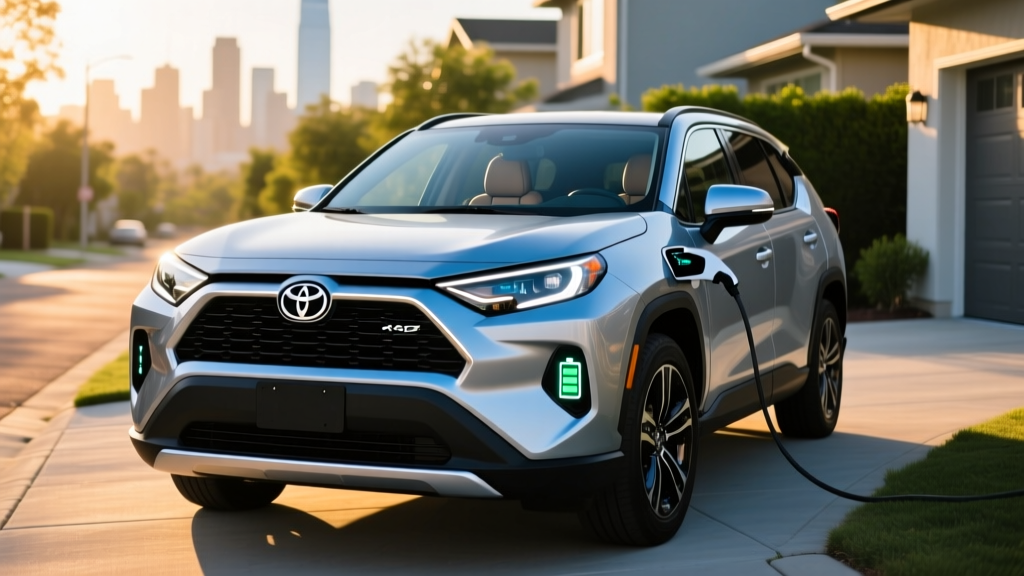
Quick Verdict: The Sporty Hybrid That Doesn't Sacrifice Efficiency
The 2025 Toyota RAV4 XSE Hybrid occupies a specific niche in the compact SUV segment: it's the sportiest trim in Toyota's hybrid lineup without stepping up to the full-electric bZ4X or the plug-in RAV4 Prime. With an EPA-estimated 39 MPG combined, a 219-horsepower dual-motor all-wheel-drive powertrain, and a starting MSRP of $36,020, the XSE Hybrid targets buyers who want electrified efficiency without plugging in, changing their fueling habits, or worrying about charging infrastructure.
After examining the specs, real-world fuel economy data, and ownership economics, the RAV4 XSE Hybrid makes the strongest case for conventional hybrid ownership in the compact crossover segment — particularly for drivers who lack reliable home charging access or who regularly take long road trips where EV charging stops would add unwanted time.
HEV vs PHEV: Where the RAV4 XSE Hybrid Fits
Before diving into specs, it's critical to understand what the RAV4 XSE Hybrid is — and isn't. Toyota sells two electrified RAV4 variants, and confusing them is a common buyer mistake:
RAV4 Hybrid (HEV) — Including the XSE Trim
- Type: Conventional (self-charging) hybrid
- Plug in? No — you never plug it in. It charges its small battery through regenerative braking and the gas engine.
- Battery: ~1.6 kWh nickel-metal hydride (NiMH)
- Electric-only driving: Very limited, low-speed only (under ~1 mile)
- Fuel: Runs entirely on gasoline
- Tax credit: Not eligible for the federal §30D EV credit
RAV4 Prime (PHEV)
- Type: Plug-in hybrid
- Plug in? Yes — you charge it at home or at public Level 2 chargers
- Battery: 18.1 kWh lithium-ion
- Electric-only range: EPA-estimated 42 miles
- Fuel: Electricity + gasoline
- Tax credit: Eligible for up to $7,500 federal §30D credit (subject to income, MSRP, and battery-sourcing rules)
Bottom line: The 2025 RAV4 XSE Hybrid is a conventional HEV. You fuel it like any gas car, and the hybrid system works invisibly in the background to boost your MPG. If you want plug-in electric range, you need the RAV4 Prime — which is only offered in SE and XSE trims at a significantly higher price.
Fuel Economy: EPA Numbers and Real-World MPG
The 2025 RAV4 Hybrid — across all trims including the XSE — carries the following EPA fuel-economy estimates, as published on fueleconomy.gov:
| Driving Cycle | EPA Estimate | Real-World Expectation |
|---|---|---|
| City | 41 MPG | 40–44 MPG (hybrids often beat EPA in city driving) |
| Highway | 38 MPG | 34–38 MPG (aerodynamic drag and sustained speed reduce hybrid advantage) |
| Combined | 39 MPG | 37–41 MPG depending on driving mix |
Why Hybrids Often Exceed EPA in the City
Conventional hybrids like the RAV4 XSE shine in stop-and-go traffic. Every time you brake, the electric motors capture kinetic energy through regenerative braking and store it in the battery. That stored energy then assists the gas engine during the next acceleration. In city driving, this cycle repeats constantly — effectively recycling energy that a gas-only car would waste as heat in the brake pads.
On the highway, the advantage narrows. At a steady 70–80 mph, the gas engine does most of the work, and aerodynamic drag dominates. Expect highway fuel economy to land closer to 34–36 MPG if you drive aggressively or carry heavy cargo. In cold weather (below 30°F), expect a 5–10% reduction across all driving cycles as the engine runs more frequently to maintain cabin heat and battery temperature.
Annual Fuel Cost Estimate
At 15,000 miles per year and $3.50/gallon regular unleaded, the RAV4 XSE Hybrid would cost approximately $1,346 per year in fuel. A comparable gas-only RAV4 (EPA 30 MPG combined) would cost roughly $1,750 — a difference of about $400 annually in the hybrid's favor.
Powertrain Specs: 219 HP With Dual Electric Motors
| Specification | 2025 RAV4 XSE Hybrid |
|---|---|
| Powertrain Type | Conventional Hybrid (HEV), AWD (Electronic On-Demand) |
| Engine | 2.5L 4-cylinder Dynamic Force (Atkinson cycle) |
| Engine Horsepower | 176 HP @ 5,700 RPM |
| Front Electric Motor | 118 HP / 149 lb-ft torque |
| Rear Electric Motor | 54 HP / 89 lb-ft torque |
| Net Combined System Output | 219 HP |
| Transmission | Electronically controlled CVT (eCVT) |
| 0–60 MPH | ~7.4 seconds |
| Towing Capacity | 1,750 lbs |
| Drivetrain | Electronic On-Demand AWD (rear motor-driven) |
| Battery Type | NiMH, ~1.6 kWh |
| Fuel Tank | 14.5 gallons |
| Total Range | ~565 miles (14.5 gal × 39 MPG) |
The XSE Hybrid's AWD system is worth noting: there's no mechanical driveshaft connecting the front and rear axles. Instead, the rear electric motor independently powers the rear wheels when traction is needed. This means AWD engagement is instant and seamless, but it also means the rear motor is relatively modest at 54 HP. In slippery conditions, the system is effective. In performance driving, the rear-axle contribution is subtle compared to a mechanical AWD system.
The eCVT transmission is Toyota's planetary-gear power-split device — not a belt-and-pulley CVT like those found in some competitors. This design is proven, durable, and avoids the "rubber-band" acceleration feel that traditional CVTs can produce. Power delivery is linear and predictable.
What the XSE Trim Adds Over Lower Hybrid Trims
The XSE sits above the LE, XLE, and Woodland Edition in Toyota's hybrid trim hierarchy, and below the top-tier Limited. For the 2025 model year, the XSE Hybrid starts at $36,020 MSRP (including destination charge). Here's what differentiates it:
- Exterior: Unique black-accented grille, black roof (two-tone), 18-inch black alloy wheels, LED headlights and taillights
- Suspension: Sport-tuned suspension with stiffer damping for sharper handling (a tangible difference over the LE/XLE)
- Interior: SofTex synthetic leather seats with blue contrast stitching, leather-trimmed steering wheel, heated front seats
- Tech: 8-inch (or available 10.5-inch) Toyota Audio Multimedia touchscreen with wireless Apple CarPlay and Android Auto, 6 speakers, Qi wireless phone charging
- Safety: Toyota Safety Sense 2.5+ (TSS 2.5+) — includes Pre-Collision System with Pedestrian Detection, Full-Speed Range Dynamic Radar Cruise Control, Lane Departure Alert with Steering Assist, Lane Tracing Assist, and Automatic High Beams
Notable options that can push the price toward $40,000+ include the JBL premium audio system ($835), panoramic glass roof ($1,400), and the Technology Package with a 10.5-inch display and 360-degree camera.
Hybrid Battery Warranty, Lifespan, and Replacement Cost
Toyota Hybrid Battery Warranty
Coverage: 10 years / 150,000 miles (whichever comes first), for all 2020 and newer Toyota hybrids.
What's covered: If the hybrid battery pack fails or drops below a functional capacity threshold, Toyota will repair or replace it at no cost.
Transferable? Yes — the warranty transfers to subsequent owners, which supports resale value.
How Long Do Toyota Hybrid Batteries Actually Last?
Toyota's hybrid battery track record is among the best in the industry, largely because the company uses conservative charge management. The NiMH battery pack in the RAV4 Hybrid never fully charges or fully discharges — it operates in a narrow state-of-charge window (roughly 40–80%). This shallow-cycling approach dramatically reduces cell stress and extends lifespan.
Real-world data from Toyota Prius fleets and high-mileage Camry Hybrids shows that the hybrid battery commonly lasts 150,000–200,000+ miles before any meaningful degradation or failure occurs. Many first-generation Prius vehicles (2004–2009) exceeded 250,000 miles on their original battery packs.
Battery Replacement Cost If Needed
If the hybrid battery fails outside the warranty window, replacement costs typically fall in the $2,000–$4,000 range for a refurbished or new Toyota OEM pack, including labor. Third-party refurbishers offer repaired packs for $1,500–$2,500. This is substantially less than the $10,000–$20,000+ replacement costs associated with full EV traction batteries, because the hybrid pack is small (~1.6 kWh) and modular.
The 12V auxiliary battery (a separate, conventional battery that powers electronics when the hybrid system is off) will need replacement every 4–6 years at typical cost of $150–$300.
Tax Credits and Incentives: What You Actually Qualify For
Because the 2025 RAV4 XSE Hybrid is a conventional hybrid (HEV), it does not qualify for the federal §30D New Clean Vehicle Credit. That credit — up to $7,500 — is reserved for plug-in electric vehicles (BEVs and PHEVs) that meet battery-sourcing, MSRP, and buyer-income requirements under current IRS rules.
If you want the RAV4 with federal tax credit eligibility, the RAV4 Prime (PHEV) is the option — it qualifies for up to $7,500 under §30D, subject to:
- MSRP cap: Vehicle must be under $80,000 (RAV4 Prime qualifies)
- Income cap: Modified AGI must not exceed $150,000 (single) / $300,000 (joint)
- Battery sourcing: Critical minerals and battery components must meet phased-in domestic/FHA-sourced requirements (check current-year IRS guidance)
- Point-of-sale transfer: You can transfer the credit to the dealer at purchase for an immediate price reduction
However, the RAV4 Prime carries a significantly higher MSRP (starting around $44,000 for the SE trim), so even with the full $7,500 credit, the net cost typically exceeds the RAV4 XSE Hybrid by $5,000–$8,000. The math only favors the Prime if you can charge at home regularly and will use the 42-mile electric range for most daily driving.
Some states and local utilities offer rebates for conventional hybrids, but these are increasingly rare as incentive programs shift toward plug-in vehicles. Check your state energy office and local utility for any current hybrid-specific programs.
Who Should Buy the RAV4 XSE Hybrid — and Who Shouldn't
Pros
- 39 MPG combined with no behavior change — just fill up with gas
- Sport-tuned suspension gives genuinely sharper handling than LE/XLE trims
- Proven Toyota hybrid reliability with 10-year/150,000-mile battery warranty
- AWD standard via rear electric motor (no fuel-economy penalty)
- ~565-mile total range eliminates range anxiety entirely
- Strong resale value supported by hybrid-battery transferable warranty
Cons
- No electric-only driving range — not eligible for HOV-lane access in most states
- No federal tax credit eligibility
- XSE starting price of $36,020 is $4,000+ over the Hybrid LE
- Towing capacity limited to 1,750 lbs
- SofTex seats (not real leather) at this price point may disappoint some buyers
- Rear motor AWD is effective for traction but not a performance system
Choose the RAV4 XSE Hybrid If:
- You don't have access to home or workplace charging — a conventional hybrid gives you all the efficiency gains without needing a plug.
- You take frequent road trips and don't want to plan around EV charging stops.
- You want AWD for snow or rain but don't want the fuel-economy penalty of a gas AWD system.
- You plan to keep the vehicle 8–10+ years and value Toyota's hybrid reliability track record.
- You want sportier styling and handling without stepping up to a luxury-brand SUV.
Look at the RAV4 Prime (PHEV) Instead If:
- You can install a Level 2 home charger and your daily commute is under 42 miles round-trip — you'd drive almost entirely on electricity.
- You qualify for the full $7,500 federal tax credit and the math works in your favor.
- You want HOV-lane access (available for PHEVs in California, Colorado, and several other states).
Look at a Full EV Instead If:
- You have reliable home charging and want to eliminate gasoline entirely.
- Your state offers substantial EV rebates on top of the federal credit.
- You want the lowest per-mile "fuel" cost — electricity at $0.13/kWh equates to roughly $4.50 per gallon-equivalent, versus $3.50/gallon gas.
Frequently Asked Questions
How many MPG does the 2025 RAV4 XSE Hybrid get?
The EPA rates the 2025 RAV4 Hybrid (all trims including XSE) at 41 MPG city, 38 MPG highway, and 39 MPG combined. In real-world city driving with frequent stops, many owners report matching or slightly exceeding the 41 MPG city figure thanks to regenerative braking. Highway driving at sustained speeds above 70 MPH typically yields 34–37 MPG.
Does the RAV4 XSE Hybrid need to be plugged in?
No. The RAV4 XSE Hybrid is a conventional hybrid (HEV). It charges its own small battery through regenerative braking and the gas engine. You never plug it in — you simply refuel at any gas station with regular unleaded.
How far can the RAV4 XSE Hybrid drive on electric power alone?
Essentially zero meaningful distance. The hybrid system uses the electric motor to assist the gas engine and to drive the vehicle at very low speeds (parking lots, creeping in traffic) for brief moments, but it cannot sustain electric-only driving for any measurable distance. If you want electric-only range, the RAV4 Prime PHEV offers 42 miles EPA-estimated on battery alone.
Is the 2025 RAV4 Hybrid reliable?
Toyota's hybrid powertrain is one of the most proven in the automotive industry, with over 25 years of continuous production since the original Prius. The RAV4 Hybrid earns top reliability scores from consumer surveys, and Toyota backs the hybrid battery with a 10-year/150,000-mile warranty. The eCVT transmission has no belts, clutches, or torque converter to wear out — it uses a planetary gearset that Toyota has demonstrated lasting well beyond 200,000 miles.
What does a RAV4 Hybrid battery replacement cost?
If the hybrid battery needs replacement outside the 10-year/150,000-mile warranty, expect to pay $2,000–$4,000 for a new OEM Toyota pack with labor, or $1,500–$2,500 for a refurbished unit. This is far less expensive than full EV battery replacement because the pack is small (~1.6 kWh) and modular. Given Toyota's track record, most owners will sell or trade the vehicle before a battery replacement is ever needed.
Does the 2025 RAV4 XSE Hybrid qualify for a federal tax credit?
No. The federal §30D New Clean Vehicle Credit applies only to plug-in electric vehicles (BEVs and PHEVs). The RAV4 Hybrid is a conventional HEV and does not qualify. The plug-in RAV4 Prime does qualify for up to $7,500, subject to buyer income limits, MSRP caps, and battery-sourcing requirements per current IRS guidance.
How does the RAV4 XSE Hybrid compare to the gas-only RAV4?
The gas-only 2025 RAV4 AWD is rated at approximately 30 MPG combined (27 city / 35 highway for the LE AWD). The XSE Hybrid delivers 39 MPG combined — a 30% improvement — while also producing more horsepower (219 HP vs. 203 HP for the gas model) and providing standard AWD. The hybrid carries a price premium of roughly $1,500–$2,000 over an equivalently trimmed gas model, which is typically recouped in fuel savings within 3–5 years depending on mileage.
What is the total driving range of the RAV4 XSE Hybrid?
With a 14.5-gallon fuel tank and 39 MPG combined, the RAV4 XSE Hybrid delivers approximately 565 miles of total range on a single tank. In city-heavy driving where MPG can exceed 41, range can approach 595 miles. This exceeds virtually every EV on the market and eliminates any range or refueling concerns.