Quick Verdict: The 2025 RAV4 XLE Premium Hybrid at a Glance
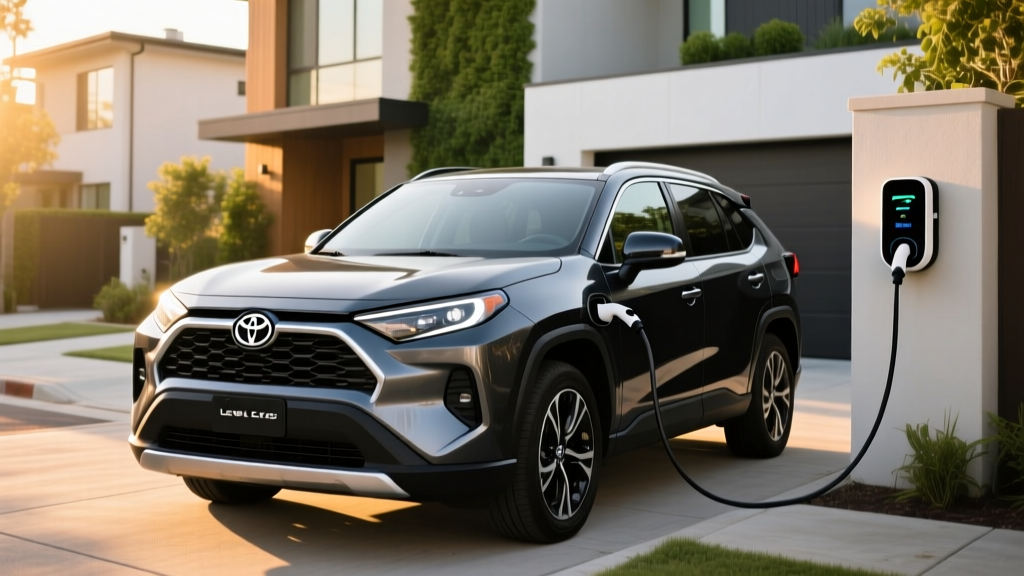
The 2025 RAV4 XLE Premium Hybrid occupies a practical sweet spot in Toyota's compact SUV lineup: it delivers all-wheel drive, a well-equipped interior, and exceptional fuel economy without requiring a charging cable. Priced at an MSRP of approximately $36,725 (including destination), this trim sits above the XLE Hybrid but below the Woodland Edition and Limited, offering SofTex-trimmed seats, a power moonroof, and a 10.5-inch infotainment display as standard.
For buyers researching the 2025 RAV4 XLE Premium Hybrid, the core appeal is straightforward: 39 MPG combined, no plug required, and Toyota's proven hybrid synergy drive system. But the real question is whether this conventional hybrid (HEV) is the right electrified choice for you — or if the RAV4 Prime PHEV or a full battery-electric vehicle better matches your driving pattern.
| Spec | Value |
|---|---|
| Powertrain Type | Conventional Hybrid (HEV) — no plug-in |
| Engine | 2.5L 4-cylinder + 3 electric motors (AWD) |
| Combined Horsepower | 219 hp (net system) |
| EPA MPG (City / Hwy / Combined) | 41 / 38 / 39 MPG |
| Fuel Tank Capacity | 14.5 gallons |
| Total Driving Range | ~565 miles |
| 0–60 mph | ~7.4 seconds |
| Drivetrain | Electronic On-Demand AWD (eAWD) |
| Hybrid Battery | ~1.6 kWh lithium-ion (sealed, self-charging) |
| MSRP (incl. destination) | ~$36,725 |
| Federal Tax Credit (§30D) | Not eligible (HEV, not PHEV/BEV) |
| Hybrid Battery Warranty | 10 years / 150,000 miles |
HEV vs. PHEV vs. EV: Which Powertrain Fits Your Life?
Before we break down the RAV4 XLE Premium Hybrid's numbers, it is essential to understand what this vehicle is — and what it is not. The RAV4 Hybrid is a conventional hybrid (HEV). It charges its small battery entirely through regenerative braking and the gasoline engine. You never plug it in. This is fundamentally different from a plug-in hybrid (PHEV) like the RAV4 Prime, or a battery-electric vehicle (BEV) like the Tesla Model Y.
How the Three Electrified RAV4 Options Compare
| Feature | RAV4 Hybrid (HEV) | RAV4 Prime (PHEV) | Full EV (e.g., bZ4X) |
|---|---|---|---|
| Plugs in? | No — self-charging | Yes — Level 1/2 | Yes — Level 1/2/DC |
| Electric-only range | ~1 mile at low speed | 42 miles (EPA) | 222–252 miles (EPA) |
| Combined MPG / MPGe | 39 MPG | 38 MPG (gas) / 94 MPGe (elec) | 114–119 MPGe |
| Total range | ~565 mi | ~600 mi | 222–252 mi |
| Battery capacity | ~1.6 kWh | 18.1 kWh | 71.4 kWh (usable) |
| Combined HP | 219 hp | 302 hp | 201–214 hp |
| Base MSRP (approx.) | ~$33,425 | ~$44,815 | ~$43,070 |
| Federal tax credit (§30D) | Not eligible | Up to $7,500* | Up to $7,500* |
*§30D credit eligibility depends on MSRP caps, buyer income limits, and battery sourcing requirements. See IRS.gov for current rules.
The RAV4 Hybrid is the right choice if you have no reliable access to home or workplace charging, drive a mix of city and highway miles, and want to eliminate range anxiety entirely. The RAV4 Prime PHEV makes sense if you can charge at home and want 42 miles of electric-only commuting before the gas engine engages. A full EV like the Toyota bZ4X fits drivers with home charging, shorter commutes, and the willingness to plan around DC fast charging on road trips.
Fuel Economy: EPA Ratings and Real-World MPG
The EPA rates the 2025 RAV4 Hybrid AWD at 41 MPG city, 38 MPG highway, and 39 MPG combined (fueleconomy.gov). These are strong figures for a compact AWD SUV, but real-world results depend heavily on your driving pattern.
Real-World MPG Expectations
EPA Combined: 39 MPG
City-dominant driving: Expect 40–44 MPG. Toyota's hybrid system excels in stop-and-go traffic where regenerative braking recaptures energy and the electric motor handles low-speed propulsion. Many owners report exceeding the EPA city estimate in warm weather.
Highway-dominant driving (70+ mph): Expect 34–37 MPG. At sustained highway speeds, the gasoline engine does most of the work and aerodynamic drag increases. Hybrid advantage shrinks on the interstate.
Cold weather (below 30°F): Expect 33–36 MPG combined. The engine runs more frequently to maintain cabin heat and battery temperature, reducing electric-motor contribution.
| Driving Scenario | EPA Estimate | Real-World Expectation |
|---|---|---|
| City | 41 MPG | 40–44 MPG |
| Highway | 38 MPG | 34–37 MPG |
| Combined | 39 MPG | 36–40 MPG |
| Cold-weather combined | — | 33–36 MPG |
For context, the non-hybrid 2025 RAV4 AWD (gas-only) returns an EPA-estimated 30 MPG combined. The hybrid saves roughly 3–4 gallons per 100 miles driven, which translates to approximately $450–$650 in annual fuel savings at 15,000 miles per year and $3.50/gallon regular unleaded.
Powertrain Details: How the Hybrid System Works
The 2025 RAV4 XLE Premium Hybrid uses Toyota's fourth-generation Hybrid Synergy Drive, pairing a 2.5-liter Atkinson-cycle four-cylinder engine with three electric motor-generators — two on the front axle and one dedicated to the rear axle for electronic on-demand AWD. The net system output is 219 horsepower.
Unlike a conventional car with a fixed-gear transmission, the RAV4 Hybrid uses an electronically controlled continuously variable transmission (eCVT) that blends engine and motor power seamlessly. There are no fixed gear shifts; the system constantly optimizes the power split for efficiency.
The rear electric motor provides up to approximately 54 hp to the rear wheels when additional traction is needed — during acceleration from a stop, on wet roads, or in light snow. This is not a mechanical driveshaft system; the rear motor engages only when the vehicle's computer detects slip or demands extra grip. In steady-state cruising, the RAV4 Hybrid operates primarily as a front-wheel-drive vehicle for maximum efficiency.
The 0–60 mph time of roughly 7.4 seconds is adequate for highway merging and daily driving. It is not a performance vehicle, but the instant torque from the electric motors gives it a responsive feel around town that the gas-only RAV4 (0–60 in ~8.1 seconds) cannot match.
Hybrid Battery: Warranty, Longevity, and Replacement Cost
Toyota Hybrid Battery Warranty
Coverage: 10 years or 150,000 miles (whichever comes first), transferable to subsequent owners.
What it covers: Defects in materials or workmanship, and capacity loss below a defined threshold (typically ~70% state of health) under normal use.
Additional coverage: Hybrid system components (inverter, control module, electric motors) are covered under the same 10-year/150,000-mile warranty.
Battery longevity is the number-one concern for hybrid buyers, and the data here is reassuring. Toyota's hybrid batteries are among the most proven in the industry. The original Prius fleet, now spanning two decades of real-world use, has demonstrated that nickel-metal hydride and lithium-ion hybrid batteries routinely last 150,000–200,000+ miles before requiring replacement. Many first-generation Prius taxis exceeded 300,000 miles on the original battery pack.
The RAV4 Hybrid's lithium-ion pack is smaller (~1.6 kWh usable) than a PHEV or BEV battery, meaning lower replacement cost if it does eventually fail outside warranty. Current replacement estimates for a RAV4 Hybrid battery range from $2,000 to $4,000 (parts and labor at a dealership), with refurbished units available for $1,500–$2,500. Independent hybrid specialists often offer lower-cost replacements.
For comparison, a RAV4 Prime PHEV battery replacement (18.1 kWh) would cost significantly more — likely $6,000–$10,000+ out of warranty — and a full EV battery replacement can exceed $15,000. The HEV's small battery is one of its lowest-risk ownership costs.
Pricing, Trims, and Tax Credit Eligibility
The 2025 RAV4 XLE Premium Hybrid carries an MSRP of approximately $36,725 including destination charges. This positions it roughly $3,300 above the base XLE Hybrid ($33,425) and about $4,000 below the Limited Hybrid.
What the XLE Premium trim adds over the standard XLE Hybrid:
- SofTex synthetic leather-trimmed seats
- Power tilt/slide moonroof
- 10.5-inch Toyota Audio Multimedia touchscreen (vs. 8-inch on XLE)
- 12.3-inch digital driver display
- Heated front seats and heated steering wheel
- Power liftgate
- Silver-painted roof rails
Options that can push the price higher include the Technology Package (panoramic view monitor, front and rear parking assist with automatic braking) and the Weather Package (heated rear seats, windshield wiper de-icer). A fully optioned XLE Premium Hybrid can approach $40,000.
Federal Tax Credit: Not Eligible
Because the RAV4 Hybrid is a conventional HEV (not a plug-in vehicle), it does not qualify for the IRS §30D Clean Vehicle Credit. That credit — up to $7,500 — applies only to new plug-in electric vehicles (BEVs and PHEVs) that meet battery sourcing, critical mineral, MSRP cap, and buyer income requirements (IRS §30D rules).
If the federal tax credit is a deciding factor for you, the RAV4 Prime PHEV may qualify for up to $7,500 depending on your income and the vehicle's battery component sourcing in the year of purchase. However, the Prime's higher base MSRP (~$44,815) partially offsets the credit advantage. Run the total-cost math before assuming the Prime is cheaper after incentives.
Some states offer additional incentives for hybrid purchases, though these are less common than EV/PHEV credits. Check your state's energy office or department of environmental quality for current programs.
Who Should Choose the RAV4 XLE Premium Hybrid?
Choose the RAV4 Hybrid (HEV) if:
- You cannot install a home charger (apartment, street parking, no garage)
- You drive a mix of city and highway miles and want consistent efficiency without behavior changes
- You want the lowest-complexity electrified vehicle — no charging cables, no plug-in routine
- Your annual mileage is moderate to high (12,000–20,000+ miles) and fuel savings compound quickly
- You value Toyota's long-term reliability record and strong resale value
Consider the RAV4 Prime (PHEV) instead if:
- You have reliable Level 2 home charging and a commute under 42 miles round-trip
- You want to drive mostly on electricity during the week and use gas only for longer weekend trips
- You qualify for the §30D federal tax credit, narrowing the price gap
- You want 302 hp and quicker acceleration (0–60 in ~5.7 seconds)
Consider a full EV (BEV) instead if:
- Your daily driving is under 200 miles and you have home Level 2 charging
- You want zero tailpipe emissions and the lowest per-mile energy cost
- You want to eliminate oil changes, spark plugs, and transmission maintenance entirely
- You are comfortable planning DC fast charging stops on road trips over 250 miles
Ownership Costs: 5-Year Outlook
| Cost Category | RAV4 Hybrid (HEV) | RAV4 Gas AWD | RAV4 Prime (PHEV) |
|---|---|---|---|
| Purchase price (MSRP) | $36,725 | $33,125 | $44,815 |
| Federal tax credit | $0 | $0 | Up to $7,500* |
| Fuel / energy (75k mi) | ~$6,730 | ~$8,750 | ~$4,200 (mixed gas/elec) |
| Maintenance (est.) | ~$2,800 | ~$3,200 | ~$2,500 |
| Insurance (est. avg) | ~$7,500 | ~$7,000 | ~$8,000 |
| 5-year depreciation (est.) | ~$14,000 | ~$15,500 | ~$18,000 |
| Est. 5-yr total cost | ~$39,755 | ~$42,075 | ~$44,015 |
Assumptions: $3.50/gal gas, $0.14/kWh electricity, 50/50 city-highway mix, PHEV charged nightly at home. Depreciation estimates based on historical Toyota resale data. Insurance varies significantly by driver profile and state. Tax credit subject to eligibility — verify at IRS.gov.
The RAV4 Hybrid's total cost of ownership is compelling. It costs about $3,600 more upfront than the gas-only RAV4 AWD but saves roughly $2,000 in fuel over five years and holds its value better — Toyota hybrids consistently rank among the strongest-resale vehicles in their segments, according to industry data.
Pros and Cons
Pros
- 39 MPG combined — excellent for an AWD compact SUV
- No plug-in required — zero lifestyle change from a gas car
- 10-year/150,000-mile hybrid battery warranty
- Strong resale value and proven Toyota reliability
- eAWD with dedicated rear motor for confident traction
- XLE Premium trim well-equipped at ~$36,700
- Smooth, quiet eCVT operation in city driving
Cons
- Not eligible for the $7,500 federal §30D tax credit
- Highway MPG drops to 34–37 in real-world driving
- CVT drone under hard acceleration
- 219 hp is adequate, not quick — 0–60 in 7.4 seconds
- Cargo space slightly reduced vs. gas model (battery placement)
- No DC fast charging or meaningful electric-only range
- Infotainment still lacks wireless Apple CarPlay/Android Auto on some configurations
Frequently Asked Questions
How many MPG does the 2025 RAV4 XLE Premium Hybrid get?
The EPA rates it at 41 MPG city, 38 MPG highway, and 39 MPG combined. In real-world driving, city-dominant commuters often see 40–44 MPG, while highway-heavy drivers at 70+ mph should expect 34–37 MPG. Cold weather can reduce combined figures to 33–36 MPG.
Does the RAV4 Hybrid need to be plugged in?
No. The RAV4 Hybrid is a conventional hybrid (HEV). Its small battery charges entirely through regenerative braking and the gasoline engine. You fuel it like any other car — no charging cable, no plug, no outlet required.
How far can the RAV4 Hybrid drive on electric power alone?
Essentially zero practical electric-only range. At very low speeds (under 25 mph, light throttle), the RAV4 Hybrid can creep short distances on battery power — perhaps a few hundred yards in a parking lot. This is not usable electric-only driving. For meaningful EV range, you need the RAV4 Prime PHEV (42 miles) or a full BEV.
Is the RAV4 Hybrid reliable? What will a battery replacement cost?
Toyota's hybrid system is one of the most reliable powertrains on the road, with two decades of fleet and consumer data supporting longevity well past 150,000 miles. The hybrid battery is warrantied for 10 years/150,000 miles. Out-of-warranty replacement costs approximately $2,000–$4,000 at a dealer, less at an independent hybrid specialist. This is significantly cheaper than PHEV or BEV battery replacement.
Does the 2025 RAV4 Hybrid qualify for any tax credit?
No. The IRS §30D Clean Vehicle Credit applies only to plug-in electric vehicles (BEVs and PHEVs). Conventional hybrids like the RAV4 Hybrid are not eligible. Some states or local utilities may offer small incentives for hybrid purchases — check your state energy office. If the federal credit matters to you, the RAV4 Prime PHEV may qualify (up to $7,500, subject to income, MSRP, and battery sourcing rules).
What is the difference between the RAV4 XLE Hybrid and the XLE Premium Hybrid?
The XLE Premium adds SofTex seats, a power moonroof, a larger 10.5-inch touchscreen, a 12.3-inch digital gauge cluster, heated front seats and steering wheel, and a power liftgate. The hybrid powertrain, AWD system, and EPA MPG ratings are identical between the two trims. The Premium trim costs approximately $3,300 more.
How does the RAV4 Hybrid compare to the Honda CR-V Hybrid?
The 2025 Honda CR-V Hybrid AWD is rated at 40 MPG city / 34 MPG highway / 37 MPG combined by the EPA. The RAV4 Hybrid holds a slight edge in highway and combined efficiency. The CR-V Hybrid offers a bit more rear-seat and cargo space, while the RAV4 Hybrid has a longer track record of hybrid reliability and stronger resale value. Both are class-leading choices — the decision often comes down to interior preference and dealer experience.
Should I get the RAV4 Hybrid or the RAV4 Prime?
If you can charge at home and your commute is under 42 miles round-trip, the RAV4 Prime lets you drive almost entirely on electricity during the week while keeping gas-engine flexibility for longer trips. It also delivers 302 hp and may qualify for the $7,500 federal credit. However, the Prime costs ~$8,000 more at base MSRP. If you cannot charge at home, the RAV4 Hybrid delivers excellent efficiency with zero plug-in hassle and a lower purchase price.