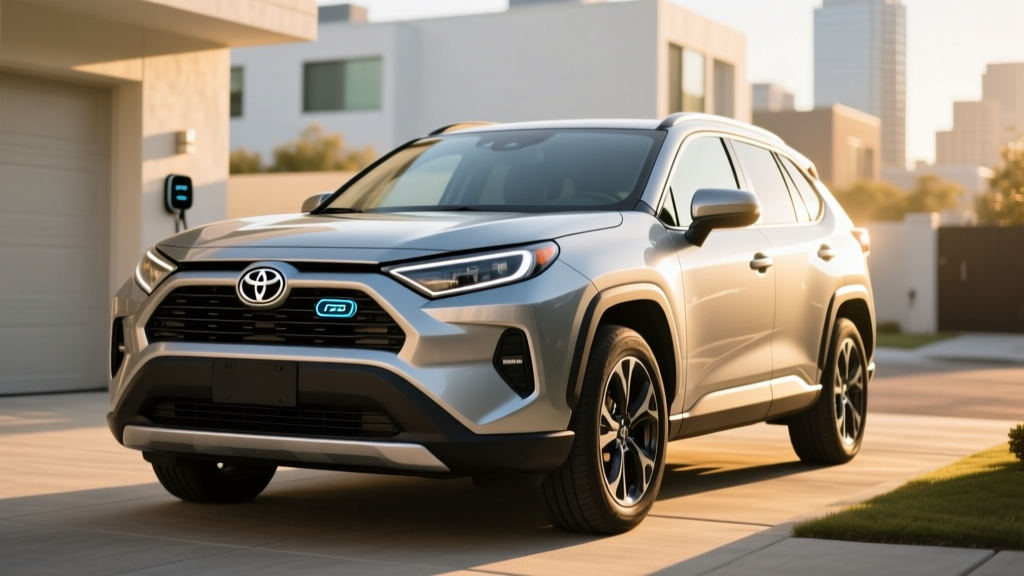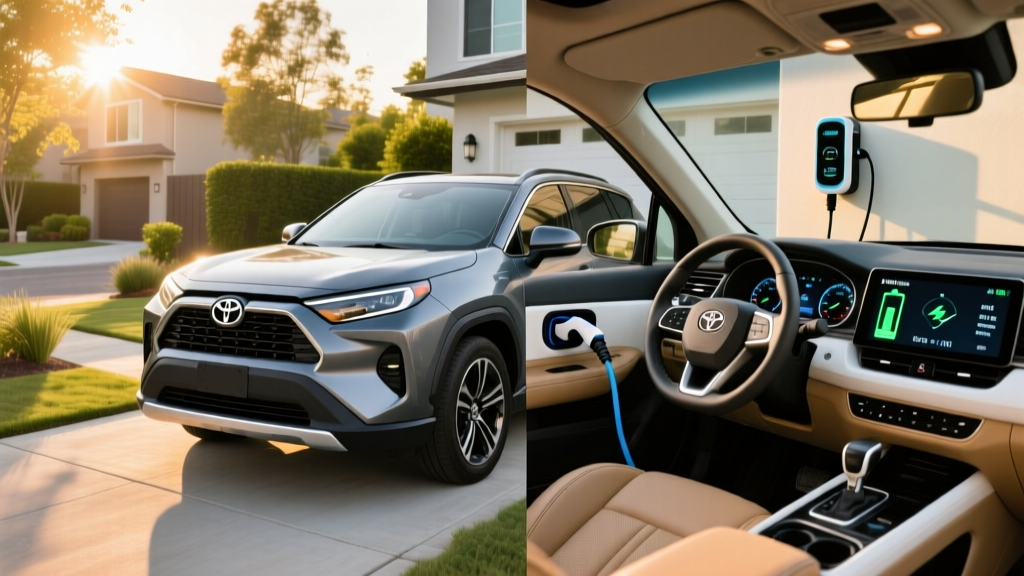
The Toyota RAV4 Prime has been one of the most sought-after plug-in hybrids on the market since its introduction, and the 2025 model year continues that dominance. With 42 miles of EPA-rated electric-only range, 302 combined horsepower, and standard all-wheel drive, the 2025 RAV4 Plug-In Hybrid threads a needle that few competitors can match: daily electric commuting without any range anxiety for longer trips. But at a starting MSRP near $44,000 and with limited dealer inventory, is it the right electrified vehicle for your garage? This guide breaks down every spec that matters.
HEV vs PHEV: Where the RAV4 Prime Fits
Toyota sells two electrified RAV4 variants, and buyers frequently confuse them. The distinction matters for your wallet and your daily routine.
RAV4 Hybrid (HEV)
- No plug — charges itself via regenerative braking and the engine
- 219 combined hp, AWD standard
- EPA 41 city / 38 highway / 40 combined MPG
- No electric-only driving beyond very low-speed creep
- Lower starting price (~$32,000)
RAV4 Prime (PHEV)
- Plug-in capable — 18.1 kWh battery charges from a wall outlet or charger
- 302 combined hp, AWD standard
- 42 miles electric-only, then 38 MPG combined as a hybrid
- 94 MPGe combined when operating in electric mode
- Higher starting price (~$44,000)
The conventional RAV4 Hybrid never needs to be plugged in. You fuel it with gas and drive — the hybrid system simply makes it more efficient. The RAV4 Prime (PHEV) adds a substantially larger battery and more powerful electric motors, enabling genuine zero-emission driving for most daily commutes. If your round-trip commute is under 42 miles and you have access to a standard 120V outlet or Level 2 charger at home, the Prime effectively operates as an EV on weekdays and a hybrid on weekends.
Electric Range, MPGe, and Fuel Economy Breakdown
| Metric | RAV4 Prime (PHEV) | RAV4 Hybrid (HEV) |
|---|---|---|
| Electric-only range | 42 miles (EPA) | N/A |
| MPGe (electric mode) | 94 combined | N/A |
| MPG (hybrid mode, city) | 40 | 41 |
| MPG (hybrid mode, highway) | 36 | 38 |
| MPG (hybrid mode, combined) | 38 | 40 |
| Total range (EV + gas) | ~600 miles | ~580 miles |
| Fuel tank | 14.5 gal | 14.5 gal |
MPGe (miles per gallon equivalent) measures how far the vehicle travels on the electrical energy equivalent of one gallon of gasoline. The Prime's 94 MPGe combined figure applies when you're driving on battery power. Once the battery is depleted, the vehicle reverts to standard hybrid operation at 38 MPG combined.
Powertrain and Performance Specs
| Specification | 2025 RAV4 Prime |
|---|---|
| Engine | 2.5L 4-cylinder Atkinson cycle |
| Engine output | 177 hp / 165 lb-ft |
| Front electric motor | 134 kW (180 hp) |
| Rear electric motor | 40 kW (54 hp) |
| Combined system output | 302 hp |
| 0–60 mph | 5.5 seconds |
| Drivetrain | AWD (electronic rear axle) |
| Battery capacity | 18.1 kWh (lithium-ion) |
| Usable battery capacity | ~14.5 kWh (buffer protects longevity) |
| Towing capacity | 2,500 lbs |
The 5.5-second 0–60 time makes the RAV4 Prime the quickest RAV4 Toyota sells — and one of the quickest compact crossovers in its class. The rear axle is driven entirely by an electric motor (no mechanical driveshaft), which gives the AWD system instant torque response. In EV mode, acceleration is strong and linear up to about 84 mph (the electric-only top speed). Switch to HV (hybrid) mode or engage the driving mode selector for full system output, and the 2.5L engine joins in seamlessly.
Charging: Times, Levels, and the DC Fast-Charge Limitation
| Charging Level | Power (kW) | 0–100% Time | Notes |
|---|---|---|---|
| Level 1 (120V household) | ~1.4 kW | ~10–12 hours | Standard outlet; adequate for overnight |
| Level 2 (240V, 16A) | ~3.3 kW | ~5.5 hours | Built-in charger limit on base trims |
| Level 2 (240V, 32A) | ~6.6 kW | ~2.5 hours | Available with optional 6.6 kW onboard charger |
| DC Fast Charge | N/A | N/A | No DC fast charging capability |
This is a critical limitation buyers must understand: the RAV4 Prime does not support DC fast charging. There is no CCS or CHAdeMO port. All charging is AC, through a J1772 connector. For most PHEV owners, this is perfectly acceptable — you charge overnight at home and start each morning with a full battery. But if you were hoping to top up at a DC fast charger during a road trip, that option does not exist on this vehicle.
The standard onboard charger is 3.3 kW. Toyota offers an available 6.6 kW onboard charger (typically bundled in certain packages or trims), which cuts Level 2 charging time roughly in half. For a PHEV with a relatively small 18.1 kWh battery, the 6.6 kW option is a worthwhile upgrade if you can spec it — it means a full charge in about 2.5 hours on a Level 2 home charger, making midday top-ups practical if you have workplace charging.
Pricing, Trims, and Tax Credit Eligibility
| Trim | Base MSRP (2025) | Key Features |
|---|---|---|
| SE | ~$44,065 | Sport-tuned suspension, 19" wheels, 3.3 kW charger |
| XSE | ~$48,400 | Premium interior, available 6.6 kW charger, panoramic roof option |
- The RAV4 Prime is assembled in Japan — battery component and critical mineral sourcing requirements under the Inflation Reduction Act have restricted the credit.
- As of the 2025 tax year, the RAV4 Prime may qualify for a partial credit ($3,750) or no credit depending on current IRS sourcing determinations. Check the latest list at fueleconomy.gov.
- Buyer income caps apply: $150,000 single / $300,000 joint modified AGI.
- MSRP cap for SUVs: $80,000 (the RAV4 Prime is well under this).
- Point-of-sale transfer is available if the credit applies — the dealer can reduce your purchase price directly.
- Always verify current eligibility on IRS.gov before purchasing, as sourcing rules are updated periodically.
State and local incentives may also apply. Many states offer additional rebates for PHEVs (California's CVRP, for example, has offered up to $1,000–$1,500 for qualifying PHEVs depending on income). Check your state energy office or AFDC incentive database for current programs.
Battery Warranty, Reliability, and Replacement Cost
- Hybrid battery: 10 years / 150,000 miles (whichever comes first), transferable to subsequent owners
- Hybrid system components (inverter, motor, controller): 8 years / 100,000 miles
- Capacity retention threshold: Toyota warrants the battery will retain sufficient capacity for normal hybrid operation — there is no published specific SoH percentage, but real-world data shows minimal degradation
Toyota's hybrid battery reliability is among the best in the industry. The Prius, which pioneered this architecture, has demonstrated hybrid battery lifespans routinely exceeding 200,000 miles with minimal degradation. The RAV4 Prime uses a larger, more robust lithium-ion pack, and Toyota's conservative buffer strategy (the system never allows the battery to fully charge to 100% true capacity or discharge to 0%) significantly extends cycle life.
If replacement is needed out of warranty, expect a cost in the range of $4,000–$6,500 for a new OEM hybrid battery pack, plus labor. However, based on Toyota's track record, this is a low-probability event within the first decade of ownership. Third-party refurbishment options are also emerging at lower price points ($2,000–$3,500).
Overall vehicle reliability ratings are strong. The RAV4 lineup consistently earns above-average marks from IIHS (Top Safety Pick ratings in prior years) and Toyota's reputation for long-term durability is well-supported by J.D. Power dependability data.
Who Should Buy the RAV4 Prime vs. a Full EV or Gas Car
- Your daily commute is 20–40 miles round trip and you can charge at home
- You want EV-like daily driving but regularly take 200+ mile road trips
- You live in a region with extreme cold where EV range loss is a concern
- You want AWD and strong acceleration without a full EV price premium
- You don't have reliable access to public DC fast chargers for road trips
- You have home Level 2 charging and your daily driving is under 250 miles
- You want zero maintenance (no oil changes, no engine)
- You want access to DC fast charging for road trips (20–30 min stops)
- You want the lowest per-mile energy cost (electricity is cheaper than gas in most states)
- You cannot charge at home (apartment, street parking, no garage)
- Your budget is closer to $32,000–$38,000
- You want simplicity — no plug, no charging routine, just fill up with gas
- You drive high highway miles where the PHEV's electric range provides less benefit
Pros, Cons, and Ownership Verdict
Pros
- 42-mile EV range covers most daily commutes entirely on electricity
- 302 hp and 5.5s 0–60 — genuinely quick for a compact SUV
- 38 MPG in hybrid mode is excellent for an AWD crossover
- AWD with electric rear axle provides confident all-weather traction
- 10-year/150,000-mile hybrid battery warranty
- No range anxiety — 600+ mile total range
- Strong resale value and Toyota reliability reputation
Cons
- No DC fast charging — AC only, limits road-trip electric replenishment
- Base 3.3 kW onboard charger is slow; 6.6 kW should be standard at this price
- MSRP starts near $44,000 — a significant premium over the RAV4 Hybrid
- Federal tax credit eligibility is limited or eliminated due to Japan assembly
- Limited dealer inventory often leads to dealer markups
- Cargo space slightly reduced vs. non-Prime RAV4 due to larger battery
- Infotainment system lags behind competitors in responsiveness
Frequently Asked Questions
How many MPG does the 2025 RAV4 Plug-In Hybrid get?
Once the battery is depleted, the RAV4 Prime operates as a conventional hybrid rated at 40 city / 36 highway / 38 combined MPG. When operating on battery power, it achieves 94 MPGe combined. In real-world city driving, many owners exceed the EPA city rating, seeing 42–44 MPG thanks to aggressive regenerative braking in stop-and-go traffic.
How far can the RAV4 Prime go on electric only?
The EPA rates the RAV4 Prime at 42 miles of electric-only range. Real-world results vary: expect 35–40 miles in moderate temperatures with mixed driving, and 28–33 miles in freezing weather. At sustained highway speeds above 70 mph, electric range drops to approximately 32–36 miles.
Does the RAV4 Prime qualify for the federal tax credit?
Federal §30D tax credit eligibility for the RAV4 Prime is limited. Because it is assembled in Japan, it must meet battery component and critical mineral sourcing thresholds that may restrict the credit to $3,750 or eliminate it entirely depending on the current IRS determination. Always check fueleconomy.gov and IRS.gov before purchase. Buyer income caps ($150K single / $300K joint) and the $80K SUV MSRP cap also apply.
Is the RAV4 Prime reliable, and what does battery replacement cost?
Toyota's hybrid systems are among the most reliable in the automotive industry. The hybrid battery is warrantied for 10 years / 150,000 miles. Out-of-warranty replacement costs approximately $4,000–$6,500 for an OEM pack, though real-world data suggests most Toyota hybrid batteries last well beyond 200,000 miles with minimal degradation.
Can the RAV4 Prime DC fast charge?
No. The RAV4 Prime supports only AC charging via a J1772 connector. The standard onboard charger is 3.3 kW (full charge in ~5.5 hours on Level 2), with an available 6.6 kW option (~2.5 hours). There is no DC fast charging capability.
What is the difference between the RAV4 Hybrid and the RAV4 Prime?
The RAV4 Hybrid (HEV) is a conventional hybrid that never needs to be plugged in — it charges its small battery through regenerative braking and the gasoline engine. It gets 40 MPG combined. The RAV4 Prime (PHEV) has a much larger 18.1 kWh battery that you plug in to charge, enabling 42 miles of electric-only driving before reverting to hybrid mode at 38 MPG combined. The Prime also produces 302 hp vs. 219 hp for the standard hybrid.
Is the RAV4 Prime worth the premium over the RAV4 Hybrid?
If you can charge at home and your daily driving is under 42 miles, the Prime can operate as an EV for most of your driving, saving significantly on fuel. The performance upgrade (302 hp vs. 219 hp) and AWD traction are also substantial. However, the ~$12,000 price premium takes several years of fuel savings to recoup. Buyers who cannot charge at home or who drive mostly long highway trips will see less benefit and may be better served by the conventional RAV4 Hybrid.