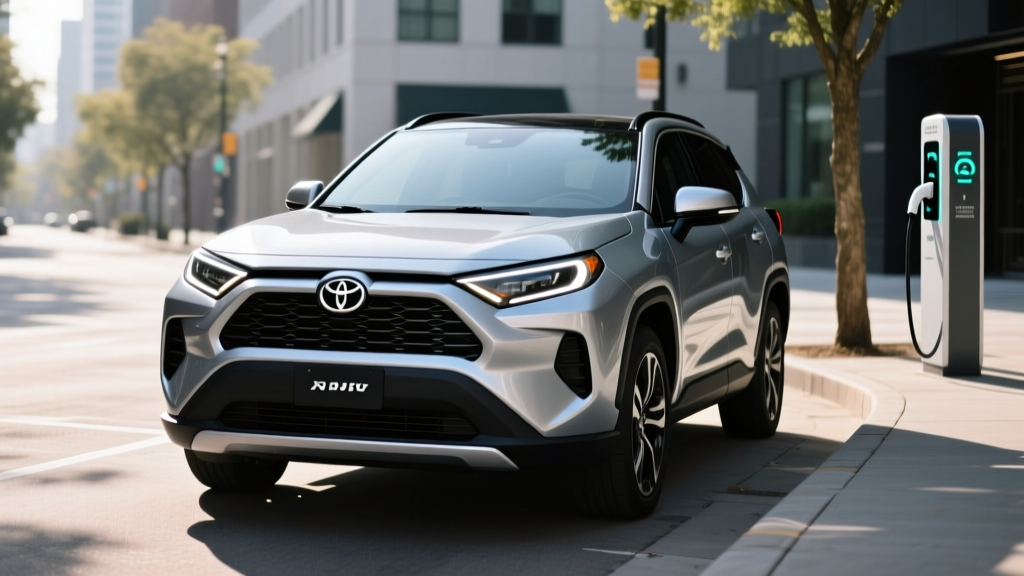
The Toyota RAV4 Prime has been one of the most sought-after plug-in hybrids on the market since its debut, and the 2025 model year continues that tradition with minimal changes. If you're searching for a 2025 RAV4 PHEV, you're likely weighing it against the conventional RAV4 Hybrid, a full battery-electric SUV, or a gas-only competitor. This guide breaks down every number that matters — electric-only range, real-world fuel economy, charging logistics, powertrain output, pricing, and whether you can claim a federal tax credit — so you can make a spec-driven decision.
RAV4 Hybrid vs. RAV4 Prime (PHEV): What's the Difference?
Toyota sells two electrified RAV4 variants, and the naming can trip up first-time buyers. Here's the critical distinction:
| Feature | RAV4 Hybrid (HEV) | RAV4 Prime (PHEV) |
|---|---|---|
| Plug-in charging required? | No — self-charging via regen & engine | Yes — plug in to access electric-only driving |
| Battery capacity | 1.6 kWh (small buffer) | 18.1 kWh (usable ~14.5 kWh) |
| Electric-only range | ~1 mile at low speed | 42 miles (EPA) |
| Combined horsepower | 219 hp | 302 hp |
| EPA combined MPG (gas mode) | 41 MPG | 38 MPG |
| MPGe (electric + gas combined) | N/A | 94 MPGe |
| 0–60 mph | 7.4 sec | 5.7 sec |
| Starting MSRP (2025) | ~$33,500 | ~$44,500 |
The HEV never needs a plug — it recovers energy through regenerative braking and the gasoline engine. The PHEV (which Toyota badges as "Prime") has a much larger battery and more powerful electric motors, enabling genuine electric-only commuting. When the battery depletes, the Prime seamlessly operates as a conventional hybrid.
Electric-Only Range and Total Driving Range
The 2025 RAV4 Prime carries over with an EPA-rated 42 miles of electric-only range. That figure applies to the SE trim with standard 18-inch wheels; stepping up to the XSE with 19-inch alloy wheels drops the rating slightly to 40 miles due to increased rolling resistance.
Real-world electric range expectation: The EPA's 42-mile figure assumes moderate temperatures and mixed driving. In our experience and owner reports, expect 35–40 miles in warm weather on a mix of city and highway driving. In freezing temperatures (below 32°F), the battery's usable capacity shrinks and cabin heating draws significant power — plan on 28–34 miles of electric range. Highway-only driving at 70+ mph will also reduce electric range to roughly 30–33 miles due to aerodynamic drag.
Once the battery is depleted, the Prime operates as a hybrid, delivering an EPA-rated 38 MPG combined. With a 14.5-gallon fuel tank, that yields roughly 550 miles of gasoline range, giving you a total combined range of approximately 590 miles — more than enough for any road trip without range anxiety.
Fuel Economy: EPA Numbers and Real-World MPG
| Driving Mode | City | Highway | Combined |
|---|---|---|---|
| Charge-depleted (hybrid mode) | 40 MPG | 36 MPG | 38 MPG |
| Charge-sustaining (MPGe) | 94 MPGe combined | ||
| Electric-only energy use | 28 kWh/100 mi | ||
According to fueleconomy.gov, the 2025 RAV4 Prime posts 40 city / 36 highway / 38 combined MPG when running on gasoline alone. That's slightly lower than the standard RAV4 Hybrid's 41 MPG combined, a trade-off for the Prime's heavier battery pack (the PHEV adds roughly 300 lbs over the HEV).
Real-world MPG notes: Like most hybrids, the RAV4 Prime tends to exceed its EPA city rating in stop-and-go traffic, where regenerative braking is most effective. Many owners report 42–45 MPG in urban driving during warm months. Highway fuel economy, however, often falls 2–4 MPG short of the sticker, especially at speeds above 70 mph or in hilly terrain. Expect 33–36 MPG on sustained highway trips.
Powertrain and Performance Specs
| Specification | 2025 RAV4 Prime (PHEV) |
|---|---|
| Engine | 2.5L 4-cylinder Atkinson-cycle |
| Engine output | 177 hp / 165 lb-ft |
| Front electric motor | 134 kW (180 hp) |
| Rear electric motor | 40 kW (54 hp) |
| Combined system output | 302 hp |
| 0–60 mph | 5.7 seconds |
| Drivetrain | AWD (electronic on-demand rear) |
| Transmission | eCVT (planetary gearset) |
| Towing capacity | 1,500 lbs |
| Battery chemistry | Lithium-ion (NMC) |
| Battery capacity | 18.1 kWh gross (~14.5 kWh usable) |
The 302-horsepower combined output makes the RAV4 Prime the quickest RAV4 variant Toyota sells — and one of the quickest compact SUVs in its class. The electric all-wheel-drive system uses a dedicated rear motor rather than a mechanical driveshaft, providing responsive traction without the parasitic loss of a traditional AWD system. Off the line, the electric motors deliver instant torque, making the Prime genuinely quick in daily driving, not just on paper.
Charging: Speed, Equipment, and What to Expect
The 2025 RAV4 Prime supports Level 1 (120V household outlet) and Level 2 (240V) AC charging. It does not support DC fast charging — a common point of confusion for buyers new to plug-in hybrids.
| Charging Level | Power | Time (0–100%) | Connector |
|---|---|---|---|
| Level 1 (120V / 12A) | ~1.4 kW | ~10–12 hours | Standard J1772 |
| Level 2 (240V / 16A) | 3.3 kW | ~4.5 hours | J1772 |
| Level 2 (240V / 32A)* | 6.6 kW | ~2.5 hours | J1772 |
| DC Fast Charge | Not supported | ||
*The 6.6 kW onboard charger is standard on the XSE trim and available as part of the Premium package on the SE trim. The base SE comes with the 3.3 kW charger.
Practical charging reality: Most PHEV owners charge overnight at home using a Level 2 wall connector, which fully replenishes the 18.1 kWh battery in roughly 2.5 to 4.5 hours depending on your onboard charger spec. Because PHEV batteries are small, DC fast charging is less critical than it is for full EVs — you're not trying to add 200 miles of range at a highway rest stop. A standard 120V outlet will add roughly 3–4 miles of electric range per hour, which is enough to top off if you drive less than 20 miles daily.
For Level 2 home installation, budget $500–$1,500 for a quality 240V charger (like the ChargePoint Home Flex or Emporia Level 2) and $800–$2,500 for electrician labor, depending on panel proximity and local permit costs. If your electrical panel needs an upgrade to 200A, add $1,500–$3,000.
Pricing, Trims, and Tax Credit Eligibility
The 2025 RAV4 Prime starts at approximately $44,500 MSRP (SE trim, including destination). The XSE trim starts around $48,000, and a fully loaded XSE with the Premium and Technology packages can push past $53,000.
Federal tax credit status: As of current IRS §30D rules, the RAV4 Prime does not qualify for the full $7,500 federal clean vehicle credit. The credit requires that a vehicle's battery components and critical minerals meet specific North American sourcing thresholds, and the RAV4 Prime's supply chain does not currently satisfy these requirements. Additionally, the §30D credit imposes buyer income caps ($150,000 single / $300,000 joint modified AGI) and an MSRP cap of $80,000 for SUVs — the RAV4 Prime clears the price cap but fails the sourcing test.
Some buyers may qualify for state-level incentives — for example, certain states offer rebates for PHEVs regardless of federal sourcing rules. Check your state energy office or the Alternative Fuels Data Center for current local programs. These vary widely and change frequently, so always verify with official state sources before counting them into your budget.
Battery Warranty, Reliability, and Replacement Cost
Toyota Hybrid Battery Warranty: Toyota covers the RAV4 Prime's hybrid battery for 10 years or 150,000 miles (whichever comes first) in all 50 states. This warranty guarantees the battery will retain sufficient capacity to function as designed. The broader hybrid system (inverter, motors, control modules) is also covered for 8 years / 100,000 miles.
Toyota's hybrid powertrains have an exceptionally strong reliability track record. The RAV4 Prime uses a proven 2.5L Atkinson-cycle engine paired with Toyota's fourth-generation hybrid transaxle — technology refined over two decades since the original Prius. Owner-reported issues are rare, and the eCVT planetary gearset has no traditional transmission clutches or bands to wear out.
Battery replacement cost: If the traction battery fails outside warranty coverage, a replacement currently runs approximately $4,000–$6,500 including parts and labor at a Toyota dealer. However, Toyota PHEV batteries rarely require full replacement within the first decade — individual cell module balancing or partial repairs are more common and less expensive. Given the 10-year/150,000-mile warranty, most original owners will never face an out-of-pocket battery cost.
Who Should Buy the 2025 RAV4 Prime vs. a Full EV or Gas Car?
Choose the RAV4 Prime (PHEV) if:
- Your daily commute is under 40 miles round-trip and you can charge at home — you'll drive on electricity most days and rarely burn gas.
- You want one vehicle for both electric commuting and long road trips without charging-planning hassle.
- You live in an area with limited public DC fast-charging infrastructure.
- You want AWD, strong acceleration, and SUV practicality without full EV pricing.
Choose a full BEV (like the Tesla Model Y or Hyundai Ioniq 5) if:
- You want zero tailpipe emissions and have reliable home charging.
- Your daily driving is predictable and under 250 miles, or you're comfortable planning DC fast-charge stops on road trips.
- You want to eliminate oil changes, spark plugs, and engine maintenance entirely.
- You qualify for the full $7,500 federal tax credit (which several BEVs still do).
Choose the RAV4 Hybrid (HEV) if:
- You can't charge at home (apartment, street parking, no garage outlet).
- You want the lowest upfront cost and simplest ownership — no plug, no charging routine.
- Your daily mileage is high enough that 42 miles of electric range wouldn't meaningfully reduce your gas use.
Pros
- 42 miles of electric range covers most commutes gas-free
- 302 hp makes it the quickest RAV4 ever
- Standard AWD with electric rear motor
- Operates as a 38 MPG hybrid when battery is depleted
- 10-year/150,000-mile hybrid battery warranty
- No range anxiety — 590+ miles total range
Cons
- $44,500+ starting price is steep for a compact SUV
- Does not qualify for $7,500 federal tax credit
- No DC fast charging support
- Long dealer waitlists — high demand, limited supply
- 38 MPG hybrid mode is lower than RAV4 Hybrid's 41 MPG
- Cargo space slightly reduced vs. gas RAV4 (~33.5 cu ft)
Frequently Asked Questions
How many MPG does the 2025 RAV4 PHEV get?
When the battery is depleted and the RAV4 Prime operates as a conventional hybrid, it achieves an EPA-rated 40 city / 36 highway / 38 combined MPG. In real-world city driving, many owners see 42–45 MPG thanks to aggressive regenerative braking. Highway driving at sustained high speeds typically yields 33–36 MPG.
How far can the 2025 RAV4 Prime go on electric only?
The EPA rates the RAV4 Prime at 42 miles of electric-only range on a full charge (SE trim). Real-world results vary: expect 35–40 miles in warm weather and 28–34 miles in freezing temperatures. Highway-speed driving also reduces electric range to roughly 30–33 miles.
Does the RAV4 Prime qualify for a federal tax credit?
No. Under current IRS §30D rules, the RAV4 Prime does not meet the critical minerals and battery component sourcing requirements for the $7,500 federal clean vehicle credit. Some state-level incentives may still apply — check your state's energy office or the Alternative Fuels Data Center for current programs.
Is the RAV4 Prime reliable, and what does battery replacement cost?
Toyota's hybrid powertrains are among the most reliable in the industry, and the RAV4 Prime uses proven, well-tested components. The hybrid battery is warranted for 10 years or 150,000 miles. Out-of-warranty battery replacement costs approximately $4,000–$6,500, though full replacements are rare within the first 10–15 years of ownership.
Can I charge the RAV4 Prime at a DC fast charger?
No. The RAV4 Prime only supports AC charging (Level 1 at 120V and Level 2 at 240V). It uses a standard J1772 connector. This is typical for plug-in hybrids — their smaller batteries don't require DC fast charging, and most owners charge overnight at home.
Should I get the RAV4 Prime or a full electric SUV?
If you can charge at home and your daily commute is under 40 miles, the Prime lets you drive electric most days while keeping the flexibility for gas-free road trips. If you have reliable charging, want zero tailpipe emissions, and qualify for the $7,500 federal credit, a full EV like the Tesla Model Y or Hyundai Ioniq 5 may offer lower total operating costs. The Prime is the better choice if public charging infrastructure is sparse in your area or you frequently drive beyond 300 miles in a day.