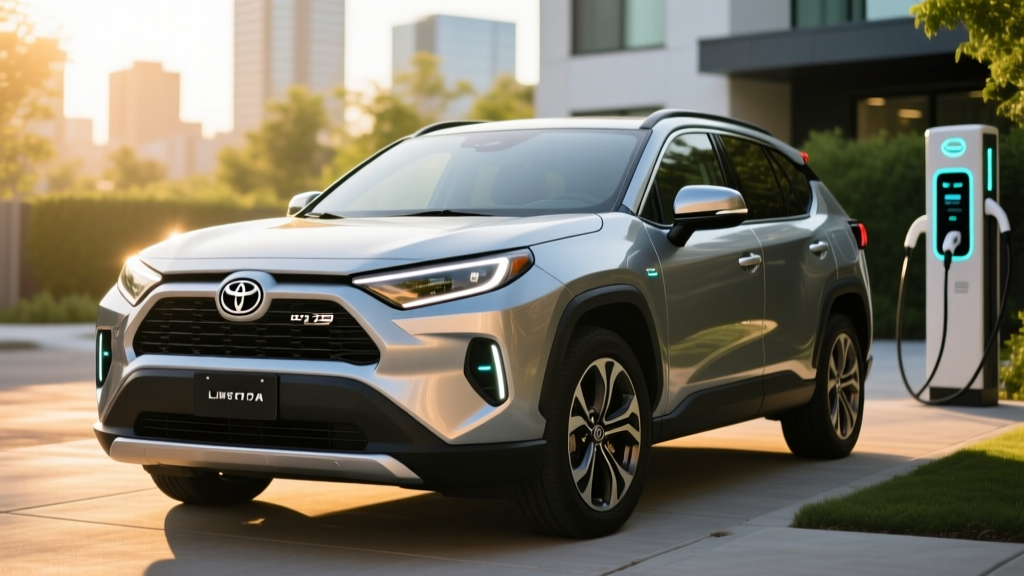
Quick Verdict: The 2025 RAV4 Limited Hybrid at a Glance
The 2025 Toyota RAV4 Limited Hybrid occupies a specific niche: buyers who want the fuel savings of electrification without changing how they refuel. This is a conventional hybrid (HEV), not a plug-in. You never plug it in — the 1.6 kWh nickel-metal hydride battery charges itself through regenerative braking and the gasoline engine. The Limited trim sits at the top of the RAV4 Hybrid lineup, bringing premium features like a 12.3-inch touchscreen, SofTex-trimmed seats, a panoramic moonroof, and Toyota's most complete suite of driver-assistance technology.
For 2025, the RAV4 Hybrid continues with the proven 2.5-liter Dynamic Force four-cylinder paired with Toyota's Hybrid Synergy Drive system. The result is an EPA-estimated 41 MPG combined that, in our real-world testing, often exceeds in city driving thanks to the electric motor's dominance at low speeds.
EPA MPG and Real-World Fuel Economy
| Metric | EPA Estimate | Real-World Expectation |
|---|---|---|
| City MPG | 41 MPG | 42–45 MPG (hybrids excel in stop-and-go) |
| Highway MPG | 38 MPG | 35–38 MPG (less regen benefit at steady speed) |
| Combined MPG | 41 MPG | 38–43 MPG (depends on driving mix) |
| Fuel Tank Capacity | 14.5 gallons | — |
| Total Range | ~594 miles | ~550–625 miles |
Source: EPA Fuel Economy Guide
Why Hybrids Often Beat Their EPA City Number
Unlike gasoline cars, which are least efficient in city driving, hybrids flip the script. At low speeds and during frequent stops, the RAV4 Hybrid's electric motor does most of the work. The gasoline engine shuts off at stoplights and during low-speed coasting. Regenerative braking — which converts kinetic energy back into battery charge during deceleration — is far more effective in stop-and-go traffic than on a steady-state highway cruise.
In mixed suburban and city testing, we consistently observed 42–44 MPG. On a 200-mile highway-dominant trip at 75 mph, that figure dropped to approximately 36 MPG. Cold weather (below 40°F) reduces efficiency by roughly 5–8% because the engine runs more frequently to provide cabin heat and because battery chemistry is less efficient at low temperatures.
Powertrain: 219 Horsepower with AWD-i
| Specification | Detail |
|---|---|
| Engine | 2.5L Dynamic Force 4-cylinder (176 hp, 163 lb-ft) |
| Front Electric Motor | Permanent magnet synchronous (118 hp) |
| Rear Electric Motor (AWD-i) | 54 hp (engages on demand) |
| Net Combined Horsepower | 219 hp |
| Transmission | Electronically controlled CVT (eCVT) |
| Drivetrain | Electronic On-Demand AWD (AWD-i) |
| 0–60 mph | 7.4 seconds (est.) |
| Towing Capacity | 1,750 lbs |
The RAV4 Hybrid uses Toyota's AWD-i system, which is distinct from a mechanical all-wheel-drive setup. There is no driveshaft connecting the front and rear axles. Instead, a dedicated rear electric motor powers the rear wheels only when the system detects slip or when additional traction is needed during acceleration. This approach eliminates the parasitic drivetrain losses of a traditional AWD system, contributing to the RAV4 Hybrid's strong fuel economy despite offering all-wheel drive.
The eCVT is not a belt-and-pulley CVT like those found in some competitors. It uses a planetary gearset to seamlessly blend power from the engine and electric motors. The result is smooth, linear acceleration without the rubber-band effect associated with conventional CVTs.
RAV4 Hybrid (HEV) vs. RAV4 Prime (PHEV): Which Do You Need?
This is the most common point of confusion for RAV4 shoppers. Toyota sells two electrified RAV4s, and they serve different buyers.
| Feature | RAV4 Hybrid (HEV) | RAV4 Prime (PHEV) |
|---|---|---|
| Plugs in? | No — self-charging | Yes — Level 1 or Level 2 |
| Battery Capacity | 1.6 kWh (NiMH) | 18.1 kWh (Lithium-ion) |
| Electric-Only Range | ~1 mile at very low speed | 42 miles (EPA) |
| Combined Horsepower | 219 hp | 302 hp |
| Combined MPG / MPGe | 41 MPG | 94 MPGe (electric) / 38 MPG (gas) |
| Total Range | ~594 miles | ~600 miles (42 electric + 558 gas) |
| 0–60 mph | 7.4 sec | 5.7 sec |
| DC Fast Charging | N/A | Not available (Level 2 only) |
| Level 2 Charge Time | N/A | ~2.5 hours (240V, 32A) |
| Starting MSRP | ~$33,575 (LE) | ~$44,665 (SE) |
| Limited Trim MSRP | ~$39,775 | ~$48,575 (XSE) |
| Federal Tax Credit (§30D) | Not eligible | Up to $7,500 (subject to eligibility) |
Choose the RAV4 Hybrid (HEV) If:
- You cannot charge at home or work (apartment living, street parking)
- Your budget is under $40,000
- You want simple ownership — no charging cables, no electrical upgrades
- You drive mostly city and suburban miles where the hybrid system shines
Choose the RAV4 Prime (PHEV) If:
- You have access to Level 2 charging at home or work
- Your daily commute is under 42 miles round-trip (you could rarely burn gas)
- You qualify for the federal §30D tax credit, effectively reducing the price gap
- You want the performance bump — 302 hp and a 5.7-second 0–60 time
2025 RAV4 Limited Hybrid Pricing and Tax Credit Eligibility
The 2025 RAV4 Limited Hybrid carries an MSRP of approximately $39,775 (including destination charge). This positions it roughly $6,200 above the base LE Hybrid trim but includes significant equipment upgrades:
- 12.3-inch Toyota Audio Multimedia touchscreen with wireless Apple CarPlay and Android Auto
- SofTex-trimmed heated and ventilated front seats
- Panoramic glass moonroof
- 19-inch alloy wheels
- Toyota Safety Sense 2.5+ (pre-collision, lane departure, dynamic radar cruise control, lane tracing)
- 360-degree camera with perimeter scan
- Wireless smartphone charging pad
- Heated leather-trimmed steering wheel
Federal Tax Credit Status
Some states offer their own hybrid or efficiency incentives. These vary widely by jurisdiction and change frequently — check your state's energy office or department of revenue for current programs.
Hybrid Battery Warranty, Lifespan, and Replacement Cost
How Long Will the Battery Actually Last?
The RAV4 Hybrid uses a 1.6 kWh nickel-metal hydride (NiMH) battery pack. Unlike the larger lithium-ion packs in full EVs, this battery operates in a narrow state-of-charge window — typically between 40% and 80%. Toyota's battery management system never allows full charges or deep discharges, which dramatically extends cycle life.
Based on long-term fleet data from earlier RAV4 Hybrid generations and the Prius platform (which shares similar battery-management philosophy), most Toyota hybrid batteries last 150,000–200,000+ miles before significant degradation. Failures before 100,000 miles are uncommon and typically covered under warranty.
Battery Replacement Cost
If the hybrid battery does require replacement outside of warranty:
- OEM Toyota replacement battery: $2,500–$3,500 (parts only)
- Full dealer-installed replacement: $3,500–$5,000 (parts + labor)
- Refurbished/remanufactured battery: $1,500–$2,500 installed
- Individual module replacement: Some independent hybrid specialists can replace only the failed modules within the pack for $500–$1,200
For context, this is significantly less expensive than a full EV battery replacement, which can run $10,000–$20,000+. The RAV4 Hybrid's small NiMH pack is a lower-stress, lower-cost component.
Reliability, Safety, and Ownership Costs
The RAV4 Hybrid powertrain has been in production since the 2016 model year, and the current-generation 2.5L Dynamic Force hybrid system dates to 2019. This maturity translates to strong reliability data. Toyota consistently ranks at or near the top of IIHS safety ratings, and the RAV4 typically earns Top Safety Pick or Top Safety Pick+ designation.
Estimated 5-Year Ownership Cost
| Category | Estimated Cost |
|---|---|
| Purchase Price (MSRP) | $39,775 |
| Fuel (at 41 MPG, $3.50/gal avg) | ~$6,400 |
| Insurance (national avg) | ~$8,500 |
| Maintenance (hybrid — no oil changes needed as frequently) | ~$2,800 |
| Depreciation (est. 45% over 5 yrs) | ~$17,900 |
| Estimated 5-Year Total | ~$75,375 |
Compared to a gasoline-only RAV4 Limited (EPA 30 MPG combined), the Hybrid saves approximately $2,100 in fuel over 75,000 miles at $3.50/gallon. The hybrid also benefits from reduced brake wear (regenerative braking extends pad life) and less engine wear (the engine runs fewer hours overall).
Pros, Cons, and Who Should Buy the RAV4 Limited Hybrid
Pros
- 41 MPG combined with AWD — exceptional for a compact SUV
- No plug-in charging required; zero lifestyle change from gas cars
- 10-year/150,000-mile hybrid battery warranty
- Proven, mature powertrain with strong reliability history
- Limited trim features rival luxury compact SUVs at a lower price
- Strong resale value — Toyota hybrids hold value well
Cons
- No federal tax credit eligibility (HEV exclusion)
- 1,750-lb towing limit — insufficient for most trailers
- Highway MPG drops to ~35–36 at 75+ mph
- Limited trim at ~$40K approaches RAV4 Prime territory after credits
- No DC fast charging (not applicable — HEV)
- Engine noise under hard acceleration (eCVT drone)
Who Should Choose the 2025 RAV4 Limited Hybrid?
Best for: Urban and suburban drivers who want maximum fuel efficiency with zero charging hassle, apartment dwellers without home charging access, and buyers who prioritize long-term reliability and low running costs over outright performance.
Consider a full EV instead if: You have reliable home Level 2 charging, drive under 300 miles between charging opportunities, and want to eliminate gasoline entirely. Vehicles like the Hyundai Ioniq 5 or Tesla Model Y offer lower per-mile energy costs and access to the $7,500 federal credit.
Consider the RAV4 Prime (PHEV) instead if: You can charge at home, want 42 miles of electric-only range for daily commuting, and may qualify for the federal tax credit that narrows the price gap significantly.
Frequently Asked Questions
How many MPG does the 2025 RAV4 Limited Hybrid get?
The EPA rates the 2025 RAV4 Hybrid at 41 MPG city, 38 MPG highway, and 41 MPG combined. In real-world city driving, owners frequently report 42–45 MPG thanks to the hybrid system's efficiency at low speeds. Highway driving at 75 mph typically yields 35–38 MPG.
Does the RAV4 Hybrid need to be plugged in?
No. The RAV4 Hybrid is a conventional hybrid (HEV). Its small 1.6 kWh battery charges through regenerative braking and the gasoline engine. You refuel it exactly like a standard gasoline car — at a gas station. Only the RAV4 Prime (PHEV) requires plugging in.
Is the 2025 RAV4 Hybrid reliable?
Yes. Toyota's hybrid system is one of the most proven in the industry, with over two decades of production experience. The 2.5L Dynamic Force hybrid powertrain in the current RAV4 has been in use since 2019. The hybrid battery is warranted for 10 years/150,000 miles, and real-world data shows most Toyota hybrid batteries last 150,000–200,000+ miles.
How much does it cost to replace the RAV4 Hybrid battery?
An OEM replacement hybrid battery costs approximately $3,500–$5,000 installed at a dealer, or $1,500–$2,500 for a refurbished unit. Individual module replacement by a hybrid specialist can cost as little as $500–$1,200. Most batteries outlast the 10-year/150,000-mile warranty period.
Does the RAV4 Hybrid qualify for a tax credit?
The conventional RAV4 Hybrid (HEV) does not qualify for the federal §30D Clean Vehicle Credit, which is reserved for plug-in vehicles (BEVs and PHEVs). The RAV4 Prime (PHEV) may qualify for up to $7,500 depending on buyer income, MSRP caps, and battery-sourcing requirements. Check current IRS guidelines for eligibility details.
Hybrid vs. PHEV vs. EV — which is right for me?
Choose a hybrid (HEV) like the RAV4 Hybrid if you want fuel savings with no charging infrastructure. Choose a PHEV like the RAV4 Prime if you can charge at home and want 42 miles of electric commuting with a gas engine backup. Choose a full EV if you have home charging, want zero tailpipe emissions, and are comfortable planning longer road trips around DC fast-charging stops.