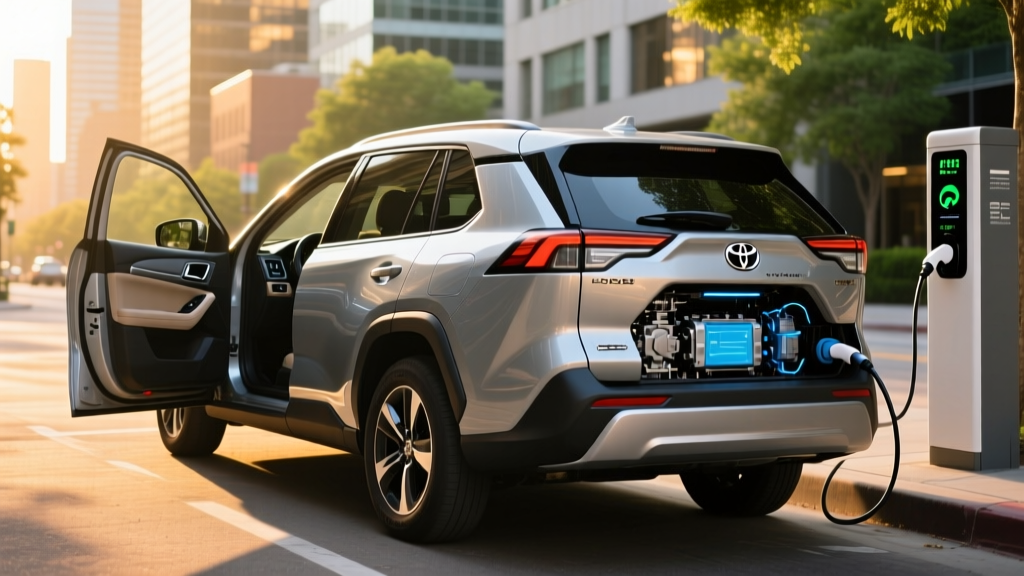
The 2025 RAV4 Hybrid XSE occupies a specific niche in Toyota's lineup: it's the sport-tuned appearance trim of America's best-selling hybrid SUV, pairing aggressive styling with a proven 219-horsepower all-wheel-drive powertrain and an EPA-estimated 39 MPG combined. For buyers who want hybrid efficiency without the plug-in commitment or the range anxiety of a full EV, the XSE trim delivers the mechanical goods wrapped in a more aggressive package than the LE or XLE.
But does the XSE's sport suspension tuning and larger wheels actually cost you fuel economy? What's the real-world MPG look like after 10,000 miles? And how does this conventional hybrid (HEV) compare to the plug-in RAV4 Prime or a full battery-electric SUV? This guide breaks down every spec that matters.
HEV vs PHEV: Where the RAV4 Hybrid XSE Fits
Before examining the XSE specifically, it's essential to distinguish Toyota's two RAV4 electrified offerings, because they serve fundamentally different use cases.
RAV4 Hybrid (HEV) — No Plug Required
- How it works: A 2.5L four-cylinder engine and electric motor(s) work together, with the battery recharged entirely through regenerative braking and the engine. You never plug it in.
- Battery: ~1.6 kWh nickel-metal hydride (NiMH) — small, self-charging
- Electric-only driving: Brief low-speed EV mode (under ~25 mph, short distances only)
- Fuel economy: EPA 41 city / 38 highway / 39 combined MPG (XSE AWD)
- Starting MSRP: ~$33,855 (LE trim); XSE starts at ~$35,555
RAV4 Prime (PHEV) — Plug-In Hybrid
- How it works: A larger 18.1 kWh lithium-ion battery provides genuine electric-only driving range before the hybrid system kicks in. You plug it in to recharge.
- Electric-only range: EPA 42 miles on battery alone
- Total combined range: ~600+ miles (42 electric + ~560 hybrid)
- Fuel economy: 94 MPGe (electric mode); 38 MPG combined (hybrid mode)
- Combined horsepower: 302 hp
- Starting MSRP: ~$44,515
- Tax credit: May qualify for up to $7,500 federal §30D credit (subject to income, sourcing, and MSRP caps — verify current IRS rules)
The 2025 RAV4 Hybrid XSE is the conventional HEV. It does not plug in, has no meaningful electric-only range, and does not qualify for the federal EV tax credit. If you're looking for plug-in capability, you need the RAV4 Prime — a different vehicle entirely.
Fuel Economy: EPA Ratings and Real-World MPG
The 2025 RAV4 Hybrid XSE comes exclusively with electronic on-demand AWD, which carries a slight MPG penalty compared to the FWD-only LE trim. Here are the official EPA estimates from fueleconomy.gov:
| Trim / Drivetrain | City MPG | Highway MPG | Combined MPG |
|---|---|---|---|
| RAV4 Hybrid XSE (AWD) | 41 | 38 | 39 |
| RAV4 Hybrid LE (AWD) | 41 | 38 | 39 |
| RAV4 Hybrid Limited (AWD) | 41 | 38 | 39 |
| RAV4 Gas (AWD, non-hybrid) | 27 | 34 | 30 |
Real-World MPG: What Owners Actually See
Toyota's hybrid system excels in stop-and-go city driving, where regenerative braking recaptures energy and the electric motor handles low-speed acceleration. This means real-world city MPG often exceeds the EPA estimate. Here's what to expect:
- City / suburban driving: 38–44 MPG. Many owners report mid-40s in warm weather with moderate traffic.
- Highway cruising (70-80 mph): 33–37 MPG. Aerodynamic drag and the engine doing most of the work reduce hybrid advantage at sustained high speeds.
- Cold weather (below 30°F): Expect a 10–15% drop, roughly 33–36 MPG combined, as the engine runs more frequently for cabin heat and battery warmup.
- Combined real-world average: Most XSE owners land between 36–41 MPG depending on driving mix and climate.
The XSE trim rides on 18-inch black alloy wheels with a sport-tuned suspension. Compared to the LE's smaller wheels, the real-world MPG difference is negligible — typically within 1 MPG under identical conditions. The sport suspension is firmer but doesn't measurably hurt efficiency.
Powertrain Specs: What Moves the XSE
| Specification | 2025 RAV4 Hybrid XSE |
|---|---|
| Engine | 2.5L Dynamic Force 4-cylinder |
| Engine Output | 176 hp / 163 lb-ft torque |
| Front Electric Motor | 118 hp / 149 lb-ft |
| Rear Electric Motor (AWD) | 54 hp / 89 lb-ft |
| Net Combined System Power | 219 hp |
| Transmission | eCVT (electronically controlled) |
| Drivetrain | Electronic On-Demand AWD |
| 0-60 mph | ~7.4 seconds |
| Towing Capacity | 1,750 lbs |
| Hybrid Battery | ~1.6 kWh NiMH (self-charging) |
| Fuel Tank | 14.5 gallons |
| Total Driving Range | ~565 miles (EPA est.) |
| Base MSRP (XSE AWD) | $35,555 |
The 219-hp combined output comes from Toyota's Hybrid Synergy Drive, which blends engine and motor power through a planetary gearset (the eCVT). Unlike a traditional belt-driven CVT, Toyota's eCVT has no belts or pulleys — it's a mechanically robust power-split device that's proven exceptionally reliable over two decades of Prius and RAV4 Hybrid production.
The rear electric motor provides AWD traction by independently powering the rear wheels when slip is detected or during hard acceleration. There's no mechanical driveshaft connecting front to rear — it's entirely electronic, which reduces weight and drivetrain losses.
Battery Warranty, Lifespan, and Replacement Cost
Toyota Hybrid Battery Warranty
Coverage: 10 years / 150,000 miles (whichever comes first) for all 2025 Toyota hybrids, per Toyota's official warranty guide.
What's covered: The hybrid battery pack, hybrid control module, and related hybrid system components against defects and capacity loss below functional thresholds.
Real-world lifespan: Toyota's NiMH hybrid batteries routinely last 150,000–200,000+ miles. Many first-generation Prius taxis exceeded 300,000 miles on the original battery. The ~1.6 kWh pack in the RAV4 Hybrid is small and shallow-cycled, which dramatically extends its life compared to large EV batteries.
Replacement Cost If Out of Warranty
If the hybrid battery does eventually need replacement outside warranty coverage:
- New OEM battery from Toyota: ~$3,000–$4,000 (parts + labor at dealer)
- Refurbished/remanufactured battery: ~$1,500–$2,500 from independent hybrid specialists
- Individual module replacement: Some shops replace only the degraded cell modules for $500–$1,200
For context, this is dramatically less than EV battery replacements ($5,000–$20,000+) because the hybrid battery is small and uses mature NiMH chemistry. The replacement cost is comparable to a major engine repair on a gas-only vehicle — and far less likely to be needed during typical ownership.
Pricing, Trims, and Tax Credit Eligibility
The 2025 RAV4 Hybrid XSE starts at an MSRP of approximately $35,555 (including destination charge). Here's how it sits in the broader RAV4 Hybrid lineup:
- Hybrid LE (AWD): ~$33,855
- Hybrid XLE (AWD): ~$34,855
- Hybrid XSE (AWD): ~$35,555
- Hybrid SE (AWD): ~$36,555
- Hybrid Woodland Edition (AWD): ~$36,455
- Hybrid Limited (AWD): ~$39,455
Does the RAV4 Hybrid XSE Qualify for Tax Credits?
No. The conventional RAV4 Hybrid (HEV) does not qualify for the federal §30D Clean Vehicle Credit. That credit applies only to plug-in electric vehicles (BEVs and PHEVs) meeting specific battery sourcing, MSRP, and buyer income requirements under current IRS rules.
The RAV4 Prime (PHEV) may qualify for up to $7,500 in federal tax credits, but eligibility depends on your taxable income, the vehicle's battery mineral and component sourcing, and the $80,000 SUV MSRP cap. Always consult a tax professional and check the IRS §30D guidance before counting on credit eligibility — rules and sourcing requirements shift annually.
Some states and municipalities offer separate incentives for conventional hybrids, but these are increasingly rare as incentive programs focus on plug-in vehicles. Check your state energy office or AFDC incentive database for local programs.
What You Get with the XSE Trim Specifically
The XSE differentiates itself from lower trims through appearance and handling upgrades rather than powertrain changes. Every RAV4 Hybrid shares the same 219-hp AWD system. The XSE adds:
- Sport-tuned suspension (firmer damping for reduced body roll)
- 18-inch black alloy wheels with a unique multi-spoke design
- Blacked-out roof, mirror caps, and badging (two-tone paint available)
- SofTex synthetic leather seats with blue contrast stitching
- Leather-trimmed steering wheel
- 8-inch (or available 10.5-inch) Toyota Audio Multimedia touchscreen
- Toyota Safety Sense 2.5+ (pre-collision, lane tracing, adaptive cruise, blind spot monitor)
- Wireless Apple CarPlay and Android Auto
- Qi wireless phone charging pad
- Power liftgate
The sport suspension gives the XSE noticeably tighter cornering feel compared to the LE and XLE, though ride quality over rough pavement is slightly firmer. For most buyers, the trade-off is worth it — the RAV4 Hybrid already prioritizes comfort, so the XSE's tuning moves it toward neutral without becoming harsh.
RAV4 Hybrid XSE vs RAV4 Prime vs Full EV: Which Is Right for You?
Choose the RAV4 Hybrid XSE (HEV) If:
- You can't charge at home (apartment, street parking, no garage)
- You want hybrid efficiency with zero behavior change — just fill up with gas
- Your budget is under $40,000 and you want AWD
- You drive a mix of city and highway with no single dominant pattern
- You plan to keep the vehicle 8-10+ years and value Toyota's long-term reliability record
- You regularly drive in areas with limited charging infrastructure
Choose the RAV4 Prime (PHEV) If:
- You have reliable home Level 2 charging and a daily commute under 42 miles
- You want to drive mostly on electricity but need gas flexibility for road trips
- You qualify for the federal tax credit (effectively reducing the ~$44,500+ price)
- You want 302 hp — the Prime is significantly quicker (0-60 in ~5.7 sec)
- You want to reduce gasoline consumption to near-zero on typical weekdays
Choose a Full EV (e.g., Tesla Model Y, Hyundai Ioniq 5) If:
- You have home charging and rarely drive more than 250 miles in a day
- You want to eliminate gasoline entirely and minimize maintenance (no oil changes, no engine)
- You want maximum federal and state incentives
- You prioritize lowest cost-per-mile (electricity is typically $0.03–$0.05/mile vs $0.12–$0.16/mile for the hybrid)
- You're comfortable with DC fast charging on road trips (20-30 min stops every ~200 miles)
The Cost-Per-Mile Reality
At 39 MPG combined and $3.40/gallon regular unleaded, the RAV4 Hybrid XSE costs approximately $0.087 per mile in fuel. A comparable gas-only RAV4 at 30 MPG costs ~$0.113/mile. A full EV charging at home at $0.14/kWh and averaging 3.5 miles/kWh costs ~$0.04/mile. The hybrid saves you ~$390/year over the gas version at 15,000 miles driven — meaningful, but the EV saves ~$700/year over the hybrid.
The hybrid's advantage is that these savings require zero infrastructure investment and zero route planning. You drive exactly as you always have; the car simply uses less fuel.
Reliability Record and Long-Term Ownership
Toyota's hybrid powertrain has one of the strongest reliability records in the automotive industry. The RAV4 Hybrid specifically benefits from:
- eCVT durability: The planetary gearset has no belts, clutches, or friction materials to wear out. Failures are exceptionally rare.
- NiMH battery longevity: Shallow charge/discharge cycles (the battery typically operates between 40-80% state of charge) minimize degradation. The 10-year/150,000-mile warranty reflects Toyota's confidence.
- Reduced brake wear: Regenerative braking handles most deceleration, so physical brake pads and rotors last significantly longer than on gas-only vehicles — often 80,000–100,000+ miles.
- Engine longevity: The Atkinson-cycle 2.5L engine runs under less stress than a conventional engine because the electric motor assists during high-load situations.
Toyota's comprehensive warranty covers 3 years/36,000 miles basic and 5 years/60,000 miles powertrain, with the hybrid battery extending to 10 years/150,000 miles. For buyers planning long-term ownership (200,000+ miles), the RAV4 Hybrid is among the lowest-risk vehicles available, which is reflected in its strong resale values.
Frequently Asked Questions
How many MPG does the 2025 RAV4 Hybrid XSE actually get?
The EPA rates it at 41 city / 38 highway / 39 combined MPG. In real-world driving, most owners see 36–41 MPG combined depending on driving style, terrain, and climate. City driving often yields 40–44 MPG thanks to regenerative braking, while sustained highway driving at 75+ mph may drop to 33–36 MPG.
Does the RAV4 Hybrid XSE need to be plugged in?
No. The RAV4 Hybrid is a conventional hybrid (HEV). The battery recharges entirely through regenerative braking and the gasoline engine. You never plug it in — you simply refuel at any gas station with regular unleaded.
How far can the RAV4 Hybrid drive on electric power alone?
Only very short distances (under a mile) at low speeds (under ~25 mph) using EV mode. This is not a meaningful electric-only range — it's designed for creeping through parking lots or driveways quietly. If you want genuine electric-only driving, you need the RAV4 Prime PHEV (42 miles electric-only) or a full BEV.
Is the RAV4 Hybrid battery expensive to replace?
A new OEM hybrid battery costs approximately $3,000–$4,000 installed at a dealer. Refurbished options run $1,500–$2,500. However, Toyota's NiMH hybrid batteries routinely last 150,000–200,000+ miles, and the 10-year/150,000-mile warranty covers premature failure. Most owners will never need a replacement.
Does the 2025 RAV4 Hybrid XSE qualify for any federal tax credit?
No. The federal §30D Clean Vehicle Credit applies only to plug-in vehicles (BEVs and PHEVs). The conventional RAV4 Hybrid does not qualify. The plug-in RAV4 Prime may qualify for up to $7,500 depending on your income, the vehicle's battery sourcing compliance, and current IRS rules.
Is the XSE trim worth the premium over the LE?
If you value sport-tuned suspension, 18-inch black wheels, SofTex seats, and the blacked-out two-tone appearance, the ~$1,700 premium over the LE is reasonable. Mechanically, every RAV4 Hybrid is identical — same 219 hp, same AWD system, same EPA MPG. The XSE is a styling and handling package, not a performance upgrade.
How does the RAV4 Hybrid compare to a gas RAV4 in annual fuel cost?
At 15,000 miles/year and $3.40/gallon, the gas RAV4 (30 MPG combined) costs ~$1,700/year in fuel. The RAV4 Hybrid (39 MPG combined) costs ~$1,310/year — saving roughly $390 annually. Over a 10-year ownership period, that's approximately $3,900 in fuel savings, which more than covers the hybrid's modest price premium.