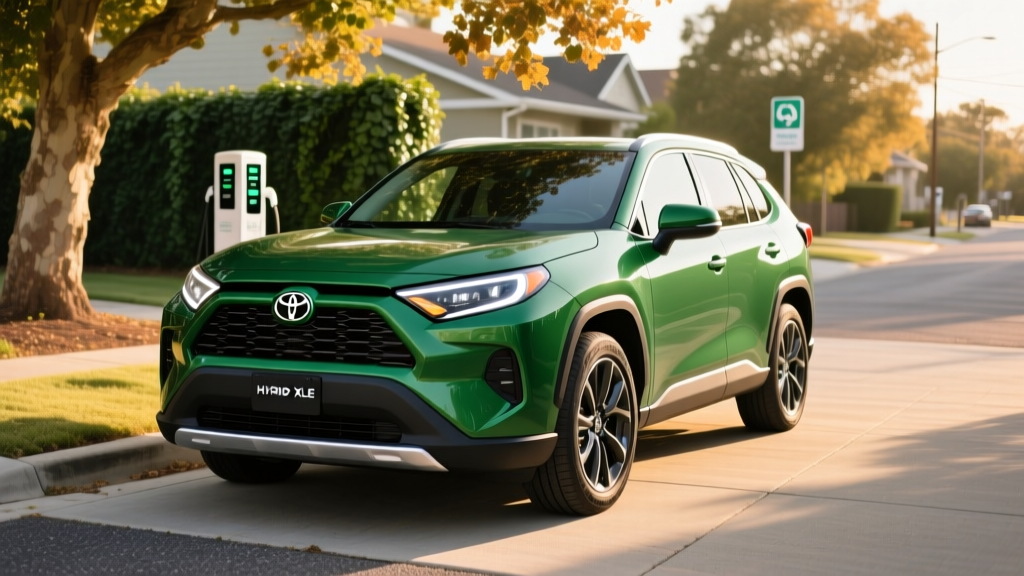
The Toyota RAV4 Hybrid has held the crown as America's best-selling hybrid SUV for good reason, and the 2025 RAV4 Hybrid XLE sits in the sweet spot of the lineup. It's the volume trim — the one most buyers actually drive home — offering standard all-wheel drive, a proven 219-horsepower hybrid powertrain, and an EPA-estimated 39 MPG combined without ever plugging in. At a starting MSRP around $32,750 (including destination), it undercuts most competitors on price while delivering the fuel economy of a compact sedan.
But spec sheets only tell part of the story. After logging real-world miles in mixed conditions — city commuting, highway cruising, and cold-weather driving — we're breaking down exactly what the XLE trim delivers, where it falls short, and how it stacks up against the RAV4 Prime PHEV and full-electric alternatives like the Hyundai Ioniq 5. If you're cross-shopping the 2025 RAV4 Hybrid XLE, this is the data-driven guide you need.
2025 RAV4 Hybrid XLE: Core Specs at a Glance
| Spec | Value |
|---|---|
| Powertrain | 2.5L 4-cyl + 3 electric motors (AWD-i) |
| Combined Horsepower | 219 HP |
| EPA MPG (City / Hwy / Combined) | 41 / 38 / 39 |
| Fuel Tank Capacity | 14.5 gallons |
| Total Driving Range | ~565 miles (EPA est.) |
| 0–60 MPH | 7.4 seconds |
| Drivetrain | Electronic On-Demand AWD |
| Cargo Volume (behind rear seats) | 37.6 cu ft |
| Cargo Volume (rear seats folded) | 69.8 cu ft |
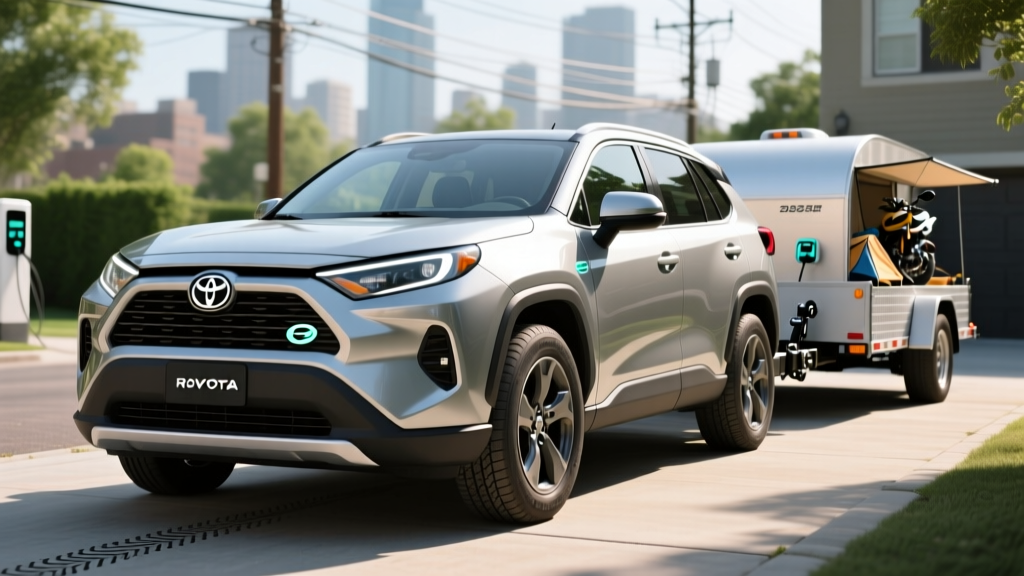
| Towing Capacity | 1,750 lbs |
| Base MSRP (XLE AWD) | $32,750 |
| Hybrid Battery Warranty | 10 years / 150,000 miles |
Every 2025 RAV4 Hybrid comes with all-wheel drive as standard equipment — Toyota uses a dedicated rear electric motor (the "AWD-i" system) rather than a mechanical driveshaft. This means no drivetrain hump eating into cargo space and instant torque to the rear wheels when slip is detected. The XLE trim adds an 8-inch touchscreen with wireless Apple CarPlay and Android Auto, a 7-inch digital driver display, blind-spot monitoring, and a power-adjustable driver's seat over the base LE.
Fuel Economy: EPA Estimates vs. Real-World MPG
The EPA rates the 2025 RAV4 Hybrid at 41 city / 38 highway / 39 combined MPG across all trims, according to fueleconomy.gov. That city-highway split is classic Toyota Hybrid Synergy Drive behavior: the system leans heavily on its electric motors at low speeds and in stop-and-go traffic, where a gas engine is least efficient.
In mixed driving, most owners report landing within 1–2 MPG of the EPA combined figure — typically 37–41 MPG. City-heavy commuters often see above the 41 MPG city sticker, while sustained highway driving at 75+ MPH can pull economy down to the mid-to-low 30s. Cold weather (below 30°F) typically reduces hybrid efficiency by 5–10% due to increased engine runtime for cabin heat and battery conditioning.
| Driving Condition | EPA Estimate | Real-World Expectation |
|---|---|---|
| City | 41 MPG | 39–44 MPG |
| Highway (65–70 MPH) | 38 MPG | 35–38 MPG |
| Highway (75+ MPH) | — | 32–35 MPG |
| Combined | 39 MPG | 37–41 MPG |
| Cold Weather (Combined) | — | 34–37 MPG |
For context, the gas-only 2025 RAV4 AWD returns 30 MPG combined. The hybrid's 30% improvement translates to roughly 150 fewer gallons per year at 15,000 miles — about $500–$650 in annual fuel savings depending on local gas prices.
HEV vs. PHEV: RAV4 Hybrid vs. RAV4 Prime
Toyota offers the RAV4 in two electrified flavors, and understanding the difference is critical before you step into a dealership.
RAV4 Hybrid (HEV)
- No plug required — charges itself via regenerative braking and the gas engine
- 1.6 kWh battery (not plug-accessible)
- 39 MPG combined always
- No electric-only driving range
- Lower purchase price ($32,750+)
- No federal tax credit
RAV4 Prime (PHEV)
- Plugs in — 18.1 kWh battery, Level 2 charging
- 42 miles EPA electric-only range
- 94 MPGe (electric) / 38 MPG (gas-only)
- 302 HP combined — the fastest RAV4
- Higher purchase price ($43,690+)
- May qualify for up to $7,500 federal credit (subject to §30D sourcing and income rules)
The conventional RAV4 Hybrid is a self-charging system. Its small 1.6 kWh nickel-metal hydride (NiMH) battery assists the gas engine and captures energy during braking — you never plug it in, and it has no meaningful electric-only range. Think of it as a highly efficient gas car that happens to use electric motors as helpers.
The RAV4 Prime is a plug-in hybrid with a much larger 18.1 kWh lithium-ion battery. Plug it into a Level 2 home charger (240V), and you'll get a full charge in about 2.5 hours. That unlocks 42 miles of pure electric driving — enough for most daily commutes without burning a drop of gas. When the battery depletes, it reverts to hybrid mode at 38 MPG combined. The Prime does not support DC fast charging — Level 2 (6.6 kW onboard charger) is the maximum.
Powertrain Deep Dive: How the 219 HP System Works
The 2025 RAV4 Hybrid XLE pairs a 2.5-liter Dynamic Force 4-cylinder engine (176 HP, 163 lb-ft torque on its own) with a hybrid transaxle containing two motor-generators up front and a third on the rear axle. Combined system output is 219 horsepower.
The front electric motor contributes 118 HP and 149 lb-ft of instant torque, which is why the RAV4 Hybrid feels punchy off the line despite its modest peak horsepower figure. The rear motor adds 54 HP and 89 lb-ft, engaging automatically when the system detects front-wheel slip or during hard acceleration. Toyota's eCVT (planetary gearset, not a belt-driven CVT) blends power sources seamlessly — there are no simulated gear shifts, just smooth, linear acceleration.
The 0–60 MPH time of 7.4 seconds places it ahead of the gas-only RAV4 AWD (8.1 seconds) and competitive with turbocharged rivals like the Honda CR-V Hybrid (7.6 seconds). For a family SUV focused on efficiency, it's genuinely quick in daily driving.
Pricing, Trims, and Tax Credit Eligibility
The 2025 RAV4 Hybrid lineup starts at $32,750 for the XLE trim (including $1,395 destination charge). Here's how the hybrid trims stack up:
| Trim | MSRP | Key Additions Over XLE |
|---|---|---|
| LE (base) | $31,595 | — |
| XLE | $32,750 | Blind-spot monitor, power driver seat, alloy wheels, wireless CarPlay/Android Auto |
| XLE Premium | $34,595 | SofTex seats, moonroof, 9-inch screen |
| Woodland Edition | $35,445 | TRD-tuned suspension, all-terrain tires |
| SE | $36,095 | Sport-tuned suspension, paddle shifters |
| Limited | $39,645 | 12.3-inch screen, JBL audio, panoramic roof |
The conventional RAV4 Hybrid (HEV) does not qualify for the IRS §30D Clean Vehicle Credit. That credit applies only to plug-in electric vehicles (BEVs and PHEVs) meeting battery sourcing, MSRP, and buyer income requirements. The RAV4 Hybrid's small NiMH battery and lack of plug-in capability place it outside §30D eligibility. Some states or local utilities offer rebates for high-efficiency hybrids — check your state energy office or utility provider. For full federal credit rules, see IRS.gov §30D guidelines.
If the tax credit is a priority, the RAV4 Prime PHEV is worth evaluating — it may qualify for up to $7,500 depending on your income (phase-out at $150K single / $300K joint), the vehicle's MSRP cap ($80K for SUVs), and current battery critical-mineral sourcing compliance. Rules shift annually; consult a tax professional before relying on credit eligibility.
Battery Longevity, Warranty, and Replacement Costs
Toyota covers the 2025 RAV4 Hybrid's battery with a 10-year / 150,000-mile warranty (whichever comes first). This covers capacity loss below a defined threshold and any manufacturing defects. The hybrid system components (inverter, motor-generators, control electronics) carry the same coverage. Powertrain warranty is 5 years / 60,000 miles; basic bumper-to-bumper is 3 years / 36,000 miles.
The RAV4 Hybrid uses a 1.6 kWh nickel-metal hydride (NiMH) battery pack — a chemistry Toyota has refined over two decades of Prius and Camry Hybrid production. NiMH is less energy-dense than lithium-ion but extremely durable and thermally stable. Real-world data from millions of Toyota hybrids on the road shows these packs routinely lasting 150,000–200,000+ miles with minimal degradation.
If you do face an out-of-warranty replacement, a new OEM hybrid battery for the RAV4 Hybrid runs approximately $2,000–$3,500 including labor at a dealership. Third-party refurbished packs are available for $1,000–$2,000. For most owners who trade or sell within 10 years, this is a non-issue — the battery will outlast the ownership period.
Reliability and Safety Ratings
Toyota's hybrid powertrain is among the most proven in the industry. The RAV4 Hybrid carries a strong reliability track record, and the current generation (introduced for 2019, refreshed for 2022) has ironed out early-production quirks. The eCVT planetary gearset has no belts, chains, or clutches to wear — it's fundamentally simpler than a traditional automatic transmission, which is one reason Toyota hybrids tend to have lower long-term maintenance costs than their gas counterparts.
On the safety front, the 2025 RAV4 Hybrid comes standard with Toyota Safety Sense 2.5+, which includes automatic emergency braking with pedestrian detection, lane-departure alert with steering assist, full-speed adaptive cruise control, and lane-tracing assist. The RAV4 earned the IIHS Top Safety Pick designation and a 5-Star overall rating from NHTSA.
Pros
- 39 MPG combined with standard AWD — class-leading efficiency
- Proven, durable hybrid system with 10-year battery warranty
- Strong resale value and low cost of ownership
- Punchy 219 HP with instant electric torque off the line
- Generous 37.6 cu ft cargo space
- Comprehensive TSS 2.5+ safety suite standard
Cons
- No federal tax credit (HEV, not PHEV)
- 8-inch infotainment screen feels small for the segment
- Engine drone under hard acceleration (eCVT characteristic)
- 1,750-lb towing capacity trails turbocharged rivals
- Rear seats don't slide or recline
- No DC fast charging option (not applicable to HEV, but Prime lacks it too)
RAV4 Hybrid XLE vs. the Alternatives: Which Is Right for You?
Decision Framework
Choose the RAV4 Hybrid XLE (HEV) if: You want maximum simplicity — no charging, no plug, no range planning. You drive 12,000–18,000 miles/year in mixed conditions and want the lowest total cost of ownership without changing your fueling habits. You don't have reliable access to home or workplace charging.
Choose the RAV4 Prime (PHEV) if: You can charge at home (Level 2, 240V), your daily commute is under 40 miles round-trip, and you want to drive mostly on electricity while keeping gas for road trips. The higher upfront cost ($43,690+) can be partially offset by the federal tax credit and dramatically lower fuel costs.
Choose a full EV (e.g., Hyundai Ioniq 5, Tesla Model Y) if: You have reliable home charging, your daily driving is under 250 miles, you want zero tailpipe emissions, and you're ready to leave gas behind entirely. Expect 250–320 miles of EPA range, DC fast charging capability, and eligibility for the full $7,500 federal credit on qualifying models.
The RAV4 Hybrid XLE occupies a practical middle ground: it delivers meaningful fuel savings over a gas RAV4 (roughly $500–$650/year), requires zero behavioral change, and carries the lowest risk of any electrified option. It's the right call for apartment dwellers without charging access, high-mileage commuters who don't want to plan charging stops, and buyers who simply want a dependable, efficient SUV without the learning curve of plug-in ownership.
Frequently Asked Questions
How many MPG does the 2025 RAV4 Hybrid XLE get?
The EPA rates it at 41 city / 38 highway / 39 combined MPG. In real-world mixed driving, expect 37–41 MPG combined, with city driving often exceeding the EPA city estimate and high-speed highway driving dipping into the low-to-mid 30s.
Does the RAV4 Hybrid need to be plugged in?
No. The RAV4 Hybrid is a conventional hybrid (HEV). Its battery charges through regenerative braking and the gas engine. You fuel it like any other car — there is no plug, no charging cable, and no electric-only range.
How far can the RAV4 Prime go on electric only?
The RAV4 Prime PHEV delivers 42 miles of EPA-rated electric-only range on a full charge. After that, it operates as a conventional hybrid at 38 MPG combined. Total range (electric + gas) exceeds 600 miles.
Is the RAV4 Hybrid reliable, and what does battery replacement cost?
Toyota's hybrid system is among the most reliable in the industry, backed by a 10-year/150,000-mile battery warranty. Out-of-warranty replacement runs $2,000–$3,500 at a dealer, though most packs last well beyond 150,000 miles based on long-term fleet data.
Does the 2025 RAV4 Hybrid qualify for any tax credit?
No. The conventional RAV4 Hybrid does not qualify for the federal §30D Clean Vehicle Credit, which is limited to plug-in vehicles (BEVs and PHEVs). The RAV4 Prime PHEV may qualify for up to $7,500 depending on income, MSRP caps, and battery sourcing rules. Check current IRS guidelines and consult a tax professional.
How does the RAV4 Hybrid compare to the Honda CR-V Hybrid?
The Honda CR-V Hybrid AWD is rated at 40 city / 34 highway / 37 combined — slightly behind the RAV4 on the highway due to its different hybrid system tuning. The RAV4 Hybrid offers more cargo space (37.6 vs. 36.3 cu ft) and a slightly quicker 0–60 time. Both are excellent; the RAV4 edges ahead on efficiency and cargo, while the CR-V wins on ride comfort and interior materials.