Quick Verdict: What Can the RAV4 Hybrid Actually Tow?
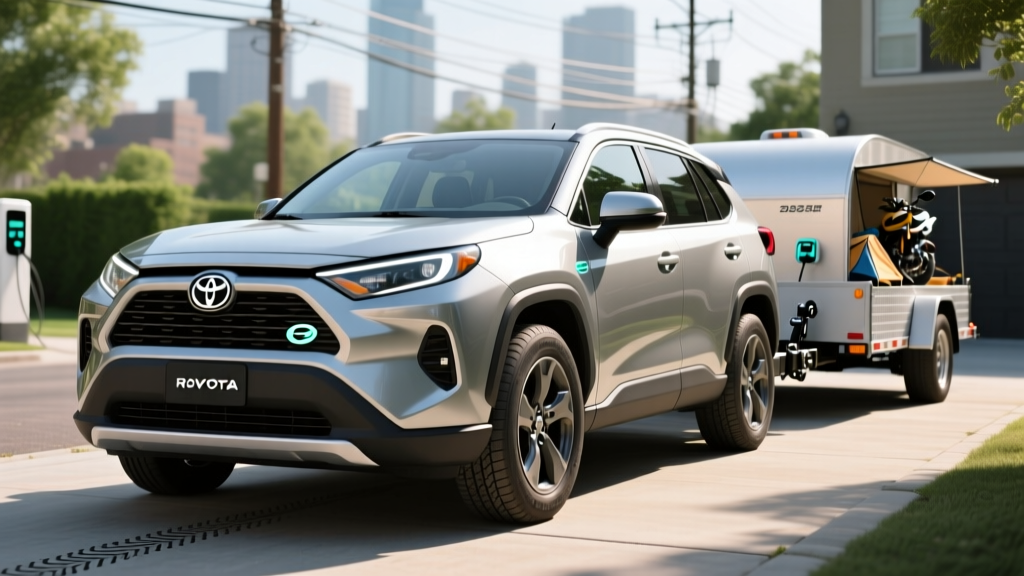
The 2025 Toyota RAV4 Hybrid carries a manufacturer-rated maximum towing capacity of 1,750 pounds across all hybrid trims when properly equipped. That figure applies whether you choose the conventional hybrid (HEV) or the plug-in hybrid RAV4 Prime. For context, 1,750 lbs covers a small utility trailer, a pair of dirt bikes on a lightweight carrier, or a compact pop-up camper — but it falls well short of the 3,500-lb rating you'd find on a V6 midsize SUV or the RAV4's non-hybrid Adventure trim (rated at 3,500 lbs in AWD form for prior model years).
If towing is a primary concern, the RAV4 Hybrid isn't the segment leader. But if you want a compact crossover that delivers outstanding fuel economy, all-weather traction via electronic AWD, and light-duty hauling capability, it occupies a very specific and practical niche. Let's break down the numbers.
2025 RAV4 Hybrid: Full Powertrain & Towing Spec Table
| Specification | RAV4 Hybrid (HEV) | RAV4 Prime (PHEV) |
|---|---|---|
| Max Towing Capacity | 1,750 lbs | 1,750 lbs |
| Powertrain | 2.5L I4 + 2 electric motors (AWD-i) | 2.5L I4 + front/rear electric motors (AWD-i) |
| Combined Horsepower | 219 hp | 302 hp |
| EPA MPG (City / Hwy / Combined) | 41 / 38 / 39 MPG | 94 MPGe combined; 38 MPG gas-only |
| Electric-Only Range (PHEV) | N/A — HEV | 42 miles (EPA) |
| Total Combined Range | ~580 miles | ~600 miles (electric + gas) |
| Battery Capacity | 1.6 kWh (NiMH, self-charging) | 18.1 kWh (lithium-ion) |
| DC Fast Charge Capable | No | No (Level 2 AC only) |
| Level 2 Charge Time (0–100%) | N/A | ~2.5 hours (6.6 kW onboard charger) |
| 0–60 mph | 7.4 seconds | 5.7 seconds |
| Starting MSRP | $33,575 (LE AWD) | $44,425 (SE) |
| Hybrid Battery Warranty | 10 years / 150,000 miles | 10 years / 150,000 miles |
Sources: fueleconomy.gov, Toyota Motor North America 2025 spec sheets.
HEV vs. PHEV: Which RAV4 Hybrid Is Which?
Conventional Hybrid (HEV) — RAV4 Hybrid
The standard RAV4 Hybrid is a self-charging hybrid. You never plug it in. A small 1.6 kWh nickel-metal-hydride battery recaptures energy from regenerative braking and the gas engine. The electric motors assist during acceleration and enable brief low-speed electric-only driving (typically under 1 mile at parking-lot speeds). It operates exactly like a conventional gas car from the driver's perspective — fill up at the pump and go.
Plug-In Hybrid (PHEV) — RAV4 Prime
The RAV4 Prime is a plug-in hybrid with a much larger 18.1 kWh lithium-ion battery. You plug it into a Level 1 (120V household outlet) or Level 2 (240V) charger to replenish the battery. A full charge gives you 42 miles of EPA-rated electric-only range — enough for most daily commutes without using a drop of gasoline. Once the battery depletes, the Prime seamlessly reverts to hybrid mode and delivers 38 MPG combined as a conventional hybrid. Total system output is a substantial 302 hp.
Key distinction: Neither the HEV nor the PHEV requires you to change how you tow. Both carry the same 1,750-lb rating. The Prime's extra horsepower (302 vs. 219) makes highway merging and grade-climbing noticeably easier when loaded, but the hitch rating itself is identical.
Fuel Economy: EPA Ratings vs. Real-World MPG
| Trim / Powertrain | City MPG | Highway MPG | Combined MPG |
|---|---|---|---|
| RAV4 Hybrid LE (AWD-i) | 41 | 38 | 39 |
| RAV4 Hybrid XLE / XLE Premium | 41 | 38 | 39 |
| RAV4 Hybrid Woodland Edition | 38 | 35 | 37 |
| RAV4 Hybrid Limited | 41 | 38 | 39 |
| RAV4 Prime (gas-only after battery depleted) | 40 | 36 | 38 |
Source: fueleconomy.gov
Real-World MPG: What Owners Actually See
Toyota's hybrid system excels in stop-and-go city driving, where regenerative braking and electric-motor assist reduce engine load. Many owners report exceeding the 41 MPG city EPA estimate by 2–4 MPG in warm-weather urban commuting. Highway driving tells a different story: at sustained 75+ mph speeds, the 2.5-liter Atkinson-cycle engine works harder and aerodynamic drag rises, often yielding 34–36 MPG on flat interstate routes.
Towing penalty: Expect a significant fuel-economy hit when towing near the 1,750-lb maximum. Real-world reports from RAV4 Hybrid owners pulling small trailers indicate combined MPG drops to the 24–28 MPG range depending on trailer weight, frontal area, and terrain. This is still competitive with or better than a gas-only compact SUV towing the same load, but the drop from 39 MPG combined is substantial.
The Woodland Edition's lower 37 MPG combined rating reflects its all-terrain tires and slightly taller ride height — a trade-off for off-road capability.
Towing in Practice: What 1,750 lbs Gets You
To put the 1,750-lb rating into real-world terms, here's what the RAV4 Hybrid can and cannot handle:
Within the 1,750-lb limit:
- Small utility trailer (4×8 ft) loaded with landscaping materials: ~800–1,200 lbs
- Lightweight pop-up camper (e.g., Aliner, SylvanSport GO): 1,100–1,600 lbs
- Two dirt bikes or a single motorcycle on a lightweight trailer: 800–1,400 lbs
- Kayak/canoe trailer with 2–3 boats: 500–900 lbs
- Small teardrop trailer (e.g., Timberleaf Pika): 1,000–1,500 lbs
Beyond the 1,750-lb limit (need a larger SUV or truck):
- Loaded enclosed cargo trailer (6×12 ft): 2,000–3,500 lbs
- Hard-sided travel trailer (even compact models): 2,500–5,000+ lbs
- Boat on a single-axle trailer (16–18 ft aluminum): 2,000–3,000 lbs
- Horse trailer (single-horse): 2,500–3,500 lbs
Hybrid Battery Warranty, Reliability & Replacement Cost
Battery Warranty Coverage
Toyota covers the hybrid battery in both the RAV4 Hybrid and RAV4 Prime for 10 years or 150,000 miles, whichever comes first. This applies to all 50 states (previously, California-emissions states received longer coverage, but Toyota extended the 10/150,000 warranty nationwide starting with the 2020 model year).
The warranty covers battery capacity loss that causes the battery to fall below a specified performance threshold, as well as defects in materials and workmanship. It also covers the hybrid control module, inverter, and related powertrain electronics.
Long-Term Reliability Track Record
Toyota's Hybrid Synergy Drive system is among the most proven electrified powertrains on the road. The Prius, which shares core hybrid architecture, has demonstrated hybrid battery lifespans routinely exceeding 200,000 miles with minimal degradation. The RAV4 Hybrid, introduced for the 2016 model year, is now entering its second decade with strong reliability data.
The RAV4 Hybrid's 1.6 kWh NiMH battery is small and conservatively managed — Toyota's battery-management system keeps the state of charge within a narrow operating window (roughly 40–80%) to minimize stress. This conservative approach is a key reason Toyota hybrid batteries rarely require replacement within the warranty period.
The RAV4 Prime's 18.1 kWh lithium-ion battery undergoes more aggressive cycling due to its 42-mile EV range, but Toyota's thermal management system and buffer strategy (the battery never charges to true 100% or discharges to true 0%) protect long-term health.
Battery Replacement Cost (Out of Warranty)
If a hybrid battery does fail outside the warranty window, replacement costs are:
- RAV4 Hybrid (HEV): $2,000–$4,000 for a new OEM battery pack, plus ~$500–$800 labor. Refurbished/remanufactured packs are available for $1,200–$2,500.
- RAV4 Prime (PHEV): $6,000–$9,000 for the larger lithium-ion pack, plus labor. This is significantly more expensive due to the larger capacity and lithium-ion chemistry.
Given the 10-year/150,000-mile warranty and Toyota's track record, most owners will never face an out-of-pocket battery replacement. It remains, however, a factor for second-hand buyers purchasing high-mileage examples outside the warranty window.
Pricing, Trims & Tax Credit Eligibility
The 2025 RAV4 Hybrid lineup spans several trims, with pricing that has climbed modestly year-over-year:
| Trim | MSRP (approx.) | Key Features |
|---|---|---|
| LE | $33,575 | AWD-i, Toyota Safety Sense 2.5+, 8" touchscreen |
| XLE | $35,075 | Blind-spot monitor, dual-zone climate, Smart Key |
| XLE Premium | $37,075 | SofTex seats, power liftgate, moonroof |
| SE | $37,575 | Sport-tuned suspension, 19" wheels |
| Woodland Edition | $37,825 | All-terrain tires, TRD-tuned suspension, roof rack |
| XSE | $38,575 | Sport styling, heated front seats |
| Limited | $40,075 | Leather, 12.3" display, premium JBL audio, heated steering wheel |
RAV4 Prime (PHEV) trims:
| Trim | MSRP (approx.) |
|---|---|
| Prime SE | $44,425 |
| Prime XSE | $48,425 |
Does the RAV4 Hybrid Qualify for a Federal Tax Credit?
Here's where the HEV vs. PHEV distinction matters enormously:
- RAV4 Hybrid (HEV): Does NOT qualify for the federal §30D Clean Vehicle Credit. Conventional hybrids are not eligible — the credit applies only to plug-in electric vehicles (BEVs and PHEVs) with sufficient battery capacity.
- RAV4 Prime (PHEV): May qualify for up to $7,500 under the §30D credit, but eligibility depends on multiple factors that change frequently under current IRS rules:
§30D Tax Credit Eligibility Checklist (RAV4 Prime)
- Battery capacity: Must be ≥7 kWh — the Prime's 18.1 kWh qualifies ✓
- MSRP cap: SUVs must be under $80,000 — the Prime qualifies ✓
- Buyer income cap: AGI must not exceed $150,000 (single) / $300,000 (joint) ✓ (buyer-dependent)
- Battery component sourcing: A percentage of battery components must be manufactured or assembled in North America — this requirement tightens annually and may disqualify the Prime depending on the current-year threshold and Toyota's supply chain. Verify at irs.gov before purchasing.
- Critical minerals: A percentage of critical minerals must be sourced from the U.S. or FTA partners — also tightening annually.
- Point-of-sale transfer: As of 2024, buyers can transfer the credit to the dealer for an immediate price reduction at purchase, rather than waiting to claim it on their tax return.
Always verify current eligibility on irs.gov and consult a tax professional. Sourcing requirements have disqualified several previously eligible PHEVs in recent years.
State incentives: Several states offer additional rebates or tax credits for PHEVs (e.g., California, Colorado, New York). These vary by jurisdiction and income level. Check your state's energy or environmental agency website for current programs.
RAV4 Hybrid vs. PHEV vs. Full EV: Which Fits You?
Choose the RAV4 Hybrid (HEV) if:
- You have no access to home or workplace charging
- You want maximum simplicity — no plugs, no charging apps, no range planning
- Your budget is under $40,000
- You drive mostly in the city where the hybrid system shines (41 MPG city)
- You want proven reliability with minimal new-technology risk
Choose the RAV4 Prime (PHEV) if:
- You can install a Level 2 charger at home (240V)
- Your daily round-trip commute is under 40 miles (you'll rarely use gas)
- You want 302 hp and 5.7-second 0–60 performance
- You may qualify for the §30D federal tax credit (check sourcing rules)
- You want EV-like daily driving with gas-engine freedom for road trips and towing
Choose a Full EV (e.g., Tesla Model Y, Hyundai Ioniq 5) if:
- You want zero tailpipe emissions and no gasoline expenses
- Your daily driving is under 250 miles and you have reliable home charging
- You want to eliminate oil changes and engine maintenance entirely
- You drive in a region with robust DC fast-charging infrastructure
- You don't need to tow more than what an EV can handle (Model Y: 3,500 lbs)
The honest truth about towing: If you regularly tow more than 1,500 lbs, none of these compact-crossover options is ideal. Consider a body-on-frame SUV or midsize truck. But if towing is occasional and light, the RAV4 Hybrid's combination of 39 MPG daily efficiency and 1,750-lb capability is a compelling compromise.
Pros & Cons at a Glance
✓ Pros
- Class-leading 39–41 MPG combined (HEV)
- Standard electronic AWD (AWD-i) on all trims
- 10-year / 150,000-mile hybrid battery warranty
- Proven Hybrid Synergy Drive reliability
- RAV4 Prime offers 302 hp and 42-mile EV range
- Strong resale value
- Comprehensive Toyota Safety Sense 2.5+ suite standard
✗ Cons
- 1,750-lb towing capacity trails gas-only competitors
- RAV4 Prime's tax credit eligibility is uncertain due to battery-sourcing rules
- No DC fast charging on the Prime (Level 2 AC only)
- Woodland Edition sacrifices 2 MPG for off-road tires
- Prime requires home charging investment to realize EV-range benefits
- Engine drone under hard acceleration (CVT characteristic)
Frequently Asked Questions
Can I increase the RAV4 Hybrid's towing capacity with an aftermarket hitch?
No. The 1,750-lb rating is set by Toyota based on the vehicle's GCWR, cooling capacity, suspension, and braking system. An aftermarket hitch rated for 3,500 lbs does not change the vehicle's rating. Exceeding 1,750 lbs risks drivetrain damage and may void your powertrain warranty.
Does towing affect the hybrid battery's lifespan?
Towing increases thermal load on the entire powertrain, including the hybrid battery. However, Toyota's battery management system actively limits charge/discharge rates under heavy load to protect the battery. Occasional light towing within the rated capacity should not meaningfully impact battery longevity. Sustained heavy towing in hot climates may accelerate degradation marginally, but remains covered under the 10-year/150,000-mile warranty.
How many MPG does the RAV4 Hybrid get while towing?
Expect 24–28 MPG combined when towing near the 1,750-lb maximum, depending on trailer aerodynamics, weight, and terrain. This represents roughly a 30–35% drop from the unloaded 39 MPG combined rating. Highway towing at sustained speeds produces the largest fuel-economy penalty.
Does the RAV4 Hybrid need to be plugged in to charge?
No. The standard RAV4 Hybrid (HEV) is a self-charging hybrid. It recharges its small battery through regenerative braking and the gasoline engine. You never plug it in. Only the RAV4 Prime (PHEV) benefits from plug-in charging to replenish its larger 18.1 kWh battery for electric-only driving.
Is the RAV4 Prime's 42-mile electric range enough for daily driving?
According to FHWA data, the average American drives approximately 37 miles per day. The Prime's 42-mile EPA electric range covers most daily commutes and errands without engaging the gas engine. In real-world conditions with moderate temperatures and suburban driving, owners commonly report 38–44 miles on a full charge. Highway-heavy or cold-weather driving may reduce this to 30–35 miles.
What's the difference between the RAV4 Hybrid AWD-i and mechanical AWD?
The RAV4 Hybrid uses Toyota's AWD-i system, which employs a dedicated rear electric motor (rather than a mechanical driveshaft from the engine) to power the rear wheels. This provides instant torque to the rear axle when slip is detected or during hard acceleration. It's effective for rain, snow, and light off-road use, but it's not a locked mechanical system designed for sustained off-road crawling or heavy-duty traction scenarios.