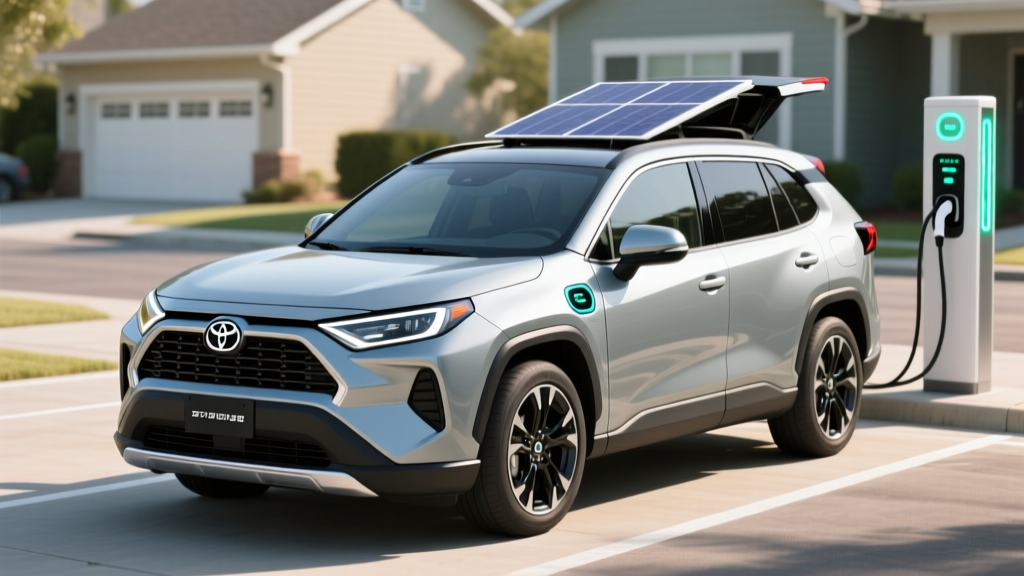
The 2025 Toyota RAV4 Hybrid SE occupies a specific niche in the compact SUV market: it's the sport-tuned variant of Toyota's best-selling hybrid, pairing the proven 2.5-liter hybrid powertrain with stiffer suspension tuning, a lower ride height, and visual upgrades that distinguish it from the LE and XLE trims. For buyers who want hybrid efficiency without committing to a plug-in lifestyle or a full battery-electric vehicle, the SE trim delivers a compelling balance of fuel economy, all-wheel-drive capability, and everyday practicality.
In this guide, we break down the 2025 RAV4 Hybrid SE's EPA fuel economy, real-world MPG expectations, powertrain specs, pricing, warranty coverage, and how it stacks up against both the RAV4 Prime (PHEV) and a fully electric alternative. Whether you're cross-shopping trims or deciding between a hybrid, plug-in hybrid, or BEV, the data below will help you make an informed choice.
HEV vs PHEV: Where the RAV4 Hybrid SE Fits
Before diving into specs, it's critical to understand the distinction between a conventional hybrid (HEV) and a plug-in hybrid (PHEV). The RAV4 Hybrid SE is a conventional hybrid (HEV) — it cannot be plugged in and has no electric-only driving range to speak of. Its small battery (approximately 1.6 kWh) is recharged entirely through regenerative braking and the gasoline engine. You simply fuel it up like any other car.
The RAV4 Prime, by contrast, is a plug-in hybrid (PHEV) with an 18.1 kWh battery, an EPA-rated 42 miles of electric-only range, and the ability to charge from a wall outlet or public charger. It's a fundamentally different ownership proposition — one we'll compare in detail below.
HEV vs PHEV at a Glance: RAV4 Lineup
| Feature | RAV4 Hybrid SE (HEV) | RAV4 Prime (PHEV) |
|---|---|---|
| Plug-in capable | No | Yes |
| Battery size | ~1.6 kWh (NiMH) | 18.1 kWh (Li-ion) |
| Electric-only range | N/A | 42 mi (EPA) |
| Combined HP | 219 hp | 302 hp |
| EPA combined MPG | 39 MPG | 38 MPG (gas) / 94 MPGe (electric) |
| Starting MSRP | ~$35,075 | ~$44,515 |
| Federal tax credit | None | Eligible (up to $7,500, subject to §30D rules) |
EPA Fuel Economy and Real-World MPG
The 2025 RAV4 Hybrid SE carries an EPA rating of 41 MPG city / 38 MPG highway / 39 MPG combined, according to fueleconomy.gov. These figures apply specifically to the SE trim with its electronic on-demand AWD system, which is standard across all RAV4 Hybrid trims.
| Cycle | EPA Rating |
|---|---|
| City | 41 MPG |
| Highway | 38 MPG |
| Combined | 39 MPG |
Real-World MPG: What Owners Actually See
Toyota's hybrid system excels in stop-and-go driving, where the electric motor handles low-speed propulsion and the engine shuts off at stops. In real-world city and suburban driving, many owners report matching or slightly exceeding the 41 MPG city EPA figure — a rarity among non-hybrid vehicles. Hybrid efficiency actually improves in traffic, the opposite of a conventional gas car.
On sustained highway trips at 70-80 mph, expect fuel economy to dip to roughly 34-36 MPG. The SE trim's sport-tuned suspension and slightly wider 235/55R19 tires (compared to the LE's 225/65R17) contribute marginally to rolling resistance, but the effect is minor. In cold weather (below 30°F), expect a 5-10% reduction in overall fuel economy as the engine runs more frequently to provide cabin heat and maintain battery temperature.
For a 14.5-gallon fuel tank, real-world range typically falls between 480 and 560 miles depending on driving mix — more than sufficient for most road trips without excessive fuel stops.
Powertrain and Performance Specs
The 2025 RAV4 Hybrid SE uses Toyota's fifth-generation hybrid system, combining a 2.5-liter Dynamic Force four-cylinder engine with front and rear electric motors for electronic on-demand AWD.
| Specification | Value |
|---|---|
| Engine | 2.5L 4-cyl Dynamic Force (176 hp, 163 lb-ft) |
| Front electric motor | 88 kW (118 hp) |
| Rear electric motor | 40 kW (54 hp) |
| Net combined system output | 219 hp |
| Transmission | eCVT (planetary gearset) |
| Drivetrain | Electronic on-demand AWD (standard) |
| 0-60 mph | ~7.4 seconds |
| Hybrid battery | ~1.6 kWh NiMH (sealed, self-charging) |
| Towing capacity | 1,750 lbs |
| Fuel tank | 14.5 gallons (87 octane regular) |
The SE trim distinguishes itself with a sport-tuned suspension (stiffer springs and dampers than the LE/XLE), a 0.6-inch lower ride height, and paddle shifters that simulate six fixed gear ratios through the eCVT. The result is noticeably tighter cornering and less body roll than the standard Hybrid trims, though the ride is firmer over rough pavement. The 219 hp output provides confident merging and passing; this is not a slow vehicle by compact SUV standards.
Pricing, Trims, and Tax Credit Eligibility
The 2025 RAV4 Hybrid SE starts at an MSRP of approximately $35,075 (including destination charge). Options are limited to packages like the Weather Package (heated steering wheel, heated front seats, rain-sensing wipers) and the Convenience Package, which can push an SE into the $37,000-$38,000 range.
Federal Tax Credit: Not Eligible
The 2025 RAV4 Hybrid SE is a conventional hybrid (HEV), not a plug-in vehicle. Under current IRS §30D Clean Vehicle Credit rules, only plug-in electric vehicles (BEVs and PHEVs with at least 7 kWh of battery capacity) qualify for the federal tax credit of up to $7,500. The RAV4 Hybrid SE does not qualify for any federal EV tax credit.
Some states and localities offer their own incentives for conventional hybrids, but these are uncommon and vary by jurisdiction. Check your state's energy office or department of environmental quality for current programs.
For buyers who want a RAV4 with federal tax credit eligibility, the RAV4 Prime PHEV is the option — though its higher MSRP (~$44,515) and limited dealer availability complicate the value equation. The §30D credit for the Prime is subject to buyer income caps ($150K single / $300K joint), MSRP caps ($80K for SUVs), and battery component/critical mineral sourcing requirements that change annually. Always verify current-year eligibility on IRS.gov before purchasing.
Battery Warranty, Reliability, and Replacement Costs
Hybrid battery longevity is consistently the top concern for first-time hybrid buyers. Toyota addresses this with one of the industry's strongest hybrid battery warranties:
Toyota Hybrid Battery Warranty Coverage
- Duration: 10 years / 150,000 miles (whichever comes first)
- Coverage: Defects and capacity loss below a defined threshold
- Transferability: Fully transferable to subsequent owners
- Hybrid system components: Also covered under 8 years / 100,000 miles (inverter, transaxle, control module)
Source: Toyota's hybrid warranty documentation. Confirm terms with your dealer at purchase.
How Long Do RAV4 Hybrid Batteries Last?
Toyota's nickel-metal hydride (NiMH) hybrid batteries have an exceptionally well-documented track record. Data from fleet operators, owner surveys, and Toyota's own service records indicate that the vast majority of RAV4 Hybrid batteries last well beyond the 10-year/150,000-mile warranty period, with many reaching 200,000+ miles without replacement. The NiMH chemistry used in the HEV is less energy-dense than lithium-ion but is extremely tolerant of the shallow charge/discharge cycles that characterize hybrid operation — the battery typically operates between 40-80% state of charge, minimizing stress.
Battery Replacement Cost
If replacement is needed outside of warranty, a new OEM RAV4 Hybrid battery from Toyota currently costs approximately $3,000-$4,000 including labor at a dealership. Third-party refurbished or reconditioned NiMH packs are available for $1,500-$2,500 installed. Given the 10-year warranty and proven longevity, most owners will never face this expense.
RAV4 Hybrid SE vs RAV4 Prime vs Full EV: Which Fits You?
The decision between a conventional hybrid, a plug-in hybrid, and a full battery-electric vehicle depends on your driving patterns, home charging access, and budget. Here's a practical decision framework:
Choose the RAV4 Hybrid SE (HEV) if:
- You have no access to home or workplace charging (apartment, street parking, no garage)
- Your budget is under $40,000 and you want the lowest upfront cost
- You drive a mix of city and highway and want consistent 36-41 MPG without behavioral changes
- You frequently take long road trips and don't want to plan around charging stops
- You want Toyota's proven hybrid reliability with minimal new-technology risk
Choose the RAV4 Prime (PHEV) if:
- You can charge at home (Level 1 or Level 2) and your daily commute is under 42 miles
- You want electric-only daily driving with gas-engine backup for road trips
- You qualify for the federal §30D tax credit (income and sourcing requirements met)
- You want the 302 hp powertrain (significantly quicker than the HEV at 5.7 seconds 0-60)
- You can find one at or near MSRP (dealer markups on the Prime remain common)
Choose a full EV (e.g., Tesla Model Y, Hyundai Ioniq 5) if:
- You have reliable home Level 2 charging and want to eliminate gas entirely
- Your daily driving is under 250 miles and you road-trip infrequently
- You want the lowest per-mile fuel cost (electricity at $0.13/kWh ≈ $4.50/gallon equivalent)
- You want minimal maintenance (no oil changes, no engine, fewer moving parts)
- You qualify for the full $7,500 federal credit and any state incentives
Ownership Costs: 5-Year Estimate
To put the RAV4 Hybrid SE's value in perspective, here's a rough 5-year / 60,000-mile ownership cost estimate compared to the gas-only RAV4 and the RAV4 Prime PHEV:
| Cost Factor | RAV4 Hybrid SE | RAV4 Gas LE (AWD) | RAV4 Prime SE |
|---|---|---|---|
| MSRP (approx.) | $35,075 | $32,675 | $44,515 |
| Federal tax credit | $0 | $0 | Up to $7,500* |
| Fuel cost (60K mi) | ~$5,230 | ~$7,200 | ~$3,100** |
| Maintenance (5 yr) | ~$2,200 | ~$2,800 | ~$2,000 |
| Insurance (5 yr est.) | ~$8,500 | ~$8,000 | ~$9,200 |
| 5-yr total (est.) | ~$51,005 | ~$50,675 | ~$51,315 |
* §30D credit eligibility varies by buyer income, battery sourcing, and MSRP caps. Verify at IRS.gov.
** Prime fuel cost assumes 70% of miles driven on electricity at $0.14/kWh and 30% on gasoline.
The Hybrid SE's fuel savings over the gas model (~$2,000 over 5 years) largely offset its higher purchase price, making the total cost of ownership very similar. The Prime's tax credit can make it cost-competitive, but only if you qualify and can purchase at or near MSRP.
Pros and Cons of the 2025 RAV4 Hybrid SE
✓ Pros
- 39 MPG combined with no plug-in required
- Standard AWD on every trim
- 10-year / 150,000-mile hybrid battery warranty
- Proven, reliable Toyota hybrid system (5th gen)
- Sport-tuned suspension adds genuine handling improvement
- Strong resale value (RAV4 Hybrid historically retains value well)
- Regular 87-octane fuel, no premium required
✗ Cons
- No federal tax credit eligibility
- Firmer ride on SE vs LE/XLE trims (trade-off for sport tuning)
- 1,750-lb towing capacity limits utility
- No DC fast charging (not applicable — HEV)
- Infotainment system is functional but not class-leading
- Rear visibility slightly compromised by roofline design
Frequently Asked Questions
How many MPG does the 2025 RAV4 Hybrid SE get?
The EPA rates the 2025 RAV4 Hybrid SE at 41 MPG city, 38 MPG highway, and 39 MPG combined. In real-world driving, city and suburban mileage often matches or slightly exceeds the EPA figure, while sustained highway driving at 75+ mph typically yields 34-36 MPG. Cold weather reduces efficiency by approximately 5-10%.
Does the RAV4 Hybrid SE need to be plugged in?
No. The RAV4 Hybrid SE is a conventional hybrid (HEV). Its small battery recharges automatically through regenerative braking and the gasoline engine. You never plug it in — you simply fill it with regular 87-octane gasoline like any other car.
How far can the RAV4 Hybrid SE drive on electric only?
Unlike the RAV4 Prime (PHEV), the RAV4 Hybrid SE has no meaningful electric-only range. The electric motor assists the gas engine and can propel the vehicle at very low speeds for brief distances (typically under 1 mile at parking-lot speeds), but it cannot sustain electric-only driving at normal speeds. If electric-only commuting is a priority, the RAV4 Prime (42 miles EPA electric range) or a full BEV is the right choice.
Is the RAV4 Hybrid reliable? What does a battery replacement cost?
Toyota's hybrid system is among the most proven in the automotive industry, with over two decades of real-world data. The RAV4 Hybrid's NiMH battery is covered by a 10-year / 150,000-mile warranty, and the majority of batteries last well beyond that period. If replacement is needed out of warranty, expect to pay approximately $3,000-$4,000 for an OEM battery at a dealership, or $1,500-$2,500 for a refurbished unit.
Does the 2025 RAV4 Hybrid SE qualify for any tax credit?
No. The RAV4 Hybrid SE is a conventional hybrid (HEV) and does not qualify for the federal §30D Clean Vehicle Credit, which is reserved for plug-in vehicles (BEVs and PHEVs). Some states may offer minor hybrid incentives, but these are uncommon and vary by jurisdiction. The RAV4 Prime (PHEV) does qualify for up to $7,500 in federal credits, subject to income limits, MSRP caps, and battery sourcing requirements.
How does the SE trim differ from the LE and XLE Hybrid?
The SE adds sport-tuned suspension, a 0.6-inch lower ride height, 19-inch alloy wheels with 235/55R19 tires, paddle shifters, a leather-trimmed steering wheel, and unique exterior styling (blacked-out accents, different grille). Mechanically, the powertrain (219 hp, AWD, 2.5L hybrid) is identical across all RAV4 Hybrid trims. The SE prioritizes handling engagement; the LE and XLE prioritize ride comfort.
What is the towing capacity of the RAV4 Hybrid SE?
The 2025 RAV4 Hybrid SE is rated to tow up to 1,750 pounds with the proper hitch equipment. This is sufficient for a small utility trailer, bike rack, or lightweight pop-up camper, but not for boats or larger trailers. If towing is a priority, consider a midsize SUV or truck — no compact hybrid SUV excels here.
Sources: fueleconomy.gov (EPA ratings), Toyota.com (manufacturer specifications), IRS.gov (§30D credit rules). All pricing and specifications reflect the 2025 model year and are subject to change. Verify current pricing and incentive eligibility with your dealer and tax professional.