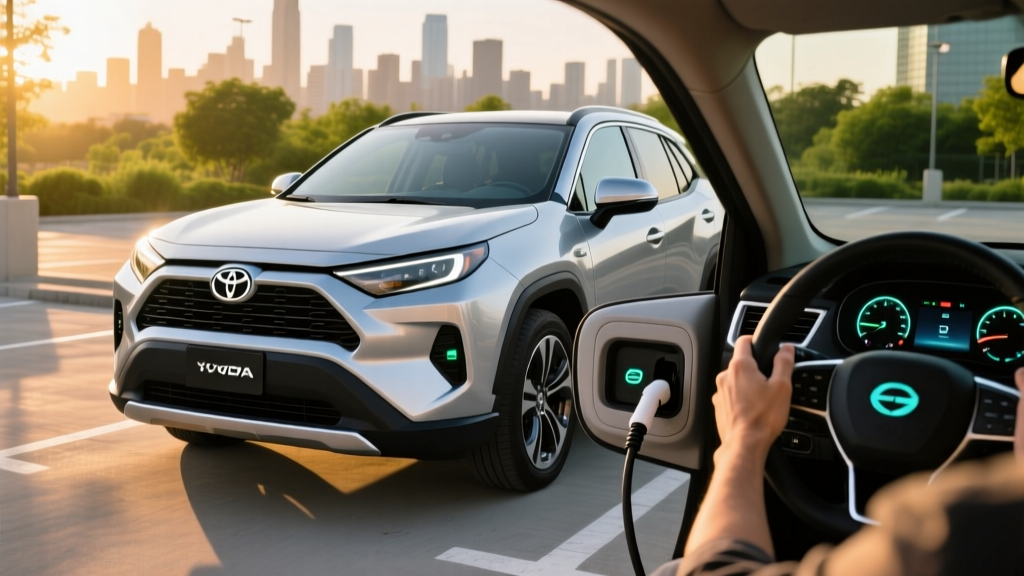
The Toyota RAV4 Hybrid has been one of the best-selling electrified vehicles in America for years, but search interest in "2025 Toyota RAV4 Hybrid problems" tells us buyers want honest answers before committing $33,000+. After analyzing owner reports, reliability data from major testing organizations, and the RAV4's powertrain evolution, here's what the evidence actually shows — and where the real concerns lie.
This guide covers both the conventional RAV4 Hybrid (HEV) and the plug-in RAV4 Prime (PHEV), because they share a platform but solve very different problems for very different buyers.
RAV4 Hybrid vs. RAV4 Prime: Understanding the Difference
Before addressing reliability, it's essential to separate these two vehicles. The conventional RAV4 Hybrid (HEV) never plugs in — it uses regenerative braking and engine-driven generation to charge a small battery. The RAV4 Prime (PHEV) has a much larger battery you charge from a wall outlet, enabling genuine electric-only driving before the hybrid system takes over.
| Attribute | RAV4 Hybrid (HEV) | RAV4 Prime (PHEV) |
|---|---|---|
| Plug-in charging required? | No — self-charging | Yes — Level 1 or Level 2 |
| Battery capacity | ~1.6 kWh (NiMH) | 18.1 kWh (Li-ion) |
| Electric-only range | N/A (EV mode ~0.5 mi at low speed) | EPA 42 miles |
| Combined horsepower | 219 hp | 302 hp |
| EPA combined MPG / MPGe | 39 MPG combined | 94 MPGe (EV) / 38 MPG (gas) |
| 0–60 mph | 7.4 seconds | 5.7 seconds |
| DC fast charging? | N/A | No — Level 2 (240V) only |
| Base MSRP (2025) | ~$33,575 | ~$44,465 |
| Federal tax credit (§30D) | Not eligible | Up to $7,500 (eligibility varies) |
How Many MPG Does the 2025 RAV4 Hybrid Actually Get?
The EPA rates the 2025 RAV4 Hybrid AWD at 41 city / 38 highway / 39 combined MPG (source: fueleconomy.gov). Front-wheel-drive variants are rated slightly higher.
| Driving Scenario | EPA Estimate | Real-World Expectation |
|---|---|---|
| City (stop-and-go) | 41 MPG | 42–45 MPG (hybrids excel here) |
| Highway (70+ mph) | 38 MPG | 33–36 MPG (aero drag, less regen benefit) |
| Combined mixed driving | 39 MPG | 37–40 MPG |
| Cold weather (below 32°F) | N/A | 32–35 MPG (engine runs more for cabin heat) |
Key insight: Unlike EVs, the RAV4 Hybrid actually exceeds its EPA city rating in real-world stop-and-go traffic. Regenerative braking recaptures energy at every stoplight, and the engine shuts off at idle. Highway driving is where it falls short of the sticker — the 2.5-liter Atkinson-cycle engine is optimized for efficiency, not sustained high-speed power.
What Are the Actual 2025 RAV4 Hybrid Problems?
Based on owner forums, NHTSA complaint databases, and reliability tracking, here are the most commonly reported issues — and which ones are genuine concerns versus overblown internet noise.
1. 12V Battery Drain (Most Common Complaint)
The RAV4 Hybrid uses a conventional 12V lead-acid battery to power electronics, computers, and the relay that connects the high-voltage traction battery. Owners have reported the 12V battery dying after the vehicle sits for 2–3 weeks. This is not unique to Toyota — many modern vehicles with always-on telematics and keyless entry systems experience parasitic drain. The fix is straightforward: a battery tender for long parking, or replacing the 12V battery on its normal 3–5 year cycle.
2. Fuel Tank Deformation (Pre-2023 Issue, Largely Resolved)
Earlier model-year RAV4 Hybrids (2019–2022) had a documented issue where the sealed fuel tank could deform due to evaporative emissions system vacuum pressure, making it difficult to fill the tank completely. Toyota issued a technical service bulletin (TSB) and redesigned the fuel tank and EVAP system. The 2025 model year benefits from this fix, and new-owner complaints about this issue are rare.
3. CVT / e-CVT Whining Noise
Some owners report a high-pitched whine from the e-CVT transaxle during acceleration. This is characteristic of Toyota's planetary-gear hybrid powertrain and is not indicative of a failure. It's more noticeable in the cabin at low speeds and tends to diminish as components break in.
4. Head Unit / Infotainment Glitches
The 2025 RAV4 Hybrid uses Toyota's newer multimedia system, which is a significant improvement over the older Entune platform. However, sporadic reports of Bluetooth dropouts and slow boot times persist. These are typically resolved with over-the-air (OTA) software updates or dealer reflashes.
5. Paint Quality on Certain Colors
Owners of Super White and Blizzard Pearl (discontinued) RAV4s have historically reported paint peeling. Toyota extended warranties on affected vehicles. The 2025 color palette uses reformulated paints, and this is not a widespread complaint on current models.
RAV4 Hybrid Battery: Lifespan, Warranty, and Replacement Cost
Hybrid Battery Warranty: Toyota covers the RAV4 Hybrid's high-voltage battery for 10 years or 150,000 miles (whichever comes first) in all 50 states, effective for 2020 and newer model years. This is among the longest hybrid battery warranties in the industry.
RAV4 Prime PHEV Battery Warranty: Same coverage — 10 years / 150,000 miles for the 18.1 kWh lithium-ion pack.
Real-world longevity data: Toyota's hybrid synergy drive system has been in production since 1997 (Prius). Independent fleet data and owner reports consistently show the NiMH battery in the RAV4 Hybrid lasting 150,000–200,000+ miles before significant capacity loss. The battery doesn't "die" suddenly — it gradually loses capacity, reducing electric-assist contribution and slightly lowering MPG over time.
Replacement cost if out of warranty: A new OEM hybrid battery pack for the RAV4 Hybrid runs approximately $3,000–$4,500 installed at a dealership. Third-party refurbished packs are available for $1,500–$2,500. For the RAV4 Prime's larger lithium-ion pack, expect $6,000–$9,000 for OEM replacement — a meaningful consideration for high-mileage buyers.
Why hybrid batteries outlast EV batteries (in calendar years): The RAV4 Hybrid's 1.6 kWh pack is tiny and is never deeply discharged. Toyota's battery management system keeps the state of charge between roughly 40% and 80%, which is the optimal longevity window for any lithium or NiMH chemistry. Shallow cycling plus active thermal management means far fewer full charge cycles than a full EV battery experiences.
RAV4 Prime (PHEV): Electric Range, Charging, and Tax Credit Reality
If you're considering the RAV4 Prime specifically, here are the numbers that matter:
| Specification | 2025 RAV4 Prime |
|---|---|
| Electric-only range (EPA) | 42 miles |
| Total combined range (EV + gas) | ~440 miles |
| Battery capacity | 18.1 kWh (lithium-ion) |
| Level 1 charging (120V / 12A) | ~12 hours (0–100%) |
| Level 2 charging (240V / 32A) | ~2.5 hours (0–100%) |
| DC fast charging | Not supported |
| Combined system horsepower | 302 hp |
| EPA MPGe (electric mode) | 94 MPGe |
| EPA MPG (gas hybrid mode) | 38 combined |
The charging limitation that matters: The RAV4 Prime does not support DC fast charging. This is a deliberate engineering choice — the 18.1 kWh pack is small enough that Level 2 charging at ~6.6 kW fully replenishes it in about 2.5 hours, which Toyota determined was sufficient for overnight and workplace charging. If you need rapid public charging, you're looking at a full BEV, not a PHEV.
Does the RAV4 Prime Qualify for the Federal Tax Credit?
Under current IRS §30D rules, the RAV4 Prime may qualify for up to $7,500 in federal tax credits — but eligibility depends on multiple factors that change frequently:
- MSRP cap: SUVs must be under $80,000 MSRP — the RAV4 Prime qualifies.
- Buyer income cap: Modified AGI must not exceed $150,000 (single) / $300,000 (joint).
- Battery sourcing requirements: Critical minerals and battery component rules phase in progressively. Toyota's supply chain for the RAV4 Prime has been adjusted, but the exact credit amount ($3,750 or $7,500) depends on current-year sourcing compliance.
- Point-of-sale transfer: As of 2024+, eligible buyers can transfer the credit to the dealer for an immediate price reduction rather than waiting for tax filing.
Critical caveat: The conventional RAV4 Hybrid (HEV) does not qualify for any federal EV tax credit. It is not a plug-in vehicle. Some states offer their own hybrid incentives — check your state's energy office or DMV for current programs.
Hybrid vs. PHEV vs. Full EV: Which RAV4 Fits Your Life?
Choose the RAV4 Hybrid (HEV) if:
- You don't have access to home or workplace charging (apartment, street parking)
- You want maximum MPG with zero behavior change — just fill up with gas
- Your budget is $33,000–$40,000
- You drive 12,000–15,000 miles/year in mixed city/highway conditions
- You plan to keep the vehicle 10+ years (proven long-term reliability)
Choose the RAV4 Prime (PHEV) if:
- You can install a Level 2 charger at home (240V outlet or hardwired station)
- Your daily commute is under 40 miles round-trip (you'll rarely use gas)
- You want 302 hp and 5.7-second 0–60 performance
- You qualify for the federal tax credit (effectively lowering the price premium)
- You take road trips and don't want to plan around charging stations
Choose a full EV (like the Toyota bZ4X or Tesla Model Y) if:
- You want zero tailpipe emissions and the lowest per-mile "fuel" cost
- You have reliable home charging and your trips are mostly under 250 miles
- You want the lowest maintenance costs (no engine oil, filters, spark plugs, or exhaust)
- You're comfortable with EV charging logistics on longer road trips
Is the 2025 RAV4 Hybrid Reliable? The Data Says Yes.
Toyota's hybrid powertrain is one of the most thoroughly proven electrified systems on the road. The RAV4 Hybrid earns strong reliability marks from both IIHS safety testing and long-term owner surveys. The 2.5-liter Dynamic Force engine (A25A-FXS) is naturally aspirated and runs an Atkinson cycle, which reduces thermal stress and extends engine life.
The e-CVT is not a traditional belt-and-pulley CVT — it's a planetary gearset with no clutches, bands, or belts to wear out. This is one reason Toyota hybrids have such low powertrain failure rates compared to conventional automatics and turbocharged engines.
What reliability does NOT mean: No vehicle is problem-free. The 12V battery drain issue, occasional infotainment bugs, and normal wear items (brake actuators, water pumps) will occur. But the high-voltage hybrid system — the component buyers worry about most — is statistically one of the most reliable parts of the vehicle.
Pricing Breakdown and Total Cost of Ownership
| Trim | 2025 MSRP (approx.) | After Potential Credits |
|---|---|---|
| RAV4 Hybrid LE AWD | $33,575 | $33,575 (no federal credit) |
| RAV4 Hybrid XLE AWD | $35,075 | $35,075 |
| RAV4 Hybrid Woodland Edition | $37,425 | $37,425 |
| RAV4 Hybrid Limited AWD | $40,075 | $40,075 |
| RAV4 Prime SE | $44,465 | ~$36,965 (with $7,500 credit) |
| RAV4 Prime XSE | $48,350 | ~$40,850 (with $7,500 credit) |
5-year fuel cost comparison (15,000 miles/year, $3.50/gal gas, $0.14/kWh electricity):
- RAV4 Hybrid: ~$6,730 in gasoline over 5 years
- RAV4 Prime (80% electric commuting): ~$2,800 in electricity + ~$1,200 in gas = ~$4,000
- Comparable gas-only RAV4 (28 MPG combined): ~$9,375 in gasoline
The RAV4 Hybrid saves approximately $2,600 in fuel over five years versus the gas-only model. The RAV4 Prime, charged regularly, saves closer to $5,300 — and that's before factoring in the federal tax credit.
Frequently Asked Questions
Are there any major 2025 Toyota RAV4 Hybrid problems I should worry about?
No widespread mechanical failures have been documented for the 2025 model year. The most common complaints — 12V battery drain, minor infotainment glitches, and e-CVT noise — are minor and do not affect drivability or safety. The earlier fuel tank deformation issue (2019–2022) has been resolved in current production.
How long will the RAV4 Hybrid battery last before needing replacement?
Toyota's hybrid batteries routinely last 150,000–200,000+ miles based on long-term fleet and owner data. The battery is covered for 10 years / 150,000 miles under warranty. Many first-generation Prius batteries lasted 200,000+ miles with the same shallow-cycling battery management approach.
Does the RAV4 Hybrid need to be plugged in?
No. The conventional RAV4 Hybrid (HEV) charges its battery entirely through regenerative braking and the gasoline engine. You never plug it in. Only the RAV4 Prime (PHEV) requires plug-in charging to use its electric-only range.
Is the RAV4 Prime worth the $11,000 premium over the regular Hybrid?
If you can charge at home and your daily driving is under 42 miles, the RAV4 Prime effectively becomes an EV for your commute with a gas backup for road trips. After the $7,500 federal credit (if eligible), the effective premium drops to ~$3,500, which you'll recover in fuel savings within 2–3 years. If you can't charge at home, stick with the regular Hybrid.
What's the real-world highway MPG for the RAV4 Hybrid?
Expect 33–36 MPG on the highway at 70–75 mph, below the EPA's 38 MPG highway rating. Hybrids lose their efficiency advantage at sustained high speeds because regenerative braking opportunities are minimal and aerodynamic drag dominates. In city driving, you'll often beat the EPA's 41 MPG city estimate.
Can the RAV4 Hybrid tow, and does towing destroy MPG?
The RAV4 Hybrid is rated to tow up to 1,750 pounds (light duty — small trailers, bike racks). Towing will reduce MPG significantly, likely into the mid-20s, as the engine runs continuously under load. The RAV4 Prime has the same tow rating. If you need serious towing capacity (3,500+ lbs), neither hybrid variant is the right tool.
How does the RAV4 Hybrid compare to the Honda CR-V Hybrid in reliability?
Both are strong, but Toyota's longer track record with hybrid systems (dating to 1997) gives the RAV4 a data advantage. The CR-V Hybrid's two-motor system is also well-regarded, but Toyota's e-CVT planetary gearset has fewer wear components. Both carry 10-year hybrid battery warranties.