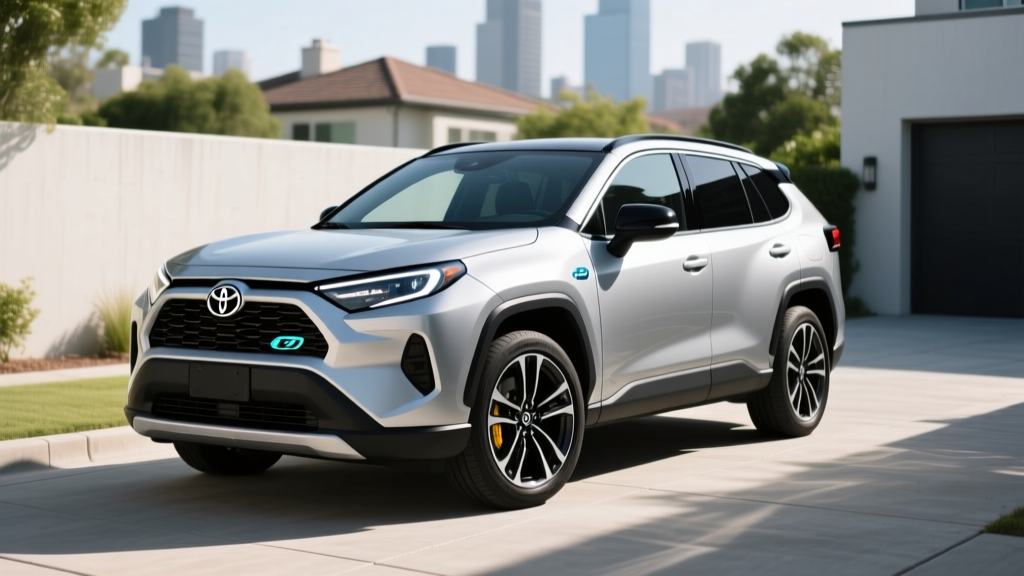
If you've been searching for the 2025 Toyota RAV4 Hybrid all-wheel drive, you're not alone. The RAV4 Hybrid remains one of the best-selling electrified vehicles in the United States — not because it's flashy, but because it delivers genuinely low fuel consumption, standard electronic AWD across every trim, and the kind of long-term reliability Toyota has built its reputation on. No plug required, no range anxiety, and a starting price well below most electric SUVs.
This guide covers every critical number — EPA MPG, real-world fuel economy, powertrain output, battery warranty, pricing by trim, and how the conventional hybrid stacks up against the plug-in RAV4 Prime and full battery-electric competitors. Whether you're cross-shopping or ready to buy, here's what the data actually shows.
2025 RAV4 Hybrid AWD Powertrain and Performance
The 2025 RAV4 Hybrid pairs a 2.5-liter four-cylinder Atkinson-cycle gasoline engine with three electric motor-generators — one integrated into the transaxle driving the front wheels, and a dedicated rear-axle motor providing electronic all-wheel drive (eAWD). There is no mechanical driveshaft connecting the front and rear axles; instead, the rear motor engages automatically under acceleration, on low-traction surfaces, and during cornering to distribute torque.
| Specification | Value |
|---|---|
| Engine | 2.5L inline-4 Atkinson cycle |
| Net Combined Horsepower | 219 hp |
| Front Motor | Permanent-magnet synchronous (integrated in eCVT) |
| Rear Motor (eAWD) | 40 kW / 54 hp independent |
| Transmission | Electronically controlled CVT (eCVT) |
| Drivetrain | Electronic on-demand AWD (standard all trims) |
| 0–60 mph | ~7.4 seconds |
| Towing Capacity | 1,750 lbs |
The 219-hp combined output puts the RAV4 Hybrid ahead of most compact hybrid SUV competitors. The eCVT doesn't behave like a traditional belt-driven CVT — Toyota's planetary gearset design manages the split between engine and electric power smoothly, and the result is linear acceleration without the rubber-band effect that older CVTs produced. The 0–60 time of roughly 7.4 seconds is perfectly adequate for highway merging and passing, though it won't win stoplight sprints.
Fuel Economy: EPA Ratings vs. Real-World MPG
Fuel economy is the headline reason buyers choose the RAV4 Hybrid over the gas-only RAV4, and the numbers deliver.
| Trim Group | City MPG | Highway MPG | Combined MPG |
|---|---|---|---|
| LE / XLE / XLE Premium / Woodland Edition | 41 | 38 | 39 |
| SE / XSE (sport-tuned suspension, larger wheels) | 41 | 38 | 39 |
| Limited (19-inch wheels) | 41 | 38 | 39 |
Source: fueleconomy.gov — EPA estimates. Your mileage will vary.
Compared to the gas-only 2025 RAV4 AWD (rated at 27 city / 34 highway / 30 combined), the hybrid delivers a 30% improvement in combined fuel economy. Over 15,000 miles per year at $3.40/gallon, that translates to roughly $460 in annual fuel savings — and the hybrid's price premium over the gas model has shrunk to nearly nothing on comparable trims.
HEV vs. PHEV: RAV4 Hybrid vs. RAV4 Prime
Toyota offers two electrified RAV4 variants, and confusing them is easy if you're new to the lineup. Here's the critical distinction:
- RAV4 Hybrid (HEV — conventional hybrid): You never plug it in. A small nickel-metal hydride (NiMH) traction battery stores energy captured from regenerative braking and the gasoline engine. The electric motor assists the engine and drives the car at very low speeds, but the engine is always the primary power source. No electric-only range to speak of beyond parking-lot maneuvers.
- RAV4 Prime (PHEV — plug-in hybrid): You plug it in to charge a much larger 18.1 kWh lithium-ion battery. It can drive up to 42 miles on electricity alone before the gasoline engine starts. After the battery depletes, it operates as a conventional hybrid. Total range exceeds 600 miles.
| Attribute | RAV4 Hybrid (HEV) | RAV4 Prime (PHEV) |
|---|---|---|
| Plug-in Required? | No | Yes (Level 1 or Level 2) |
| Traction Battery | ~1.6 kWh NiMH | 18.1 kWh Lithium-ion |
| Electric-Only Range | ~1 mile (low speed) | 42 miles (EPA) |
| Combined Horsepower | 219 hp | 302 hp |
| Combined MPG (after EV range) | 39 MPG | 38 MPG (hybrid mode) / 94 MPGe (EV+gas) |
| Total Range | ~580 miles | ~600+ miles |
| DC Fast Charging | N/A | No (Level 2 AC only) |
| Level 2 Charge Time | N/A | ~2.5 hours (240V, 32A) |
| 0–60 mph | ~7.4 sec | ~5.7 sec |
| Starting MSRP (AWD) | $33,575 | $44,905 |
| Federal Tax Credit (§30D) | Not eligible | Up to $7,500 (eligibility varies) |
The RAV4 Prime is the clear winner if you have home charging access and a commute under 42 miles — you'd burn almost no gasoline on most days. But the $11,330 price gap is substantial, and the Prime's availability has been constrained by battery supply. The conventional RAV4 Hybrid asks nothing of your electrical setup and still delivers exceptional efficiency.
2025 RAV4 Hybrid Pricing by Trim
Toyota has simplified the RAV4 Hybrid lineup for 2025. All-wheel drive is standard on every trim — there is no FWD-only hybrid variant. Here's where pricing stands:
| Trim | Starting MSRP | Key Features |
|---|---|---|
| LE | $33,575 | Toyota Safety Sense 2.5+, 8" touchscreen, wireless CarPlay/Android Auto |
| XLE | $35,060 | Blind-spot monitor, dual-zone climate, Smart Key, alloy wheels |
| XLE Premium | $37,335 | SofTex seats, power liftgate, moonroof |
| SE | $37,085 | Sport-tuned suspension, 19" black alloy wheels, paddle shifters |
| XSE | $38,575 | Bi-LED headlights, SofTex, sport appearance |
| Woodland Edition | $37,460 | TRD-tuned suspension, all-terrain tires, roof rack, rugged styling |
| Limited | $41,085 | 12.3" touchscreen, JBL audio, panoramic roof, heated/ventilated front seats |
Source: Toyota.com — MSRP excludes dealer fees and options.
Does the RAV4 Hybrid Qualify for a Federal Tax Credit?
No. The conventional RAV4 Hybrid (HEV) does not qualify for the federal §30D Clean Vehicle Credit. That credit applies only to plug-in electric vehicles — battery-electric vehicles (BEVs) and plug-in hybrids (PHEVs) like the RAV4 Prime. The HEV's traction battery is far too small and is not externally chargeable, which disqualifies it under IRS rules.
Some states offer separate incentives for conventional hybrids, but these are increasingly rare as policy focuses on plug-in vehicles. Check your state's energy office or the AFDC state incentive database for local programs.
Battery Longevity, Warranty, and Replacement Cost
The RAV4 Hybrid uses a nickel-metal hydride (NiMH) traction battery — a chemistry Toyota has refined over 25+ years since the original Prius. NiMH is less energy-dense than lithium-ion but is extremely durable and tolerant of the shallow charge-discharge cycles that hybrids use. The battery never fully charges or fully depletes; the hybrid system keeps it in a narrow state-of-charge window (roughly 40–80%) to maximize lifespan.
What does real-world degradation look like? Toyota hybrid battery failures before 150,000 miles are statistically uncommon. Independent fleet data and owner surveys show most Toyota NiMH hybrid batteries retain sufficient capacity to function normally well past 200,000 miles. When capacity does decline, the symptom is slightly reduced electric-motor assist and marginally lower MPG — not a sudden failure.
Replacement cost if out of warranty: A new OEM replacement hybrid battery for the RAV4 Hybrid runs approximately $3,000–$4,000 including installation at a Toyota dealer. Refurbished or reconditioned batteries from third-party suppliers can reduce this to $1,500–$2,500. Individual battery modules can sometimes be replaced for even less if only a few cells have degraded. Compare this to the $10,000–$20,000+ cost of a full EV battery pack replacement, and the hybrid's long-term risk profile looks quite favorable.
Who Should Buy the RAV4 Hybrid AWD — and Who Shouldn't
✓ Choose the RAV4 Hybrid If
- You want dramatically better fuel economy without changing any habits — no plugging in, no route planning
- You live in an area with limited or unreliable public charging infrastructure
- Your budget is $33,000–$42,000 and you need a practical compact SUV with AWD
- You plan to keep the vehicle 8–10+ years and want proven long-term reliability
- You tow occasionally (1,750 lbs) or drive on unpaved roads
- You want the lowest total cost of ownership in the compact SUV segment
✗ Look Elsewhere If
- You want to drive on electricity alone for your commute — consider the RAV4 Prime (PHEV) or a full BEV
- You have reliable home charging and want to minimize gasoline use entirely
- You need more than 1,750 lbs of towing capacity
- You want a third row — the RAV4 is strictly a five-passenger SUV
- Performance driving is a priority — the 219-hp hybrid is efficient, not thrilling
RAV4 Hybrid vs. Full EV vs. Gas — Decision Framework
The RAV4 Hybrid occupies a specific niche in the electrification spectrum, and it's the right choice for a particular buyer profile:
- Gas-only RAV4 AWD (30 MPG combined, ~$31,500): Makes sense only if your budget is extremely tight and you drive very few miles annually. The hybrid's fuel savings pay back the small price premium in roughly 2–3 years for most drivers.
- RAV4 Hybrid AWD (39 MPG combined, ~$33,575): The optimal choice for buyers who want maximum efficiency with zero lifestyle changes. No charging infrastructure needed, no range planning, and Toyota's strongest reliability track record.
- RAV4 Prime PHEV AWD (42 mi EV + 38 MPG hybrid, ~$44,905): Best for home-chargers with sub-40-mile commutes who still want road-trip flexibility. The $7,500 federal tax credit (if eligible) narrows the price gap significantly, and the 302-hp powertrain is genuinely quick.
- Full BEV (e.g., Tesla Model Y, Hyundai Ioniq 5): Best for buyers with reliable home charging, mostly urban/suburban driving, and a desire to eliminate gasoline entirely. Higher upfront cost, lower running costs, and zero tailpipe emissions — but requires charging infrastructure commitment.
Frequently Asked Questions
How many MPG does the 2025 RAV4 Hybrid AWD actually get?
The EPA rates it at 41 city / 38 highway / 39 combined MPG across most trims. In real-world driving, owners consistently report 37–42 MPG depending on conditions. City and suburban driving with frequent stops yields the best numbers (the electric motor handles low-speed work). Sustained highway driving at high speeds and cold-weather operation reduce MPG to the low-to-mid 30s.
Does the RAV4 Hybrid need to be plugged in?
No. The RAV4 Hybrid is a conventional (self-charging) hybrid. Its small traction battery is charged exclusively through regenerative braking and the gasoline engine. You simply fill it with gas and drive — exactly like a conventional car. If you want a RAV4 that plugs in, you're looking for the RAV4 Prime (PHEV).
Is the RAV4 Hybrid reliable, and how long will the battery last?
Toyota's hybrid system has one of the strongest reliability records in the automotive industry, refined since the 1997 Prius. The hybrid battery is warranted for 10 years/150,000 miles, and real-world data shows most units function well beyond that mileage. Replacement cost, should it be needed out of warranty, is approximately $3,000–$4,000 — far less than an EV battery replacement.
Does the 2025 RAV4 Hybrid qualify for any tax credit?
The conventional RAV4 Hybrid (HEV) does not qualify for the federal §30D Clean Vehicle Credit, which is limited to plug-in vehicles. However, the RAV4 Prime (PHEV) may qualify for up to $7,500, subject to buyer income caps, MSRP limits, and battery-sourcing requirements under current IRS rules. Always verify eligibility with a tax professional before purchasing.
How does the RAV4 Hybrid AWD system work in snow and ice?
The electronic AWD system engages the rear motor automatically when front-wheel slip is detected, providing torque to the rear axle within milliseconds. It's not a heavy-duty off-road system, but it performs well in snow, rain, and light off-pavement conditions. The Woodland Edition adds all-terrain tires and a TRD-tuned suspension for more aggressive use. For severe winter conditions, dedicated winter tires on any trim will make a larger difference than the AWD system alone.
What's the difference in cargo space between the Hybrid and the gas RAV4?
Essentially none. The RAV4 Hybrid's battery is packaged under the rear seats, so cargo volume matches the gas model: 37.6 cubic feet behind the second row and 69.8 cubic feet with the rear seats folded. The RAV4 Prime (PHEV), with its larger battery, loses a small amount of cargo space — about 1.2 cubic feet.