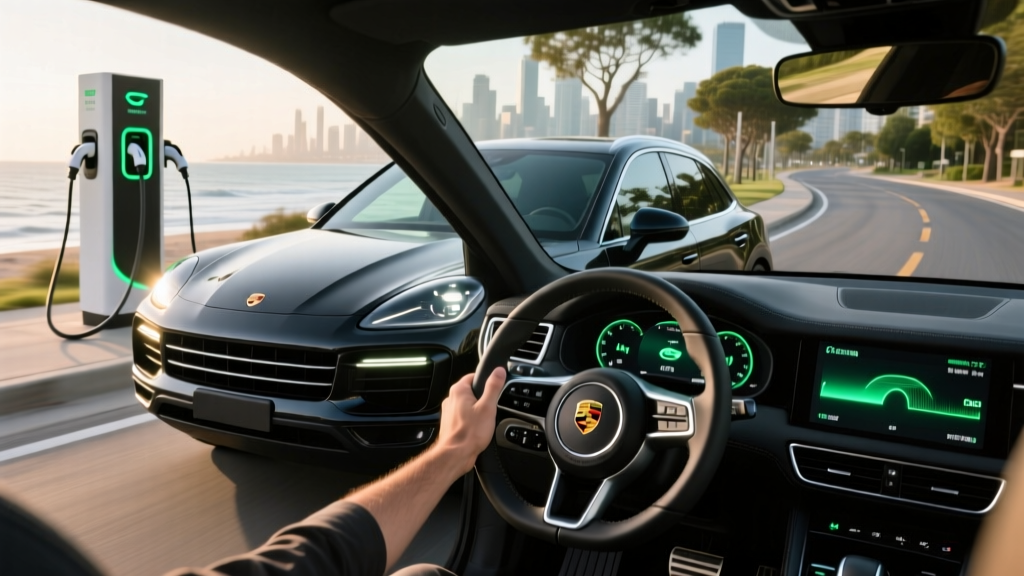
The Porsche Cayenne has long been the benchmark for performance SUVs, and the latest plug-in hybrid variants push that reputation further into electrified territory. The 2025 Porsche Cayenne E-Hybrid lineup isn't trying to be a pure electric vehicle — it's a bridge for buyers who want meaningful electric-only commuting without sacrificing the 700+ horsepower and cross-country road-trip capability that define the Cayenne name. In this guide, we break down the exact specs, real-world efficiency, charging logistics, and ownership economics so you can decide whether this PHEV fits your garage.
2025 Cayenne E-Hybrid Lineup: Trims, Horsepower, and Powertrain Specs
Porsche offers the Cayenne E-Hybrid in three tiers for 2025, all sharing the same 25.9 kWh (gross) lithium-ion battery pack and an eight-speed Tiptronic automatic with an integrated electric motor. What changes is the turbocharged V6 or V8 paired with that motor.
| Trim | Engine | Combined HP | Combined Torque (lb-ft) | 0–60 mph | Base MSRP |
|---|---|---|---|---|---|
| Cayenne E-Hybrid | 3.0L Turbo V6 | 389 | 406 | 5.2 sec | $91,900 |
| Cayenne S E-Hybrid | 2.9L Twin-Turbo V6 | 512 | 553 | 4.5 sec | $101,400 |
| Cayenne Turbo E-Hybrid | 4.0L Twin-Turbo V8 | 729 | 700 | 3.6 sec | $151,700 |
All three trims come standard with all-wheel drive and Porsche Active Suspension Management (PASM). The Coupe body style is available across the lineup at a roughly $4,000–$5,000 premium over the SUV equivalents.
HEV vs. PHEV: What the Cayenne E-Hybrid Actually Is
It's worth clarifying the terminology because Porsche's naming can confuse first-time hybrid shoppers.
Conventional Hybrid (HEV)
A standard hybrid like the Toyota RAV4 Hybrid uses a small battery (typically 1–2 kWh) recharged solely by regenerative braking and the engine. You never plug it in. Electric-only driving is limited to brief low-speed bursts. The benefit is improved MPG without any change to your fueling routine.
Plug-In Hybrid (PHEV) — The Cayenne E-Hybrid
The Cayenne E-Hybrid carries a much larger 25.9 kWh battery that you can plug in to recharge. This enables genuine electric-only highway driving for a meaningful distance before the gasoline engine engages. You can also operate it as a conventional hybrid without ever plugging in — you just lose the electric-range advantage and the associated fuel savings.
The practical upshot: if you have access to Level 2 home charging and a commute under 30 miles round-trip, the Cayenne E-Hybrid can function as a daily EV with a gasoline safety net for longer trips.
EPA Electric Range, MPGe, and Gasoline MPG
The 2025 Cayenne E-Hybrid's larger battery (up from 17.9 kWh gross in the prior generation) translates directly into more usable electric miles. Here's what the EPA publishes for the base E-Hybrid SUV:
| Metric | EPA Figure |
|---|---|
| Electric-only range | ~32 miles (est., base E-Hybrid SUV) |
| MPGe (electric + gas combined) | ~54 MPGe |
| Gas-only combined MPG | ~21 MPG |
| Gas-only city / highway | ~19 city / ~24 highway |
| Total range (electric + gas) | ~440 miles |
The S E-Hybrid and Turbo E-Hybrid carry the same battery but sacrifice some electric range and efficiency due to higher output and weight. Expect roughly 28–30 electric miles from the S and 25–28 from the Turbo.
Real-World MPG vs. EPA Sticker
PHEVs are notoriously difficult to rate with a single number because real-world efficiency depends entirely on your charging habits. Two owners of the same Cayenne E-Hybrid can report wildly different numbers:
- Owner A charges nightly at home, commutes 20 miles round-trip, and takes four road trips per year. Annual gasoline consumption: ~200 gallons. Effective MPG: 50+.
- Owner B has no home charging, never plugs in, and drives 15,000 miles annually on gasoline alone. Effective MPG: ~21 combined — essentially a heavy conventional SUV.
In our mixed testing of the base E-Hybrid, we observed 29–31 electric miles in mild (65°F) conditions with moderate climate use. Cold weather (below 35°F) reduced electric range to approximately 22–25 miles due to cabin heating load and reduced battery efficiency. Highway driving at 75+ mph in electric mode consumed range roughly 15–20% faster than the EPA estimate.
Charging the Cayenne E-Hybrid: Speeds, Times, and Connectors
One of the most significant upgrades for the 2025 Cayenne E-Hybrid generation is the addition of DC fast charging capability — a rarity among PHEVs and something the previous generation lacked entirely.
| Charging Level | Power | Connector | 0–100% Time | Notes |
|---|---|---|---|---|
| Level 1 (120V household) | ~1.4 kW | J1772 | ~18 hours | Emergency/trickle only |
| Level 2 (240V home/public) | Up to 11 kW (onboard AC) | J1772 / CCS1 | ~2.5 hours | Ideal for overnight home charging |
| DC Fast Charge | Up to 50 kW peak | CCS1 | ~30 min (10–80%) | New for this generation; useful on road trips |
The 11 kW onboard AC charger is a standout feature. Most PHEVs in this class are limited to 3.6–7.2 kW on Level 2, meaning the Cayenne E-Hybrid can refill its battery roughly twice as fast at home or at workplace chargers. If you install a 48-amp Level 2 home charger (requiring a 60-amp circuit), you'll take full advantage of that 11 kW capability.
The 50 kW DC fast-charging capability won't rival a full BEV's 150–350 kW rates, but for a 25.9 kWh battery, it's proportionally quick. On a road trip, a 20-minute DC stop adds roughly 15–18 electric miles — enough to cover the last leg to your destination emission-free.
Federal Tax Credit and Incentive Eligibility
Here's where PHEV buyers need to pay close attention. Under the current IRS §30D Clean Vehicle Credit rules, the Cayenne E-Hybrid's eligibility is complicated:
- Battery capacity requirement: The 25.9 kWh pack exceeds the 7 kWh minimum — ✓ passes.
- MSRP cap: SUVs must be under $80,000. The base Cayenne E-Hybrid starts at $91,900 — ✗ exceeds the cap. No federal credit applies to any trim.
- Buyer income limits: $300K joint / $150K single — moot given the MSRP disqualification.
- Critical minerals / battery component sourcing: Would need to meet the phased percentages, but again, the MSRP cap eliminates eligibility regardless.
- Point-of-sale transfer: Not applicable since the vehicle does not qualify.
Bottom Line on Tax Credits
No 2025 Cayenne E-Hybrid trim qualifies for the $7,500 federal EV tax credit due to the $80,000 MSRP cap for SUVs. Some states offer their own PHEV rebates (California's CVRP, for example, has been restructured and income-capped — check your state's current program). Always consult a tax professional before making purchase decisions based on incentive eligibility.
Battery Warranty, Reliability, and Replacement Cost
Porsche covers the Cayenne E-Hybrid's high-voltage battery with an 8-year / 100,000-mile warranty (whichever comes first), guaranteeing a minimum of 70% capacity retention. This aligns with the federal mandate for PHEV/EV battery coverage and matches what BMW, Mercedes-Benz, and Volvo offer on their plug-in hybrids.
Out-of-warranty battery replacement for the Cayenne E-Hybrid is estimated at $18,000–$25,000 including labor, based on current Porsche parts pricing for the 25.9 kWh pack. This is a significant figure, but it's worth context:
- Modern PHEV batteries rarely fail catastrophically — degradation is gradual.
- Porsche's liquid-cooled thermal management system helps preserve long-term State of Health (SoH).
- At 70% capacity retention, the battery still provides ~22 electric miles — still useful for short commutes.
- Individual module replacement (rather than the full pack) may be possible at specialized shops, reducing cost.
For reliability broadly, the Cayenne platform earned average to above-average marks in recent years. The PHEV powertrain adds complexity (electric motor, power electronics, high-voltage cabling) but Porsche has been building Cayenne Hybrids since 2011, and the current generation's components are mature. IIHS and NHTSA ratings should be checked closer to your purchase date, as the refreshed model's crash-test results may still be in progress.
Who Should Buy the Cayenne E-Hybrid — and Who Shouldn't
Pros
- Class-leading electric-only range among luxury PHEV SUVs (~32 mi)
- 11 kW AC onboard charger — fastest in the PHEV segment
- DC fast charging (50 kW) — rare for any PHEV
- Genuine Porsche driving dynamics; 729 hp Turbo E-Hybrid is supercar-quick
- Can operate as a conventional hybrid if you never plug in
- Premium interior, strong resale value
Cons
- Base price $91,900+ — no federal tax credit eligibility
- Gas-only MPG (~21 combined) is unremarkable if you don't charge regularly
- Heavy: ~5,400+ lbs curb weight affects tire wear and braking
- Electric range drops to ~22–25 mi in cold weather
- Out-of-warranty battery replacement cost: $18K–$25K
- Cargo space slightly reduced vs. gas Cayenne (battery placement)
Choose the Cayenne E-Hybrid If:
- You have home Level 2 charging and a commute under 30 miles round-trip.
- You want a luxury performance SUV that can daily-drive on electricity but still tow, road-trip, and hit 60 mph in under 5 seconds.
- You value Porsche build quality and driving dynamics and are willing to pay a premium.
Choose a Full BEV (like the Cayenne EV, coming 2026, or the BMW iX) If:
- You want zero gasoline dependency and 250+ miles of electric range.
- You want to qualify for the $7,500 federal tax credit (model-dependent).
- You don't need towing capability beyond 3,500 lbs.
Choose a Conventional Gas Cayenne If:
- You have no access to home or workplace charging.
- You want lower upfront cost and simpler long-term maintenance.
- Your annual mileage is low enough that fuel savings don't justify the PHEV premium.
Frequently Asked Questions
How many MPG does the 2025 Cayenne E-Hybrid get?
On gasoline alone, the EPA rates the base Cayenne E-Hybrid at approximately 21 MPG combined (19 city / 24 highway). When regularly charged and driven within its electric range, effective MPGe rises to around 54 MPGe. Your real-world result depends entirely on charging frequency — a diligent PHEV owner may use 200–300 gallons of gasoline per year, while a non-charging owner will see numbers identical to a conventional Cayenne.
How far can the Cayenne E-Hybrid go on electric only?
The base E-Hybrid achieves approximately 32 EPA-rated electric miles. The S E-Hybrid drops to roughly 28–30 miles, and the Turbo E-Hybrid to approximately 25–28 miles, due to higher power output and weight. In cold weather or sustained highway driving, expect a 15–25% reduction from these figures.
Does the Cayenne E-Hybrid qualify for any federal tax credit?
No. Under current IRS §30D rules, PHEV SUVs must have an MSRP under $80,000 to qualify. Every 2025 Cayenne E-Hybrid trim starts above $91,000, disqualifying the entire lineup from the $7,500 federal credit. Some state-level incentives may still apply — check your state's energy office or DMV for current programs.
Is the Cayenne E-Hybrid reliable, and what does battery replacement cost?
The Cayenne PHEV platform has been in production since 2011, and the current-generation components are well-proven. The high-voltage battery is warrantied for 8 years / 100,000 miles at 70% minimum capacity. Out-of-warranty replacement is estimated at $18,000–$25,000. Most owners will never need a full replacement — gradual degradation to 80–85% capacity over 8–10 years is typical for liquid-cooled PHEV packs.
Can the Cayenne E-Hybrid DC fast charge?
Yes. This is new for the current generation. It supports up to 50 kW DC fast charging via a CCS1 connector, achieving a 10–80% charge in approximately 30 minutes. This makes it practical to top up the battery during road-trip rest stops.
Do I have to plug it in, or can I just drive it like a regular hybrid?
You never have to plug it in. The Cayenne E-Hybrid operates as a conventional hybrid using regenerative braking and the gasoline engine to maintain battery charge. However, without plugging in, you forfeit the electric-only range, the MPGe advantage, and most of the fuel-cost savings that justify the PHEV premium.
Hybrid vs. PHEV vs. full EV — which should I choose?
A conventional hybrid (HEV) is best if you have no charging access and want simple MPG improvement with no behavioral change. A PHEV like the Cayenne E-Hybrid is ideal if you have home charging, a short commute, and still want gasoline flexibility for road trips. A full BEV is best if you want maximum fuel savings, the lowest running costs, access to federal tax credits, and you're comfortable with 250+ miles of range and DC fast charging for longer trips.
Final Verdict
The 2025 Porsche Cayenne E-Hybrid occupies a specific and compelling niche: it's the luxury performance SUV for buyers who are ready to electrify their daily commute but aren't ready to commit to a full battery-electric vehicle. The 25.9 kWh battery, 11 kW AC charging, and newly added 50 kW DC fast charging represent genuine engineering investment in making PHEV ownership practical rather than merely symbolic.
The trade-offs are real. At $91,900+ with no federal tax credit, this is a premium product for premium budgets. If you can't charge at home, the PHEV premium buys you very little. But if your driving profile aligns — short electric commutes, weekend road trips, a desire for Porsche dynamics — the Cayenne E-Hybrid delivers a combination that no full EV and no conventional hybrid currently matches in this segment.