Quick Verdict: The Family SUV That Bridges Gas and Electric
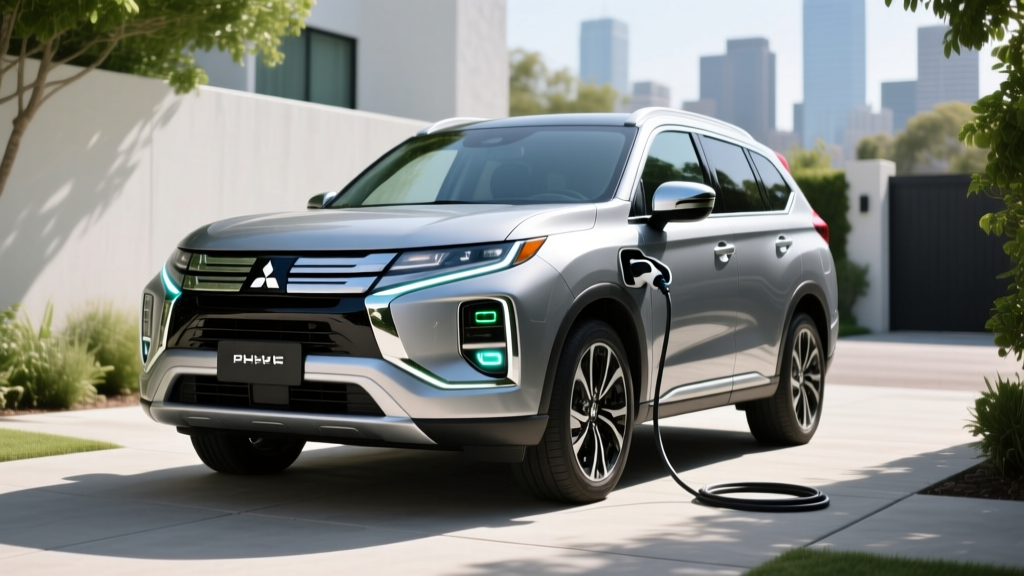
The 2025 Mitsubishi Outlander PHEV occupies a narrow but valuable lane: a three-row plug-in hybrid that can genuinely replace a pure EV for daily commuting while eliminating range anxiety on road trips. With 38 miles of EPA-rated electric-only range and a combined 248 horsepower from its twin-motor all-wheel-drive system, it handles school runs, grocery hauls, and weekend getaways without asking you to plan around charging infrastructure.
But the Outlander PHEV isn't for everyone. Its highway fuel economy once the battery depletes is merely adequate, and DC fast charging is limited to CHAdeMO — a connector standard that's fading in North America. Let's break down every number that matters before you sign a purchase agreement.
HEV vs PHEV: What the Outlander Actually Is
Conventional Hybrid (HEV): A small battery (typically 1-2 kWh) recharges solely through regenerative braking and the gasoline engine. You never plug it in. Examples: Toyota RAV4 Hybrid, Honda CR-V Hybrid. Fuel economy is consistent but you get zero electric-only miles.
Plug-in Hybrid (PHEV) — the Outlander: A larger battery (20 kWh in this case) charges via a plug — Level 1 (120V household outlet) or Level 2 (240V home charger). You get a meaningful electric-only range (38 miles EPA) before the gasoline engine engages. Once depleted, it operates like a conventional hybrid.
The Outlander PHEV is not available as a conventional HEV in the US market. Mitsubishi offers only the plug-in variant. If you cannot charge at home or work, a conventional hybrid like the RAV4 Hybrid may serve you better — the Outlander's advantage depends on regular plugging in.
EPA Fuel Economy and Real-World MPG
| Metric | EPA Rating | Real-World Expectation |
|---|---|---|
| MPGe (combined, electric + gas) | 64 MPGe | 58-68 MPGe depending on charge frequency |
| Gas-only combined MPG | 26 MPG | 24-28 MPG (city favors regen; highway less efficient) |
| Gas-only city MPG | 25 MPG | 26-29 MPG (regen braking helps in stop-and-go) |
| Gas-only highway MPG | 27 MPG | 24-26 MPG (aerodynamic drag, heavier curb weight) |
| Electric-only range | 38 miles | 32-36 miles (highway/cold); up to 40 miles (city/mild weather) |
| Total combined range | 402 miles | ~370-390 miles real-world |
Source: fueleconomy.gov — 2025 Mitsubishi Outlander PHEV
The key insight for PHEV owners: your actual fuel cost depends entirely on how often you charge. If your daily commute is under 35 miles round-trip and you charge nightly, you may burn gasoline only a handful of times per month. Mitsubishi's own data suggests engaged PHEV owners use the engine for less than 20% of their total miles. Neglect to charge, and you're driving a 4,400-pound hybrid that returns 26 MPG — respectable but not exceptional for the class.
Real-World MPG Tip: The Outlander PHEV's regenerative braking system has six adjustable levels (via paddle shifters). Setting regen to maximum in city driving recaptures more energy and extends both electric range and gas-only MPG. On the highway, lower regen settings allow more coasting efficiency.
Battery, Charging Times, and the CHAdeMO Problem
| Specification | Detail |
|---|---|
| Battery capacity (total) | 20.0 kWh |
| Battery usable capacity | ~17.5 kWh (buffer protects longevity) |
| Battery chemistry | Lithium-ion (NMC) |
| Level 1 charging (120V / 12A) | ~1.4 kW — full charge in ~14 hours |
| Level 2 charging (240V / 16A) | ~3.7 kW — full charge in ~5.5 hours |
| DC fast charging | CHAdeMO only — up to ~22 kW, 0-80% in ~38 minutes |
| Charge port location | Driver-side rear quarter panel |
The Outlander PHEV's DC fast-charging capability is its most significant limitation. It uses the CHAdeMO connector — the same standard found on the Nissan Leaf. In 2026, the North American charging landscape has overwhelmingly standardized on NACS (Tesla's connector, now adopted by Ford, GM, Rivian, Hyundai, and others) and CCS1. CHAdeMO stations are increasingly scarce outside legacy networks and are not being built out further.
Practically, this means:
- Home charging is where 90%+ of your charging will happen. A Level 2 home charger (240V, 3.7 kW) fills the battery from empty to full overnight in about 5.5 hours — more than adequate for daily use.
- Public DC fast charging is unreliable for road trips. Even when you find a CHAdeMO station, the ~22 kW peak rate is slow by modern standards. A Tesla Model Y on a V3 Supercharger pulls 250 kW. The Outlander PHEV's DC charging is a convenience top-up, not a road-trip solution.
- Adapters exist but have limits. CHAdeMO-to-CCS adapters are available (~$300-500) but add complexity and are not universally compatible with all stations.
Powertrain: How 248 Horsepower Gets to All Four Wheels
The 2025 Outlander PHEV uses Mitsubishi's Twin Motor 4WD system with a series-parallel hybrid architecture:
- Gasoline engine: 2.4-liter Atkinson-cycle four-cylinder, producing 126 hp and 147 lb-ft of torque
- Front electric motor: 114 hp (85 kW)
- Rear electric motor: 134 hp (100 kW)
- Combined system output: 248 hp
- 0-60 mph: ~7.2 seconds (manufacturer estimate)
- Drivetrain: Standard AWD with torque vectoring (AYC — Active Yaw Control)
Three drive modes manage the powertrain automatically:
- EV Mode: Pure electric, up to 38 miles at speeds up to ~84 mph. The engine stays off unless you floor the accelerator or the battery depletes.
- Series Hybrid Mode: The engine acts as a generator to feed the electric motors. Used under moderate acceleration or when the battery is partially depleted.
- Parallel Hybrid Mode: The engine directly drives the front wheels (via a clutch) at higher cruising speeds where it's most efficient, supplemented by electric motors as needed.
The transitions between modes are mostly seamless, though you'll hear the 2.4L engine drone under hard acceleration — it's an Atkinson-cycle design optimized for efficiency, not refinement. The AWD system provides genuine all-weather capability with independent front and rear motor torque distribution, making it competitive with Subaru's symmetrical AWD in snow and rain.
Pricing, Trims, and Federal Tax Credit Eligibility
| Trim | MSRP (2025) | Key Features |
|---|---|---|
| ES | $41,440 | 18" wheels, 8" touchscreen, heated front seats, Mitsubishi Connect |
| SE | $44,340 | 20" wheels, synthetic leather, power liftgate, 360° camera |
| SEL | $47,040 | Nappa leather, panoramic sunroof, Bose audio, head-up display |
| SEL Touring | $49,540 | Two-tone roof, premium interior, semi-autonomous driving assist |
All trims include destination charge. Pricing per Mitsubishi's official site.
Does the 2025 Outlander PHEV Qualify for the Federal Tax Credit?
Under IRS §30D, the 2025 Outlander PHEV is eligible for up to $3,750 in federal tax credits (not the full $7,500) based on current critical mineral and battery component sourcing requirements. Eligibility depends on:
- Buyer income cap: Modified AGI ≤ $150,000 (single) / ≤ $300,000 (married filing jointly) / ≤ $225,000 (head of household)
- MSRP cap: SUVs/vans capped at $80,000 — all Outlander PHEV trims qualify
- Battery sourcing: The Outlander PHEV's battery components are sourced from Japan/Asia; it meets the critical minerals requirement for half the credit ($3,750) but does not meet the battery component requirement for the other half as of the 2025 tax year
- Point-of-sale transfer: You can transfer the credit to the dealer at purchase, reducing your out-of-pocket cost immediately — no need to wait for tax filing
Source: IRS Clean Vehicle Credits. Always verify with a tax professional before purchase — sourcing rules change and are model-year specific.
Some states offer additional PHEV incentives. California's Clean Vehicle Rebate Project (CVRP), for example, has offered rebates for PHEVs with ≥35 miles of electric range, though funding varies. Check your state energy office for current programs.
Battery Warranty, Reliability, and Long-Term Ownership
Mitsubishi PHEV Battery Warranty:
- PHEV battery pack: 10 years / 100,000 miles (whichever comes first)
- Capacity retention guarantee: Mitsubishi warrants the battery against defects and excessive capacity loss — typically defined as dropping below ~70% of original capacity during the warranty period
- Powertrain warranty: 10 years / 100,000 miles (engine, motors, transmission)
- Bumper-to-bumper: 5 years / 60,000 miles
Is the Outlander PHEV Reliable?
Mitsubishi's PHEV system has been in production since 2013 (the original Outlander PHEV launched in Japan), giving it one of the longest track records of any plug-in hybrid on the market. The second-generation system in the 2025 model benefits from over a decade of iteration.
Key reliability considerations:
- Battery degradation: PHEV batteries experience less stress than full EV batteries because they operate in a narrower state-of-charge window (the buffer prevents full 0% or 100% usage). Expect 10-15% capacity loss over 10 years / 100,000 miles based on industry averages for NMC chemistry in PHEV applications.
- Battery replacement cost: If out of warranty, a PHEV battery replacement runs approximately $8,000-$12,000 (parts and labor). This is significantly less than a full EV battery replacement because the pack is smaller (20 kWh vs. 75-100 kWh in a BEV).
- Common issues: Earlier-generation Outlander PHEVs had occasional reports of charge-port latch failures and software glitches in the battery management system. The 2025 model's updated electronics have largely addressed these.
Who Should Buy the Outlander PHEV vs. a Full EV or Gas Car?
Choose the Outlander PHEV if:
- You have home charging (garage or driveway with 120V/240V access)
- Your daily commute is under 35 miles round-trip
- You need three rows of seating for family
- You take road trips to areas with sparse charging infrastructure
- You want AWD for snow/rain without the efficiency penalty of a gas-only SUV
- You're not ready to commit to a full EV but want to reduce gasoline consumption
Choose a full EV (like the Hyundai Ioniq 5 or Tesla Model Y) if:
- You have reliable home Level 2 charging
- Your daily driving rarely exceeds 250 miles
- You want to eliminate gasoline entirely and minimize maintenance
- You value fast DC charging (NACS/CCS at 200+ kW) for road trips
- You want the full $7,500 federal tax credit (if eligible and sourcing requirements are met)
Choose a conventional hybrid (like the Toyota RAV4 Hybrid) if:
- You cannot charge at home or work (apartment living, street parking)
- You want simpler ownership with no plug-in routine
- Your budget is under $35,000
- You drive mostly highway miles where PHEV electric range provides minimal benefit
Pros and Cons at a Glance
Pros
- 38 miles electric-only covers most daily commutes without gasoline
- Standard AWD with genuine all-weather capability
- Three-row seating in a compact footprint
- 10-year/100,000-mile battery and powertrain warranty
- Eligible for up to $3,750 federal tax credit (with point-of-sale transfer)
- Proven PHEV system with 10+ years of development history
- Regenerative braking paddle adjustment for efficiency tuning
Cons
- CHAdeMO DC fast-charging connector is a dying standard in North America
- DC fast-charge rate (~22 kW) is very slow by modern standards
- Gas-only MPG (26 combined) is average, not class-leading
- Engine noise under hard acceleration is noticeable
- Only $3,750 of the potential $7,500 federal credit (battery component sourcing)
- Third row is tight for adults — best for children or short trips
- No conventional HEV option if you can't charge at home
Frequently Asked Questions
How many MPG does the 2025 Outlander PHEV get?
The EPA rates the 2025 Outlander PHEV at 64 MPGe combined when operating in blended electric-gas mode. Once the battery is depleted and it runs on gasoline alone, it returns 26 MPG combined (25 city / 27 highway). In real-world driving, expect 24-28 MPG gas-only depending on conditions, and significantly better MPGe if you charge regularly.
How far can the Outlander PHEV go on electric only?
The EPA rates it at 38 miles of electric-only range. In real-world driving, expect 32-36 miles on the highway or in cold weather, and up to 40 miles in mild-weather city driving where regenerative braking is most effective. The gasoline engine will automatically engage if you exceed roughly 84 mph in EV mode or demand full acceleration.
Can I charge the Outlander PHEV at a Tesla Supercharger?
No. The Outlander PHEV uses a CHAdeMO DC fast-charging connector and a J1772 Level 2 connector. Tesla Superchargers use the NACS connector. There is currently no reliable adapter that allows a CHAdeMO vehicle to use a NACS Supercharger. For Level 2 public charging, the J1772 connector is compatible with most non-Tesla public stations (ChargePoint, EVgo, etc.).
Is the Outlander PHEV reliable and what does battery replacement cost?
Mitsubishi's PHEV powertrain has been in production since 2013 and is considered mature and reliable. The battery is covered by a 10-year/100,000-mile warranty. Out-of-warranty battery replacement costs approximately $8,000-$12,000, which is lower than full EV replacements due to the smaller 20 kWh pack. Battery degradation in PHEVs is typically slower than in BEVs due to the narrower state-of-charge operating window.
Does the 2025 Outlander PHEV qualify for a federal tax credit?
Yes, it qualifies for up to $3,750 under the IRS §30D Clean Vehicle Credit for the 2025 tax year. It does not qualify for the full $7,500 because it does not meet the battery component sourcing requirement. The credit can be transferred to the dealer at point of sale. Buyer income limits apply: ≤$150K single / ≤$300K married filing jointly. Verify eligibility with a tax professional before purchase, as sourcing rules are subject to change. More details at irs.gov.
Hybrid vs PHEV vs EV — which is right for me?
A conventional hybrid (HEV) is best if you can't plug in at home — it requires no behavior change and delivers consistent MPG. A PHEV like the Outlander is ideal if you can charge at home and want electric daily commuting plus gasoline flexibility for longer trips. A full EV (BEV) is best if you have home charging, want zero gasoline, and your trips rarely exceed 250 miles (or you're willing to plan around DC fast charging). The Outlander PHEV is the bridge option — it removes the biggest barriers to going electric (range anxiety, charging access) while still cutting your gasoline use by 60-80% if you charge daily.
How long does it take to charge the Outlander PHEV at home?
On a standard 120V household outlet (Level 1, ~1.4 kW), a full charge takes approximately 14 hours — adequate if you plug in when you get home from work. On a 240V Level 2 home charger (~3.7 kW), a full charge takes about 5.5 hours. Most PHEV owners find Level 1 sufficient for overnight charging since the 20 kWh battery is small. A dedicated Level 2 charger is a convenience upgrade, not a necessity, for this vehicle.