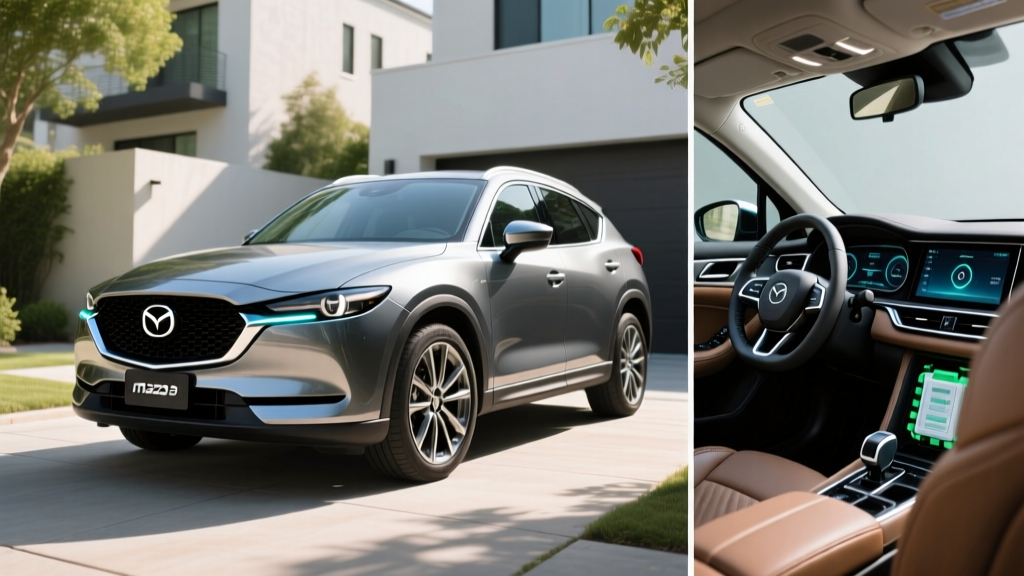
Quick Verdict: The CX-5 Finally Goes Hybrid
For years, the Mazda CX-5 has been the driver's choice in the compact SUV segment — sharp handling, a premium interior, and a willing turbocharged engine. What it lacked was fuel economy. The 2025 Mazda CX-5 Hybrid addresses that gap with a Toyota-sourced 2.5-liter hybrid powertrain that delivers an EPA-estimated 39 MPG combined while retaining the CX-5's upscale cabin and composed ride. This is a conventional hybrid (HEV), not a plug-in — you never plug it in, and it refuels exclusively at the gas pump.
Starting around $33,990 (including destination), the CX-5 Hybrid undercuts many rivals on price while offering one of the best fuel-economy figures in its class. The trade-off? Cargo space is slightly tighter than the gas CX-5 due to hybrid battery packaging, and all-wheel drive is standard, which adds weight but improves traction.
2025 Mazda CX-5 Hybrid: Key Specifications
| Spec | Detail |
|---|---|
| Powertrain | 2.5L 4-cyl + electric motor (HEV) |
| Combined Horsepower | 219 hp |
| Transmission | eCVT (planetary gearset, not belt-driven) |
| Drivetrain | AWD (standard, electronic rear motor assist) |
| EPA Fuel Economy | 39 city / 37 highway / 39 combined MPG |
| Fuel Tank | 12.7 gallons |
| Total Range | ~495 miles |
| 0–60 mph | ~7.2 seconds (est.) |
| Cargo Volume | 27.1 cu ft (rear seats up) / 59.3 cu ft (folded) |
| Towing Capacity | 2,000 lbs |
| Starting MSRP | $33,990 (Preferred trim) |
| Hybrid Battery Warranty | 8 years / 100,000 miles |
Fuel Economy: EPA Ratings vs. Real-World MPG
The headline number for the 2025 CX-5 Hybrid is 39 MPG combined — a massive jump over the turbocharged gas CX-5, which manages just 26 MPG combined. Here's the full EPA breakdown according to fueleconomy.gov:
| Driving Cycle | EPA MPG | Real-World Expectation |
|---|---|---|
| City | 39 MPG | 38–42 MPG (hybrids excel in stop-and-go) |
| Highway | 37 MPG | 34–37 MPG (sustained high speed reduces regen benefit) |
| Combined | 39 MPG | 36–40 MPG |
Real-world note: Like all Toyota-derived hybrid systems, the CX-5 Hybrid tends to match or slightly exceed its EPA city rating in urban driving, where regenerative braking recaptures energy at every stoplight. Highway driving at 75+ mph will drop economy to the low-to-mid 30s, especially with roof rails or cargo. In cold weather (below 30°F), expect a 5–10% reduction as the engine runs more frequently to heat the cabin before the hybrid system can shut it off.
Compared to the gas-only CX-5 Turbo (24 MPG combined), the hybrid saves roughly $650–$800 per year in fuel costs for a driver covering 15,000 miles annually at $3.40/gallon — paying back the hybrid premium in about 3–4 years.
Powertrain Deep Dive: Toyota Hybrid Tech in a Mazda Chassis
The 2025 CX-5 Hybrid uses a variant of Toyota's proven Hybrid Synergy Drive — the same architecture found in the RAV4 Hybrid and Camry Hybrid. Mazda pairs a naturally aspirated 2.5-liter four-cylinder engine (176 hp on its own) with a front electric motor and a rear-mounted electric motor for electronic AWD. Combined system output is 219 horsepower.
The eCVT transmission is not a traditional belt-and-cone CVT. It uses a planetary gearset to seamlessly blend engine and motor power without the rubber-band feel that plagues some competitors. Acceleration from 0–60 mph takes approximately 7.2 seconds — quicker than the base gas CX-5 (8.2 seconds) but slightly behind the CX-5 Turbo (6.4 seconds).
The 2025 CX-5 Hybrid is a conventional hybrid (HEV). It has a small battery (~1.6 kWh) that charges through regenerative braking and the gas engine. You never plug it in. A plug-in hybrid (PHEV) like the Toyota RAV4 Prime has a much larger battery (~18 kWh), can drive 25–42 miles on electricity alone, and requires plugging in to realize its full efficiency benefit. Mazda does not currently offer a CX-5 PHEV in the U.S. market. If you want electric-only commuting, look at the Mazda CX-70 PHEV or the RAV4 Prime.
Pricing, Trims & Tax Credit Eligibility
The 2025 Mazda CX-5 Hybrid is available across multiple trims:
| Trim | MSRP (incl. destination) |
|---|---|
| Preferred | $33,990 |
| Carbon Edition | $35,590 |
| Premium | $37,790 |
| Premium Plus | $40,390 |
Federal tax credit: Under current IRS §30D rules, conventional hybrids like the CX-5 Hybrid do not qualify for the $7,500 federal clean vehicle credit. That credit is reserved for battery electric vehicles (BEVs) and plug-in hybrids (PHEVs) that meet battery-sourcing, critical-mineral, MSRP, and buyer-income requirements. The CX-5 Hybrid's ~1.6 kWh battery falls well below the 7 kWh minimum threshold for §30D eligibility.
State incentives: Some states offer smaller rebates or HOV-lane access for hybrids, but these vary widely. Check your state's energy office or DMV for current programs. A few states (e.g., Colorado) have offered hybrid-specific rebates in past years, but availability changes annually.
Hybrid Battery: Warranty, Longevity & Replacement Cost
Mazda covers the CX-5 Hybrid's battery pack for 8 years or 100,000 miles, whichever comes first. In California Air Resources Board (CARB) states, that extends to 10 years or 150,000 miles. This warranty covers defects and capacity loss below a specified threshold — typically 60–70% of original capacity.
How long will the battery last? The Toyota-derived hybrid system in the CX-5 has one of the strongest reliability track records in the industry. RAV4 Hybrid and Camry Hybrid battery packs routinely last 150,000–200,000+ miles with minimal degradation. The CX-5 Hybrid's nickel-metal hydride (NiMH) battery is smaller and less stressed than a full EV pack, which works in its favor for longevity.
Replacement cost: If the hybrid battery does fail outside warranty, expect a replacement to cost between $2,500 and $4,500 (parts and labor) at a Mazda dealer. Independent hybrid specialists often offer refurbished packs for $1,500–$2,500. Given the Toyota-sourced architecture, aftermarket support is robust.
Is the CX-5 Hybrid reliable? Mazda as a brand consistently ranks in the top third of Consumer Reports' reliability surveys, and the hybrid powertrain itself is essentially a Toyota unit with decades of proven durability. The primary reliability variables are Mazda-specific electronics and build quality — areas where the CX-5 has historically performed well.
Who Should Buy the CX-5 Hybrid — and Who Shouldn't
✅ Choose the CX-5 Hybrid If:
- You want 39 MPG without changing your fueling habits (no plug needed)
- You prioritize driving dynamics — the CX-5 still handles better than the RAV4 Hybrid
- You want a premium-feeling interior without luxury-badge pricing
- You drive mostly city/suburban miles where hybrid efficiency peaks
- You want AWD standard for snow or rain
❌ Look Elsewhere If:
- You need maximum cargo space (RAV4 Hybrid offers 37.6 cu ft vs. 27.1)
- You want electric-only commuting (consider a PHEV like the RAV4 Prime or CX-70 PHEV)
- You prioritize the lowest possible fuel cost (a BEV like the Ioniq 5 costs ~$0.04/mi on home electricity)
- You need more than 2,000 lbs of towing capacity
- You want Apple CarPlay wireless on base trims (wired on Preferred)
- HEV (CX-5 Hybrid): Best for apartment dwellers or those without home charging. No behavior change needed — just buy gas less often. Saves ~$700/yr vs. gas-only.
- PHEV (RAV4 Prime, CX-70 PHEV): Best if you can charge at home and commute under 30–40 miles. Runs on electricity daily, gas for road trips. Qualifies for partial federal credit.
- BEV (Ioniq 5, Model Y): Best for homeowners with Level 2 charging access. Lowest fuel and maintenance cost. Qualifies for up to $7,500 federal credit (subject to eligibility). Highest upfront cost.
How the CX-5 Hybrid Stacks Up Against Rivals
| Model | Combined MPG | HP | Cargo (cu ft) | Starting MSRP |
|---|---|---|---|---|
| 2025 Mazda CX-5 Hybrid | 39 | 219 | 27.1 | $33,990 |
| Toyota RAV4 Hybrid | 39 | 219 | 37.6 | $33,425 |
| Honda CR-V Hybrid | 40 | 204 | 36.3 | $35,395 |
| Hyundai Tucson Hybrid | 38 | 226 | 38.7 | $33,485 |
The CX-5 Hybrid matches the RAV4 Hybrid on MPG and horsepower (unsurprising, given the shared powertrain DNA) but gives up roughly 10 cubic feet of cargo space. Where Mazda wins is interior material quality, ride refinement, and steering feel — areas that matter on daily commutes and long road trips alike.
Frequently Asked Questions
How many MPG does the 2025 Mazda CX-5 Hybrid get?
The EPA rates the CX-5 Hybrid at 39 city / 37 highway / 39 combined MPG. In real-world city driving, owners often see 38–42 MPG thanks to aggressive regenerative braking. Highway cruising at 75+ mph typically returns 34–37 MPG.
Does the CX-5 Hybrid need to be plugged in?
No. The CX-5 Hybrid is a conventional hybrid (HEV). Its small battery charges through regenerative braking and the gas engine. You fuel it like any other car — at a gas station.
Does the 2025 CX-5 Hybrid qualify for a federal tax credit?
No. The federal §30D clean vehicle credit requires a minimum 7 kWh battery and applies only to BEVs and PHEVs. The CX-5 Hybrid's ~1.6 kWh battery does not qualify. Check your state for any local hybrid incentives.
Is the Mazda CX-5 Hybrid reliable?
The hybrid powertrain is sourced from Toyota's Hybrid Synergy Drive, one of the most proven hybrid systems in production since 1997. Mazda's overall brand reliability ranks well in industry surveys. The hybrid battery carries an 8-year/100,000-mile warranty.
How much does a CX-5 Hybrid battery replacement cost?
Outside of warranty, expect $2,500–$4,500 at a dealer or $1,500–$2,500 from an independent hybrid specialist for a refurbished pack. Given the Toyota-derived architecture, many packs last well beyond 150,000 miles.
Is there a plug-in hybrid (PHEV) version of the CX-5?
Not in the U.S. market. Mazda offers the larger CX-70 PHEV and CX-90 PHEV if you want plug-in capability with electric-only range. The Toyota RAV4 Prime remains the closest CX-5-sized PHEV alternative.
How does the CX-5 Hybrid compare to the RAV4 Hybrid?
Both deliver 39 MPG combined and 219 hp, but the CX-5 Hybrid offers a more premium interior, sharper handling, and standard AWD with a rear electric motor. The RAV4 Hybrid provides significantly more cargo space (37.6 vs. 27.1 cu ft) and a slightly lower starting price.