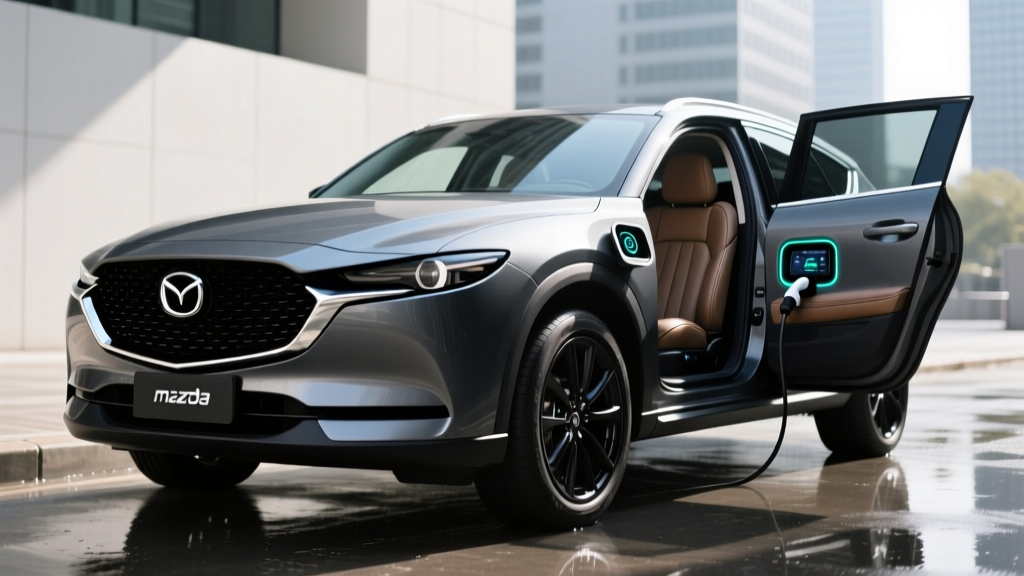
The 2025 Mazda CX-50 Hybrid pairs Mazda's rugged compact-SUV styling with a Toyota-sourced hybrid powertrain, delivering 38 MPG combined EPA and 219 horsepower. It's a conventional hybrid (HEV) — not a plug-in — meaning you never plug it in. The gas engine and regenerative braking keep the small battery charged automatically. For buyers who want Mazda's premium interior and standard all-wheel drive without range anxiety or charging logistics, the CX-50 Hybrid occupies a compelling middle ground between a pure EV and a gas-only SUV.
Quick Clarification: HEV vs. PHEV
The 2025 Mazda CX-50 Hybrid is a conventional hybrid (HEV). It has no plug, no electric-only driving range, and no external charging requirement. A plug-in hybrid (PHEV) like the Toyota RAV4 Prime offers 30–42 miles of electric-only range and requires home charging to maximize value. The CX-50 Hybrid simply asks you to fill it with gas and drive — the hybrid system works invisibly in the background.
2025 Mazda CX-50 Hybrid Specifications at a Glance
| Specification | Detail |
|---|---|
| Powertrain | 2.5L 4-cylinder + 2 electric motors (Toyota hybrid system) |
| Combined Horsepower | 219 hp |
| Drivetrain | AWD (electronic rear motor, standard on all trims) |
| Transmission | eCVT (electronically controlled continuously variable) |
| EPA Fuel Economy | 39 city / 37 highway / 38 combined MPG |
| Fuel Tank | 14.5 gallons |
| Total Driving Range | ~551 miles (EPA combined estimate) |
| Battery Type | Sealed nickel-metal hydride (NiMH) hybrid pack |
| Plug-In / Electric-Only Range | None — conventional HEV |
| Towing Capacity | 3,500 lbs (with towing package) |
| Cargo Volume | 31.4 cu ft (rear seats up) / 56.4 cu ft (rear seats folded) |
| 0–60 mph | ~7.8 seconds (est.) |
| Base MSRP | $33,970 (Preferred Hybrid) |
| Battery Warranty | 8 years / 100,000 miles (hybrid components) |
Fuel Economy: EPA Ratings vs. Real-World MPG
| Driving Scenario | MPG |
|---|---|
| EPA City | 39 MPG |
| EPA Highway | 37 MPG |
| EPA Combined | 38 MPG |
| Real-World City (mixed stop-and-go) | 36–41 MPG |
| Real-World Highway (70–75 mph) | 32–35 MPG |
| Real-World Cold Weather (below 32°F) | 30–34 MPG |
Hybrids typically shine in city driving where regenerative braking recaptures energy during frequent stops. The CX-50 Hybrid's EPA city rating of 39 MPG actually exceeds its highway figure — a hallmark of Toyota's hybrid synergy drive system. In real-world testing, owners who commute in stop-and-go traffic often match or slightly exceed the EPA city number, while sustained highway driving at speeds above 70 mph pushes fuel economy down to the low-to-mid 30s.
Cold weather affects all vehicles, but hybrids see a more pronounced drop because the engine runs more frequently to maintain cabin heat and battery temperature. Expect a 10–15% fuel economy reduction in sub-freezing conditions. Source: fueleconomy.gov.
The Toyota-Sourced Powertrain: How It Works
Mazda partnered with Toyota to equip the CX-50 Hybrid with the proven hybrid powertrain from the RAV4 Hybrid. Under the hood sits a 2.5-liter Atkinson-cycle four-cylinder engine paired with two electric motor-generators and an eCVT transmission. Combined output is 219 horsepower — a meaningful bump over the non-hybrid CX-50's base 187 hp.
The AWD system uses a separate electric motor to drive the rear wheels when needed, eliminating a mechanical driveshaft. This electronic AWD engages automatically and seamlessly. The result is confident acceleration from stops, adequate highway merging power, and the fuel economy advantage that comes from electric-motor torque fill.
Because the system is Toyota's fourth-generation hybrid architecture — the same one proven across millions of RAV4 Hybrids, Camrys, and Highlanders — long-term reliability expectations are strong. This isn't untested technology; it's one of the most widely deployed hybrid systems in the world.
Battery Warranty, Lifespan, and Replacement Cost
Hybrid Battery Coverage
- Hybrid battery warranty: 8 years / 100,000 miles (10 years / 150,000 miles in CARB states including CA, NY, MA, and others)
- Hybrid system components warranty: 8 years / 100,000 miles
- Expected battery lifespan: 150,000–200,000+ miles based on Toyota hybrid fleet data
- Estimated replacement cost (out of warranty): $3,000–$5,000 for the hybrid battery pack
The CX-50 Hybrid uses a NiMH battery pack — a mature chemistry known for longevity and thermal stability. Unlike large lithium-ion EV packs that can cost $10,000–$20,000 to replace, hybrid battery packs are smaller, simpler, and significantly cheaper. Toyota's hybrid fleet data shows most original hybrid batteries lasting well beyond 150,000 miles with minimal degradation. Individual module replacement (rather than full pack) is also possible at many independent hybrid specialists for under $1,500.
Pricing, Trims, and Tax Credit Eligibility
The 2025 Mazda CX-50 Hybrid is offered in four trims:
- Preferred Hybrid: $33,970 MSRP
- Premium Hybrid: $36,570 MSRP
- Premium Plus Hybrid: $39,470 MSRP
All trims include standard AWD, which is a $1,400–$2,000 value compared to competitors that charge extra for all-wheel drive.
Federal Tax Credit Status
The CX-50 Hybrid does not qualify for the federal §30D Clean Vehicle Credit. Under current IRS rules, the §30D credit applies only to plug-in electric vehicles (BEVs and PHEVs) with a minimum battery capacity of 7 kWh. Conventional hybrids like the CX-50 Hybrid are ineligible regardless of price or income.
Some states offer modest hybrid rebates or reduced registration fees, but these vary by jurisdiction and change frequently. Check your state's energy or DMV website for current programs.
Hybrid vs. PHEV vs. EV: Which Is Right for You?
Choose the CX-50 Hybrid (HEV) if:
- You don't have reliable home charging access (apartment, street parking, no garage)
- You want maximum simplicity — just fill up and drive
- Your commute is under 40 miles round-trip with stop-and-go traffic
- You want AWD and 3,500-lb towing without the weight and cost of a large EV battery
- Your budget is under $40,000 and you don't qualify for EV tax credits
Consider a PHEV (like the Toyota RAV4 Prime or Hyundai Tucson PHEV) if:
- You can install a Level 2 home charger and want 30–40 miles of electric-only daily driving
- You want to run most errands on electricity but need gas for road trips
- You qualify for the §30D federal tax credit (up to $7,500) based on income, MSRP, and battery sourcing
Consider a full EV (like the Hyundai Ioniq 5 or Tesla Model Y) if:
- You have home Level 2 charging and your daily driving is under 250 miles
- You want zero tailpipe emissions and the lowest per-mile energy cost
- You qualify for the full $7,500 federal credit and can absorb higher upfront cost
- You want the lowest long-term maintenance cost (no oil changes, fewer moving parts)
Who Should Buy the 2025 Mazda CX-50 Hybrid
The CX-50 Hybrid is best suited for buyers who prioritize Mazda's premium interior quality, standard AWD, and rugged styling but want the fuel economy of a hybrid without the complexity of plug-in charging. It's ideal for suburban commuters, small families, and outdoor-oriented drivers who tow light trailers or carry gear but don't need a full-size SUV.
Where it falls short: the CX-50 Hybrid doesn't offer the electric-only commuting of a PHEV, and its cargo space (31.4 cu ft behind the rear seats) trails the RAV4 Hybrid's 37.6 cu ft. Rear-seat legroom is also tighter than some competitors. If maximum interior volume is your priority, the RAV4 Hybrid or Honda CR-V Hybrid may serve you better — but neither matches the CX-50's interior materials and driving refinement.
Pros
- 38 MPG combined with standard AWD
- Proven Toyota hybrid powertrain with strong reliability history
- Premium interior that punches above its price class
- 219 hp provides confident acceleration
- 3,500-lb towing capacity (with towing package)
- No charging infrastructure needed
Cons
- Less cargo space than RAV4 Hybrid and CR-V Hybrid
- No PHEV variant available (no electric-only range)
- No federal tax credit eligibility
- eCVT drone under hard acceleration
- Rear-seat legroom is tight for taller passengers
- Infotainment lacks a touchscreen (uses rotary dial)
Frequently Asked Questions
How many MPG does the 2025 Mazda CX-50 Hybrid get?
The EPA rates the CX-50 Hybrid at 39 city / 37 highway / 38 combined MPG. In real-world driving, expect 36–41 MPG in city conditions and 32–35 MPG at sustained highway speeds above 70 mph.
Does the Mazda CX-50 Hybrid need to be plugged in?
No. The CX-50 Hybrid is a conventional hybrid (HEV), not a plug-in hybrid. The battery charges automatically through the gas engine and regenerative braking. You simply fill it with gasoline like any other car.
Is there a plug-in hybrid (PHEV) version of the CX-50?
Not for the 2025 model year. Mazda has not announced a CX-50 PHEV variant. If you want a Mazda plug-in hybrid, the CX-90 PHEV is currently the only option in Mazda's lineup.
Is the CX-50 Hybrid reliable? What about battery replacement cost?
The CX-50 Hybrid uses Toyota's proven hybrid system, which has been deployed in millions of vehicles with strong long-term reliability data. The hybrid battery is warranted for 8 years/100,000 miles (10 years/150,000 miles in CARB states). Out-of-warranty replacement costs are estimated at $3,000–$5,000, and individual module repairs can cost under $1,500 at hybrid specialists.
Does the 2025 CX-50 Hybrid qualify for any tax credit?
No. The federal §30D Clean Vehicle Credit applies only to plug-in vehicles (BEVs and PHEVs). Conventional hybrids are not eligible. Some states may offer minor hybrid incentives — check your state's energy office for current programs.
How does the CX-50 Hybrid compare to the RAV4 Hybrid?
Both use the same Toyota hybrid powertrain, but the CX-50 Hybrid produces 219 hp (vs. 219 hp for the RAV4 Hybrid) with nearly identical fuel economy. The RAV4 Hybrid offers more cargo space (37.6 vs. 31.4 cu ft) and more rear legroom, while the CX-50 Hybrid offers a more premium interior, more rugged exterior styling, and slightly sportier driving dynamics.