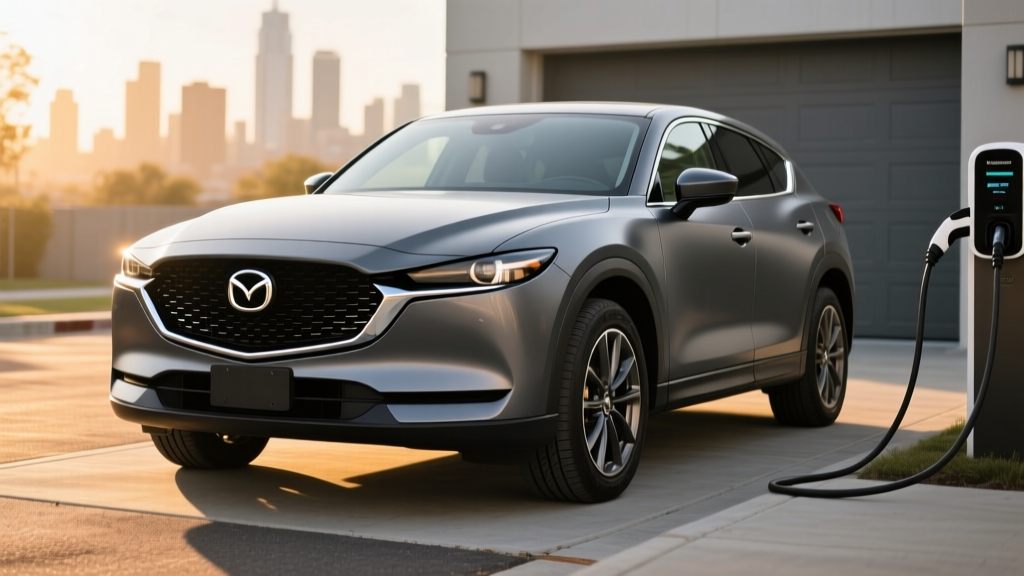
The 2025 Mazda CX-50 Hybrid Premium occupies a specific niche: a compact crossover that pairs Mazda's upscale interior and rugged styling with Toyota's proven hybrid powertrain. If you've been cross-shopping the RAV4 Hybrid but want something that feels a half-step more premium inside, this is the vehicle Mazda built for you. But does the real-world fuel economy match the EPA sticker, and is the Premium trim the right buy? Here's the data-driven breakdown.
Quick Verdict: Who the CX-50 Hybrid Premium Is For
The 2025 Mazda CX-50 Hybrid Premium delivers 38 MPG combined in a package that drives better than its Toyota underpinnings suggest. It's a conventional hybrid (HEV) — no plug, no electric-only range, no charging anxiety. You just fill it with regular unleaded and drive. The Premium trim sits in the middle of the hybrid lineup, adding leatherette upholstery, a power moonroof, and a 10.25-inch infotainment display over the base Hybrid Select, without stepping all the way up to the Premium Plus or Turbo-badged trims.
Choose the CX-50 Hybrid Premium if: You want 35+ MPG in a compact SUV with a near-luxury interior and standard AWD, and you don't want to plug in.
Look elsewhere if: You need electric-only commuting range (consider a PHEV like the RAV4 Prime or CX-70 PHEV), or you prioritize maximum cargo space (the RAV4 Hybrid edges it out).
HEV vs PHEV: Where the CX-50 Hybrid Fits
Mazda's CX-50 lineup can confuse shoppers because the brand sells both conventional hybrids and plug-in hybrids across its broader range. Let's clarify:
| Feature | Conventional Hybrid (HEV) | Plug-In Hybrid (PHEV) |
|---|---|---|
| CX-50 Availability | Yes — CX-50 Hybrid (this model) | No — PHEV not offered on CX-50 |
| Plug Required? | No — charges via regenerative braking and engine | Yes — plug in for electric-only miles |
| Electric-Only Range | None (motor assists engine at all times) | Typically 25-40 miles on PHEVs |
| Battery Size | ~1.6 kWh (small, self-charging) | 13-18 kWh (larger, grid-chargeable) |
| Federal Tax Credit (§30D) | Not eligible | Up to $7,500 if eligible |
| Best For | Drivers without home charging access | Commuters with home Level 2 charging |
The 2025 CX-50 Hybrid is strictly an HEV. It uses a small traction battery that charges itself through regenerative braking and the gasoline engine. There is no plug, no EV mode button, and no electric-only driving range to manage. This makes it ideal for apartment dwellers or anyone without access to a dedicated charging circuit.
Fuel Economy: EPA Ratings vs Real-World MPG
The headline number for the 2025 Mazda CX-50 Hybrid is its EPA-estimated fuel economy. Because the hybrid powertrain is standard across all hybrid trims (Select, Preferred, Premium, Premium Plus), the MPG figures don't change with equipment level:
| Driving Cycle | EPA Estimate | Real-World Expectation |
|---|---|---|
| City | 39 MPG | 38-42 MPG (hybrids often beat EPA in stop-and-go) |
| Highway | 37 MPG | 33-36 MPG (aerodynamic drag and sustained speed reduce hybrid advantage) |
| Combined | 38 MPG | 35-39 MPG depending on driving mix |
Why real-world numbers vary: Hybrid systems recapture the most energy in city driving, where frequent braking feeds the battery. On sustained highway cruises above 70 mph, the electric motor contributes less and the 2.5-liter four-cylinder does most of the work. In our experience with Toyota's fourth-generation hybrid system (which underpins this powertrain), drivers who do 70%+ city driving routinely exceed the EPA combined number. Highway-heavy commuters should expect to land closer to 34-36 MPG.
Cold weather also matters. Below freezing, expect a 5-10% fuel economy penalty as the engine runs longer to generate cabin heat and the battery operates less efficiently. Source: fueleconomy.gov.
Powertrain Specs: Toyota Hybrid System, Mazda Tuning
Mazda partnered with Toyota for the CX-50 Hybrid's powertrain, and the result is the same 2.5-liter Dynamic Force four-cylinder paired with two electric motor-generators that Toyota uses in the RAV4 Hybrid. Mazda has retuned the throttle mapping, steering feel, and transmission calibration, but the core hardware is shared.
| Specification | 2025 Mazda CX-50 Hybrid (All Trims) |
|---|---|
| Engine | 2.5L inline-4 (Atkinson cycle) |
| Electric Motors | 2 motor-generators (front + rear axle) |
| Combined System Output | 219 hp |
| Transmission | eCVT (planetary gearset, not a belt-driven CVT) |
| Drivetrain | Electronic AWD (rear motor powers rear axle on demand) |
| Hybrid Battery | ~1.6 kWh nickel-metal hydride (NiMH) |
| 0-60 mph | ~7.2 seconds (estimated) |
| Towing Capacity | 1,500 lbs (hybrid); non-hybrid turbo models rate 3,500 lbs |
| Fuel Type | Regular unleaded (87 octane) |
The eCVT here is not the rubber-band-style continuously variable transmission found in some competitors. It's a planetary gearset that seamlessly blends engine and motor power with no fixed gear ratios and no belt or chain. It's one of the most durable hybrid transmission designs in production — Toyota has used variants of this system since the 1997 Prius with very few mechanical failures.
The electronic AWD system uses the rear electric motor to power the rear wheels when the front tires slip or under hard acceleration. There's no mechanical driveshaft connecting the axles. This keeps weight down and packaging efficient, but it also means the system is optimized for on-road traction and light snow — not off-road crawling.
Pricing: 2025 CX-50 Hybrid Premium MSRP & Tax Credit Status
The 2025 Mazda CX-50 Hybrid Premium carries an MSRP of approximately $38,950 (including destination). Here's how the hybrid trim stack breaks down:
| Trim | Approx. MSRP | Key Additions Over Base |
|---|---|---|
| Hybrid Select | $35,950 | Base hybrid: 17" wheels, cloth seats, 10.25" display |
| Hybrid Preferred | $37,450 | Leatherette, heated front seats, power liftgate |
| Hybrid Premium | $38,950 | Moonroof, Bose 12-speaker audio, wireless charging, adaptive headlights |
| Hybrid Premium Plus | $41,450 | Ventilated seats, heated steering wheel, 360° camera |
Does the CX-50 Hybrid Qualify for a Federal Tax Credit?
No. The CX-50 Hybrid is a conventional HEV, not a plug-in hybrid or battery-electric vehicle. Under current IRS §30D rules, only new plug-in electric vehicles (BEVs and PHEVs with at least 7 kWh of battery capacity) qualify for the federal clean vehicle credit of up to $7,500. Conventional hybrids like this one do not qualify.
Some states offer their own hybrid incentives, but these are increasingly rare as state programs shift focus to zero-emission vehicles. Check your state's energy office or DMV for current programs — but plan your purchase budget assuming no credit.
Reliability, Battery Warranty & Replacement Cost
This is where the Toyota-sourced powertrain pays dividends. The hybrid system in the CX-50 is fundamentally the same architecture used in millions of RAV4 Hybrids, Camry Hybrids, and Highlander Hybrids on the road. Failure rates for the motor-generators, eCVT, and power control electronics are exceptionally low based on long-term fleet data.
Hybrid Battery Warranty: Mazda covers the hybrid battery and related components for 8 years / 100,000 miles (whichever comes first) under the standard hybrid system warranty. In states that follow California Air Resources Board (CARB) emissions rules — including CA, NY, MA, NJ, CT, RI, VT, ME, NH, OR, WA, CO, MD, and others — that coverage extends to 10 years / 150,000 miles.
What Does Hybrid Battery Replacement Cost?
If the traction battery fails outside of warranty, replacement typically runs $2,000 to $4,000 for a remanufactured NiMH pack, or $4,000 to $6,000 for a new OEM unit installed at a dealer. However, NiMH hybrid batteries in Toyota-derived systems have demonstrated remarkable longevity — it's common for these packs to last 150,000-200,000+ miles with minimal capacity loss. Unlike the large lithium-ion packs in full EVs (which can cost $10,000-$20,000+ to replace), the small NiMH battery in a conventional hybrid is a relatively affordable repair.
The battery doesn't "wear out" the way an EV battery degrades. Because it operates in a narrow state-of-charge window (roughly 40-80% SoC), managed by the hybrid control computer, stress on the cells is minimal. Individual modules can sometimes be replaced rather than the entire pack, further reducing out-of-warranty costs.
Who Should Choose the CX-50 Hybrid vs a Full EV or Gas Car?
The CX-50 Hybrid Premium makes sense for a specific buyer profile. Here's the decision framework:
Pros
- 38 MPG combined on regular unleaded — no premium fuel required
- Standard electronic AWD included at every trim
- Proven Toyota hybrid hardware with low failure rates
- Mazda's interior quality exceeds the RAV4 Hybrid at similar price points
- No charging infrastructure needed — works for apartment/condo dwellers
- Strong resale value projected based on hybrid demand
Cons
- No electric-only driving range — always burning some fuel
- Not eligible for the $7,500 federal EV tax credit
- 1,500-lb towing capacity (turbo gas CX-50 rates 3,500 lbs)
- Rear seat and cargo space slightly less than RAV4 Hybrid
- No DC fast charging or plug-in capability
- Infotainment lacks a touchscreen (controlled via rotary dial)
Hybrid vs PHEV vs EV — Which Fits You?
If you can install a Level 2 home charger and your daily commute is under 35 miles, a PHEV like the Toyota RAV4 Prime (42 miles electric-only) or the Mazda CX-70 PHEV might save you more fuel on a day-to-day basis. But PHEVs cost more upfront, carry heavier batteries, and require charging discipline to realize their advantage.
If you're ready to go fully electric and have reliable charging access, vehicles like the Hyundai Ioniq 5 or Tesla Model Y offer lower per-mile energy costs and zero tailpipe emissions — but at higher purchase prices and with range planning required on road trips.
The CX-50 Hybrid is the pragmatic middle path: dramatically better fuel economy than a gas-only SUV, zero lifestyle changes required, and a purchase price that undercuts comparable PHEVs and EVs by $5,000-$10,000.
Frequently Asked Questions
How many MPG does the 2025 Mazda CX-50 Hybrid get?
The EPA rates it at 39 city / 37 highway / 38 combined MPG. Real-world results typically range from 34-42 MPG depending on driving conditions, with city-heavy routes producing the best numbers.
Does the CX-50 Hybrid need to be plugged in?
No. It is a conventional hybrid (HEV), not a plug-in hybrid. The battery charges itself through regenerative braking and the gasoline engine. There is no plug, no charging port, and no electric-only range.
How far can the CX-50 Hybrid drive on electric power alone?
It cannot. Unlike a PHEV, the CX-50 Hybrid has no EV-only mode. The electric motor assists the gasoline engine at all speeds but cannot propel the vehicle independently for meaningful distances.
Is the Mazda CX-50 Hybrid reliable?
The hybrid powertrain is sourced from Toyota and based on a system with decades of proven reliability across millions of vehicles. The eCVT transmission, motor-generators, and power electronics have very low failure rates. Mazda's overall vehicle reliability ratings have improved in recent model years.
What is the hybrid battery replacement cost?
Out-of-warranty replacement typically costs $2,000-$4,000 for a remanufactured pack or $4,000-$6,000 for a new OEM unit. Under warranty, it's covered for 8 years/100,000 miles (10 years/150,000 miles in CARB states). In practice, these NiMH packs commonly last 150,000-200,000+ miles.
Does the CX-50 Hybrid qualify for any tax credit?
It does not qualify for the federal §30D clean vehicle credit, which is reserved for plug-in vehicles (BEVs and PHEVs). Some states may offer minor hybrid incentives, but these are uncommon. Check your state's energy office for current programs.
How does the CX-50 Hybrid compare to the RAV4 Hybrid?
They share the same powertrain (219 hp, 2.5L hybrid, eCVT, electronic AWD), so performance and MPG are nearly identical. The CX-50 offers a more premium interior and Mazda's driving dynamics, while the RAV4 Hybrid provides slightly more cargo space, a touchscreen infotainment system, and a lower starting price. The RAV4 Hybrid also offers the Prime PHEV variant, which the CX-50 does not.
Can the CX-50 Hybrid tow?
Yes, but with a reduced capacity of 1,500 pounds — adequate for a small utility trailer or a pair of dirt bikes, but not enough for most campers or boats. If you need 3,500-lb towing, you'll need the non-hybrid CX-50 with the 2.5L turbo engine.
Sources: fueleconomy.gov, Mazda USA, IRS §30D Clean Vehicle Credits.