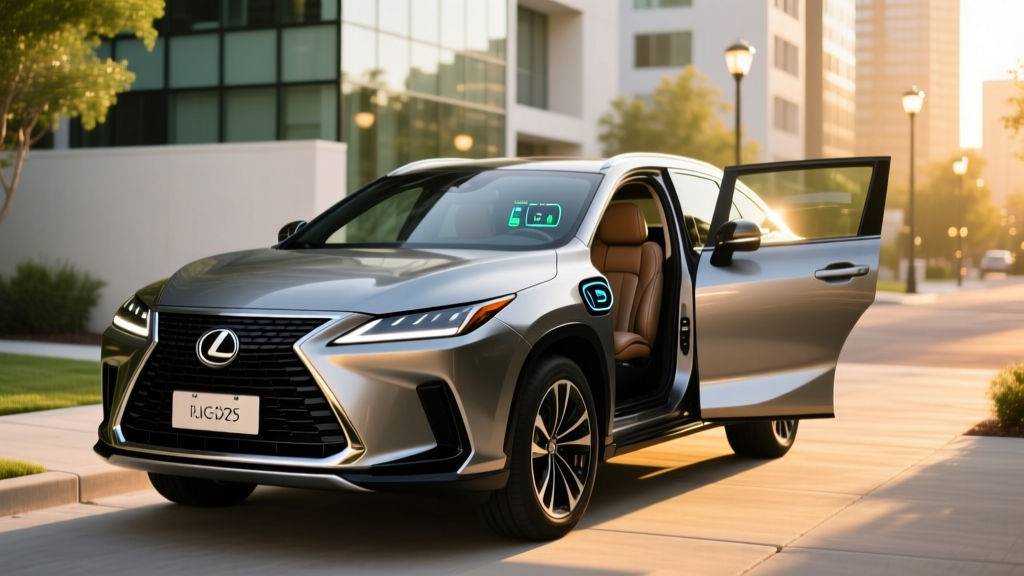
The three-row luxury SUV segment has no shortage of options, but the 2025 Lexus TX plug-in hybrid occupies a rare position: a full-size, seven-passenger family hauler that can handle school runs and grocery trips on electricity alone before its gas engine ever fires up. Badged as the TX 550h+, this PHEV pairs a turbocharged V6 with a substantial battery pack to deliver V8-rivaling power with compact-car efficiency — at least when you keep it charged.
Here's everything you need to know about the 2025 Lexus TX plug-in hybrid, from real-world range and charging logistics to whether it qualifies for the federal tax credit.
HEV vs PHEV: Understanding the Lexus TX Lineup
Lexus sells the TX in three distinct powertrains, and confusing them is easy at the dealership. Here's the breakdown:
| Feature | TX 350 (Gas) | TX 500h (HEV) | TX 550h+ (PHEV) |
|---|---|---|---|
| Powertrain | 2.4L turbo I-4 | 2.4L turbo hybrid | 3.5L V6 PHEV |
| Horsepower | 275 hp | 366 hp | 406 hp |
| Plug-in capable? | No | No | Yes |
| Electric-only range | N/A | N/A | 33 miles (EPA) |
| EPA combined MPG/MPGe | 23 MPG | 27 MPG | 64 MPGe / 27 MPG (gas-only) |
| Battery | 12V auxiliary | ~1.4 kWh NiMH | 18.1 kWh lithium-ion |
| Starting MSRP | ~$55,000 | ~$63,000 | ~$75,000 |
The TX 500h is a conventional hybrid (HEV). It recovers energy through regenerative braking and uses a small battery to assist the gas engine — you never plug it in, and it cannot drive on electricity alone for meaningful distances.
The TX 550h+ is the plug-in hybrid (PHEV). It carries a much larger 18.1 kWh battery pack, can travel up to 33 miles on electric power alone, and requires plugging in to realize its full efficiency and cost-savings potential. This review focuses on the TX 550h+.
Electric-Only Range and Total Driving Range
EPA electric-only range: 33 miles
Real-world expectation: 27–31 miles in mixed driving; as low as 22–25 miles in cold weather (below 40°F) or sustained highway speeds above 70 mph.
Total combined range (electric + gas): approximately 420 miles with a full tank and full battery.
The 33-mile electric range is competitive for a vehicle this size. Most daily commutes in the U.S. fall under 30 miles round-trip, meaning many TX 550h+ owners could complete weekday driving without burning a drop of gasoline — provided they charge at home overnight.
When the battery depletes, the TX 550h+ seamlessly transitions to hybrid mode, operating much like the conventional TX 500h. You don't lose functionality; you simply revert to hybrid efficiency.
Fuel Economy: EPA Numbers and Real-World MPG
The EPA rates the TX 550h+ using two metrics: MPGe (miles-per-gallon-equivalent) when factoring in electric driving, and standard MPG when operating as a hybrid after the battery is depleted.
| Mode | City | Highway | Combined |
|---|---|---|---|
| MPGe (with charge) | 65 MPGe | 63 MPGe | 64 MPGe |
| MPG (gas-only hybrid) | 27 MPG | 27 MPG | 27 MPG |
Real-world MPG observations: Hybrid-mode fuel economy tends to hold steady in city driving thanks to aggressive regenerative braking — expect 28–30 MPG around town. Highway cruising at 75+ mph can drop that to 24–25 MPG. Cold weather and short trips where the engine must run for cabin heat will also reduce efficiency. Source: fueleconomy.gov.
Powertrain and Performance Specs
| Specification | TX 550h+ Detail |
|---|---|
| Engine | 3.5L V6 naturally aspirated + electric motors |
| Combined horsepower | 406 hp |
| Drivetrain | AWD (DIRECT4 electronic) |
| Transmission | e-CVT |
| 0–60 mph | ~5.9 seconds (est.) |
| Towing capacity | 5,000 lbs |
| Battery (traction) | 18.1 kWh lithium-ion |
| Seating capacity | 6 or 7 passengers |
| Cargo (behind 3rd row) | ~20.2 cu ft |
The 406-horsepower output makes the TX 550h+ the most powerful variant in the lineup. The DIRECT4 all-wheel-drive system uses a rear-mounted electric motor to provide instant torque to the rear axle, giving it confident acceleration from stops and stable handling in wet conditions. It's not a performance SUV, but it moves with authority that the base TX 350 simply can't match.
Charging: How Long Does It Take?
This is where the TX 550h+ reveals one of its key limitations — and a critical consideration for buyers comparing it to full EVs.
| Charging Method | Power (kW) | 0–100% Time | Notes |
|---|---|---|---|
| Level 1 (120V household) | ~1.4 kW | ~13 hours | Emergency/top-up only |
| Level 2 (240V home charger) | ~6.6 kW | ~3 hours | Recommended for daily use |
| DC fast charging | Not supported | N/A | No DCFC capability |
The TX 550h+ charges exclusively via AC (Level 1 or Level 2). There is no DC fast-charging capability. This is standard for most PHEVs — the battery is small enough that Level 2 replenishes it in a few hours, and automakers avoid the cost and weight of DCFC hardware. Practically, this means you'll charge at home overnight or at work during the day. Road-trip charging relies entirely on the gasoline engine.
Important distinction: kW (kilowatts) measures charging power — how fast energy flows into the battery. kWh (kilowatt-hours) measures battery capacity — how much energy it stores. The TX 550h+ has an 18.1 kWh battery that accepts up to 6.6 kW of AC charging power.
Pricing, Trims, and Tax Credit Eligibility
The 2025 Lexus TX 550h+ starts around $75,000 MSRP (including destination) in Luxury trim, with Premium and Ultra Luxury trims climbing to approximately $78,000–$82,000 depending on options.
Federal §30D Tax Credit Eligibility (2025 rules):
- Vehicle MSRP cap: SUVs must be ≤ $80,000 MSRP — the TX 550h+ base trims qualify; fully optioned Ultra Luxury may exceed the cap.
- Buyer income cap: Modified AGI ≤ $300,000 (joint) / $225,000 (head of household) / $150,000 (single).
- Battery sourcing: Critical minerals and battery components must meet phased-in domestic content thresholds. Lexus has not publicly confirmed full compliance for the TX 550h+.
- Credit amount: Up to $3,750 (critical minerals) + up to $3,750 (battery components) = max $7,500, but many PHEVs only qualify for partial credit.
- Point-of-sale transfer: Eligible buyers can apply the credit as an immediate dealer discount rather than waiting for a tax refund.
Source: IRS.gov §30D. Always verify current eligibility with a tax professional before purchasing.
The TX 550h+'s credit eligibility is uncertain. Toyota/Lexus has faced challenges meeting battery-sourcing requirements across its PHEV lineup. Check the fueleconomy.gov tax credit database for the most current status before relying on the credit in your budget.
Reliability and Battery Warranty
Hybrid battery warranty: 10 years / 150,000 miles (whichever comes first) — covers the high-voltage traction battery against defects and excessive capacity loss.
Powertrain warranty: 6 years / 70,000 miles.
Basic warranty: 4 years / 50,000 miles.
Lexus consistently ranks at or near the top of J.D. Power and Consumer Reports reliability surveys, and the TX's powertrain borrows heavily from proven Toyota/Lexus hybrid architecture. The 3.5L V6 is a known quantity in Lexus products, and the hybrid system has been refined over two decades of Prius, RAV4 Hybrid, and RX production.
Battery replacement cost: If the high-voltage battery fails outside warranty, expect a replacement cost between $8,000 and $12,000 including labor. However, lithium-ion PHEV batteries rarely fail catastrophically — gradual capacity loss is more typical, and the 10-year/150,000-mile warranty provides substantial protection. Most owners will trade or sell the vehicle before encountering out-of-pocket battery costs.
TX 550h+ vs Full EV vs Gas: Which Should You Choose?
Choose the TX 550h+ (PHEV) if:
- You have home Level 2 charging and a daily commute under 30 miles
- You need three rows and 5,000-lb towing but want to minimize fuel costs
- You take regular road trips where charging infrastructure is sparse
- You want electric daily driving without range anxiety on longer trips
Choose a full EV (e.g., Rivian R1S, Tesla Model X) if:
- You have reliable home charging and access to DC fast chargers for road trips
- You want zero tailpipe emissions and the lowest per-mile fuel cost
- You prefer minimal maintenance (no oil changes, no engine)
Choose the TX 350 or TX 500h (gas/HEV) if:
- You cannot install a home charger (apartment, no garage)
- You want a lower purchase price and simpler ownership
- Your daily driving far exceeds 30 miles, negating PHEV benefits
Pros
- 33 miles electric covers most daily commutes
- 406 hp and 5,000-lb towing in a luxury package
- Seamless transition between EV and hybrid modes
- 10-year/150,000-mile hybrid battery warranty
- Excellent Lexus reliability reputation
- Three rows of seating with premium interior
Cons
- No DC fast charging
- $75,000+ starting price is steep
- Federal tax credit eligibility uncertain
- Electric range drops significantly in cold weather
- Cargo space reduced vs gas-only TX due to battery placement
- 3-hour Level 2 charge time is slow vs some PHEV competitors
Frequently Asked Questions
How many MPG does the 2025 Lexus TX plug-in hybrid get?
The TX 550h+ achieves 64 MPGe combined when factoring in electric driving. Once the battery is depleted and it operates as a conventional hybrid, it returns an EPA-estimated 27 MPG combined (27 city / 27 highway). Real-world hybrid-mode MPG ranges from 24–30 depending on driving conditions.
How far can the TX 550h+ drive on electric power alone?
The EPA rates it at 33 miles of electric-only range. Real-world results typically fall between 27–31 miles in mild conditions, dropping to 22–25 miles in cold weather or at sustained highway speeds.
Does the 2025 Lexus TX 550h+ qualify for a federal tax credit?
Possibly, but it's not guaranteed. Under current §30D rules, the vehicle must meet battery-sourcing and critical-mineral requirements, the MSRP must be ≤ $80,000 (SUV cap), and buyer income must fall below thresholds. Check fueleconomy.gov and consult a tax professional before counting on the credit. The maximum potential credit is $7,500, but many PHEVs qualify for $3,750 or less.
Can I charge the TX 550h+ at a public fast charger?
No. The TX 550h+ only supports AC charging (Level 1 at 120V or Level 2 at 240V). It cannot use DC fast chargers like Electrify America or Tesla Superchargers. Plan to charge at home or at Level 2 destination chargers.
What happens if I never plug in the TX 550h+?
It will function as a conventional hybrid, returning roughly 27 MPG combined. You'll miss the efficiency and cost benefits of electric driving, but the vehicle operates normally. That said, buying a PHEV and never plugging it in defeats the purpose — consider the TX 500h HEV instead if you can't charge at home.
Is the Lexus TX plug-in hybrid reliable?
Lexus has one of the strongest reliability records in the industry, and the TX's hybrid system builds on decades of Toyota/Lexus hybrid engineering. The high-voltage battery is covered by a 10-year/150,000-mile warranty. Replacement cost outside warranty is estimated at $8,000–$12,000, though catastrophic battery failure is rare in modern PHEVs.