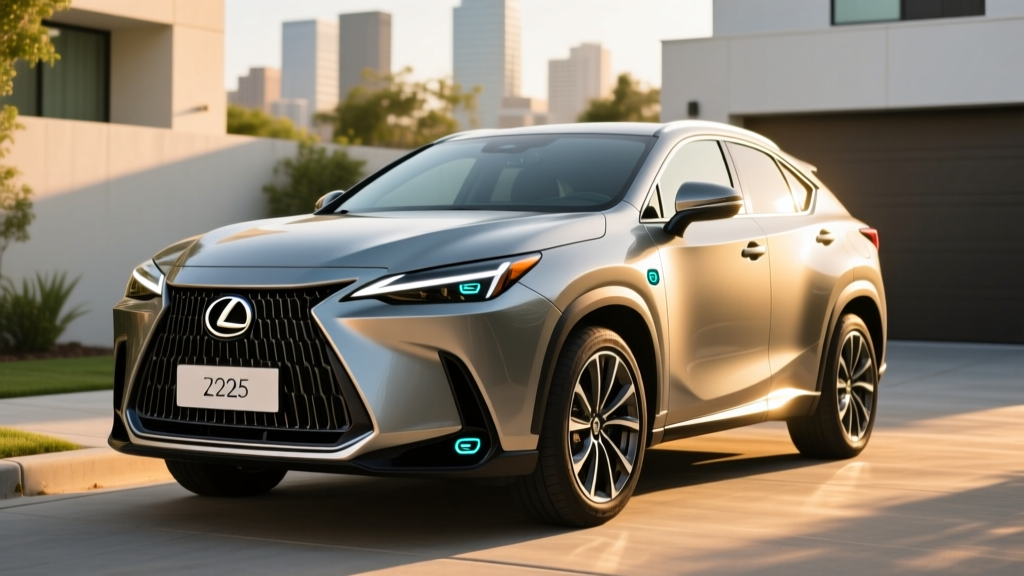
The 2025 Lexus NX Hybrid lineup occupies a rare sweet spot in the luxury compact SUV segment: genuine fuel efficiency without sacrificing the refinement Lexus buyers expect. But the NX badge hides two fundamentally different electrified powertrains under its skin — a conventional hybrid (HEV) in the NX 350h and a plug-in hybrid (PHEV) in the NX 450h+. Understanding which one fits your driving pattern is the single most important decision you'll make at the dealership.
We've broken down every critical spec — EPA MPG, electric-only range, battery chemistry, charging times, warranty coverage, and federal tax credit eligibility — so you can compare apples to apples before you schedule a test drive.
HEV vs PHEV: What's the Difference in the 2025 NX Lineup?
The 2025 Lexus NX Hybrid comes in two electrified flavors. Neither is a full battery-electric vehicle (BEV), but they operate very differently day to day.
| Feature | NX 350h (HEV) | NX 450h+ (PHEV) |
|---|---|---|
| Powertrain type | Conventional hybrid — no plug | Plug-in hybrid — charges from outlet |
| Electric-only driving | Very short, low-speed assists only | EPA-est. 37 miles on battery alone |
| Needs to plug in? | No — regenerative braking recharges battery | Yes, for maximum benefit; runs as hybrid when depleted |
| Battery size | ~1.6 kWh (small NiMH/NMC pack) | 18.1 kWh usable (lithium-ion) |
| Combined horsepower | 244 hp | 304 hp |
| 0–60 mph | 7.2 seconds | 6.0 seconds |
The critical distinction: the NX 350h generates all its electricity internally through the gasoline engine and regenerative braking. You never plug it in. The NX 450h+ has a much larger battery that you charge from a wall outlet or public charger, giving you roughly 37 miles of pure electric driving before the gasoline engine seamlessly takes over.
Fuel Economy: EPA MPG and Real-World Expectations
Fuel economy is where the NX 350h earns its keep. According to fueleconomy.gov, the EPA rates the NX 350h at:
| Model | City MPG | Highway MPG | Combined MPG |
|---|---|---|---|
| NX 350h (AWD) | 41 | 37 | 39 |
| NX 450h+ (AWD, charge-depleting) | 84 MPGe | 84 MPGe | 84 MPGe |
| NX 450h+ (charge-sustaining, hybrid mode) | 38 | 31 | 35 |
Real-world caveat: Toyota/Lexus hybrid systems consistently deliver city MPG that meets or beats the EPA sticker because regenerative braking recovers energy in stop-and-go traffic. Many NX 350h owners report 42–44 MPG in urban driving. Highway mileage, however, tends to fall slightly short — expect 34–36 MPG at sustained 75 mph cruising, where the electric motor provides less benefit and aerodynamic drag dominates.
For the NX 450h+, the 84 MPGe figure applies only while the battery is charged and you're driving within the 37-mile electric range. Once the battery depletes, you're operating a 35-MPG combined hybrid — still excellent, but not the triple-digit number some marketing materials imply.
NX 450h+ Electric-Only Range and Charging Details
If you're considering the plug-in variant, the electric-only range determines how much of your daily driving can be zero-tailpipe-emission. The NX 450h+ delivers an EPA-estimated 37 miles of electric-only range on a full charge.
That covers the average American round-trip commute. According to FHWA data, roughly 78% of US drivers travel fewer than 40 miles per day — meaning most NX 450h+ owners who charge at home will rarely visit a gas station on weekdays.
| Charging Spec | NX 450h+ Detail |
|---|---|
| Battery capacity (usable) | 18.1 kWh lithium-ion |
| Level 1 (120V household outlet) | ~1.4 kW — full charge in approximately 12 hours |
| Level 2 (240V home/public) | Up to 6.6 kW onboard charger — full charge in approximately 3 hours |
| DC fast charging | Not supported — no CCS/CHAdeMO port |
| Charge connector | J1772 (Level 2 AC only) |
| Total combined range (EV + gas) | Approximately 470 miles |
The lack of DC fast charging is a deliberate trade-off. Lexus prioritized cabin and cargo space over fast-charge capability, and given the 18.1 kWh battery, a Level 2 home charger handles overnight replenishment easily. If you regularly take road trips exceeding 40 miles and lack destination charging, the NX 350h's simplicity may suit you better.
Powertrain Specs: What's Under the Hood?
Both NX Hybrid models pair a 2.5-liter inline-four Atkinson-cycle engine with Lexus's e-AWD system — an electric motor on the rear axle that provides all-wheel drive without a mechanical driveshaft.
NX 350h: The 2.5L engine produces 189 hp on its own, supplemented by front and rear electric motors for a combined system output of 244 horsepower. Torque delivery is immediate from the electric motors, giving it a responsive feel in city driving despite the modest peak number.
NX 450h+: The same 2.5L engine is paired with more powerful electric motors and the larger 18.1 kWh battery, yielding 304 combined horsepower. This makes the 450h+ the quickest NX variant short of the turbocharged NX 350 F Sport, and the electric torque fill eliminates the rubber-band CVT sensation common in lesser hybrids. The 6.0-second 0–60 time puts it in the territory of sporty luxury crossovers.
Both use Lexus's e-CVT (planetary gearset), which is fundamentally different from the belt-driven CVTs in budget compacts. There are no bands or pulleys to wear — it's a gear-based power-split device that has proven exceptionally durable over two decades of Toyota hybrid production.
Pricing, Trims, and Tax Credit Eligibility
The 2025 Lexus NX Hybrid pricing starts well within the luxury compact segment, though the PHEV premium is significant.
| Trim | MSRP (approx.) | Powertrain |
|---|---|---|
| NX 350h Premium | $43,715 | HEV |
| NX 350h Luxury | $48,465 | HEV |
| NX 350h F Sport Handling | $48,715 | HEV |
| NX 450h+ Premium | $51,415 | PHEV |
| NX 450h+ Luxury | $56,065 | PHEV |
Federal Tax Credit (§30D) — NX 450h+ Only
The NX 450h+ PHEV may qualify for a partial or full federal tax credit under IRS §30D, but eligibility is not automatic. Per IRS guidelines, the credit depends on:
- Battery sourcing: Critical minerals and battery components must meet phased-in domestic-content thresholds. For 2025, at least 80% of critical minerals and 100% of battery components must be sourced from the US or free-trade-agreement partners to qualify for the full $7,500.
- Buyer income caps: AGI must not exceed $150,000 (single), $225,000 (head of household), or $300,000 (joint).
- MSRP cap: SUVs must be under $80,000 — all NX 450h+ trims qualify.
- Point-of-sale transfer: As of 2024, buyers can transfer the credit to the dealer for an immediate price reduction at purchase, subject to dealer participation.
The NX 350h conventional hybrid does not qualify for the §30D federal credit. It may be eligible for certain state or utility incentives, but these vary widely — check your state energy office or local utility for details.
Because battery sourcing requirements tighten annually and Lexus has not publicly confirmed full compliance for every model year, verify current eligibility on the IRS clean vehicle credit page or with your tax professional before relying on the credit in your purchase budget.
Battery Warranty, Reliability, and Replacement Cost
Battery longevity is the number-one concern for hybrid buyers, and Lexus's track record here is among the strongest in the industry. Toyota's hybrid synergy drive system has accumulated billions of real-world miles across Prius, Camry, RAV4, and Lexus platforms since 1997.
| Component | Warranty Coverage |
|---|---|
| Hybrid battery (both HEV and PHEV) | 10 years / 150,000 miles (whichever comes first) |
| Hybrid system components (inverter, motor, control module) | 8 years / 100,000 miles |
| Basic vehicle warranty | 4 years / 50,000 miles |
| Powertrain warranty | 6 years / 70,000 miles |
The 10-year/150,000-mile hybrid battery warranty applies in all 50 states (not just CARB states, as was historically the case). Lexus warrants that the battery will retain sufficient capacity to function normally — typically defined as not dropping below roughly 60-70% of original capacity.
Replacement cost if out of warranty: A Lexus NX hybrid battery replacement runs approximately $3,000–$5,000 for the NX 350h (smaller pack) and $6,000–$9,000 for the NX 450h+ (larger 18.1 kWh pack), including labor. Independent hybrid-battery specialists often offer refurbished or reconditioned packs for 40–60% less than dealer pricing.
In practice, Toyota/Lexus hybrid batteries routinely last 150,000–200,000+ miles with gradual capacity loss rather than sudden failure. The NX 350h's small battery cycles shallowly and is managed conservatively by the thermal system, contributing to exceptional longevity. The NX 450h+'s larger pack sees deeper cycling but benefits from active thermal management.
Lexus consistently scores at or near the top of J.D. Power Vehicle Dependability Studies and Consumer Reports reliability rankings. The NX specifically has maintained strong reliability ratings across its current generation (introduced for 2022).
Who Should Choose the NX Hybrid vs a Full EV or Gas Car?
The NX Hybrid isn't the right call for everyone. Here's a practical decision framework based on driving patterns, charging access, and budget.
Choose the NX 350h (HEV) if:
- You lack access to home or workplace charging (apartment, street parking, no garage)
- You want maximum MPG simplicity — no plugs, no range planning, no charging apps
- Your daily driving is 30–80 miles with frequent stop-and-go city segments
- You want to minimize upfront cost while still cutting fuel consumption 35–40% vs a gas-only luxury SUV
- You plan to keep the vehicle 8+ years and value Lexus's long-term reliability record
Choose the NX 450h+ (PHEV) if:
- You have reliable Level 2 charging at home (garage or dedicated outlet)
- Your daily commute is under 37 miles round-trip and you want zero-tailpipe weekday driving
- You take regular road trips where a full EV's charging logistics would be inconvenient
- You qualify for the federal tax credit, effectively reducing the PHEV premium over the 350h
- You want the performance bump (304 hp, 6.0s 0–60) alongside electric efficiency
Choose a full EV instead if:
- You have home Level 2 charging and rarely drive more than 250 miles between overnight stops
- You want to eliminate gasoline entirely and reduce maintenance (no oil changes, fewer moving parts)
- Your state offers substantial EV-only incentives (rebates, HOV access, reduced registration)
- You're considering vehicles like the Tesla Model Y, BMW iX3, or Genesis Electrified GV70
Frequently Asked Questions
How many MPG does the 2025 Lexus NX Hybrid get?
The NX 350h achieves an EPA-estimated 41 city / 37 highway / 39 combined MPG. Real-world city driving often yields 42–44 MPG thanks to regenerative braking. Highway mileage typically runs 34–36 MPG at 75 mph. The NX 450h+ PHEV returns 84 MPGe on electric power and 35 MPG combined once the battery is depleted.
How far can the NX 450h+ drive on electric only?
The EPA rates the NX 450h+ at 37 miles of electric-only range. Real-world range varies with temperature and driving style — expect 30–35 miles in cold weather or at highway speeds, and up to 40 miles in mild conditions around town. Once the battery is depleted, the vehicle operates as a conventional hybrid with no range limitation beyond its 14.5-gallon fuel tank.
Does the NX 350h need to be plugged in?
No. The NX 350h is a conventional hybrid that recharges its small battery through regenerative braking and the gasoline engine. You fuel it exactly like a gas car and never need to think about charging infrastructure.
Is the 2025 Lexus NX Hybrid reliable?
Lexus is consistently one of the highest-ranked brands in long-term reliability studies from J.D. Power and Consumer Reports. The NX's hybrid powertrain uses Toyota's proven planetary e-CVT and a thermal management system that preserves battery health. The hybrid battery is warrantied for 10 years / 150,000 miles, and real-world data from Toyota/Lexus hybrids shows batteries routinely lasting 150,000–200,000+ miles.
What does a Lexus NX hybrid battery replacement cost?
Out-of-warranty replacement runs approximately $3,000–$5,000 for the NX 350h and $6,000–$9,000 for the NX 450h+. Refurbished packs from independent specialists can reduce cost by 40–60%. However, given the 10-year/150,000-mile warranty and the proven longevity of Toyota hybrid batteries, most owners will never face this expense during typical ownership.
Does the 2025 Lexus NX Hybrid qualify for a tax credit?
The NX 450h+ PHEV may qualify for up to $7,500 under the federal §30D Clean Vehicle Credit, subject to battery sourcing requirements, buyer income caps ($150K single / $300K joint), and the $80K SUV MSRP cap (all trims qualify). The credit can be transferred to the dealer at point of sale for an immediate price reduction. The NX 350h conventional hybrid does not qualify for the federal credit. State and utility incentives may apply to either model — check local programs for specifics.
How long does it take to charge the NX 450h+?
On a standard 120V household outlet (Level 1), a full charge takes approximately 12 hours — adequate for overnight replenishment. On a 240V Level 2 charger at the full 6.6 kW onboard rate, a full charge takes roughly 3 hours. The NX 450h+ does not support DC fast charging.
Pros
- NX 350h achieves 39+ MPG combined — best in luxury compact SUV class
- NX 450h+ delivers 37 miles EV range with 470+ total miles of range
- 10-year/150,000-mile hybrid battery warranty across all 50 states
- 304 hp in the 450h+ provides genuine performance alongside efficiency
- Lexus reliability and resale value track record
- No charging infrastructure required for the NX 350h
Cons
- NX 450h+ does not support DC fast charging
- PHEV premium of ~$7,700 over equivalent HEV trim may not pay back in fuel savings alone
- Federal tax credit eligibility depends on evolving battery sourcing rules
- Cargo space slightly reduced in 450h+ due to larger battery pack
- Highway MPG for the 350h falls short of city numbers (34–36 real-world)