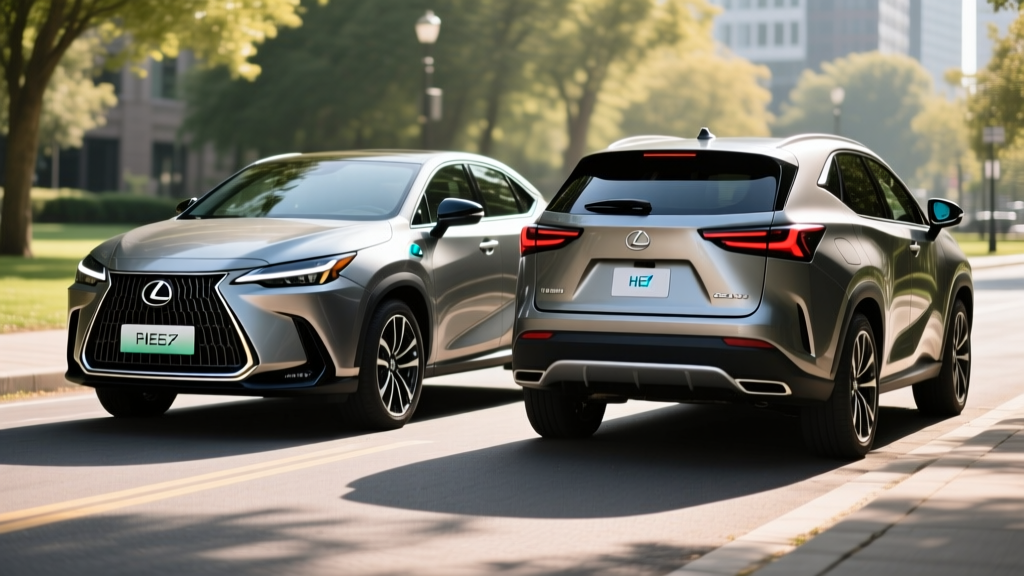
The 2025 Lexus NX Hybrid lineup gives luxury compact-SUV buyers two distinct electrified paths: the conventional NX 350h hybrid (HEV) that never needs a plug, and the NX 450h+ plug-in hybrid (PHEV) that can commute on electricity alone before its gas engine kicks in. Both share the same premium cabin and Lexus Safety System+ 3.0 suite, but their powertrains, fuel economy, and tax-credit eligibility diverge sharply. Here's every number you need to decide which one fits your garage.
HEV vs PHEV: What's the Difference in the NX Lineup?
NX 350h — Conventional Hybrid (HEV)
- No plug required — the gas engine and regenerative braking recharge a small 1.6 kWh battery
- Prioritizes seamless MPG gains with zero behavior change
- Ideal for apartment dwellers or anyone without home-charging access
- No federal EV tax credit eligibility
NX 450h+ — Plug-In Hybrid (PHEV)
- 18.1 kWh lithium-ion battery delivers 37 miles of electric-only driving
- Plug in overnight at home (Level 2) or at public stations
- Gas engine provides unlimited range once the battery depletes
- May qualify for federal §30D tax credit (rules vary — details below)
The core trade-off is simple: the NX 350h asks nothing of you and delivers strong MPG everywhere. The NX 450h+ rewards you with near-silent electric commuting but requires access to a plug — ideally a home Level 2 charger — to realize its advantage.
2025 Lexus NX Hybrid Powertrain & Performance Specs
| Specification | NX 350h (HEV) | NX 450h+ (PHEV) |
|---|---|---|
| Engine | 2.5L 4-cyl + 2 electric motors | 2.5L 4-cyl + 2 high-output electric motors |
| Combined Horsepower | 240 hp | 304 hp |
| 0–60 mph | 7.2 seconds | 6.0 seconds |
| Drivetrain | AWD (electronic rear axle) | AWD (electronic rear axle) |
| Hybrid Battery Capacity | ~1.6 kWh (NiMH) | 18.1 kWh (lithium-ion) |
| Transmission | eCVT | eCVT |
| Towing Capacity | 2,000 lbs | 2,000 lbs |
The NX 450h+ shares its plug-in powertrain architecture with the Toyota RAV4 Prime, but Lexus tunes it for more refined power delivery and a quieter cabin. The 64-hp advantage over the NX 350h is immediately noticeable in highway merging and passing.
Fuel Economy: EPA MPG & Real-World Results
| Metric | NX 350h (HEV) | NX 450h+ (PHEV) |
|---|---|---|
| EPA City MPG | 41 mpg | 38 mpg (charge-depleted) |
| EPA Highway MPG | 37 mpg | 33 mpg (charge-depleted) |
| EPA Combined MPG | 39 mpg | 36 mpg (charge-depleted) |
| Combined MPGe (PHEV EV mode) | N/A | 84 MPGe |
| Electric-Only Range (PHEV) | N/A | 37 miles |
| Total Range (PHEV) | ~520 miles | ~550 miles (EV + gas) |
Source: EPA Fuel Economy
Real-World MPG vs. EPA Stickers
Toyota's hybrid system has a well-documented characteristic: it routinely exceeds EPA city estimates in stop-and-go traffic because regenerative braking recaptures energy that gas cars waste as heat. NX 350h owners frequently report 42–44 mpg in urban driving. Highway mileage, however, tends to fall to 33–35 mpg at sustained 75+ mph speeds because the aerodynamic drag penalty overwhelms the hybrid system's advantages.
For the NX 450h+, the 37-mile electric-only range is EPA-rated and achievable in mild weather with moderate speeds. Expect 30–33 miles in cold weather (below 40°F) due to cabin heating load and reduced battery efficiency. Once the battery depletes, the NX 450h+ operates as a conventional hybrid — slightly less efficient than the NX 350h because it hauls a heavier battery pack.
NX 450h+ Charging: How Long and What You Need
The NX 450h+ accepts AC charging only — there is no DC fast-charge capability, which is typical for PHEVs in this class.
| Charging Level | Power | 0–100% Time | Notes |
|---|---|---|---|
| Level 1 (120V outlet) | ~1.4 kW | ~12 hours | Emergency/trickle only |
| Level 2 (240V, 16A) | 3.3 kW | ~5.5 hours | Standard onboard charger |
| Level 2 (240V, 32A) | 6.6 kW (optional) | ~2.5 hours | Available with Premium+ trim or standalone option |
| DC Fast Charge | N/A | N/A | Not supported — J1772 AC only |
If you opt for the 6.6 kW onboard charger, a full overnight charge on a standard Level 2 home station (like a ChargePoint Home Flex or Tesla Wall Connector with J1772 adapter) takes roughly 2.5 hours — meaning even a midday top-up during work-from-home hours is practical. The 3.3 kW base charger requires a full overnight session, which is fine for most commuters who plug in at night.
Pricing, Trims & Tax Credit Eligibility
| Model / Trim | Base MSRP (2025) |
|---|---|
| NX 350h Premium | $43,965 |
| NX 350h Premium+ | $47,065 |
| NX 350h Luxury | $50,665 |
| NX 450h+ Premium | $59,905 |
| NX 450h+ Premium+ | $62,005 |
Prices include destination. The NX 450h+ commands a roughly $13,000–$15,000 premium over a comparably trimmed NX 350h.
Federal Tax Credit for the NX 450h+
§30D Clean Vehicle Credit — Key Rules (2025 tax year):
- Maximum credit: Up to $7,500, split into $3,750 for critical-minerals sourcing and $3,750 for battery-component sourcing
- MSRP cap: SUVs must be at or below $80,000 (both NX 450h+ trims qualify)
- Buyer income limits: AGI ≤ $300,000 (joint), $225,000 (head of household), $150,000 (single)
- Battery sourcing: Critical-mineral and component requirements tighten annually — the actual credit amount depends on current-year supply-chain compliance
- Point-of-sale transfer: Eligible buyers can transfer the credit to the dealer for an immediate price reduction at purchase
Source: IRS Clean Vehicle Credit
Consult a tax professional to confirm your personal eligibility. State incentives (e.g., California, Colorado, New York) may stack on top — check your state's energy office.
The NX 350h does not qualify for any federal tax credit because it is a conventional hybrid without plug-in capability. Some states offer modest hybrid rebates, but these are rare and typically small ($250–$500).
Reliability, Battery Warranty & Replacement Cost
Lexus consistently ranks at or near the top of J.D. Power and Consumer Reports reliability surveys, and the NX Hybrid's powertrain leverages Toyota's fourth-generation hybrid system — one of the most field-proven electrified drivetrains in existence, with millions of units on the road since the original Prius.
Hybrid Battery Warranty
- Coverage: 10 years / 150,000 miles (whichever comes first)
- What's covered: Hybrid battery pack, battery control module, inverter, and related hybrid-system components
- Capacity threshold: Lexus warrants the battery against abnormal degradation — typically defined as falling below ~70% of original capacity
Battery Replacement Cost
Out-of-warranty hybrid battery replacement for the NX 350h (small NiMH pack) typically runs $2,000–$3,500 including labor. For the NX 450h+ (larger 18.1 kWh lithium-ion pack), expect $6,000–$9,000 — comparable to other PHEV battery replacements in this class. However, Toyota/Lexus hybrid batteries have demonstrated exceptional longevity, with many exceeding 200,000 miles before meaningful degradation. Individual cell replacement (rather than the full pack) is sometimes possible at independent hybrid specialists for significantly less.
Who Should Buy the NX Hybrid vs. a Full EV or Gas Car?
Choose the NX 350h (HEV) If:
- You have no access to home or workplace charging
- You want luxury-SUV refinement with 39+ MPG and zero lifestyle change
- You drive a mix of city and highway miles and want consistent efficiency
- You plan to keep the vehicle 8+ years (proven reliability, long warranty)
- Upfront cost matters — it's $13K–$15K less than the PHEV
Choose the NX 450h+ (PHEV) If:
- You can install a Level 2 charger at home
- Your daily commute is under 35 miles round-trip (you'll rarely use gas)
- You want EV-like daily driving without range anxiety on road trips
- You qualify for the federal §30D credit, narrowing the price gap
- Performance matters — 304 hp and a 6.0-second 0–60 time
What About a Full EV Instead?
If you have reliable home charging and your daily driving rarely exceeds 250 miles, a battery-electric vehicle like the Tesla Model Y, Genesis Electrified GV70, or BMW iX eliminates gasoline entirely and delivers lower per-mile fueling costs. However, the NX 450h+ makes sense if you frequently take long road trips through areas with sparse charging infrastructure, or if you simply want the safety net of a gas engine. The PHEV is a bridge — not a compromise — for drivers who aren't ready to commit to full-electric logistics.
Frequently Asked Questions
How many MPG does the 2025 Lexus NX Hybrid get?
The NX 350h achieves an EPA-rated 41 city / 37 highway / 39 combined mpg. The NX 450h+ PHEV delivers 84 MPGe in electric mode (37-mile range) and 36 mpg combined once the battery is depleted.
How far can the NX 450h+ drive on electric only?
The EPA rates the NX 450h+ at 37 miles of electric-only range. In cold weather or at sustained highway speeds, expect 30–33 miles. For most commutes under 35 miles, you can drive weeks without the gas engine engaging.
Does the Lexus NX Hybrid qualify for a tax credit?
The NX 350h conventional hybrid does not qualify for any federal tax credit. The NX 450h+ plug-in hybrid may qualify for up to $7,500 under IRS §30D, depending on your income, the vehicle's battery-sourcing compliance, and current-year rules. Check the DOE/IRS eligible vehicle list before purchasing.
Is the Lexus NX Hybrid reliable?
Lexus ranks among the most reliable luxury brands in J.D. Power Vehicle Dependability Studies. The NX Hybrid's Toyota-derived hybrid system has decades of field-proven durability. The hybrid battery is warranted for 10 years / 150,000 miles.
What does a Lexus NX hybrid battery replacement cost?
The NX 350h's smaller NiMH pack costs roughly $2,000–$3,500 to replace out of warranty. The NX 450h+ lithium-ion pack runs $6,000–$9,000. In practice, Toyota/Lexus hybrid batteries routinely last 150,000–200,000+ miles, and many owners never face a replacement.
Can the NX 450h+ DC fast charge?
No. The NX 450h+ supports AC charging only (Level 1 and Level 2) via a J1772 connector. The optional 6.6 kW onboard charger fills the 18.1 kWh battery in about 2.5 hours on a Level 2 station. This is standard for PHEVs — DC fast charging is typically reserved for battery-electric vehicles with much larger batteries.
Hybrid vs PHEV vs EV — which is right for me?
Hybrid (HEV): Best if you lack charging access and want maximum simplicity. PHEV: Best if you can charge at home and want electric commuting with gas-engine backup for road trips. Full EV: Best if you have reliable charging and want the lowest operating cost with zero tailpipe emissions. The NX lineup covers the first two; Lexus doesn't yet offer a fully electric NX equivalent.