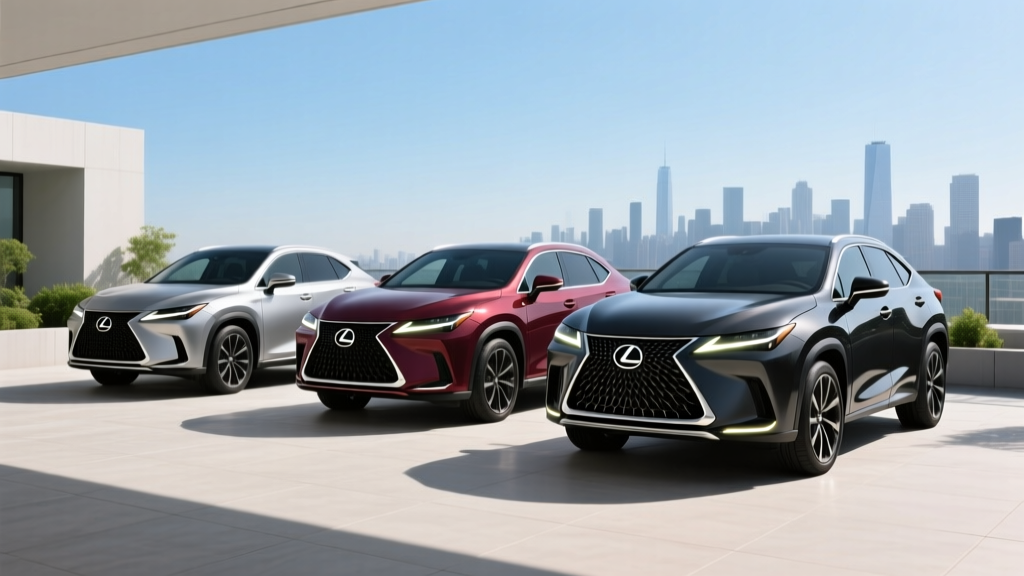
Lexus offers one of the broadest hybrid SUV lineups in the luxury segment, spanning from the compact UX Hybrid all the way to the three-row TX and the flagship LX 600. For buyers who want electrified efficiency without range anxiety or home charging infrastructure, the 2025 Lexus hybrid SUV range presents a compelling case. But with both conventional hybrids (HEVs) and plug-in hybrids (PHEVs) in the mix, choosing the right one requires understanding the real-world differences in fuel economy, electric-only range, pricing, and federal incentive eligibility.
This guide breaks down every 2025 Lexus hybrid SUV with exact EPA figures, powertrain specs, and ownership costs — the data you need to decide which model fits your driving pattern.
HEV vs PHEV: What Lexus Offers in 2025
Before diving into individual models, it's critical to understand the two hybrid architectures Lexus uses. Confusing them is the most common mistake buyers make.
Conventional Hybrid (HEV)
How it works: A small battery (typically 1–2 kWh) is charged by the gasoline engine and regenerative braking. You never plug it in.
Benefit: Better fuel economy than a gas-only vehicle with zero behavior change required. Ideal if you lack home charging access.
2025 Lexus HEV SUVs: NX 350h, RX 350h, RX 500h, TX 500h, UX 300h, LX 600 (mild-hybrid assist)
Plug-In Hybrid (PHEV)
How it works: A larger battery (18+ kWh) provides meaningful electric-only driving range. You plug in to recharge, but the gas engine eliminates range anxiety on longer trips.
Benefit: Daily commutes on electricity alone with the fallback of a gas engine for road trips. May qualify for federal tax credits.
2025 Lexus PHEV SUVs: NX 450h+, RX 500h+ (where available)
2025 Lexus Hybrid SUV Lineup: MPG, Range & Specs
Here's the complete data for every electrified Lexus SUV currently on sale, sourced from fueleconomy.gov and Lexus official specifications.
| Model | Type | EPA Combined MPG | City / Hwy MPG | Combined HP | Battery | EV Range (PHEV) | Base MSRP |
|---|---|---|---|---|---|---|---|
| NX 350h | HEV | 39 MPG | 41 / 37 | 240 hp | ~1.6 kWh NiMH | N/A | $42,465 |
| NX 450h+ | PHEV | 84 MPGe (36 MPG gas) | 38 / 33 (gas-only) | 304 hp | 18.1 kWh Li-ion | 37 miles | $59,915 |
| RX 350h | HEV | 36 MPG | 37 / 34 | 250 hp | ~1.6 kWh NiMH | N/A | $52,750 |
| RX 500h | HEV (Performance) | 30 MPG | 29 / 31 | 371 hp | ~1.4 kWh NiMH | N/A | $63,350 |
| TX 500h | HEV | 27 MPG | 27 / 28 | 371 hp | ~1.4 kWh NiMH | N/A | $66,200 |
| UX 300h | HEV | 43 MPG | 43 / 41 | 196 hp | ~1.4 kWh NiMH | N/A | $38,350 |
Pricing includes destination charge. Specs reflect 2025 model-year data as published by Lexus and the EPA.
Real-World MPG: What to Actually Expect
Lexus hybrids consistently deliver real-world fuel economy close to — or sometimes exceeding — their EPA estimates, particularly in city driving where regenerative braking recovers the most energy.
Real-world MPG expectations for 2025 Lexus hybrid SUVs:
- City driving: Most Lexus HEVs match or slightly exceed EPA city figures. The UX 300h and NX 350h are especially efficient in stop-and-go traffic, where the electric motor handles low-speed propulsion and regen captures braking energy.
- Highway driving: Expect 2–4 MPG below EPA highway estimates at sustained 75–80 mph speeds. Hybrid systems provide less benefit at constant high speed, where the gas engine does most of the work.
- Cold weather: Fuel economy drops 5–15% in freezing temperatures as the engine runs more frequently for cabin heat and battery conditioning.
- PHEV gas-only mode: Once the NX 450h+ depletes its battery, real-world gas-only MPG typically lands around 33–35 MPG combined — slightly below the EPA's 36 MPG blended rating.
For context, a driver covering 12,000 miles per year in an NX 350h at 39 MPG combined uses roughly 308 gallons of fuel annually. At $3.50/gallon, that's about $1,078/year — compared to roughly $1,714 for a comparable non-hybrid luxury compact SUV averaging 25 MPG.
NX 450h+ PHEV Deep Dive: Electric Range & Charging
The NX 450h+ is the standout in the lineup for buyers who can charge at home. Its 18.1 kWh lithium-ion battery pack delivers an EPA-rated 37 miles of electric-only range — enough to cover the average American's one-way commute (roughly 16 miles, per Census Bureau data) with room to spare.
| Charging Method | Power | 0–100% Time | Notes |
|---|---|---|---|
| Level 1 (120V household outlet) | ~1.4 kW | ~12 hours | Trickle charge; suitable for overnight if daily use is under 30 miles |
| Level 2 (240V home charger) | ~3.3 kW (onboard charger limit) | ~5.5 hours | Standard home charging; full overnight replenishment |
| DC Fast Charging | Not supported | N/A | The NX 450h+ does NOT have a DC fast-charge port |
The 3.3 kW onboard charger is the limiting factor here — even if you connect to a 48-amp Level 2 station capable of 11.5 kW, the NX 450h+ will only draw 3.3 kW. This is a deliberate engineering trade-off: the smaller onboard charger saves weight and cost, and Lexus determined that overnight Level 2 charging meets most PHEV owners' needs. However, it means you cannot top up quickly at a public DC fast charger during a road trip.
Total combined range (electric + gas) is approximately 420–440 miles depending on driving conditions.
Battery Warranty, Reliability & Replacement Costs
Hybrid battery longevity is consistently the top concern for buyers considering their first hybrid. Lexus has one of the strongest track records in the industry.
2025 Lexus Hybrid Battery Warranty
Hybrid Battery: 10 years or 150,000 miles (whichever comes first) — transferable to subsequent owners.
Hybrid System Components: 8 years or 100,000 miles, covering the inverter, electric motor, and related control electronics.
Basic Vehicle Warranty: 4 years / 50,000 miles bumper-to-bumper; 6 years / 70,000 miles powertrain.
Lexus hybrid batteries are engineered for longevity, and real-world data from Toyota/Lexus hybrid vehicles (which share the same hybrid synergy drive architecture) shows most original hybrid batteries lasting well beyond 150,000 miles with gradual capacity loss rather than sudden failure. The NiMH packs used in most Lexus HEVs are particularly robust — they avoid the thermal stress issues that can affect high-energy-density lithium-ion cells.
Out-of-warranty replacement cost: If a hybrid battery does need replacement after the warranty period, expect to pay between $3,000 and $5,500 for a refurbished or new OEM pack, plus roughly $500–$1,000 in labor. The PHEV's larger lithium-ion battery (NX 450h+) will cost more — estimated at $6,000–$9,000 — though failures within the warranty period are rare.
Lexus hybrids consistently earn top reliability scores from J.D. Power and Consumer Reports, with the RX and NX lines frequently ranking at the top of their respective luxury SUV segments.
Federal & State Tax Credit Eligibility
Tax incentive eligibility varies sharply between Lexus HEVs and PHEVs under the current IRS §30D Clean Vehicle Credit rules.
- Conventional HEVs (NX 350h, RX 350h, UX 300h, etc.): Do NOT qualify for the federal §30D tax credit. This credit applies only to plug-in electric vehicles (BEVs and PHEVs) with sufficient battery capacity.
- NX 450h+ (PHEV): May qualify for up to $3,750 of the federal credit, depending on battery component and critical mineral sourcing requirements. The full $7,500 credit requires meeting both the critical minerals and battery component thresholds, and most Lexus PHEVs (assembled in Japan) do not currently meet the North American battery-sourcing rules for the full amount.
- Buyer income caps: Adjusted gross income must not exceed $150,000 (single), $225,000 (head of household), or $300,000 (joint filers).
- MSRP cap: SUVs must have an MSRP at or below $80,000. All 2025 Lexus hybrid SUVs fall under this threshold.
- Point-of-sale transfer: Eligible buyers can transfer the credit to the dealer at purchase, reducing the purchase price directly rather than waiting for a tax refund.
State incentives: Several states offer additional rebates or HOV lane access for PHEVs. California's CVRP program, for example, has offered up to $1,000–$2,000 for eligible PHEV purchases, though funding varies by cycle. Check your state's energy office for current availability.
Who Should Choose a Lexus Hybrid vs. a Full EV or Gas SUV?
Choose a Lexus HEV (NX 350h, RX 350h, UX 300h) if:
- You cannot install a home charger (apartment living, no garage, landlord restrictions)
- You want 35–43 MPG without changing any driving or fueling habits
- You frequently take long road trips and don't want to plan around charging stops
- You prioritize long-term reliability and low maintenance costs
- Your budget is $38,000–$67,000 and you don't need electric-only commuting
Choose the NX 450h+ PHEV if:
- You have access to Level 2 charging at home or work
- Your daily round-trip commute is under 35 miles (you'll rarely use gas on weekdays)
- You want electric driving for errands but gas flexibility for weekend trips
- You want to reduce your carbon footprint now while charging infrastructure matures
Choose a full EV (e.g., Tesla Model Y, BMW iX, Genesis GV60) if:
- You have reliable home Level 2 charging and access to DC fast-charging networks
- You want to eliminate gasoline entirely and minimize operating costs
- Your household has a second gas or hybrid vehicle for long trips
- You want to maximize federal tax credit eligibility (full $7,500 on qualifying BEVs)
Pros and Cons: 2025 Lexus Hybrid SUVs
Pros
- Best-in-class reliability reputation with 10yr/150k-mile hybrid battery warranty
- Real-world MPG that meets or exceeds EPA estimates in city driving
- No charging infrastructure required for HEV models
- Quiet, refined powertrain transitions between gas and electric
- Strong resale value — Lexus hybrids depreciate less than most luxury competitors
- UX 300h starts under $39K, making it one of the most affordable luxury hybrid SUVs
Cons
- PHEV (NX 450h+) limited to 3.3 kW charging — no DC fast-charge capability
- HEV models do not qualify for the federal §30D tax credit
- Highway MPG advantage is modest vs. efficient gas turbo models at sustained speed
- PHEV premium is steep: NX 450h+ costs ~$17,450 more than the NX 350h
- No fully electric Lexus SUV option yet in the compact/midsize segment (RZ 450e is limited-range)
- Third-row TX 500h MPG (27 combined) is unremarkable for a hybrid
Frequently Asked Questions
How many MPG does the 2025 Lexus NX 350h hybrid get?
The NX 350h is EPA-rated at 41 MPG city, 37 MPG highway, and 39 MPG combined. In real-world city driving with frequent stops, many owners report matching or slightly exceeding the 41 MPG city figure thanks to aggressive regenerative braking. Highway fuel economy at 75+ mph tends to settle around 34–36 MPG.
How far can the Lexus NX 450h+ go on electric only?
The EPA rates the NX 450h+ at 37 miles of electric-only range. Real-world EV range depends on temperature and driving style: expect 32–37 miles in mild weather with moderate acceleration, and 25–30 miles in freezing temperatures or at highway speeds, where battery efficiency drops and the climate system draws more power.
Is the Lexus hybrid battery reliable and what does replacement cost?
Lexus hybrid batteries are among the most reliable in the industry, backed by a 10-year / 150,000-mile warranty. Toyota/Lexus hybrid battery packs routinely last 150,000–200,000+ miles with gradual capacity degradation. Out-of-warranty replacement costs range from $3,000–$5,500 for HEV models and $6,000–$9,000 for the PHEV's larger lithium-ion pack.
Do Lexus hybrid SUVs qualify for any tax credits?
Conventional Lexus hybrids (HEVs) do not qualify for the federal §30D Clean Vehicle Credit — that credit is reserved for plug-in vehicles. The NX 450h+ PHEV may qualify for up to $3,750 depending on battery sourcing requirements and your income level. Always verify current eligibility on irs.gov before purchasing, as sourcing rules update periodically.
Do I need to plug in a Lexus hybrid?
No — only the NX 450h+ plug-in hybrid requires (or benefits from) plugging in. All other Lexus hybrid SUVs (NX 350h, RX 350h, RX 500h, TX 500h, UX 300h) are self-charging conventional hybrids. They regenerate energy during braking and use the gas engine to maintain battery charge. You simply fill up with gas as normal.
How does the UX 300h get 43 MPG?
The UX 300h achieves its class-leading 43 MPG combined (43 city / 41 highway) through a combination of its compact size, relatively low curb weight (~3,500 lbs), and a 2.0-liter four-cylinder hybrid powertrain optimized for efficiency over performance. Its 196 combined horsepower is adequate for city and suburban driving but less suited to aggressive highway merging than the larger NX or RX hybrids.
Should I buy the RX 350h or RX 500h?
Choose the RX 350h (36 MPG combined, 250 hp) if fuel economy and lower cost are priorities. Choose the RX 500h (30 MPG combined, 371 hp) if you want significantly more power for highway passing and towing, and can accept a 6 MPG penalty. The 500h's DIRECT4 all-wheel-drive system also provides more confident all-weather traction via its rear electric motor.