Quick Verdict: The 2025 Land Cruiser Hybrid at a Glance
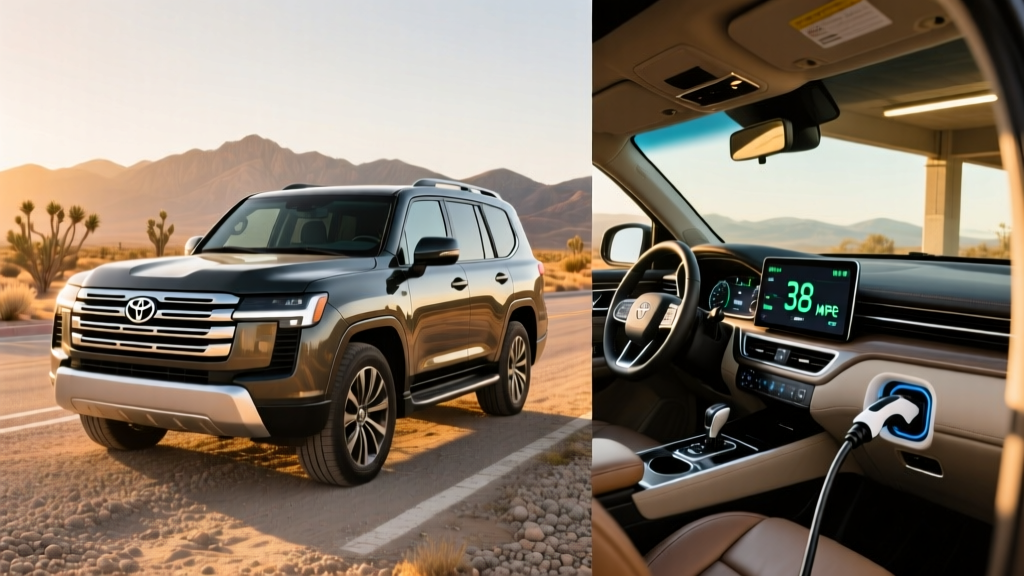
The 2025 Toyota Land Cruiser returns to the U.S. market after a four-year hiatus, and this time it's exclusively a hybrid. Built on the TNGA-F body-on-frame platform shared with the 4Runner and Sequoia, the new Land Cruiser pairs a turbocharged 2.4-liter four-cylinder engine with a permanent-magnet electric motor in Toyota's i-FORCE MAX powertrain. The result: 326 horsepower, 465 lb-ft of torque, and an EPA-estimated 23 MPG combined — respectable for a 5,000-pound body-on-frame SUV with standard full-time four-wheel drive.
Let's be clear about what this hybrid is and isn't. The 2025 Land Cruiser is a conventional hybrid (HEV), not a plug-in hybrid (PHEV). There is no charging port, no electric-only driving mode, and no federal EV tax credit eligibility. The small hybrid battery recovers energy from braking and deceleration, assisting the gas engine for improved efficiency and torque fill. If you're looking for electric-only commuting, this isn't it — but if you want a capable off-road SUV that sips less fuel than its V8 predecessors, the i-FORCE MAX delivers.
| Specification | Value |
|---|---|
| Powertrain | i-FORCE MAX 2.4L turbo I-4 + electric motor (HEV) |
| Combined Horsepower | 326 hp |
| Combined Torque | 465 lb-ft |
| Transmission | 8-speed automatic |
| Drivetrain | Full-time 4WD with low range |
| EPA MPG (City / Hwy / Combined) | 23 / 25 / 23 |
| Hybrid Battery | ~1.87 kWh NiMH (self-charging, no plug) |
| 0–60 mph | ~6.5 seconds (est.) |
| Towing Capacity | 6,000 lbs |
| Cargo Volume (behind 2nd row) | 41.4 cu ft |
| Base MSRP (1958 trim) | $57,345 |
| Base MSRP (Land Cruiser trim) | $62,345 |
| Hybrid Battery Warranty | 10 years / 150,000 miles |
HEV vs PHEV: Understanding the Land Cruiser's Hybrid System
Toyota offers hybrid systems across its lineup, but they fall into two distinct categories. The 2025 Land Cruiser uses the first type exclusively.
| Feature | HEV (2025 Land Cruiser) | PHEV (e.g., RAV4 Prime) |
|---|---|---|
| Plug-in charging | No — self-charging via regen | Yes — Level 1 or Level 2 |
| Electric-only range | None (motor assists engine only) | 25–42 miles typical |
| Battery capacity | ~1–2 kWh | ~18–22 kWh |
| Federal tax credit (§30D) | Not eligible | Up to $7,500 (if eligible) |
| Best for | No home charging access, off-road use | Short commute + home charging |
The Land Cruiser's hybrid system works transparently. The electric motor sits between the engine and transmission, providing torque fill at low RPMs where turbo lag would otherwise be noticeable. During braking and coasting, the motor acts as a generator, recapturing kinetic energy into the nickel-metal hydride (NiMH) battery pack. You'll never need to think about charging — the system manages itself entirely.
Fuel Economy: EPA Ratings and Real-World MPG
According to fueleconomy.gov, the 2025 Land Cruiser hybrid earns the following EPA estimates:
| Driving Cycle | EPA Estimate |
|---|---|
| City | 23 MPG |
| Highway | 25 MPG |
| Combined | 23 MPG |
Real-world expectations: Hybrid SUVs often exceed their EPA city estimate because regenerative braking recovers more energy in stop-and-go traffic. Expect 24–26 MPG in urban driving if you're not heavy on the throttle. Highway fuel economy tends to land closer to the EPA sticker or slightly below — around 23–24 MPG at 70–75 mph. The Land Cruiser's boxy aerodynamics and all-terrain tires work against it at speed.
In cold weather (below 30°F), expect a 5–10% efficiency reduction, primarily from increased engine idle time for cabin heat and reduced battery efficiency. Towing will drop fuel economy significantly — figure 14–17 MPG when pulling a 4,000–5,000 lb trailer, which is typical for any hybrid or gas SUV in this weight class.
For context, the previous-generation Land Cruiser (5.7L V8, discontinued 2021) returned 14 MPG combined. The i-FORCE MAX hybrid represents a roughly 64% improvement in combined fuel economy while delivering more torque and maintaining the off-road capability the nameplate demands.
i-FORCE MAX Powertrain: Engine, Motor, and Performance
The i-FORCE MAX is Toyota's performance-oriented hybrid system, distinct from the efficiency-focused Toyota Hybrid System (THS) found in the Camry or RAV4 Hybrid. Here's how the components break down:
- Engine: 2.4-liter turbocharged inline-four, producing approximately 278 hp and 317 lb-ft on its own
- Electric motor: Permanent-magnet synchronous motor integrated into the bell housing, contributing roughly 48 hp and 184 lb-ft
- Combined output: 326 hp and 465 lb-ft (peak outputs don't simply add — they're tuned for combined delivery)
- Transmission: Direct-shift 8-speed automatic with a torque converter
The electric motor's primary contribution isn't peak power — it's low-end torque. The turbo four-cylinder needs time to spool, and the electric motor fills that gap with instant torque from zero RPM. This makes the Land Cruiser feel responsive off the line and confident when merging or passing. The 0–60 mph time of approximately 6.5 seconds is quick for a body-on-frame SUV, and the 465 lb-ft of combined torque is what you'll notice most when climbing grades or pulling away from stops.
The system also enables a brief electric-only creep mode at very low speeds (parking lots, traffic jams), but this lasts only a few hundred yards before the engine restarts. This is normal HEV behavior — the battery simply doesn't have the capacity for sustained electric driving.
Off-Road Capability Meets Hybrid Efficiency
Toyota didn't compromise the Land Cruiser's off-road credentials to achieve hybrid efficiency. Both available trims — the 1958 and the Land Cruiser — come with full-time four-wheel drive, a locking center differential, and a two-speed transfer case with a low range. The Land Cruiser trim adds a rear locking differential, front stabilizer bar disconnect, and Multi-Terrain Select with Crawl Control.
The hybrid system actually benefits off-road driving. The electric motor's instant torque provides precise, controllable power at low speeds — exactly what you want when crawling over rocks or navigating deep sand. Toyota's Crawl Control leverages the motor's responsiveness for smoother low-speed modulation than a purely mechanical setup.
Ground clearance is 8.7 inches, approach angle is 31 degrees, and departure angle is 22 degrees. Water fording depth is rated at 27.6 inches. These are legitimate off-road numbers, and the hybrid powertrain doesn't diminish them.
Pricing, Trims, and Tax Credit Eligibility
The 2025 Land Cruiser hybrid is offered in two trims:
- 1958: $57,345 MSRP (including destination). Includes heated front seats, 8-inch touchscreen, wireless Apple CarPlay/Android Auto, Toyota Safety Sense 3.0, and 18-inch alloy wheels.
- Land Cruiser: $62,345 MSRP. Adds 20-inch wheels, leather-trimmed seats, 12.3-inch touchscreen, rear locking differential, stabilizer bar disconnect, Multi-Terrain Monitor camera, and JBL premium audio.
Federal tax credit status: The 2025 Land Cruiser hybrid does not qualify for the IRS §30D Clean Vehicle Credit (up to $7,500). That credit applies only to plug-in electric vehicles (BEVs and PHEVs) with sufficient battery capacity and compliant critical-mineral sourcing. Conventional hybrids like the Land Cruiser HEV are excluded under current IRS rules.
Some states offer their own incentives for hybrid vehicles, though these are increasingly rare as state programs shift focus to zero-emission vehicles. Check your state's energy or environmental agency website for current programs — amounts and eligibility vary by jurisdiction and change frequently.
Battery Warranty, Reliability, and Replacement Cost
Hybrid battery warranty: Toyota covers the Land Cruiser's hybrid battery for 10 years or 150,000 miles, whichever comes first. This is the same coverage Toyota extends across its hybrid lineup and is among the longest in the industry. The warranty covers battery capacity loss below a defined threshold as well as defects.
Toyota's hybrid battery reliability record is well-established. The Prius, now in its sixth generation, has demonstrated that NiMH and lithium-ion hybrid batteries routinely last 150,000–200,000+ miles before needing replacement. The Land Cruiser's relatively small NiMH pack operates within a conservative state-of-charge window (typically 40–80%), which significantly reduces degradation stress compared to a full EV battery that cycles through deeper discharge ranges.
Replacement cost if out of warranty: Based on current Toyota hybrid battery replacement pricing, expect $2,500–$4,000 for a new or remanufactured hybrid battery pack, plus $500–$1,000 in labor. This is substantially less than an EV traction battery replacement because the pack is small (~1.87 kWh) and uses mature NiMH chemistry. Independent hybrid battery repair shops can often replace individual failed cells for $500–$1,500, extending the pack's life at a fraction of a full replacement.
The broader powertrain — engine, transmission, electric motor — is covered under Toyota's 5-year/60,000-mile powertrain warranty, with the hybrid system components (inverter, motor, control ECU) covered under the 10-year/150,000-mile hybrid warranty.
Land Cruiser Hybrid vs Full EV vs Gas SUV: Which Fits You?
Choose the 2025 Land Cruiser hybrid if:
- You need serious off-road capability and body-on-frame durability
- You don't have reliable access to home or workplace charging
- You tow up to 6,000 lbs and want better fuel economy than a gas V6 or V8
- You want Toyota's hybrid reliability track record without plugging in
- You regularly drive in remote areas where charging infrastructure doesn't exist
Choose a plug-in hybrid (like the Toyota 4Runner PHEV or Jeep Wrangler 4xe) if:
- You have home Level 2 charging and a commute under 30 miles
- You want electric-only daily driving with gas-engine range for road trips
- You want to reduce fuel consumption significantly without range compromise
Choose a full battery-electric vehicle (like the Rivian R1S or Cadillac Escalade IQ) if:
- You have reliable home charging and want zero tailpipe emissions
- You primarily drive on-road and want the lowest per-mile fuel cost
- You qualify for the §30D federal tax credit and want to offset a higher purchase price
The Land Cruiser hybrid occupies a specific niche: buyers who prioritize off-road capability, Toyota reliability, and better-than-expected fuel economy, but who can't (or don't want to) deal with plug-in charging. It's not the most efficient option on this list — a full EV will always win on per-mile energy cost — but it's the most capable option that doesn't require any change to your fueling habits.
Pros
- 326 hp / 465 lb-ft with smooth electric torque fill
- 23 MPG combined — 64% improvement over prior V8 Land Cruiser
- Genuine off-road capability: locking diffs, low range, 8.7" ground clearance
- 10-year/150,000-mile hybrid battery warranty
- No plug-in charging required — works with existing gas-station habits
- Strong Toyota resale value and reliability history
Cons
- No electric-only driving mode — always burns gas
- No federal tax credit eligibility (HEV, not PHEV/BEV)
- Starting price above $57K; well-equipped examples push $68K+
- Only two rows of seating — no third-row option
- Highway MPG unremarkable due to boxy aero and curb weight
- Turbo four-cylinder lacks the sound and feel of the old V8
Frequently Asked Questions
How many MPG does the 2025 Land Cruiser hybrid get?
The EPA rates the 2025 Land Cruiser hybrid at 23 MPG city, 25 MPG highway, and 23 MPG combined. In real-world city driving with frequent stops, many owners report 24–26 MPG thanks to regenerative braking. Highway driving at 70+ mph typically yields 22–24 MPG. Towing drops fuel economy to roughly 14–17 MPG depending on trailer weight and terrain.
Does the 2025 Land Cruiser hybrid need to be plugged in?
No. The Land Cruiser is a conventional hybrid (HEV), not a plug-in hybrid (PHEV). There is no charging port. The small hybrid battery charges itself through regenerative braking and engine-driven generation. You fuel it exclusively with gasoline, just like a conventional vehicle.
How far can the Land Cruiser hybrid drive on electric power alone?
Essentially zero miles in any practical sense. The hybrid system can propel the vehicle at very low speeds (under ~15 mph) for a few hundred yards in parking lots or traffic jams, but the engine restarts almost immediately under any meaningful acceleration or speed. This is standard behavior for all conventional hybrids — the battery is too small for sustained electric driving.
Does the 2025 Land Cruiser hybrid qualify for any tax credit?
Not at the federal level. The IRS §30D Clean Vehicle Credit applies only to plug-in vehicles (BEVs and PHEVs) that meet battery sourcing and MSRP requirements. The Land Cruiser HEV does not qualify. Some states may offer modest hybrid incentives, but these vary by jurisdiction and are increasingly rare. Consult your state's energy office or a tax professional for current eligibility.
Is the hybrid battery reliable, and what does replacement cost?
Toyota's hybrid battery reliability is among the best in the industry, with millions of Prius, Camry Hybrid, and RAV4 Hybrid vehicles demonstrating battery lifespans of 150,000–200,000+ miles. The Land Cruiser's hybrid battery is covered for 10 years or 150,000 miles. If replacement is needed out of warranty, expect $2,500–$4,000 for the battery plus labor — significantly less than an EV battery replacement because the pack is small (~1.87 kWh). Independent hybrid shops can often repair individual cells for $500–$1,500.
How does the Land Cruiser hybrid compare to the 4Runner hybrid?
The 2025 4Runner also uses the i-FORCE MAX hybrid powertrain with 326 hp and 465 lb-ft, but it's tuned slightly differently and offers an available third row. The 4Runner's EPA ratings are similar (approximately 23–24 MPG combined for the hybrid 4WD model). The Land Cruiser is positioned as the more premium, off-road-focused option with standard full-time 4WD, while the 4Runner offers more trim variety and a lower entry price. Both are conventional hybrids with no plug-in capability.
What is the towing capacity of the 2025 Land Cruiser hybrid?
The 2025 Land Cruiser hybrid is rated to tow up to 6,000 pounds when properly equipped. The electric motor's instant torque actually benefits towing, providing strong low-speed pulling power and smoother acceleration from stops compared to a non-hybrid turbo engine. Expect fuel economy to drop to 14–17 MPG while towing a substantial load.