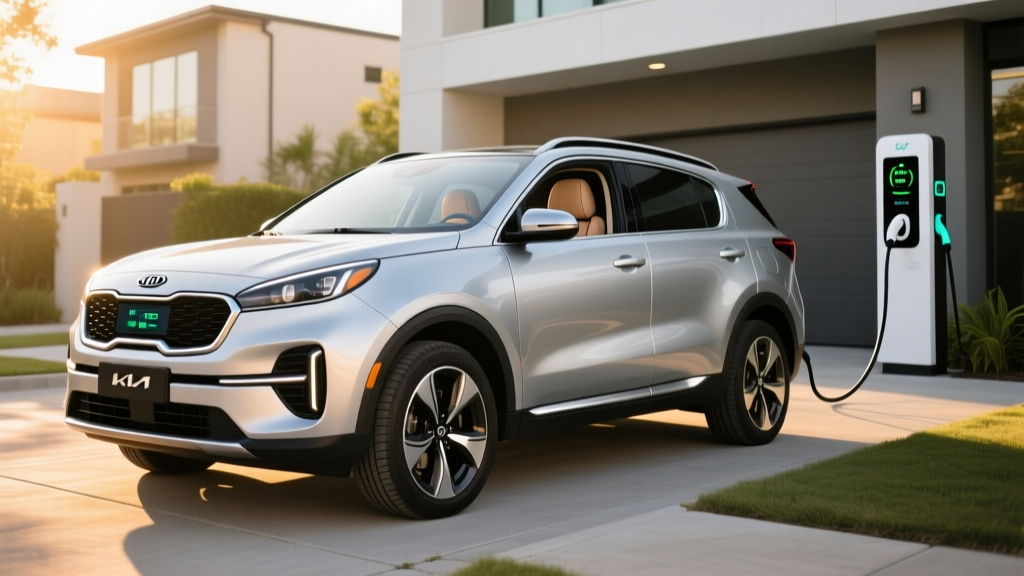
The 2025 Kia Sportage Hybrid SX-Prestige sits at the top of Kia's compact hybrid SUV lineup, bundling a 261-horsepower turbocharged powertrain with a loaded feature list and EPA-estimated fuel economy that beats most rivals in the segment. For buyers weighing a conventional hybrid against a plug-in hybrid or full battery-electric vehicle, the Sportage HEV occupies a specific niche: no plug required, no range anxiety, and real-world city MPG that often exceeds the sticker. This review breaks down the exact numbers, ownership economics, and decision framework you need before signing the paperwork.
2025 Kia Sportage Hybrid SX-Prestige: Quick Verdict
If you want a compact SUV that sips fuel in stop-and-go traffic without ever needing a charging cable, the Sportage Hybrid SX-Prestige delivers. Its 1.6-liter turbocharged engine paired with a 47.7 kW electric motor produces a combined 261 hp — enough for confident highway merging and a 0-60 mph time of approximately 7.4 seconds. The SX-Prestige trim adds premium touches like a panoramic sunroof, heated and ventilated front seats, a Harman Kardon audio system, and Kia's full suite of ADAS features. At an MSRP starting around $38,090 (including destination), it undercuts comparably equipped hybrid rivals from Toyota and Honda while offering more standard technology.
| Spec | Value |
|---|---|
| Powertrain | 1.6L turbo I-4 + 47.7 kW electric motor (6-speed auto) |
| Combined Output | 261 hp / 258 lb-ft torque |
| EPA Fuel Economy (FWD) | 43 city / 34 highway / 38 combined MPG |
| EPA Fuel Economy (AWD) | 38 city / 34 highway / 36 combined MPG |
| 0-60 mph | ~7.4 seconds |
| Cargo Volume | 39.6 cu ft (rear seats up) / 73.7 cu ft (folded) |
| Towing Capacity | 2,000 lbs |
| Base MSRP (SX-Prestige FWD) | $38,090 (incl. destination) |
| Hybrid Battery Warranty | 10 years / 100,000 miles |
| Tax Credit Eligibility | Not eligible for §30D federal credit (HEV, not PHEV/BEV) |
HEV vs. PHEV: Which Sportage Hybrid Is Which?
Kia offers the Sportage in three powertrain flavors for 2025: a conventional gas-only model, a conventional hybrid (HEV), and a plug-in hybrid (PHEV). This review focuses on the HEV, but the distinction matters because buyers frequently confuse the two hybrid types.
| Attribute | Sportage Hybrid (HEV) | Sportage Plug-In Hybrid (PHEV) |
|---|---|---|
| Needs to be plugged in? | No — self-charging via engine + regen | Yes — for max electric-only range |
| Electric-only range | None (EV assist only at low speeds) | ~34 miles (EPA est.) |
| Battery size | ~1.49 kWh (small buffer) | 13.7 kWh usable |
| Combined horsepower | 261 hp | 261 hp |
| EPA combined MPG / MPGe | 38 MPG (combined, FWD) | 84 MPGe (elec+gas) / 35 MPG (gas only) |
| Federal tax credit (§30D) | Not eligible | Eligible (up to $7,500, subject to sourcing/income rules) |
| Starting MSRP (top trim) | ~$38,090 (SX-Prestige) | ~$43,090 (X-Line Prestige) |
The HEV uses a small battery that charges entirely through regenerative braking and the gasoline engine. You never plug it in — you just fill up at any gas station and drive. The PHEV, by contrast, has a larger 13.7 kWh battery that you can charge at home via a Level 2 (240V) outlet for roughly 34 miles of electric-only driving before the gas engine kicks in. If your commute is under 30 miles round-trip and you have home charging access, the PHEV can run almost entirely on electricity for daily driving. If you lack reliable charging access, the HEV is the simpler, lower-cost choice.
Fuel Economy: EPA Estimates and Real-World MPG
The EPA rates the 2025 Sportage Hybrid FWD at 43 city / 34 highway / 38 combined MPG. AWD models drop slightly to 38 city / 34 highway / 36 combined. These figures come from fueleconomy.gov and represent the official government estimates.
| Drivetrain | City MPG | Highway MPG | Combined MPG |
|---|---|---|---|
| FWD | 43 | 34 | 38 |
| AWD | 38 | 34 | 36 |
Real-World MPG: What to Actually Expect
Conventional hybrids like the Sportage HEV tend to exceed their EPA city estimates in real-world stop-and-go driving, where the electric motor does the most work and regenerative braking recaptures energy constantly. Owners and independent testers have reported city figures in the 40-46 MPG range for FWD models in moderate temperatures. Highway driving is a different story: at sustained 70-80 mph speeds, the turbocharged engine carries more of the load, and real-world highway MPG typically settles between 30-33 MPG — slightly below the EPA highway estimate.
Cold weather reduces hybrid efficiency by roughly 10-15% due to thicker fluids, reduced battery performance, and increased cabin heating demand. In winter testing at temperatures below 30°F, expect combined MPG in the 32-35 range for FWD models. This is still substantially better than a comparable gas-only compact SUV, which typically returns 24-28 MPG combined.
Powertrain and Performance Details
The Sportage Hybrid pairs a 1.6-liter turbocharged inline-four (producing 178 hp and 195 lb-ft on its own) with a 47.7 kW (64 hp) electric motor integrated into the transmission housing. Combined output is 261 hp and 258 lb-ft of torque. Unlike some competitors that use a continuously variable transmission (CVT), Kia routes power through a conventional 6-speed automatic, which gives more natural-feeling acceleration without the rubber-band effect some drivers dislike in CVTs.
The result is a 0-60 mph time of approximately 7.4 seconds — quicker than the Toyota RAV4 Hybrid (~7.6 sec) and Honda CR-V Hybrid (~7.8 sec). The Sportage Hybrid's turbocharged engine provides strong mid-range torque, making highway passing maneuvers confident. The AWD system uses a traditional mechanical driveshaft to the rear wheels (not a separate rear electric motor as in some rival systems), which contributes to the slight city MPG penalty versus FWD.
Pricing, Trims, and Tax Credit Eligibility
The 2025 Sportage Hybrid is offered in three trims: LX, EX, and SX-Prestige. The SX-Prestige is the range-topper and includes features like a 12.3-inch digital instrument cluster, a 12.3-inch infotainment touchscreen with navigation, wireless Apple CarPlay and Android Auto, a Harman Kardon premium audio system, a panoramic sunroof, heated and ventilated front seats, heated rear seats, a heated steering wheel, a power liftgate, LED projector headlights, and Kia's full Highway Driving Assist 2 (HDA2) ADAS suite.
Pricing for the SX-Prestige starts at approximately $38,090 for FWD and $39,890 for AWD (including destination charges). Add roughly $500-$800 for premium paint colors.
Does the Sportage Hybrid Qualify for a Federal Tax Credit?
No. The conventional Sportage Hybrid (HEV) does not qualify for the IRS §30D Clean Vehicle Credit. That credit applies only to plug-in electric vehicles (BEVs and PHEVs) that meet specific battery sourcing, critical mineral, MSRP cap, and buyer income requirements. The HEV has no plug and no large battery, so it falls outside the program entirely. If federal tax incentives are a priority, consider the Sportage PHEV or a full BEV instead. Some states offer separate rebates for conventional hybrids — check your state energy office for current programs, as these vary widely by jurisdiction.
Battery Warranty, Lifespan, and Replacement Cost
Hybrid Battery Warranty: Kia covers the Sportage Hybrid's lithium-ion battery pack for 10 years or 100,000 miles, whichever comes first. This is one of the longest hybrid battery warranties in the industry and matches Toyota's coverage. The warranty covers defects and capacity loss below a functional threshold.
Hybrid batteries in modern vehicles like the Sportage are designed to last the life of the vehicle under normal use. The ~1.49 kWh battery in the HEV is small and operates within a narrow state-of-charge window (the car's management system never fully charges or fully depletes it), which dramatically reduces degradation stress. Most hybrid batteries from Kia, Toyota, and Honda last 150,000-200,000+ miles without requiring replacement.
If replacement is eventually needed out of warranty, expect a cost in the $2,000-$4,000 range for the HEV's small battery pack — significantly less than a full EV battery replacement. Refurbished packs and third-party repair shops are increasingly available and can reduce this cost further. For context, the PHEV's larger 13.7 kWh battery would cost considerably more to replace ($6,000-$9,000 estimated), but it carries the same 10-year/100,000-mile warranty.
Who Should Choose the Sportage Hybrid (and Who Shouldn't)
Choose the Sportage HEV if:
- You lack access to home or workplace charging (apartment, street parking)
- Your driving is primarily city and suburban with frequent stops
- You want maximum simplicity — no charging cables, no behavioral changes
- Your budget is under $40,000 and you want a loaded compact SUV
- You drive 12,000-15,000 miles per year and want to cut fuel costs 30-40% vs. a gas-only SUV
Choose the Sportage PHEV if:
- You have Level 2 home charging and a commute under 34 miles round-trip
- You want electric-only daily driving with gas-engine flexibility for road trips
- You may qualify for the §30D federal tax credit (up to $7,500, subject to IRS rules)
Choose a full BEV (e.g., Hyundai Ioniq 5, Tesla Model Y) if:
- You have reliable home charging and want zero tailpipe emissions
- You drive under 250 miles between charging opportunities most days
- You want to eliminate gas station visits entirely and minimize maintenance
Pros
- 43 MPG city (FWD) — class-leading for a turbocharged hybrid SUV
- 261 hp provides confident acceleration (7.4 sec 0-60)
- 6-speed automatic avoids CVT drone
- SX-Prestige is loaded with premium features at ~$38K
- 10-year/100,000-mile hybrid battery warranty
- Spacious cargo area (39.6 cu ft behind rear seats)
- Comprehensive ADAS suite standard (HDA2, blind-spot, rear cross-traffic)
Cons
- Highway MPG (34 EPA) trails some competitors; real-world highway often 30-33
- AWD system uses mechanical driveshaft, reducing city MPG advantage
- No federal tax credit for the HEV
- Infotainment learning curve with dual-screen layout
- Rear visibility somewhat limited by thick C-pillars
Ownership Costs: 5-Year Fuel Savings vs. Gas-Only Sportage
At 15,000 miles per year and a national average gas price of $3.40/gallon (check current prices in your area), the Sportage Hybrid FWD at 38 MPG combined uses approximately 395 gallons annually, costing about $1,343 per year. The gas-only Sportage AWD (25 MPG combined) uses 600 gallons per year, costing about $2,040. That's a fuel savings of roughly $697 per year, or about $3,485 over five years. The HEV's price premium over the gas-only LX trim is approximately $2,000-$3,000, meaning the fuel savings alone can pay back the hybrid premium within 3-4 years before factoring in any maintenance differences.
Hybrids also tend to have slightly lower brake wear costs due to regenerative braking doing much of the deceleration work. However, insurance premiums for the hybrid may be 5-10% higher than the gas model — get a quote before purchasing to budget accurately.
Frequently Asked Questions
How many MPG does the 2025 Kia Sportage Hybrid get?
The EPA rates the FWD model at 43 city / 34 highway / 38 combined MPG. AWD models are rated at 38 city / 34 highway / 36 combined. Real-world city driving often exceeds the EPA city estimate, while sustained highway driving at 75+ mph typically returns 30-33 MPG.
Does the Sportage Hybrid need to be plugged in?
No. The conventional Sportage Hybrid (HEV) charges its own small battery through regenerative braking and the gasoline engine. You never plug it in. Only the Sportage PHEV (plug-in hybrid) requires plugging in to access its 34 miles of electric-only range.
Is the Kia Sportage Hybrid reliable?
Kia's hybrid powertrain has proven reliable across multiple model years. The 1.6L turbo engine and electric motor combination has been used across the Kia/Hyundai lineup since 2022 with no widespread failure patterns reported. The hybrid battery carries a 10-year/100,000-mile warranty. IIHS and NHTSA safety ratings should be checked for the latest crash-test scores.
What does it cost to replace the hybrid battery?
Out-of-warranty replacement for the Sportage HEV's ~1.49 kWh hybrid battery is estimated at $2,000-$4,000. However, most hybrid batteries last 150,000-200,000+ miles, and Kia's 10-year/100,000-mile warranty provides long-term coverage. The battery operates within a narrow charge window to minimize degradation.
Does the 2025 Sportage Hybrid qualify for any tax credit?
The conventional hybrid (HEV) does not qualify for the federal §30D Clean Vehicle Credit, which applies only to plug-in vehicles. The Sportage PHEV may qualify for up to $7,500 depending on battery sourcing, buyer income, and MSRP caps — consult a tax professional and review current IRS guidance. Some states offer hybrid-specific rebates; check your state energy office.
How does the Sportage Hybrid compare to the RAV4 Hybrid?
The Toyota RAV4 Hybrid is rated at 41 city / 38 highway / 41 combined MPG — slightly better on the highway due to its rear-motor AWD system. However, the Sportage Hybrid offers more horsepower (261 vs. 219), quicker acceleration, more cargo volume, and a longer warranty. The RAV4 Hybrid's advantage is its higher highway MPG and Toyota's long-standing hybrid reliability reputation.