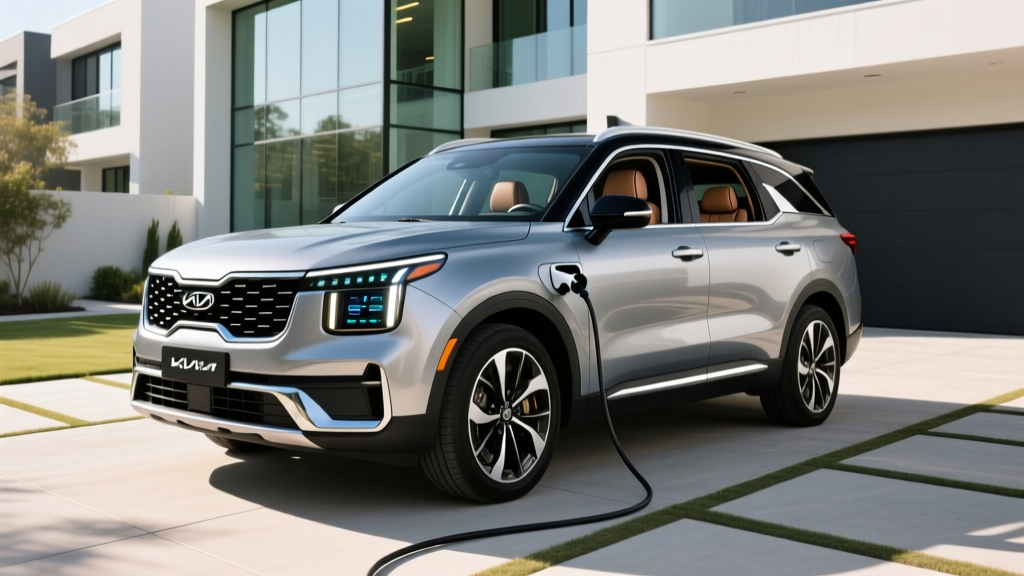
The 2025 Kia Sorento Hybrid SX Prestige sits at the top of Kia's three-row hybrid lineup, packing premium features, standard all-wheel drive, and a turbocharged hybrid powertrain into a midsize SUV that undercuts competitors on price. For families who need three rows but aren't ready to commit to a full battery-electric vehicle, the Sorento Hybrid offers a compelling bridge — real fuel savings without range anxiety or charging infrastructure dependency.
This review focuses on the range-topping SX Prestige trim, covering its EPA fuel economy, real-world efficiency, powertrain specs, battery longevity, pricing, and how it stacks up against plug-in hybrid and full EV alternatives.
HEV vs PHEV: Which Sorento Hybrid Are We Talking About?
Kia sells two electrified Sorento variants, and confusing them is the most common buyer mistake. The Sorento Hybrid (HEV) is a conventional, self-charging hybrid — it recovers energy through regenerative braking and its gasoline engine, never needing to be plugged in. The Sorento Plug-In Hybrid (PHEV) has a larger battery you charge from a wall outlet and offers roughly 32 miles of electric-only driving before the gas engine kicks in.
| Feature | Sorento Hybrid (HEV) | Sorento Plug-In Hybrid (PHEV) |
|---|---|---|
| Plug-in required? | No — self-charging | Yes — Level 1 or Level 2 |
| Battery capacity | ~1.49 kWh | 13.8 kWh |
| Electric-only range | N/A (electric assist only) | 32 miles (EPA) |
| Combined horsepower | 261 hp | 261 hp |
| EPA combined MPG / MPGe | 34 MPG | 79 MPGe (electric) / 34 MPG (gas) |
| DC fast charging | N/A | No — Level 2 only |
| Federal tax credit (§30D) | Not eligible | Eligible — up to $7,500* |
| Starting MSRP (SX Prestige) | ~$47,590 | ~$51,590 |
*§30D eligibility depends on buyer income, MSRP caps, and battery critical-mineral sourcing. Verify current-year rules at irs.gov.
This review focuses on the Sorento Hybrid (HEV) in SX Prestige trim. If you have home charging access and a short commute, the PHEV variant is worth the premium — we'll note where it diverges.
Fuel Economy: EPA Ratings and Real-World MPG
The 2025 Sorento Hybrid pairs a 1.6-liter turbocharged four-cylinder engine with a 47.7 kW electric motor and a six-speed automatic transmission, sending 261 combined horsepower to all four wheels through Kia's AWD system. The EPA rates it at:
| Driving Cycle | EPA Rating | Real-World Expectation |
|---|---|---|
| City | 34 MPG | 35–38 MPG (regenerative braking shines in stop-and-go) |
| Highway | 34 MPG | 30–33 MPG (aerodynamic drag and AWD parasitic loss) |
| Combined | 34 MPG | 32–36 MPG depending on driving mix |
Like most hybrids, the Sorento Hybrid tends to exceed its EPA city rating in real-world urban driving. Regenerative braking recaptures kinetic energy that a conventional gas car wastes as heat, so the more you stop, the more the electric motor assists. On a 200-mile highway-heavy road trip at 75 mph, expect fuel economy to dip to the low 30s — the turbo engine works harder without frequent regen opportunities.
In cold weather (below 30°F), expect a 5–10% reduction in MPG. The engine runs more frequently to heat the cabin and maintain battery temperature, reducing the electric motor's contribution. This is normal hybrid behavior, not a defect.
For comparison, the non-hybrid 2025 Sorento with the 2.5L turbo achieves 22 MPG combined — a 12 MPG gap that translates to roughly $400–$550 in annual fuel savings for a driver covering 15,000 miles per year at $3.40/gallon.
Powertrain and Performance Specs
| Specification | 2025 Sorento Hybrid SX Prestige |
|---|---|
| Engine | 1.6L turbocharged GDI inline-4 |
| Electric motor | 47.7 kW (64 hp) permanent-magnet synchronous |
| Combined system output | 261 hp / 258 lb-ft torque |
| Transmission | 6-speed automatic (no CVT) |
| Drivetrain | AWD (standard on all Hybrid trims) |
| 0–60 mph | ~7.7 seconds |
| Towing capacity | 2,000 lbs |
| Cargo volume (behind 3rd / 2nd row) | 12.6 / 45.0 cu ft |
| Seating | 7 passengers (bench 2nd row) |
| Curb weight | ~4,365 lbs |
The six-speed automatic is a deliberate choice over the CVTs found in competitors like the Toyota Highlander Hybrid. It delivers more natural shift feel and better highway passing response, though a CVT might extract marginally better city MPG. The 261 hp output puts the Sorento Hybrid ahead of the Highlander Hybrid (243 hp) and close to the Mazda CX-90 PHEV (327 hp), though the Kia is significantly lighter.
Battery Warranty, Lifespan, and Replacement Cost
Hybrid battery longevity is the number-one concern for buyers new to electrified powertrains. The Sorento Hybrid uses a relatively small 1.49 kWh lithium-ion battery pack — far smaller than an EV's 60–100 kWh pack — and it operates within a narrow state-of-charge window managed by the vehicle's battery management system. This shallow-cycling approach dramatically extends cell life.
Kia Hybrid Battery Warranty
- Hybrid battery: 10 years / 100,000 miles (whichever comes first)
- Hybrid system components: 10 years / 100,000 miles
- Bumper-to-bumper: 5 years / 60,000 miles
- Powertrain: 10 years / 100,000 miles
Kia's warranty covers the hybrid battery against defects and capacity loss below a manufacturer-defined threshold. This warranty is transferable to second owners, which supports resale value.
Real-world data from Kia and Hyundai hybrids (which share powertrain architecture) shows hybrid batteries routinely lasting 150,000–200,000+ miles before meaningful degradation. Out-of-warranty replacement for the Sorento Hybrid's 1.49 kWh pack is estimated at $2,000–$3,500 including labor — significantly less than EV battery replacement because the pack is small and accessible.
For the PHEV variant with its larger 13.8 kWh battery, replacement costs would be higher (estimated $4,000–$6,000), but the same 10-year/100,000-mile warranty applies.
SX Prestige Trim: What You Get for the Price
The SX Prestige is the top-of-line trim for the Sorento Hybrid, and it bundles features that would cost thousands as add-ons elsewhere. The 2025 model year brings a refreshed interior with Kia's latest infotainment system, dual 12.3-inch displays, and updated driver-assistance features.
Key SX Prestige standard equipment includes:
- Nappa leather seat trim with heated and ventilated front seats
- Heated steering wheel and heated second-row outboard seats
- Head-up display (HUD)
- Highway Driving Assist 2 (HDA2) — Kia's Level 2 adaptive cruise with lane-centering
- Remote Smart Parking Assist
- 12-speaker Bose premium audio
- Wireless Apple CarPlay and Android Auto
- Surround-view monitor with blind-spot view
- 19-inch alloy wheels
- LED projection headlights with dynamic bending light
The 2025 Sorento Hybrid SX Prestige carries an MSRP of approximately $47,590 (including destination). This positions it roughly $3,000–$5,000 below a comparably equipped Toyota Highlander Hybrid Limited and $8,000+ below the Mazda CX-90 PHEV in its top trim.
Tax Credit Eligibility
The conventional Sorento Hybrid (HEV) does not qualify for the federal §30D clean vehicle tax credit, which is reserved for plug-in electric vehicles and fuel-cell vehicles. Some states offer hybrid-specific rebates or HOV lane access — check your state's energy office or fueleconomy.gov for local incentive details, as these vary by jurisdiction and change frequently.
If tax credit eligibility is a priority, the Sorento Plug-In Hybrid may qualify for up to $7,500 under §30D, subject to buyer income caps ($150K single / $300K joint), MSRP caps ($80,000 for SUVs), and battery critical-mineral and component sourcing requirements. Always confirm current-year eligibility with a tax professional and reference the IRS clean vehicle credit page.
Who Should Choose the Sorento Hybrid Over an EV or Gas SUV?
Decision Framework: Is This the Right Powertrain for You?
Choose the Sorento Hybrid (HEV) if:
- You don't have access to home or workplace Level 2 charging
- You regularly drive more than 300 miles between stops (road trips, rural routes)
- You want fuel savings without changing your refueling habits
- You live in an area with sparse DC fast-charging infrastructure
- Your budget is under $50K for a three-row electrified SUV
Choose the Sorento Plug-In Hybrid (PHEV) if:
- You can install a Level 2 charger at home
- Your daily commute is under 30 miles round-trip (most driving on electric)
- You want to minimize gasoline use while keeping gas-engine range for road trips
- You may qualify for the §30D federal tax credit
Choose a full BEV (e.g., Kia EV9, Hyundai Ioniq 5) if:
- You have reliable home Level 2 charging
- Your daily driving is under 250 miles and you can plan road-trip charging stops
- You want zero tailpipe emissions and the lowest per-mile fuel cost
- You're eligible for the full $7,500 federal tax credit
The Sorento Hybrid's sweet spot is the family that drives 12,000–18,000 miles per year in a mix of suburban and highway conditions, lacks home charging access, and needs three rows without stepping up to a minivan or full-size SUV. At 34 MPG combined, it'll use roughly 440 gallons per year at 15,000 miles — compared to 625 gallons for the gas-only Sorento turbo, a savings of about 185 gallons annually.
Reliability, Safety Ratings, and Ownership Costs
Kia's 1.6T hybrid powertrain has been in service across the Hyundai-Kia lineup since 2021 (Tucson Hybrid, Sorento Hybrid, Sportage Hybrid), and long-term reliability data is encouraging. The system has fewer moving parts than a conventional turbo-only powertrain — the electric motor smooths load on the engine, reducing wear. Common complaints in earlier model years centered on infotainment software, not the hybrid system itself.
Safety ratings for the 2025 Sorento are strong. The previous-generation Sorento earned an IIHS TOP SAFETY PICK award, and the 2025 refresh carries forward the same structural platform with updated HDA2 driver-assistance features. The National Highway Traffic Safety Administration (NHTSA) rates the Sorento family highly in crash testing.
A note on HDA2: this is an SAE Level 2 driver-assistance system, meaning it provides adaptive cruise control and lane-centering simultaneously, but the driver must remain fully attentive and keep hands on or near the wheel at all times. It is not autonomous driving.
Insurance costs for the Sorento Hybrid SX Prestige run roughly 5–10% higher than the gas-only equivalent, reflecting the higher repair cost of hybrid-specific components and the vehicle's higher MSRP. Shop quotes from multiple carriers — hybrid insurance premiums vary widely by insurer.
Pros and Cons at a Glance
Pros
- 34 MPG combined is excellent for a 4,365-lb three-row AWD SUV
- SX Prestige trim is loaded — HUD, Bose, ventilated seats, HDA2 standard
- 10-year/100,000-mile hybrid battery and powertrain warranty
- 261 hp provides confident merging and highway passing
- No plug-in required — zero lifestyle change from a gas car
- Competitive pricing vs Highlander Hybrid, CX-90, and Atlas
Cons
- Third row is tight for adults — best for children on longer trips
- 2,000-lb towing capacity is low for the segment
- No DC fast charging (HEV doesn't need it; PHEV also lacks it)
- No federal tax credit for the HEV variant
- Highway MPG dips to low 30s at sustained 75+ mph speeds
- Cargo space behind the third row (12.6 cu ft) is modest
Frequently Asked Questions
How many MPG does the 2025 Kia Sorento Hybrid get?
The EPA rates the 2025 Sorento Hybrid AWD at 34 MPG city, 34 MPG highway, and 34 MPG combined. In real-world driving, expect 35–38 MPG in city traffic (where regenerative braking excels) and 30–33 MPG on sustained highway trips at 70–80 mph. Cold weather may reduce these figures by 5–10%.
How far can the Sorento Plug-In Hybrid go on electric only?
The Sorento PHEV delivers an EPA-rated 32 miles of electric-only range on its 13.8 kWh battery. That covers most daily commutes without burning gasoline. Once the battery is depleted, it operates as a conventional hybrid at 34 MPG combined. Total range exceeds 420 miles.
Is the Kia Sorento Hybrid reliable, and what does battery replacement cost?
Kia's 1.6T hybrid system has been in production since 2021 with no widespread reliability issues. The hybrid battery is warrantied for 10 years/100,000 miles. Out-of-warranty replacement for the HEV's 1.49 kWh pack is estimated at $2,000–$3,500. Real-world data suggests these packs routinely last 150,000–200,000+ miles.
Does the Sorento Hybrid qualify for a federal tax credit?
No. The conventional Sorento Hybrid (HEV) does not qualify for the IRS §30D clean vehicle tax credit, which requires plug-in capability. The Sorento Plug-In Hybrid may qualify for up to $7,500, subject to income caps, MSRP limits, and battery sourcing requirements. Check irs.gov for current-year eligibility.
Can I tow with the Sorento Hybrid?
Yes, but capacity is limited to 2,000 pounds — enough for a small utility trailer, a pair of jet skis, or a lightweight pop-up camper. If you need 3,500–5,000 lbs of towing, look at the Kia Telluride or a body-on-frame SUV.
How does the Sorento Hybrid compare to the Toyota Highlander Hybrid?
The Highlander Hybrid achieves 35 MPG combined (1 MPG better) and offers a more spacious third row, but starts higher in price for equivalent trims and delivers less power (243 hp vs 261 hp). The Sorento Hybrid wins on value and feature content at the SX Prestige level; the Highlander wins on third-row space and slightly better fuel economy.