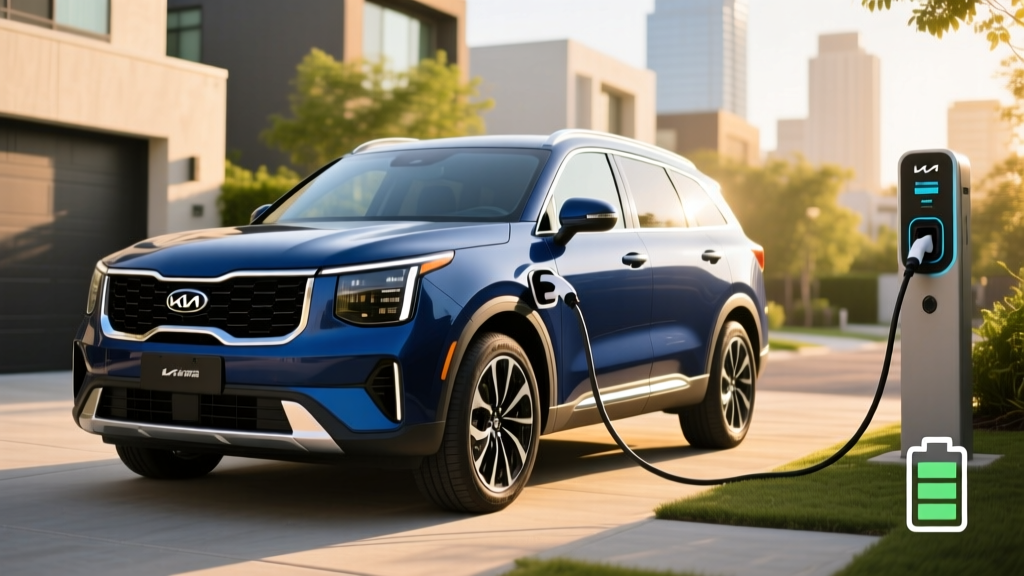
The three-row midsize SUV segment is crowded, but the 2025 Kia Sorento Hybrid SUV occupies a specific niche: family hauler with genuine electrified efficiency, available in both conventional hybrid (HEV) and plug-in hybrid (PHEV) forms. For buyers who want three rows, better fuel economy than a pure gas model, but aren't ready to commit to a full battery-electric vehicle, the Sorento Hybrid lineup deserves a close look. Here's every number that matters — MPG, range, pricing, warranty, and tax-credit reality — without the marketing gloss.
HEV vs PHEV: Which 2025 Sorento Hybrid Fits You?
Kia offers the Sorento in two distinct electrified configurations for 2025. Confusing them is easy at the dealership; understanding the difference is essential before you sign.
| Feature | Sorento Hybrid (HEV) | Sorento Plug-In Hybrid (PHEV) |
|---|---|---|
| Needs to plug in? | No — self-charging via regen & engine | Yes — plug in to access electric-only range |
| Battery size | 1.49 kWh (lithium-ion) | 13.8 kWh (lithium-ion) |
| Electric-only driving | Brief low-speed assist only | EPA-est. 32 miles |
| Combined horsepower | 227 hp | 261 hp |
| Drivetrain | AWD standard | AWD standard |
| Seating | 3 rows / 6-7 passengers | 3 rows / 6-7 passengers |
The conventional HEV never needs a plug — it captures energy through regenerative braking and the gasoline engine to keep its small battery charged. The PHEV has a substantially larger battery that you charge via a standard 120V outlet (Level 1) or a 240V home charger (Level 2), giving you roughly 32 miles of pure electric driving before the gasoline engine kicks in as a hybrid.
Fuel Economy: EPA MPG and Real-World Numbers
Fuel efficiency is the headline reason buyers choose the Sorento Hybrid over the gasoline-only Sorento. Here's what the EPA reports for the 2025 model year:
| Model | City MPG | Highway MPG | Combined MPG | MPGe (PHEV w/ elec.) |
|---|---|---|---|---|
| Sorento Hybrid (HEV) AWD | 34 | 34 | 34 | N/A |
| Sorento PHEV AWD (hybrid mode) | 33 | 34 | 33 | 79 MPGe |
Real-world expectation: Kia's hybrid system, like Toyota's, tends to deliver city MPG that meets or slightly exceeds the EPA sticker because regenerative braking recovers energy in stop-and-go traffic. Expect 33–36 MPG combined in mixed suburban driving. On sustained highway trips at 75+ mph, expect a dip to roughly 29–31 MPG — hybrids lose their city advantage at high constant speeds where the electric motor contributes less. In cold weather (below 30°F), plan for a 5–8% reduction across the board as the engine runs more frequently to provide cabin heat.
Powertrain Specs: What's Under the Hood
| Specification | Sorento HEV | Sorento PHEV |
|---|---|---|
| Engine | 1.6L turbo 4-cyl | 1.6L turbo 4-cyl |
| Electric motor | 47.7 kW (64 hp) | 66.9 kW (90 hp) |
| Combined output | 227 hp / 258 lb-ft | 261 hp / 258 lb-ft |
| Transmission | 6-speed automatic | 6-speed automatic |
| 0-60 mph (est.) | ~7.8 sec | ~7.2 sec |
| Towing capacity | 2,000 lbs | 2,000 lbs |
Both powertrains pair a 1.6-liter turbocharged four-cylinder with an electric motor integrated into the transmission housing. The PHEV's larger motor and battery give it a noticeable acceleration advantage, particularly in electric-only mode where it feels responsive off the line. The conventional 6-speed automatic (no CVT) is a deliberate choice that gives the Sorento Hybrid a more natural driving feel than some competitors, though it sacrifices a fraction of efficiency compared to e-CVT designs.
PHEV Charging: Battery Size, Speed, and Home Setup
If you're considering the Sorento PHEV, charging logistics matter. Here's the exact picture:
| Charging Method | Power | Time (0–100%) | Miles of Range Added/Hour |
|---|---|---|---|
| Level 1 (120V household) | ~1.4 kW | ~10 hours | ~4 miles |
| Level 2 (240V home charger) | ~3.3 kW (onboard limit) | ~3 hours 45 min | ~9 miles |
| DC Fast Charge | Not supported | N/A | N/A |
Critical detail: The Sorento PHEV's onboard charger is limited to approximately 3.3 kW on Level 2. That means even if you plug into a 7.2 kW or 11.5 kW home charger, the vehicle will only accept 3.3 kW. For overnight charging, this is perfectly adequate — plug in when you get home, wake up to a full battery. But it also means the Sorento PHEV does not support DC fast charging, which is standard for most PHEVs in this class. You won't find a CCS or NACS fast-charge port here.
The 13.8 kWh battery pack is sized for daily commuting. If your round-trip commute is under 30 miles and you charge nightly, you may go weeks without the gasoline engine engaging — effectively driving an EV for daily needs while keeping the gas engine for road trips.
Pricing, Trims, and Tax Credit Eligibility
Here's where the 2025 Sorento Hybrid lineup stands on MSRP (destination included):
| Trim | HEV MSRP | PHEV MSRP |
|---|---|---|
| S (HEV only) | ~$39,090 | N/A |
| EX | ~$42,390 | ~$51,590 |
| SX Prestige | ~$46,190 | ~$55,490 |
Federal Tax Credit Reality (§30D)
The PHEV variant may qualify for the federal clean vehicle credit under IRS Section 30D, but eligibility is far from guaranteed and depends on several factors that change regularly:
- MSRP cap: SUVs must be at or below $80,000 — the Sorento PHEV clears this easily.
- Buyer income cap: Modified AGI must not exceed $150,000 (single), $225,000 (head of household), or $300,000 (joint).
- Battery sourcing: Critical minerals and battery components must meet phased-in domestic content requirements that tighten each year. As of 2025, many Kia PHEVs face partial or full disqualification due to foreign-sourced battery components — check the fueleconomy.gov tax credit lookup for the specific VIN's eligibility at time of purchase.
- Point-of-sale transfer: If eligible, the credit (up to $7,500) can be transferred to the dealer at purchase, reducing your out-of-pocket cost immediately rather than waiting for tax filing.
The conventional HEV does not qualify for the §30D federal tax credit — that credit is reserved for plug-in vehicles with a minimum battery capacity of 7 kWh. However, some states and utilities offer rebates for conventional hybrids; check your local programs.
Battery Warranty, Reliability, and Replacement Cost
• 10 years / 100,000 miles (hybrid battery pack)
• 10 years / 100,000 miles (hybrid system components including motor, inverter)
• 5 years / 60,000 miles (basic bumper-to-bumper)
• Warranty covers battery capacity falling below approximately 70% of original capacity
Kia's 10-year hybrid battery warranty is one of the strongest in the segment, matching Hyundai and exceeding most competitors. In practice, modern lithium-ion hybrid batteries experience relatively mild degradation because they operate in a narrow state-of-charge window — the vehicle's battery management system never allows a full 0% or 100% charge, which dramatically extends cycle life.
Reliability data: Kia's 1.6T hybrid powertrain has been in service since the 2021 model year across the Sorento and Tucson platforms. Early models had some software-related complaints (hesitation during engine-motor handoff), which Kia addressed through ECU updates. The powertrain is generally regarded as reliable, though it doesn't yet have the decades-long track record of Toyota's hybrid system. Check NHTSA for the latest recall and complaint data.
Battery replacement cost: If the hybrid battery fails outside warranty, expect a replacement cost in the range of $2,500–$4,500 for the HEV's smaller pack and $5,000–$8,000 for the PHEV's 13.8 kWh pack (parts and labor). These costs have been trending downward as supply chains mature, and refurbished packs are increasingly available.
Who Should Choose the Sorento Hybrid vs. a Full EV or Gas SUV?
Choose the Sorento HEV if:
- You can't charge at home (apartment, street parking, no garage)
- You want maximum simplicity — no plugs, no charging apps, no route planning
- Your budget tops out around $42,000–$46,000
- You take frequent long road trips and don't want to think about charging stops
Choose the Sorento PHEV if:
- You can install a Level 2 charger at home and your daily commute is under 30 miles round-trip
- You want EV-like daily driving with gas-engine backup for longer trips
- You want the extra 34 hp and stronger low-end torque
- You can verify federal or state PHEV incentives that offset the ~$9,000 price premium over the HEV
Choose a full EV (like the Kia EV9) instead if:
- You have reliable home charging and your trips rarely exceed 250 miles
- You want the lowest per-mile fuel cost and minimal maintenance
- You're ready to plan road trips around DC fast-charging infrastructure
The Sorento PHEV makes the most financial sense when your daily driving falls within its 32-mile electric envelope. At an average electricity cost of $0.14/kWh, fully charging the 13.8 kWh battery costs roughly $1.93 — equivalent to over 100 MPG in fuel cost terms. But if you can't charge at home, the PHEV premium is wasted; you'll be driving a heavier, more expensive hybrid with no electric-range benefit. In that scenario, the HEV is the clear pick.
Pros
- Three-row seating in a hybrid — rare in the segment
- 34 MPG combined (HEV) genuinely cuts fuel costs vs. gas-only Sorento (26 MPG combined)
- 10-year/100,000-mile hybrid battery warranty
- PHEV offers 32 miles of daily electric commuting
- AWD standard on all hybrid trims
- Conventional 6-speed auto avoids CVT drone
Cons
- PHEV does not support DC fast charging
- PHEV's 3.3 kW onboard charger limits Level 2 speed
- Third row is tight for adults on longer trips
- Federal tax credit eligibility uncertain due to battery sourcing rules
- ~$9,000 price gap between equivalent HEV and PHEV trims
- Towing limited to 2,000 lbs (gas model tows 3,500 lbs)
Frequently Asked Questions
How many MPG does the 2025 Kia Sorento Hybrid get?
The Sorento HEV AWD is EPA-rated at 34 MPG city / 34 highway / 34 combined. In real-world suburban driving, owners commonly report 33–36 MPG combined. Highway-only driving at higher speeds typically yields 29–31 MPG. The PHEV in hybrid mode (battery depleted) rates at 33/34/33 MPG.
How far can the Sorento PHEV go on electric only?
The EPA rates the 2025 Sorento PHEV at 32 miles of electric-only range on a full charge. In mild weather at city speeds, you may see 34–35 miles. In cold weather or at highway speeds, expect 25–28 miles before the gasoline engine engages.
Is the 2025 Sorento Hybrid reliable, and what does battery replacement cost?
The 1.6T hybrid powertrain has been in service since 2021 with generally positive reliability, especially after early software updates. Kia backs the hybrid battery and components with a 10-year/100,000-mile warranty. Out-of-warranty replacement costs range from roughly $2,500–$4,500 (HEV) to $5,000–$8,000 (PHEV).
Does the 2025 Kia Sorento PHEV qualify for the federal tax credit?
Eligibility for the up-to-$7,500 §30D credit depends on current battery sourcing requirements, which have tightened significantly. Many Kia PHEVs have faced partial or full disqualification in recent years. Check the specific vehicle on fueleconomy.gov and consult a tax professional. The conventional HEV does not qualify for the federal plug-in credit.
Can I charge the Sorento PHEV at a public fast charger?
No. The Sorento PHEV does not have a DC fast-charge port. It can only charge via Level 1 (120V) or Level 2 (240V) AC charging, with an onboard charger limit of approximately 3.3 kW. This is normal for PHEVs in this class but worth knowing if you expected quick top-ups on road trips.
Hybrid vs PHEV vs EV — which version of the Sorento should I buy?
If you lack home charging access, the HEV is the obvious choice — excellent MPG with zero behavior change. If you can charge at home and commute under 30 miles daily, the PHEV lets you drive on electricity most days while keeping the gas engine for longer trips. If you have home charging and rarely drive over 250 miles between stops, consider skipping the Sorento entirely and looking at a full EV like the Kia EV9 for lower running costs and zero tailpipe emissions.