Quick Verdict: The Sorento Hybrid Balances Cabin Quality and Efficiency
The 2025 Kia Sorento Hybrid occupies a narrow but valuable lane: a three-row midsize SUV that sips fuel without requiring a plug. For buyers researching the 2025 Kia Sorento Hybrid interior, the headline is a cabin that punches above its price class — soft-touch materials, a curved dual-screen layout, and usable third-row space — wrapped around a 1.6-liter turbocharged hybrid powertrain rated at 35 MPG combined. Kia also offers the Sorento Plug-In Hybrid (PHEV) for drivers who want electric-only commuting. This guide breaks down both powertrains, real-world efficiency, battery longevity, and tax-credit eligibility so you can decide which version — if either — fits your garage.
HEV vs PHEV: Which Sorento Hybrid Are You Actually Buying?
Kia sells two electrified Sorento variants. Confusing them is the most common buyer mistake, so let's separate them clearly before diving into specs.
| Attribute | Sorento Hybrid (HEV) | Sorento Plug-In Hybrid (PHEV) |
|---|---|---|
| Powertrain | 1.6L Turbo + 47 kW electric motor | 1.6L Turbo + 72 kW electric motor |
| Combined Horsepower | 232 hp | 261 hp |
| Battery | 1.49 kWh (self-charging) | 13.8 kWh usable (plug-in) |
| EPA Electric-Only Range | N/A — no plug | 32 miles |
| EPA Combined MPG / MPGe | 35 MPG (FWD) / 34 MPG (AWD) | 79 MPGe (electric) / 34 MPG (gas-only) |
| Needs to Plug In? | No — regenerative braking charges it | Yes — for EV range; runs as hybrid without plug |
| DC Fast Charge? | No | No — Level 2 AC only |
| Starting MSRP (2025) | ~$38,390 (S trim) | ~$50,290 (SX Prestige) |
The conventional HEV generates all its electricity internally. You never plug it in; regenerative braking and the engine top off the small 1.49 kWh battery. The PHEV, by contrast, carries a much larger 13.8 kWh battery you charge via a J1772 connector at home or public Level 2 stations, giving you roughly 32 miles of electric-only driving before the gasoline engine engages.
2025 Kia Sorento Hybrid Interior: Materials, Tech, and Space
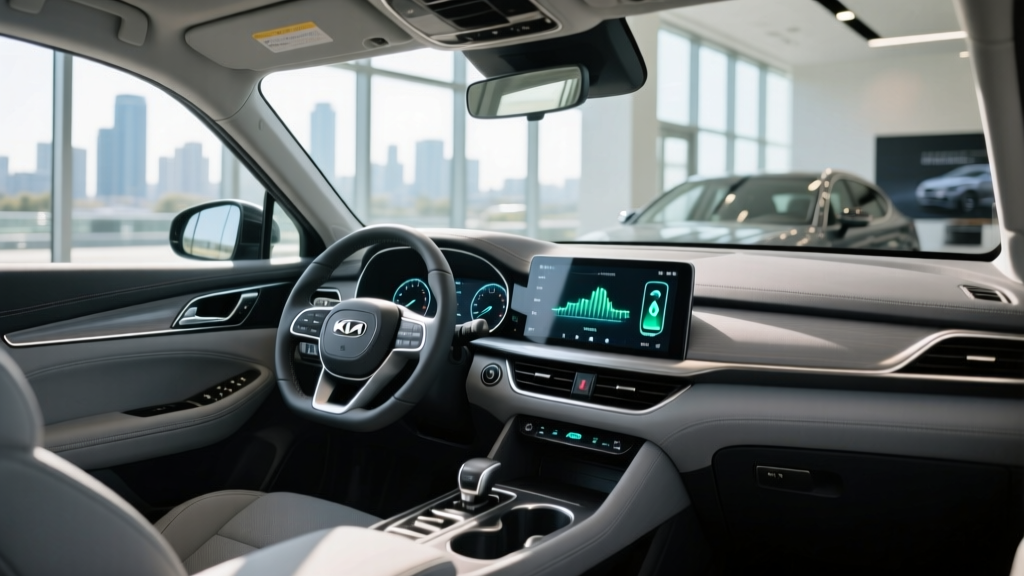
The cabin is where the Sorento Hybrid earns its strongest reviews. Kia's 2024 refresh carried forward into 2025 with a 12.3-inch digital instrument cluster merged with a 12.3-inch infotainment touchscreen under a single curved glass panel. Wireless Apple CarPlay and Android Auto are standard across all trims.
Material Quality by Trim
Base S trims use cloth seating and a leatherette-wrapped steering wheel. Step up to EX and above, and you get SynTex (Kia's synthetic leather) upholstery, heated front seats, and dual-zone automatic climate control. The SX Prestige — available on both HEV and PHEV — adds genuine leather, ventilated front seats, a heated steering wheel, and a head-up display.
Seating and Cargo
The Sorento Hybrid seats up to six (captain's chairs in the second row on EX and above) or seven (bench second row on S trim). Third-row space is tight for adults on long trips — expect roughly 29.6 inches of legroom — but works well for children or short errands. Cargo volume behind the third row is approximately 12.6 cubic feet, expanding to 45 cu ft with the third row folded and 76 cu ft with both rear rows down.
Tech and Driver Assistance
Kia's Highway Driving Assist (HDA) is standard on EX and above — this is an SAE Level 2 system combining adaptive cruise control with lane-centering. It requires continuous driver supervision and does not make the Sorento autonomous. A surround-view monitor, blind-spot view cameras, and rear occupant alert round out the driver-assist suite on higher trims.
Fuel Economy: EPA Ratings vs Real-World MPG
| Powertrain | EPA City | EPA Highway | EPA Combined | Real-World Expectation |
|---|---|---|---|---|
| HEV FWD | 36 MPG | 35 MPG | 35 MPG | 33–37 MPG (hybrids often beat EPA in city) |
| HEV AWD | 34 MPG | 34 MPG | 34 MPG | 31–35 MPG |
| PHEV (charge-sustaining) | 34 MPG | 34 MPG | 34 MPG | 30–35 MPG once battery depleted |
| PHEV (electric mode) | 79 MPGe combined | ~2.4 miles/kWh, 32 mi EV range | ||
Hybrid powertrains excel in stop-and-go city driving where regenerative braking recaptures energy. In our experience, the Sorento HEV FWD can match or slightly exceed its 36 MPG city EPA estimate in moderate climates with mixed urban use. Highway-heavy commutes at 75+ mph tend to pull figures 2–3 MPG below the sticker, as the turbocharged engine works harder at sustained speed.
For the PHEV, the 32-mile electric-only range covers most daily commutes. Once that battery is depleted, it operates as a conventional hybrid at roughly 34 MPG combined. Total combined range (electric + gas tank) exceeds 430 miles, according to fueleconomy.gov.
Powertrain Deep Dive: Engine, Motor, and Drivetrain
Both the HEV and PHEV use Kia's Smartstream 1.6-liter turbocharged four-cylinder engine paired with a six-speed automatic transmission — not a CVT, which matters to drivers who dislike the rubber-band feel of continuously variable gearboxes.
| Specification | Sorento HEV | Sorento PHEV |
|---|---|---|
| Engine | 1.6L Turbo GDI I-4 | 1.6L Turbo GDI I-4 |
| Electric Motor Output | 47 kW (63 hp) | 72 kW (97 hp) |
| Net System Horsepower | 232 hp | 261 hp |
| Net System Torque | 258 lb-ft | 258 lb-ft |
| Transmission | 6-speed automatic | 6-speed automatic |
| Drivetrain | FWD or AWD | AWD standard |
| 0–60 mph (est.) | ~7.8 sec | ~7.2 sec |
| Towing Capacity | 2,000 lbs | 2,000 lbs |
The PHEV's larger motor gives it a noticeable acceleration advantage, especially from a stop where electric torque fills in before the turbo spools. AWD is standard on the PHEV and optional on the HEV (standard on HEV EX and above). Towing is limited to 2,000 pounds across both powertrains — adequate for a small utility trailer but not a boat or camper.
PHEV Charging: Level 2 Times, Connector, and Home Setup
The Sorento PHEV uses a standard J1772 connector for AC charging. There is no DC fast-charging capability — a common omission on PHEVs with smaller batteries, since the 13.8 kWh pack fills quickly enough on Level 2 power.
| Charging Level | Power | 0–100% Time | Where You'll Use It |
|---|---|---|---|
| Level 1 (120V household) | ~1.4 kW | ~10 hours | Overnight at a standard outlet |
| Level 2 (240V home/public) | ~7.2 kW (onboard charger) | ~3 hours 15 min | Home wallbox, workplace, public AC stations |
For most PHEV owners, a home Level 2 charger installed on a 240V circuit is the practical choice. A full charge in roughly three hours means you can top off during the workday or overnight without issue. Expect home Level 2 installation to cost between $500 and $1,500 depending on your electrical panel capacity and run length — consult a licensed electrician for a site-specific quote.
Pricing, Trims, and Tax Credit Eligibility
The 2025 Sorento Hybrid lineup starts at approximately $38,390 for the HEV S trim (FWD) and climbs to roughly $45,000 for the HEV SX Prestige AWD. The PHEV is offered exclusively in the SX Prestige trim at approximately $50,290.
Federal §30D Tax Credit — PHEV Eligibility Checklist
- Credit amount: Up to $7,500 for the Sorento PHEV if all requirements are met. The conventional HEV does not qualify for the §30D new-vehicle credit.
- MSRP cap: SUVs must be at or below $80,000 MSRP. The Sorento PHEV at ~$50,290 clears this easily.
- Buyer income cap: Modified AGI must not exceed $150,000 (single), $225,000 (head of household), or $300,000 (joint filers).
- Battery sourcing: Critical minerals and battery component requirements phase in progressively. Verify current-year compliance on the IRS clean vehicle credit page at irs.gov.
- Point-of-sale transfer: As of 2024, you can transfer the credit to the dealer at purchase, reducing your out-of-pocket cost immediately rather than waiting for tax filing.
Note: Eligibility rules change. Confirm with a tax professional and the IRS before purchasing.
The conventional HEV does not qualify for the federal §30D new clean vehicle credit because it lacks sufficient plug-in electric range. However, some state and utility incentives offer rebates for any electrified vehicle — check your local programs.
Battery Warranty, Longevity, and Replacement Cost
Kia Hybrid Battery Warranty
- HEV battery: 10 years / 100,000 miles (whichever comes first)
- PHEV battery: 10 years / 100,000 miles
- Hybrid system components: 10 years / 100,000 miles (inverter, motor, control unit)
- Capacity retention threshold: Kia covers the battery if it falls below approximately 70% of original capacity during the warranty period
Kia's 10-year hybrid battery warranty is among the longest in the segment. In practice, modern lithium-ion hybrid batteries — which use relatively conservative charge windows (never fully depleting or fully charging) — tend to outlast their warranty periods with minimal degradation. The Sorento HEV's tiny 1.49 kWh battery cycles shallowly, meaning stress on the cells is low. The PHEV's 13.8 kWh pack sees deeper cycles but benefits from active thermal management.
If replacement is needed out of warranty, expect a Sorento HEV hybrid battery to cost roughly $2,000–$3,500 (parts and labor), while the PHEV's larger pack may run $4,000–$7,000. Third-party refurbishment options are emerging and can reduce cost. For most owners, the battery will last the life of the vehicle.
Who Should Choose the Sorento Hybrid, PHEV, or a Full EV?
Choose the Sorento HEV If:
- You cannot install a home charger (apartment, street parking, no garage)
- You want three rows and 35 MPG without changing any habits
- Your budget is under $45,000
- You take frequent long road trips where charging infrastructure is sparse
Choose the Sorento PHEV If:
- Your daily commute is under 30 miles and you can charge at home
- You want electric-only weekday driving plus gas-engine flexibility for weekend trips
- You qualify for the §30D credit, effectively dropping the price by up to $7,500
- You want the extra 29 hp from the larger electric motor
Choose a Full BEV (e.g., Kia EV9, Hyundai Ioniq 5) If:
- You have reliable home Level 2 charging
- Your daily driving is under 250 miles and you're comfortable with public DC fast charging on road trips
- You want zero tailpipe emissions and the lowest per-mile fuel cost
- You don't need a third row (or can step up to the EV9 for three-row BEV space)
Pros
- Upscale interior with dual 12.3-inch curved displays
- 35 MPG combined (HEV) with no plug-in requirement
- 10-year / 100,000-mile hybrid battery warranty
- PHEV offers 32 miles EV range for daily commuting
- 6-speed automatic (no CVT drone)
- Available AWD on both powertrains
Cons
- Third row is tight for adults (29.6" legroom)
- PHEV limited to single SX Prestige trim at ~$50,290
- No DC fast charging on PHEV
- 2,000-lb towing capacity trails some V6 competitors
- Cargo space behind 3rd row (12.6 cu ft) is modest
- HEV does not qualify for federal §30D tax credit
Frequently Asked Questions
How many MPG does the 2025 Kia Sorento Hybrid get?
The FWD Sorento HEV is EPA-rated at 36 city / 35 highway / 35 combined MPG. The AWD version drops slightly to 34/34/34 MPG. Real-world results vary: city-dominant driving often yields 36–37 MPG thanks to regenerative braking, while sustained highway driving above 75 mph can pull figures to 31–33 MPG.
How far can the Sorento PHEV go on electric only?
The EPA rates the 2025 Sorento PHEV at 32 miles of electric-only range. Real-world results depend on temperature and driving style — expect 28–32 miles in mild weather and potentially 22–26 miles in cold conditions (below 35°F), where cabin heating and battery resistance reduce efficiency.
Does the 2025 Sorento Hybrid qualify for a tax credit?
The conventional HEV does not qualify for the federal §30D new clean vehicle credit. The PHEV may qualify for up to $7,500, subject to buyer income limits ($150K single / $300K joint), MSRP caps ($80K for SUVs), and battery-sourcing requirements. The credit can be transferred to the dealer at point of sale. Always verify current rules at irs.gov and consult a tax professional.
Is the Sorento Hybrid reliable, and what does battery replacement cost?
Kia's hybrid system has proven reliable across the Sorento and Niro lineups. The hybrid battery is covered by a 10-year / 100,000-mile warranty. Out-of-warranty replacement costs approximately $2,000–$3,500 for the HEV and $4,000–$7,000 for the PHEV. Most hybrid batteries last well beyond 150,000 miles under normal use due to conservative charge management.
Do I need to plug in the Sorento Hybrid?
No. The conventional Sorento HEV charges its battery entirely through regenerative braking and the gasoline engine — there is no plug. Only the Sorento PHEV requires plugging in to access its 32-mile electric-only range. If you don't plug in the PHEV, it simply operates as a conventional hybrid at 34 MPG combined.
How does the Sorento Hybrid interior compare to the Toyota Highlander Hybrid?
The Sorento's interior is generally rated more modern, with its curved dual 12.3-inch display and available SynTex or leather upholstery. The Highlander Hybrid offers a slightly roomier third row and a larger cargo area, but its infotainment interface and material quality on lower trims lag behind Kia's 2025 refresh. The Highlander Hybrid achieves 36 MPG combined (FWD) — marginally better than the Sorento HEV FWD.