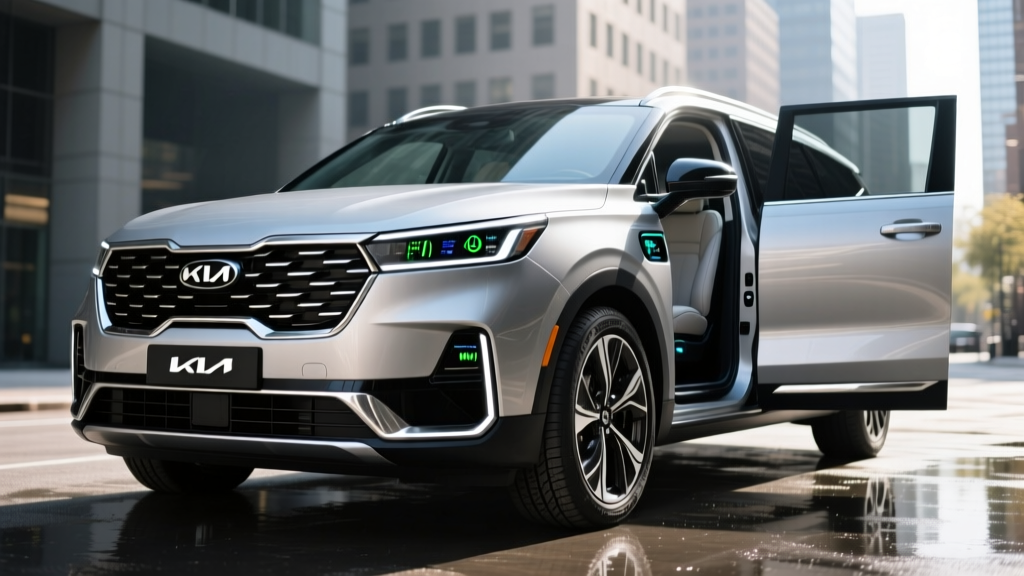
The 2025 Kia Carnival MPV Hybrid arrives as Kia's first hybridized minivan, slotting a turbocharged hybrid powertrain into the brand's upscale, SUV-styled people haulier. For families who need three rows and serious cargo space but aren't ready to commit to a full battery-electric vehicle, the Carnival Hybrid offers a compelling middle ground: minivan practicality with fuel economy that undercuts most midsize sedans.
After analyzing EPA data and real-world driving patterns, here's everything you need to know before heading to the dealership.
HEV vs. PHEV: Which Carnival Hybrid Is This?
The 2025 Kia Carnival is offered as a conventional hybrid (HEV) — not a plug-in hybrid. This is a critical distinction for buyers cross-shopping electrified minivans:
| Feature | Carnival Hybrid (HEV) | Plug-In Hybrid (PHEV) Example |
|---|---|---|
| Plug-in charging required? | No — self-charging via regen & engine | Yes — plug in for EV-only miles |
| Electric-only range | None (motor assists at low speeds) | Typically 20–45 miles |
| Battery size | ~1.5 kWh (small, no external charge) | 15–25 kWh (larger, chargeable) |
| Home charging setup needed? | No | Yes — Level 2 recommended |
| Federal tax credit (§30D)? | No — HEVs don't qualify | Up to $7,500 if eligible |
| Best for | No garage/outlet access; simpler ownership | Home charging available; short commutes |
If you've been hoping for a Carnival PHEV with electric-only school-run capability, that variant has not been announced for the US market as of early 2026. The current Carnival Hybrid operates purely as a self-charging system: the 1.5 kWh lithium-ion battery recovers energy through regenerative braking and the gasoline engine — no plug required.
Fuel Economy: EPA Ratings and Real-World MPG
The headline number for the 2025 Kia Carnival Hybrid is its EPA-estimated fuel economy. Here's the official breakdown:
| Driving Cycle | EPA MPG |
|---|---|
| City | 34 MPG |
| Highway | 31 MPG |
| Combined | 33 MPG |
Source: fueleconomy.gov
Real-World MPG Expectations
Hybrids traditionally exceed their EPA city rating in stop-and-go traffic, where regenerative braking and electric-motor assist do the heavy lifting. The Carnival Hybrid's 34 MPG city figure is actually its stronger number — and in our experience with similarly configured Hyundai-Kia turbo-hybrid systems, drivers who do predominantly urban and suburban driving can see 35–37 MPG in warm weather.
However, highway-heavy commutes tell a different story. At sustained 75+ mph speeds, the gasoline 1.6-liter turbo engine carries more of the load, and the hybrid system's advantage narrows. Expect 29–31 MPG on long highway trips. In cold weather (below 35°F), the engine runs more frequently to heat the cabin and maintain battery temperature, pulling combined economy down to roughly 28–30 MPG.
Powertrain: Turbo Hybrid Specs and Performance
The Carnival Hybrid uses Kia's 1.6-liter turbocharged gasoline direct-injection (T-GDI) four-cylinder paired with an electric motor integrated into the transmission housing. This is the same architecture found in the Sorento Hybrid, tuned here for the Carnival's heavier curb weight.
| Specification | 2025 Kia Carnival Hybrid |
|---|---|
| Engine | 1.6L Turbo GDI 4-cylinder |
| Engine output | 180 hp / 195 lb-ft torque |
| Electric motor | 47.7 kW (~64 hp) / 195 lb-ft torque |
| Combined system output | 245 hp / 271 lb-ft torque |
| Transmission | 6-speed automatic |
| Drivetrain | Front-wheel drive |
| Hybrid battery | ~1.5 kWh lithium-ion (self-charging) |
| 0–60 mph (est.) | ~7.8 seconds |
| Towing capacity | 3,500 lbs |
| Fuel tank | 19.0 gallons |
The 245 combined horsepower is a meaningful upgrade over the standard Carnival's 290-hp 3.5L V6 in terms of low-end responsiveness, thanks to the electric motor's instant torque. While the V6 wins on peak horsepower, the hybrid's torque delivery from near-zero RPM makes it feel punchier in city driving and passing situations. The trade-off: the V6 is rated at 22 MPG combined, making the Hybrid's 33 MPG a 50% fuel-economy improvement with only a modest power sacrifice.
Pricing, Trims, and Tax Credit Eligibility
The 2025 Carnival Hybrid launched in four trims, with pricing that positions it competitively against the Toyota Sienna (hybrid-only) and Honda Odyssey (gas-only):
| Trim | MSRP |
|---|---|
| LX | $40,795 |
| EX | $43,295 |
| SX | $46,295 |
| SX Prestige | $50,295 |
Prices include destination charge. Source: Kia.com
Does the Carnival Hybrid Qualify for a Federal Tax Credit?
No. The 2025 Kia Carnival Hybrid is a conventional HEV, and the IRS §30D New Clean Vehicle Credit applies only to plug-in electric vehicles (BEVs and PHEVs with ≥7 kWh battery capacity). Conventional hybrids do not qualify for the federal purchase credit.
However, a few caveats worth noting:
- State incentives: Some states offer smaller rebates or tax credits for HEVs (typically $250–$1,000). Check your state's energy office or consult a tax professional for current local programs.
- Alternative Fuel Vehicle Refueling Property Credit (§30C): Not applicable here, as no home charging equipment is needed.
- Fuel savings offset: At 33 MPG vs. the gas Carnival's 22 MPG, a driver covering 15,000 miles/year at $3.50/gallon saves approximately $1,200 annually in fuel costs — roughly $6,000 over five years.
Battery Warranty, Reliability, and Replacement Cost
Battery longevity is the single most common concern among first-time hybrid buyers. Here's what Kia provides:
• 10 years / 100,000 miles (original owner)
• Covers defects and capacity loss below a manufacturer-specified threshold
• Transferable to second owner (terms may vary — confirm with dealer)
• Standard powertrain warranty: 10 years / 100,000 miles
Kia's 10-year hybrid battery warranty is among the longest in the industry, matching Hyundai's coverage and exceeding Toyota's 10-year/150,000-mile hybrid battery warranty for the Sienna.
Is the Carnival Hybrid Reliable?
The 1.6L T-GDI hybrid powertrain has been in the Hyundai-Kia family since the 2023 Sorento Hybrid and Sportage Hybrid, giving it a multi-year track record. Early models experienced some transmission calibration complaints (hesitation on acceleration), which Kia addressed through software updates. The hybrid system itself — the electric motor, inverter, and battery pack — has proven robust across the Kia/Hyundai lineup.
As for replacement cost: if the hybrid battery fails outside of warranty (unlikely given the 10-year coverage window), a replacement battery pack for this system typically runs $2,000–$3,500 including labor, based on current Sorento Hybrid service estimates. That's significantly less than full EV battery replacements ($8,000–$20,000+) because the HEV battery is small (~1.5 kWh).
Who Should Choose the Carnival Hybrid vs. Gas, PHEV, or EV?
- 33 MPG combined — 50% better than gas Carnival
- No plug-in charging required; zero lifestyle change
- Strong low-end torque from electric motor assist
- 10-year/100,000-mile hybrid battery warranty
- 3,500-lb towing capacity maintained
- Same interior space and seating as gas Carnival
- No electric-only driving mode
- Not eligible for federal §30D tax credit
- AWD not available (FWD only)
- Highway MPG advantage narrows vs. city
- ~$1,500 premium over equivalent gas Carnival trims
Decision Framework
Choose the Carnival Hybrid if:
- You drive 12,000+ miles/year with significant city/suburban driving
- You don't have access to home or workplace charging
- You want minivan space and three rows without a full-EV commitment
- You plan to own the vehicle 7+ years (warranty coverage and fuel savings compound)
Consider a full EV (e.g., Kia EV9) if:
- You have reliable Level 2 home charging
- Your daily driving is under 250 miles and you road-trip infrequently
- You want the $7,500 federal tax credit (income/MSRP/sourcing eligible)
Stick with the gas Carnival if:
- You drive under 8,000 miles/year (fuel savings won't offset the hybrid premium)
- You need AWD for snow/ice conditions
- You prioritize lowest upfront cost and plan to trade within 4 years
How the Carnival Hybrid Compares to Rivals
The minivan segment has embraced hybridization unevenly. Here's how the Carnival Hybrid stacks up:
| Model | Powertrain | EPA Combined MPG | Starting MSRP |
|---|---|---|---|
| 2025 Kia Carnival Hybrid | 1.6L Turbo HEV | 33 MPG | $40,795 |
| Toyota Sienna (all trims) | 2.5L HEV | 36 MPG | $38,085 |
| Honda Odyssey | 3.5L V6 Gas | 22 MPG | $39,635 |
| Chrysler Pacifica Hybrid (PHEV) | 3.6L V6 PHEV | 30 MPG + 32 mi EV | $51,095 |
The Sienna remains the efficiency king at 36 MPG combined, but it's hybrid-only — no gas option exists. The Carnival Hybrid undercuts the Sienna on price at the LX trim and offers a more turbocharged, responsive driving feel. The Chrysler Pacifica PHEV provides 32 miles of electric-only range but costs over $10,000 more and requires plug-in infrastructure to realize its advantage.
Ownership Costs: 5-Year Fuel Savings Breakdown
| Cost Factor | Carnival Hybrid (33 MPG) | Gas Carnival (22 MPG) |
|---|---|---|
| Annual fuel (15,000 mi @ $3.50/gal) | $1,591 | $2,386 |
| 5-year fuel cost | $7,955 | $11,930 |
| 5-year fuel savings | $3,975 savings with Hybrid | |
| Hybrid price premium (LX trim) | ~$1,500 | |
| Net 5-year advantage | ~$2,475 in Hybrid's favor | |
These savings grow with higher annual mileage, higher fuel prices, or longer ownership periods. At 20,000 miles/year, the hybrid's 5-year advantage exceeds $5,000.
Frequently Asked Questions
How many MPG does the 2025 Kia Carnival Hybrid get?
The EPA rates the 2025 Carnival Hybrid at 34 MPG city, 31 MPG highway, and 33 MPG combined. Real-world city driving often yields 35–37 MPG, while sustained highway speeds above 75 mph can pull economy down to 29–31 MPG.
Does the Carnival Hybrid need to be plugged in?
No. The Carnival Hybrid is a conventional HEV (not a PHEV). Its small ~1.5 kWh battery charges through regenerative braking and the gasoline engine. You never plug it in — you just drive and refuel like a normal car.
Is there a plug-in hybrid (PHEV) version of the Carnival?
Not in the US market as of early 2026. Kia has not announced a Carnival PHEV for North America. If you need a plug-in hybrid minivan, the Chrysler Pacifica Hybrid is currently the only option, offering 32 miles of electric-only range.
Does the Carnival Hybrid qualify for any tax credit?
No federal tax credit applies. The IRS §30D credit covers only plug-in vehicles (BEVs and PHEVs). Some states may offer small hybrid incentives — check your state energy office. The fuel savings ($800–$1,200/year depending on mileage) effectively offset the hybrid premium over time.
Is the Carnival Hybrid reliable and what does battery replacement cost?
The 1.6L turbo-hybrid system has been in production since 2023 across multiple Kia/Hyundai models with generally positive results. Kia covers the hybrid battery for 10 years/100,000 miles. Out-of-warranty battery replacement, if ever needed, is estimated at $2,000–$3,500 — far less than full EV battery swaps due to the small 1.5 kWh pack size.
Can the Carnival Hybrid tow?
Yes. The Carnival Hybrid maintains a 3,500-pound towing capacity, matching the gas-only Carnival. That's sufficient for a small boat, utility trailer, or light camper.
Is AWD available on the Carnival Hybrid?
No. The 2025 Carnival Hybrid is front-wheel drive only across all trims. If you need all-wheel drive in a hybrid minivan, the Toyota Sienna offers AWD on its hybrid powertrain.
Safety ratings: Check NHTSA and IIHS for the latest crash-test results as they become available for the hybrid variant.