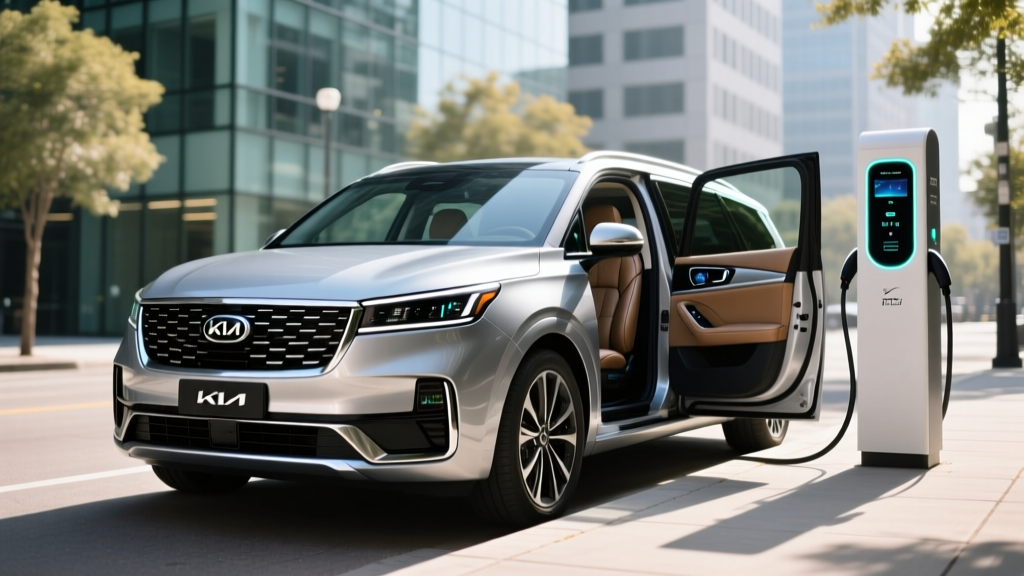
Quick Verdict: The Hybrid Minivan That Doesn't Compromise
The 2025 Kia Carnival Hybrid SX Prestige is the top-trim variant of Kia's turbocharged hybrid minivan, pairing a 1.6-liter turbocharged four-cylinder engine with a 54 kW electric motor for a combined 245 horsepower. With an EPA-estimated 34 MPG combined, it delivers meaningful fuel savings over the gas-only Carnival (22 MPG combined) without requiring a plug, a charging routine, or any change in driving habits. At a starting MSRP of $53,400 for the SX Prestige Hybrid, it undercuts the Toyota Sienna hybrid on price while offering a more premium interior and a longer warranty.
For families who drive 15,000+ miles per year and want minivan practicality without the fuel bill of a traditional V6, the Carnival Hybrid is the strongest conventional hybrid option in the segment. But it's not a plug-in — and that distinction matters for buyers weighing electrification options.
HEV vs PHEV: What the Carnival Hybrid Actually Is
Before diving into specs, it's critical to understand what the Carnival Hybrid is — and isn't.
| Feature | Carnival Hybrid (HEV) | Plug-In Hybrid (PHEV) Example | Full EV (BEV) |
|---|---|---|---|
| Plug-in charging required? | No — self-charging via regen + engine | Yes — 25-40 mi electric range | Yes — full battery only |
| Electric-only driving | Brief low-speed assists only | 20-45 miles on battery alone | 200-400+ miles |
| Fuel source | Gasoline + regenerative braking | Gasoline + grid electricity | Grid electricity only |
| Tax credit (§30D federal) | Not eligible | Up to $7,500 (if eligible) | Up to $7,500 (if eligible) |
| Best for | No home charging access; long trips | Home charging + short commutes | Home charging + daily driving |
The 2025 Carnival Hybrid is a conventional hybrid (HEV). It uses a small lithium-ion battery (approximately 1.49 kWh) that recharges through regenerative braking and the gasoline engine. You never plug it in. The electric motor assists the engine during acceleration and enables brief electric-only operation at low speeds — in parking lots, stop-and-go traffic, or while coasting. But there is no meaningful electric-only range like a PHEV offers.
If you were hoping for a Carnival PHEV with 30+ miles of electric driving, that variant does not currently exist in the U.S. market. Kia offers PHEV versions of the Sorento and Sportage, but not the Carnival.
Fuel Economy: EPA Ratings and Real-World MPG
The headline number for the 2025 Kia Carnival Hybrid is its EPA fuel economy rating, which represents a substantial improvement over the non-hybrid model.
| Driving Cycle | EPA Estimate | Real-World Expectation |
|---|---|---|
| City | 34 MPG | 35-38 MPG (hybrids excel in stop-and-go) |
| Highway | 31 MPG | 28-31 MPG (hybrid advantage shrinks at sustained speed) |
| Combined | 34 MPG | 31-35 MPG depending on driving mix |
Why city MPG beats highway: Conventional hybrids recapture kinetic energy during braking and deceleration, converting it to battery charge. City driving with frequent stops maximizes this regenerative cycle. On the highway, the engine runs continuously at steady load, so the hybrid system provides less benefit. Expect your actual combined MPG to land near 32-34 in mixed suburban/highway driving, but potentially 36+ if your commute is predominantly urban.
Compared to the gas-only Carnival (22 MPG combined), the hybrid saves roughly 4.4 gallons per 100 miles. At $3.50/gallon, that's approximately $1,540 in annual fuel savings for a driver covering 15,000 miles per year.
For official ratings, check the EPA's fueleconomy.gov comparison tool for the latest Carnival Hybrid data.
Powertrain and Performance Specs
| Specification | 2025 Kia Carnival Hybrid SX Prestige |
|---|---|
| Engine | 1.6L turbocharged 4-cylinder |
| Electric Motor | 54 kW (72 hp) permanent-magnet synchronous |
| Combined Output | 245 hp / 271 lb-ft torque |
| Transmission | 6-speed automatic |
| Drivetrain | Front-wheel drive |
| Battery | ~1.49 kWh lithium-ion (self-charging) |
| 0-60 mph | ~7.7 seconds (estimated) |
| Towing Capacity | 3,500 lbs |
| Seating | 7 or 8 passengers |
| Cargo (behind 3rd row) | 41.1 cu ft |
| Cargo (max, seats folded) | 145.1 cu ft |
The turbo-hybrid powertrain is smooth and adequately quick for a 4,700-lb minivan. The 6-speed automatic avoids the drone typical of CVT-equipped hybrids (like the Toyota Sienna), delivering more natural shift feel. The trade-off: the Sienna hybrid offers standard AWD and slightly higher combined MPG (36), while the Carnival Hybrid is FWD-only but offers more cargo space and a more upscale interior at the SX Prestige level.
SX Prestige Trim: What You Get for $53,400
The SX Prestige is the top-of-the-line Carnival Hybrid trim, and it loads the minivan with features typically found in luxury SUVs:
- Nappa leather seating surfaces with heated and ventilated front seats
- Heated steering wheel and heated second-row outboard seats
- Dual 12.3-inch panoramic curved displays (instrument cluster + infotainment)
- Harman Kardon premium audio (12 speakers)
- Head-up display (HUD)
- Surround-view monitor with 3D perspective
- Highway Driving Assist 2 (HDA2) — Level 2 driver assistance with lane-centering and adaptive cruise
- Remote Smart Parking Assist
- Power-sliding rear doors and power liftgate (hands-free)
- Second-row VIP lounge seating with power recline, leg rests, and wing-out headrests (7-passenger config)
MSRP breakdown (2025 model year):
- Carnival Hybrid LXS (base): $41,400
- Carnival Hybrid EX: $45,400
- Carnival Hybrid SX: $49,400
- Carnival Hybrid SX Prestige: $53,400
All prices include destination charge. No dealer-installed accessories included.
Tax Credit Eligibility: Does the Carnival Hybrid Qualify?
Federal §30D Tax Credit: The 2025 Kia Carnival Hybrid does not qualify for the federal EV tax credit. Under current IRS §30D rules, the credit applies only to battery electric vehicles (BEVs) and plug-in hybrids (PHEVs) with sufficient battery capacity (≥7 kWh) and compliant battery sourcing. Conventional hybrids like the Carnival HEV are excluded entirely.
State incentives: Some states offer rebates for conventional hybrids, though these are increasingly rare as programs shift toward BEVs and PHEVs. Check your state's energy office or AFDC incentive database for current programs. A few states may offer reduced registration fees or HOV lane access for hybrids, but these vary by jurisdiction and change frequently.
Tax professional recommended: Always consult a qualified tax professional before making purchase decisions based on incentive eligibility. Rules change, and individual circumstances (income caps, tax liability, point-of-sale transfer availability) affect what you can actually claim.
Battery Warranty, Reliability, and Replacement Cost
Hybrid battery longevity is the single most common concern among first-time hybrid buyers. Here's what Kia provides:
Kia Hybrid Battery Warranty:
- Duration: 10 years / 100,000 miles (whichever comes first)
- Coverage: Defects in materials/workmanship; capacity loss beyond normal degradation
- Transferable: Yes, to subsequent owners (varies by state)
- Hybrid system components: Also covered under the 10-year/100,000-mile powertrain warranty
Replacement cost if out of warranty: A Carnival Hybrid battery replacement would likely range from $2,000-$4,000 based on current hybrid battery pricing for comparable systems. However, the 1.49 kWh pack is far smaller and less expensive than a full EV battery. Hybrid batteries in modern Toyota and Kia systems routinely last 150,000-200,000+ miles before significant degradation, as they operate within a narrow state-of-charge window (typically 40-80%) managed by the vehicle's battery management system.
Reliability outlook: Kia's 1.6L turbo-hybrid powertrain has been in service since the 2023 model year across the Sorento Hybrid and Sportage Hybrid. Early data suggests solid reliability, though the Carnival's heavier weight and higher towing loads place more stress on the system. Kia's 10-year/100,000-mile powertrain warranty is among the best in the industry and provides strong protection.
For crash-test data, check the NHTSA vehicle safety page and IIHS once 2025 model testing is complete.
Who Should Choose the Carnival Hybrid vs an EV or Gas Minivan?
✓ Choose the Carnival Hybrid If:
- You drive 15,000+ miles/year and want fuel savings without behavioral change
- You lack access to home Level 2 charging (apartment, street parking, no garage)
- You regularly take long road trips (400+ miles) and don't want to plan charging stops
- You want minivan space with better MPG than the Honda Odyssey or Chrysler Pacifica gas models
- You value Kia's 10-year warranty over Toyota's hybrid reputation
✗ Look Elsewhere If:
- You have home charging and a commute under 30 miles — a PHEV (e.g., Chrysler Pacifica PHEV, 32 mi electric) or BEV may save more
- You need AWD — consider the Toyota Sienna Hybrid (standard AWD) or a three-row electric SUV
- You want to qualify for the $7,500 federal tax credit — only BEVs and PHEVs qualify under §30D
- You prioritize lowest possible emissions — a BEV eliminates tailpipe emissions entirely
The decision framework: If you can charge at home and your daily driving is under 40 miles round-trip, a PHEV like the Pacifica Hybrid (32 miles electric-only, then gas) will save more fuel and may qualify for tax incentives. If you can't charge at home, or you regularly drive 300+ miles without stopping, the Carnival Hybrid gives you the best fuel economy with zero lifestyle compromise. A full EV three-row SUV (Kia EV9, Rivian R1S) offers the lowest running costs but requires charging infrastructure and a higher purchase price.
Frequently Asked Questions
How many MPG does the 2025 Kia Carnival Hybrid get?
The EPA rates the 2025 Carnival Hybrid at 34 MPG city, 31 MPG highway, and 34 MPG combined. In real-world city-heavy driving, owners often see 35-38 MPG thanks to regenerative braking. Highway-only trips may drop to 28-31 MPG.
Does the Carnival Hybrid need to be plugged in?
No. The Carnival Hybrid is a conventional hybrid (HEV), not a plug-in hybrid (PHEV). The battery charges automatically through regenerative braking and the gasoline engine. You fuel it like any other gas car — just less often.
How far can the Carnival Hybrid drive on electric power alone?
Only very short distances at low speeds — typically under 1 mile at parking-lot speeds. The 1.49 kWh battery is designed to assist the engine, not to provide meaningful electric-only range. If you want electric-only driving, you need a PHEV or BEV.
Is the Carnival Hybrid eligible for any federal tax credit?
No. Under current IRS §30D rules, only battery electric vehicles (BEVs) and plug-in hybrids (PHEVs) with ≥7 kWh battery capacity qualify for the federal clean vehicle tax credit. The Carnival Hybrid's ~1.49 kWh battery does not meet this threshold. Some states may offer minor hybrid incentives — check your local programs.
How long will the hybrid battery last?
Kia covers the hybrid battery for 10 years or 100,000 miles. Modern hybrid batteries are engineered to operate within a protective state-of-charge window (roughly 40-80%), which dramatically extends cycle life. Based on industry data from Toyota and Hyundai/Kia hybrid platforms, these batteries commonly last 150,000-200,000+ miles before requiring replacement.
What does the hybrid battery replacement cost?
Based on comparable hybrid battery pricing, expect $2,000-$4,000 for a replacement if needed out of warranty. This is significantly less than an EV battery replacement ($5,000-$20,000+) because the hybrid pack is much smaller (~1.49 kWh vs 77-100+ kWh in a BEV).
How does the Carnival Hybrid compare to the Toyota Sienna Hybrid?
The Sienna Hybrid offers slightly better combined MPG (36 vs 34) and standard AWD, but the Carnival Hybrid provides more cargo space (145.1 vs 101.0 cu ft max), a more premium interior at the SX Prestige level, and Kia's 10-year/100,000-mile powertrain warranty vs Toyota's 8-year/100,000-mile hybrid coverage. The Sienna is CVT-only; the Carnival uses a traditional 6-speed automatic.
Is the SX Prestige worth the premium over lower trims?
The SX Prestige adds $12,000 over the base LXS Hybrid but includes Nappa leather, VIP second-row seating, Harman Kardon audio, head-up display, Highway Driving Assist 2, and the full suite of premium convenience features. If you're buying a family hauler you'll keep for 5-8 years and value luxury touches, the SX Prestige delivers near-luxury-SUV amenities at a fraction of the price. If budget is the priority, the EX Hybrid at $45,400 still gets the same powertrain and MPG with solid equipment.