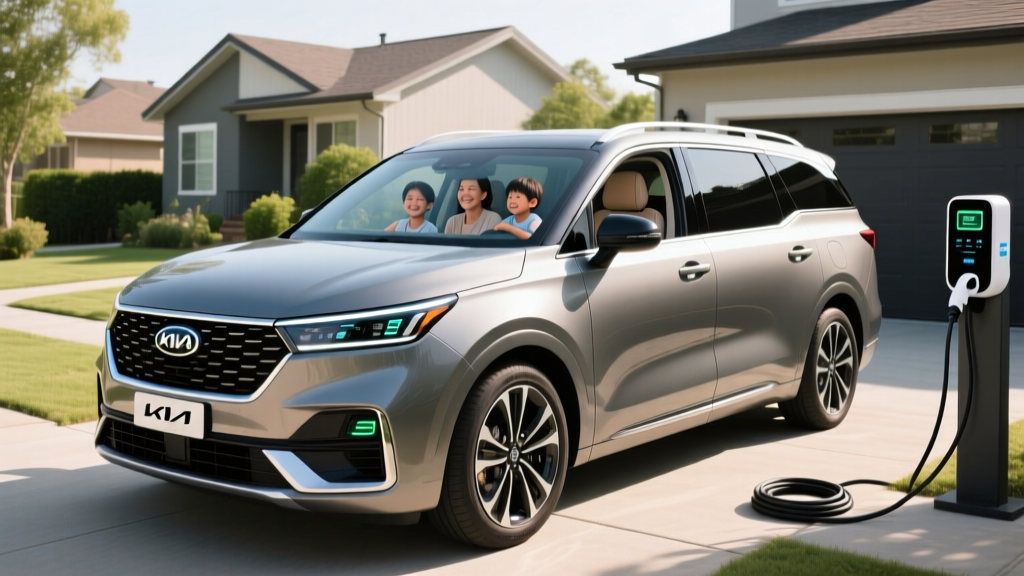
The minivan segment just got more efficient. For 2025, Kia introduced its first-ever hybrid version of the Carnival, replacing the V6 with a turbocharged 1.6-liter four-cylinder paired with an electric motor. The result is a three-row family hauler that squeezes significantly more miles from every gallon while retaining the Carnival's class-leading cargo space and upscale interior. If you've been searching for a 2025 Carnival MPV hybrid to replace your aging gas minivan—or cross-shopping it against the Toyota Sienna and Chrysler Pacifica hybrids—this guide breaks down every number that matters.
HEV vs. PHEV: What Kind of Hybrid Is the Carnival?
Let's clear this up immediately: the 2025 Kia Carnival Hybrid is a conventional hybrid electric vehicle (HEV), not a plug-in hybrid. You never plug it in. The small battery recharges through regenerative braking and the gasoline engine. This is a critical distinction because Kia also sells PHEV models (like the Sorento Plug-In Hybrid), and shoppers sometimes confuse the two.
Carnival Hybrid (HEV): No plug. 1.5 kWh battery. Charges itself via regen + engine. ~34 MPG combined. No federal tax credit.
Plug-In Hybrid (PHEV): Plugs in. 12–18 kWh battery typical. 25–40 miles electric-only range before the gas engine starts. May qualify for up to $7,500 federal credit under IRS §30D rules.
Bottom line: The Carnival Hybrid is strictly HEV. If you want plug-in electric-only commuting, you'll need to look at the Chrysler Pacifica PHEV or wait for Kia to potentially offer a Carnival PHEV variant in future model years.
Fuel Economy: EPA MPG and Real-World Expectations
The headline number for the 2025 Carnival Hybrid is a major leap over the outgoing V6. Here's the official EPA breakdown according to fueleconomy.gov:
| Metric | EPA Estimate | Real-World Expectation |
|---|---|---|
| City | 34 MPG | 33–36 MPG |
| Highway | 31 MPG | 28–32 MPG |
| Combined | 33 MPG | 30–34 MPG |
| Total Range | ~610 miles | ~555–630 miles |
Why city MPG often exceeds EPA in hybrids: Conventional hybrids thrive in stop-and-go traffic. Every braking event feeds energy back into the battery via regenerative braking, and the electric motor handles low-speed propulsion where gasoline engines are least efficient. In our experience with similar Hyundai-Kia hybrid powertrains (the Tucson Hybrid and Sorento Hybrid share architecture), city driving consistently matches or slightly beats the EPA sticker.
Where you'll fall short: Sustained highway speeds above 75 mph, fully loaded with passengers and cargo, and cold-weather driving all reduce efficiency. Expect highway-heavy road trips to return 27–29 MPG. That's still a meaningful improvement over the previous V6 Carnival's 22 MPG combined, but don't expect the full 33 MPG sticker on a 70-mph interstate run with seven occupants.
For comparison, the Toyota Sienna Hybrid (also an HEV) is rated at 36 MPG combined, while the Chrysler Pacifica PHEV achieves 30 MPG combined once its electric range is depleted and 82 MPGe when operating on electricity. The Carnival Hybrid sits between the Sienna's efficiency and the old V6's thirst.
Powertrain: Turbo Four-Cylinder Meets Electric Motor
| Specification | Detail |
|---|---|
| Engine | 1.6L turbocharged 4-cylinder |
| Electric Motor | 47.7 kW (64 hp) permanent-magnet synchronous |
| Combined Output | 245 hp / 271 lb-ft torque |
| Transmission | 6-speed automatic |
| Drivetrain | Front-wheel drive |
| Hybrid Battery | 1.5 kWh lithium-ion (sealed, self-charging) |
| Fuel Tank | 18.5 gallons |
| Towing Capacity | 3,500 lbs |
| 0–60 mph (est.) | ~7.8 seconds |
The 245-horsepower combined output actually exceeds the outgoing 3.5L V6's 290 hp on paper only in torque — the hybrid's 271 lb-ft is available much lower in the rev range thanks to the electric motor's instant torque delivery. In practice, the Carnival Hybrid feels responsive off the line and confident during highway merges, even when loaded. The 6-speed automatic is a conventional torque-converter unit (not a CVT), which means shift feel is familiar and there's no "rubber-band" drone under hard acceleration—a common complaint with Toyota's e-CVT in the Sienna.
One trade-off: the hybrid powertrain is front-wheel drive only. If you need all-wheel drive for snow-belt duty, the Toyota Sienna Hybrid offers AWD (though with a slight MPG penalty), and the Chrysler Pacifica PHEV is also FWD-only. Kia has not announced an AWD Carnival Hybrid variant.
Hybrid Battery Warranty and Long-Term Reliability
Hybrid battery: 10 years / 100,000 miles (whichever comes first)
Hybrid system components: 10 years / 100,000 miles (inverter, motor, controller)
Basic vehicle warranty: 5 years / 60,000 miles
Powertrain warranty: 10 years / 100,000 miles
Kia's 10-year hybrid battery warranty is among the strongest in the segment, matching Hyundai's coverage and exceeding the federal mandate of 8 years / 80,000 miles for emissions-related components. Toyota covers the Sienna's hybrid battery for 10 years / 150,000 miles, which is slightly more generous on mileage.
Real-world degradation expectations: The Carnival Hybrid's 1.5 kWh battery is small and never cycles through deep charge-discharge events. The vehicle's battery management system (BMS) maintains a buffer—typically keeping the state of charge between roughly 30% and 70% during normal driving. This shallow-cycling strategy is proven to maximize lithium-ion longevity. Hyundai-Kia's hybrid systems in the Tucson, Sorento, and Niro have demonstrated minimal capacity loss over 100,000+ miles in fleet and owner data. Battery failure before 150,000 miles is uncommon.
Replacement cost if out of warranty: Based on current Hyundai-Kia hybrid battery pricing for comparable systems, expect a full hybrid battery replacement to run between $2,500 and $4,000 (parts and labor) at a dealership. Independent hybrid specialists may offer refurbished units for $1,500–$2,500. This is significantly less than a full EV battery replacement, which can exceed $10,000–$15,000, because the Carnival's hybrid battery is small and relatively simple.
Pricing, Trims, and Tax Credit Eligibility
The 2025 Kia Carnival Hybrid is offered across multiple trims, with pricing starting around $40,900 MSRP for the LXS Hybrid and climbing to approximately $52,000 for the top SX Prestige Hybrid (destination charge included). This represents a premium of roughly $1,500–$2,000 over equivalent non-hybrid Carnival trims from the previous generation, though the non-hybrid V6 is being phased out for 2025.
Federal tax credit status: The Carnival Hybrid does not qualify for the IRS §30D New Clean Vehicle Credit. That credit is available only for plug-in electric vehicles (BEVs and PHEVs) with battery capacities of at least 7 kWh and meeting critical-mineral and battery-component sourcing requirements. The Carnival's 1.5 kWh battery falls far below the threshold. If you're seeking a minivan that qualifies for up to $7,500 in federal tax credits, the Chrysler Pacifica PHEV is currently the only minivan option, though eligibility depends on your income, the vehicle's MSRP, and battery sourcing rules that shift annually. Always verify current-year rules with a tax professional.
State-level incentives: Some states offer rebates or HOV-lane access for conventional hybrids, but these programs vary widely and change frequently. Check your state's energy office or DMV for current availability.
Carnival Hybrid vs. Sienna Hybrid vs. Pacifica PHEV
The minivan hybrid market now offers three distinct approaches. Here's how they stack up on the numbers that matter:
| Attribute | 2025 Carnival Hybrid | Toyota Sienna Hybrid | Chrysler Pacifica PHEV |
|---|---|---|---|
| Type | HEV | HEV | PHEV |
| Combined MPG | 33 | 36 | 30 (gas) / 82 MPGe |
| Electric-Only Range | N/A | N/A | 32 miles |
| Combined HP | 245 | 245 | 260 |
| AWD Available? | No | Yes | No |
| Cargo (max, cu ft) | 145.1 | 101.0 | 140.5 |
| Starting MSRP | ~$40,900 | ~$39,500 | ~$51,000 |
| Federal Tax Credit | None | None | Up to $7,500* |
*Pacifica PHEV credit eligibility depends on buyer income, MSRP caps, and battery sourcing per IRS §30D. Verify at irs.gov.
Who Should Buy the Carnival Hybrid — And Who Shouldn't
- Class-leading cargo volume (145.1 cu ft max)
- 33 MPG combined — 50% improvement over old V6
- Conventional 6-speed automatic (no CVT drone)
- 10-year / 100,000-mile hybrid battery warranty
- Strong low-end torque from electric motor
- Premium interior, upscale SX Prestige trim
- No AWD option (Sienna offers it)
- No plug-in / electric-only mode
- No federal tax credit eligibility
- Fuel economy trails Sienna Hybrid by 3 MPG
- First model year for hybrid — no long-term reliability data yet
- FWD only limits traction in heavy snow
Choose the Carnival Hybrid if: Maximum cargo space is non-negotiable, you prefer a traditional automatic transmission over a CVT, and you want a ~33 MPG minivan without plugging in.
Choose the Sienna Hybrid if: You need AWD, want the highest MPG (36 combined), and don't mind less cargo room and a CVT.
Choose the Pacifica PHEV if: Your daily commute is under 30 miles, you can charge at home, and you want to drive mostly on electricity with the option for gas-powered road trips.
Choose a full EV (e.g., Kia EV9) if: You have reliable home charging, your trips rarely exceed 250 miles, and you want zero tailpipe emissions with ~300 miles of range.
Frequently Asked Questions
How many MPG does the 2025 Carnival Hybrid get?
The EPA rates the 2025 Kia Carnival Hybrid at 34 MPG city, 31 MPG highway, and 33 MPG combined. In real-world mixed driving, expect 30–34 MPG depending on your route profile. City-heavy driving favors the hybrid system, while sustained highway speeds above 75 mph will push you toward the high 20s.
Does the Carnival Hybrid need to be plugged in?
No. The Carnival Hybrid is a conventional HEV (hybrid electric vehicle). Its small 1.5 kWh battery charges automatically through regenerative braking and the gasoline engine. You fuel it like any other car—just fill the 18.5-gallon tank with regular unleaded.
Is the Carnival Hybrid reliable? What about battery replacement cost?
Kia covers the hybrid battery for 10 years / 100,000 miles. The Hyundai-Kia hybrid system has a strong track record across the Tucson, Sorento, and Niro lineups. If the battery does need replacement after warranty, expect $2,500–$4,000 at a dealership—far less than an EV battery swap. The 1.5 kWh pack is small and doesn't undergo deep cycling, which promotes long life.
Does the 2025 Carnival Hybrid qualify for any tax credit?
No. The federal §30D New Clean Vehicle Credit requires a plug-in vehicle with at least 7 kWh of battery capacity. The Carnival Hybrid's 1.5 kWh battery disqualifies it. Some states may offer minor hybrid incentives, but there is no federal credit. Check IRS.gov for current rules.
How does the Carnival Hybrid compare to a full EV minivan?
There is currently no fully electric minivan on the US market. The closest electric three-row SUV is the Kia EV9 (EPA range up to 304 miles, starting ~$55,000), which offers three rows and qualifies for federal tax credits but provides significantly less cargo volume than the Carnival. If you need true minivan space and want electrification, the Carnival Hybrid or Pacifica PHEV are your options.
Can the Carnival Hybrid tow?
Yes. The 2025 Carnival Hybrid maintains a 3,500-pound towing capacity when properly equipped, matching the non-hybrid version. This is sufficient for a small boat, light camper, or utility trailer. For reference, the Sienna Hybrid is rated at 3,500 lbs as well, while the Pacifica PHEV is not recommended for towing.