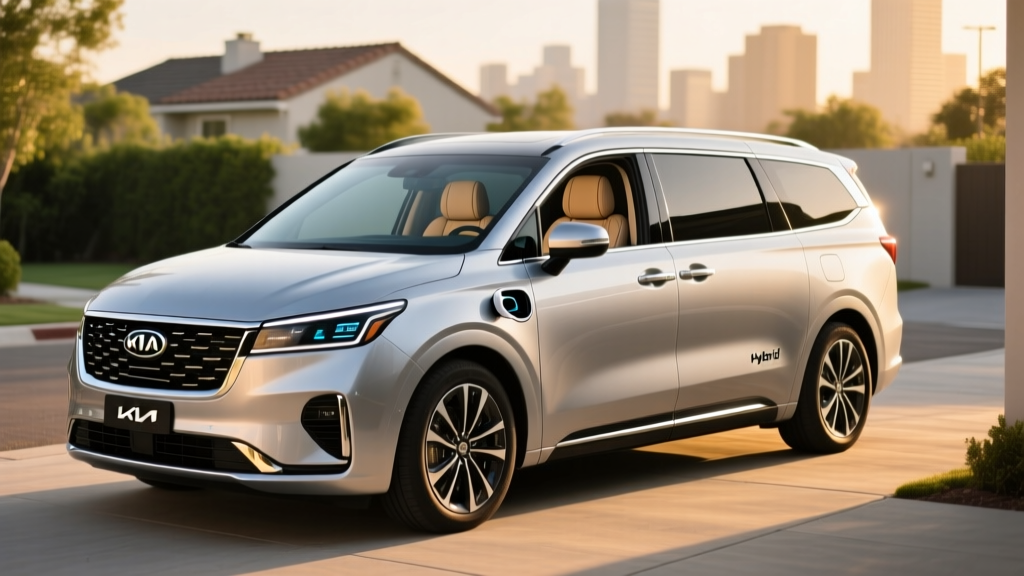
The 2025 Kia Carnival Hybrid LXS arrives as Kia's answer to families who need minivan space but want to cut fuel costs without plugging in. As a conventional hybrid (HEV), it requires no charging infrastructure — it refuels at any gas station while its electric motor assists the turbocharged engine for measurable efficiency gains. With the 2025 refresh, Kia added a 1.6-liter turbocharged hybrid powertrain across the Carnival lineup, replacing the V6 entirely. Here's what the base LXS trim delivers in real-world driving.
2025 Kia Carnival Hybrid LXS: Key Specs at a Glance
| Specification | Detail |
|---|---|
| Powertrain | 1.6L Turbo 4-cyl + electric motor (HEV) |
| Combined Horsepower | 245 hp / 271 lb-ft torque |
| EPA MPG (City / Hwy / Combined) | 34 / 31 / 33 |
| Fuel Tank Capacity | 16.9 gallons |
| Total Driving Range | ~557 miles (EPA est.) |
| Drivetrain | Front-wheel drive (FWD) |
| Seating Capacity | 7 or 8 passengers |
| Cargo Volume (behind 3rd row) | 41.1 cu ft |
| Max Cargo Volume | 145.1 cu ft |
| Towing Capacity | 3,500 lbs |
| Starting MSRP (LXS trim) | $41,900 |
| Hybrid Battery Warranty | 10 years / 100,000 miles |
| Federal EV Tax Credit | Not eligible (HEV) |
HEV vs PHEV: What the Carnival Hybrid Actually Is
The 2025 Kia Carnival Hybrid is a conventional hybrid (HEV), not a plug-in hybrid (PHEV). This distinction matters for buyers comparing electrified minivans:
- HEV (Carnival Hybrid): Charges its small battery (~1.5 kWh) through regenerative braking and the gasoline engine. You never plug it in. It improves fuel economy 30-40% over a comparable gas-only vehicle.
- PHEV (e.g., Chrysler Pacifica Hybrid): Has a larger battery (~16 kWh) that plugs in for 20-40 miles of electric-only range, then operates as a hybrid. Requires access to charging to maximize value.
- BEV (full electric): Runs entirely on electricity with 200+ miles of range. Requires reliable home or public charging access.
Kia does not currently offer a Carnival PHEV in the United States. If you want plug-in capability in a minivan, the Chrysler Pacifica Hybrid remains the only option in the segment.
Fuel Economy: EPA Ratings vs Real-World MPG
| Driving Condition | EPA Estimate | Real-World Expectation |
|---|---|---|
| City | 34 MPG | 33-36 MPG (hybrids excel in stop-and-go) |
| Highway | 31 MPG | 28-31 MPG (aero drag, speed dependent) |
| Combined | 33 MPG | 30-34 MPG |
The EPA rates the 2025 Carnival Hybrid at 34 city / 31 highway / 33 combined MPG. In practice, hybrid minivans tend to match or slightly exceed their EPA city estimates because regenerative braking recaptures energy during frequent stops. Highway driving is where hybrids lose their advantage — at sustained 70-80 MPH speeds, the electric motor provides minimal assist and aerodynamic drag dominates.
For context, the pre-2025 gas-only Carnival with the 3.5L V6 was rated at 19/26/22 MPG combined. The hybrid powertrain represents a roughly 50% improvement in city fuel economy and a 50% gain combined. On a 15,000-mile annual driving cycle at $3.50/gallon, that translates to approximately $850 in annual fuel savings over the old V6.
Powertrain and Driving Performance
The 2025 Carnival Hybrid pairs a 1.6-liter turbocharged 4-cylinder engine (180 hp) with an electric motor (74 hp) for a combined system output of 245 horsepower and 271 lb-ft of torque. Power routes through a 6-speed automatic transmission to the front wheels.
Kia does not publish an official 0-60 time for the Hybrid LXS, but independent testing of the mechanically similar Sorento Hybrid suggests a 0-60 time in the 7.5-8.0 second range. That's adequate for merging and passing, though noticeably slower than the outgoing V6 Carnival (which hit 60 in roughly 6.8 seconds). The turbo torque fills in at low RPMs, so around-town responsiveness feels strong even if highway passing requires more pedal.
The hybrid system's electric motor also enables brief low-speed electric-only operation in parking lots and heavy traffic — typically under 1 mile at speeds below 25 MPH. This is not a meaningful electric range figure; it's a feature that smooths stop-and-go driving and reduces fuel consumption at idle.
Pricing, Trims, and Tax Credit Eligibility
The 2025 Kia Carnival Hybrid starts at $41,900 for the LXS trim (including destination). The hybrid powertrain is available across all Carnival trims:
- LXS: $41,900 — 7- or 8-passenger seating, 18-inch wheels, dual 12.3-inch displays
- EX: $44,900 — adds leatherette, power liftgate, highway driving assist
- SX: $48,500 — adds navigation, ventilated front seats, surround-view monitor
- SX Prestige: $52,900 — adds Nappa leather, dual sunroof, rear-seat entertainment
Battery Warranty, Reliability, and Replacement Costs
Kia backs the Carnival Hybrid's battery pack with a 10-year / 100,000-mile warranty, consistent with Hyundai/Kia's hybrid and EV battery coverage. This warranty guarantees the battery will retain sufficient capacity to function as designed. If the battery fails or degrades below Kia's threshold within the warranty period, replacement is covered.
Conventional hybrid batteries are smaller (~1.5 kWh) and less stressed than full EV batteries because they operate within a narrow state-of-charge window (typically 40-80%). This shallow cycling significantly extends lifespan. Based on data from Toyota and Hyundai/Kia hybrid platforms, most HEV batteries last 150,000-200,000+ miles before meaningful degradation occurs.
If replacement is eventually needed out of warranty, a Carnival Hybrid battery pack is estimated to cost $2,000-$4,000 including labor — far less than a full EV battery replacement ($10,000-$20,000+). Individual cell modules can sometimes be replaced for less.
Who Should Choose the Carnival Hybrid LXS?
Choose the Carnival Hybrid if:
- You need a 7-8 passenger minivan and want to reduce fuel costs without changing your refueling habits
- You lack access to home or workplace charging (ruling out PHEVs and BEVs)
- You drive a city-heavy commute where hybrid efficiency shines (34 MPG city)
- You want the lowest-complexity path to better fuel economy
Look elsewhere if:
- You want electric-only driving range — consider the Chrysler Pacifica Hybrid (PHEV, 32 miles electric-only)
- You want zero tailpipe emissions — consider a fully electric SUV like the Kia EV9 (3-row, 270+ mile range), though cargo and passenger space differ
- You prioritize acceleration over efficiency — the hybrid is slower than the prior V6
Pros
- 50% fuel economy gain over prior V6
- No plug-in charging required
- 10-year/100,000-mile battery warranty
- Class-leading cargo volume (145.1 cu ft)
- Smooth, quiet hybrid operation in city driving
Cons
- Slower acceleration than outgoing V6
- No AWD option (FWD only)
- No federal tax credit eligibility
- Highway MPG lower than city (typical for hybrids)
- Base LXS trim lacks some premium features
Frequently Asked Questions
How many MPG does the 2025 Kia Carnival Hybrid get?
The EPA rates it at 34 city / 31 highway / 33 combined MPG. In real-world city driving with frequent stops, many owners report matching or slightly exceeding the 34 MPG city figure. Highway driving at 75+ MPH typically yields 28-31 MPG.
Does the Carnival Hybrid need to be plugged in?
No. The Carnival Hybrid is a conventional hybrid (HEV). Its battery charges through regenerative braking and the gasoline engine. You refuel it at any gas station — no plug, no charger, no range anxiety.
How far can the Carnival Hybrid go on electric power alone?
Only about 1 mile or less at very low speeds (under 25 MPH). This is not a plug-in hybrid with meaningful electric-only range. The electric motor's role is to assist the gas engine for better fuel economy, not to replace it.
Is the hybrid battery reliable and what does replacement cost?
Kia's hybrid batteries carry a 10-year/100,000-mile warranty. Based on industry data, HEV batteries typically last 150,000-200,000+ miles. Out-of-warranty replacement is estimated at $2,000-$4,000 — significantly less than a full EV battery.
Does the 2025 Carnival Hybrid qualify for any tax credit?
No federal tax credit applies. The IRS §30D clean vehicle credit is limited to plug-in vehicles (PHEVs and BEVs). Some states may offer modest hybrid incentives — check your state's energy office or fueleconomy.gov for current programs.
How does the Carnival Hybrid compare to the Pacifica Hybrid?
The Chrysler Pacifica Hybrid is a PHEV offering 32 miles of electric-only range and a combined 30 MPG once the battery is depleted. It qualifies for up to $7,500 in federal tax credits (subject to income and sourcing rules). The Carnival Hybrid offers better overall MPG (33 combined) without needing a charger, but no electric-only range and no federal credit. Your choice depends on charging access and whether you can utilize the PHEV tax credit.
Sources: EPA Fuel Economy (fueleconomy.gov), Kia Motors America specifications, IRS Clean Vehicle Credits (irs.gov).