Quick Verdict: The Tucson PHEV SEL Sits in the Sweet Spot
The 2025 Hyundai Tucson Plug-In Hybrid SEL occupies a narrow but valuable lane: it's one of the few compact SUVs offering meaningful electric-only commuting range, standard all-wheel drive, and a sub-$40,000 starting price before incentives. With an EPA-rated 33 miles of electric-only driving and a combined 80 MPGe when the battery is charged, the Tucson PHEV SEL is engineered for drivers who want EV-like daily commutes without the range commitment of a full battery-electric vehicle.
But the PHEV formula only works if your routine matches its capabilities. If you can charge at home nightly and your round-trip commute falls within roughly 30 miles, this Tucson behaves like an EV on weekdays and a capable gas-electric hybrid on road trips. If you can't plug in regularly, you're paying a premium for battery capacity you'll never use — and a conventional Tucson Hybrid would save you money upfront.
Here's the complete data-driven breakdown of what the 2025 Tucson Plug-In Hybrid SEL delivers, where it falls short, and whether it qualifies for federal tax credits.
HEV vs. PHEV: Which Tucson Are You Actually Looking At?
Hyundai sells three distinct Tucson powertrains, and confusing them is the most common buyer mistake. Here's the structural difference:
| Attribute | Tucson Hybrid (HEV) | Tucson Plug-In Hybrid (PHEV) | Tucson (Gas Only) |
|---|---|---|---|
| Needs to plug in? | No — self-charging | Yes — plug in for EV range | No |
| Electric-only driving | Very short, low-speed only | 33 miles EPA | None |
| Battery size | ~1.49 kWh | 13.8 kWh (usable) | N/A |
| Combined horsepower | 226 hp | 261 hp | 187 hp |
| EPA combined MPG/MPGe | 38 MPG | 80 MPGe / 35 MPG (gas) | 28 MPG |
| Starting MSRP (2025) | ~$33,585 | ~$39,590 (SEL) | ~$31,085 |
The conventional Tucson Hybrid (HEV) never plugs in. It uses a small battery recharged through regenerative braking and the engine to assist acceleration and enable brief electric-only coasting. The Tucson Plug-In Hybrid (PHEV) carries a much larger 13.8 kWh battery and a more powerful electric motor, enabling genuine zero-emission driving at highway speeds for 33 miles before the gasoline engine engages.
Bottom line: If you can't install a home charger or plug in at work, the PHEV's advantages evaporate. Buy the HEV instead.
Electric Range, MPGe, and Fuel Economy — the Exact Numbers
The EPA rates the 2025 Hyundai Tucson Plug-In Hybrid SEL as follows, per fueleconomy.gov:
| Metric | EPA Rating | Real-World Expectation |
|---|---|---|
| Electric-only range | 33 miles | 28–35 miles (weather/terrain dependent) |
| MPGe (electric + gas combined) | 80 MPGe | Varies heavily by charging frequency |
| MPG (gas-only, battery depleted) | 35 combined (33 city / 37 highway) | 30–34 highway at 75+ mph |
| Total combined range | ~420 miles | 380–430 miles depending on conditions |
| Energy consumption (EV mode) | 35 kWh/100 mi | 38–42 kWh/100 mi in cold weather |
What This Means in Practice
The 33-mile electric range is a genuine commuter asset. If your daily driving totals 25–30 miles and you charge overnight on a Level 2 home charger, you'll burn almost zero gasoline Monday through Friday. On a 2025 Tucson PHEV SEL, that translates to visiting a gas station roughly once a month instead of once a week.
However, electric range contracts in cold weather. At 20°F with cabin heating active, expect the electric-only range to drop to roughly 22–26 miles. The Tucson PHEV does not offer a dedicated heat pump for the cabin — it relies on engine waste heat once the engine starts, which is efficient in gas mode but means EV range takes a hit in winter before the engine kicks on.
Once the battery is depleted, the Tucson PHEV operates as a conventional hybrid, returning 35 MPG combined. That's competitive with the Tucson HEV's 38 MPG, though slightly lower due to the PHEV's extra battery weight (~350 lbs more than the HEV). Highway fuel economy in gas mode is honest: expect 30–34 MPG at sustained 75 mph, which is typical for a turbocharged compact SUV hybrid.
Real-World Range Note: The EPA's 33-mile electric estimate is achievable in moderate weather at mixed city/suburban speeds. Sustained highway driving above 70 mph reduces EV range to approximately 26–29 miles. In sub-freezing temperatures, plan for 22–26 miles of electric-only range.
Powertrain Specs: 261 Horsepower, Standard AWD
The 2025 Tucson PHEV pairs a 1.6-liter turbocharged four-cylinder engine with a more powerful electric motor than the standard HEV, producing a combined 261 horsepower and 273 lb-ft of torque. Power routes through a six-speed automatic transmission to standard HTRAC all-wheel drive.
| Specification | 2025 Tucson PHEV SEL |
|---|---|
| Engine | 1.6L turbocharged GDI 4-cylinder |
| Electric motor | Permanent-magnet synchronous, 97 kW (129 hp) |
| Combined system output | 261 hp / 273 lb-ft torque |
| Transmission | 6-speed automatic |
| Drivetrain | HTRAC AWD (standard) |
| Battery capacity | 13.8 kWh usable (lithium-ion polymer) |
| 0–60 mph | ~7.1 seconds (est.) |
| Towing capacity | 2,000 lbs |
| Cargo volume (behind rear seats) | 38.7 cu ft |
| Cargo volume (rear seats folded) | 72.3 cu ft |
The 261-hp output makes the PHEV the quickest Tucson variant short of the discontinued N Line performance trim. The electric motor delivers instant torque at low speeds, which makes the PHEV feel noticeably more responsive in city driving and highway merging than the 187-hp gas-only Tucson. The six-speed automatic, while less refined than a CVT or e-CVT in smoothness, avoids the rubber-band rev sensation that some hybrid CVTs produce.
Charging: Level 2 Only, No DC Fast Charging
This is where the Tucson PHEV's limitations become clear — and where buyers need to set realistic expectations.
| Charging Level | Power | Time (0–100%) | Availability |
|---|---|---|---|
| Level 1 (120V household) | ~1.4 kW | ~11 hours | Any standard outlet |
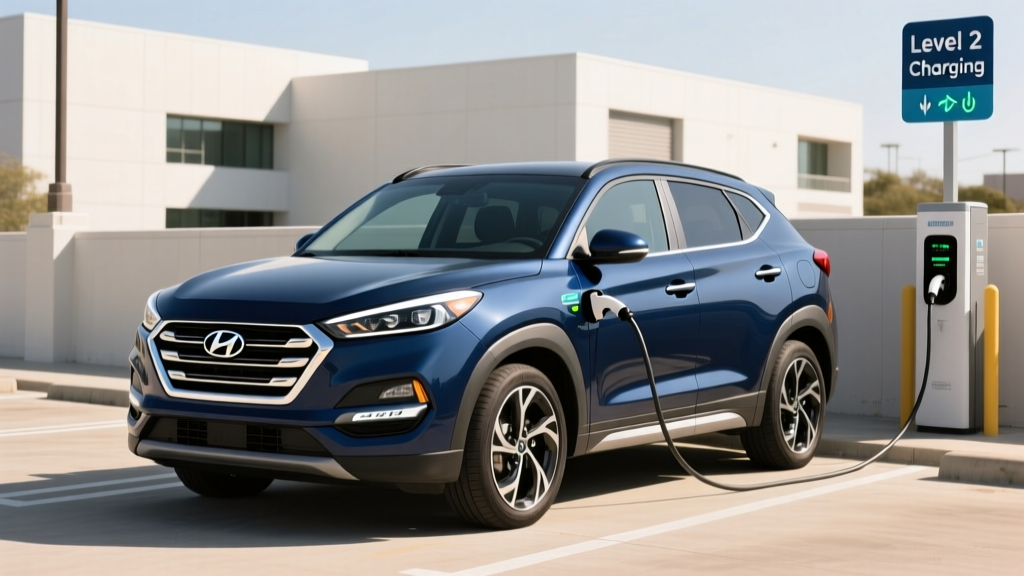
| Level 2 (240V home/public) | ~7.2 kW (onboard charger max) | ~2 hours | Home wallbox, public L2 stations |
| DC Fast Charging | Not supported | N/A | N/A |
The Tucson PHEV's 7.2 kW onboard charger means a full recharge from empty takes approximately two hours on a 240V Level 2 home charger. That's fast enough to fully replenish during a workday or overnight, which is the intended use case. On a standard 120V Level 1 outlet, expect roughly 11 hours for a full charge — feasible for overnight top-ups if your daily electric usage is modest (under 20 miles).
No DC fast charging: Unlike full EVs, the Tucson PHEV cannot use CCS or NACS DC fast chargers. This is standard for the PHEV segment — the Toyota RAV4 Prime and Ford Escape PHEV also lack DC fast charging. The small battery simply doesn't warrant the added cost and weight of DC fast-charge hardware.
Home Charging Setup Cost
If you're installing a Level 2 home charger (strongly recommended for any PHEV), budget the following:
| Component | Estimated Cost |
|---|---|
| Level 2 charger (32A–48A, J1772) | $300–$700 |
| Electrician (240V circuit, 50-ft run) | $500–$1,500 |
| Permit (where required) | $50–$200 |
| Total typical install | $850–$2,400 |
If your electrical panel needs an upgrade to 200A service (common in older homes), add $1,500–$3,500. Get a quote from a licensed electrician before purchasing — panel capacity is the single biggest variable in home charging cost.
Pricing, Trim Content, and Federal Tax Credit Eligibility
The 2025 Hyundai Tucson Plug-In Hybrid SEL starts at an MSRP of approximately $39,590, including destination charge. The SEL is the mid-level PHEV trim and includes:
- 10.25-inch touchscreen with wireless Apple CarPlay/Android Auto
- Heated front seats and heated steering wheel
- Smart liftgate (power tailgate)
- Hyundai SmartSense safety suite (forward collision-avoidance, lane-keeping, blind-spot monitoring, rear cross-traffic avoidance)
- Digital key (NFC-based)
- Proximity key with push-button start
The Limited trim adds roughly $4,500 and includes leather seats, ventilated front seats, a panoramic sunroof, highway driving assist, and a surround-view monitor.
Does the Tucson PHEV Qualify for the Federal Tax Credit?
Under IRS §30D rules (current for 2025), the Tucson Plug-In Hybrid may qualify for a partial or full federal tax credit, but eligibility depends on several conditions that change frequently:
- MSRP cap: SUVs must have an MSRP at or below $80,000 — the Tucson PHEV clears this easily.
- Buyer income cap: Modified AGI must not exceed $150,000 (single), $225,000 (head of household), or $300,000 (joint).
- Battery component sourcing: A percentage of battery components must be manufactured or assembled in North America, with thresholds increasing annually. This requirement has eliminated several PHEVs from full credit eligibility.
- Critical minerals: A percentage of critical minerals must be sourced from the U.S. or free-trade-agreement countries.
- Point-of-sale transfer: Buyers can elect to transfer the credit to the dealer at purchase, reducing the sale price directly rather than waiting for a tax refund.
As of early 2025, the Tucson PHEV's credit status has been in flux due to evolving battery-sourcing requirements. Hyundai has worked to shift supply chains, but buyers should verify current eligibility at the IRS qualified vehicles list before relying on the credit in their purchase math. The credit can range from $0 to $7,500 depending on sourcing compliance at time of purchase. Always consult a tax professional for your specific situation.
Reliability, Battery Warranty, and Long-Term Costs
Hyundai provides one of the strongest hybrid battery warranties in the segment:
| Warranty Coverage | Duration |
|---|---|
| Hybrid/EV battery | 10 years / 100,000 miles (original owner) |
| Hybrid system components | 10 years / 100,000 miles |
| Powertrain (engine, transmission) | 10 years / 100,000 miles |
| New vehicle limited | 5 years / 60,000 miles |
| Capacity retention threshold | Below ~70% of original capacity triggers warranty claim |
Hyundai's 10-year/100,000-mile hybrid battery warranty is among the best in the industry, matching Kia and exceeding Toyota's 10-year/150,000-mile coverage for hybrid batteries on newer models. The warranty covers the battery pack if its capacity drops below approximately 70% of original capacity — a threshold that most PHEV batteries won't approach within the warranty period under normal use.
Battery Replacement Cost
Out-of-warranty replacement of the 13.8 kWh battery pack in the Tucson PHEV is estimated at $4,000–$6,500 including labor, based on Hyundai parts pricing and dealer labor rates. This is significantly less than full-EV battery replacements ($10,000–$20,000+) because the PHEV battery is far smaller. In practice, modern lithium-ion PHEV batteries rarely require full replacement within the first 150,000 miles; gradual capacity loss of 10–15% over 10 years is more typical.
Reliability Track Record
The Tucson PHEV's powertrain — the 1.6L turbo paired with the electric motor and six-speed automatic — has been in Hyundai's lineup since the 2022 model year refresh. Early model-year PHEVs showed minimal systemic issues. The conventional Tucson's turbocharged engine has a solid reliability record. Hyundai's hybrid system is less complex than a full EV's (fewer high-voltage components, proven engine architecture), which works in its favor for long-term maintenance costs.
One note: the Tucson PHEV does carry slightly higher insurance premiums than the gas-only Tucson — typically 8–15% higher depending on your insurer and region, due to the higher replacement cost of hybrid-specific components.
Who Should Buy the Tucson PHEV SEL — and Who Shouldn't
Choose the Tucson PHEV SEL if:
- You can charge at home (Level 2 strongly preferred) every night
- Your daily round-trip commute is 20–33 miles
- You want EV-like weekday driving but need gas flexibility for road trips
- You want AWD and a compact SUV footprint
- You're not ready to commit to a full EV due to apartment living, unreliable public charging, or frequent long-distance travel
Choose the Tucson HEV (conventional hybrid) instead if:
- You cannot plug in at home or work
- Your daily driving exceeds 40 miles (you'd deplete the PHEV battery daily anyway)
- You want a lower purchase price (~$6,000 less than the PHEV)
- You prioritize maximum gas-mode fuel economy (38 MPG combined vs. 35 MPG for the PHEV in gas mode)
Choose a full EV (like the Hyundai Ioniq 5 or Kia EV6) instead if:
- You can charge at home and want zero gasoline costs
- Your daily driving is under 250 miles (well within modern EV range)
- You want lower maintenance costs (no oil changes, no engine, fewer moving parts)
- You want access to DC fast charging for road trips
Pros
- 33-mile electric range covers most daily commutes
- 261 hp makes it the quickest Tucson variant
- Standard AWD with no drivetrain compromise
- Strong 10-year/100,000-mile battery warranty
- Comfortable ride quality and spacious cargo area
- Comprehensive SmartSense safety suite standard
Cons
- No DC fast charging capability
- Gas-mode MPG (35 combined) trails the Tucson HEV (38 combined)
- Electric range drops noticeably in cold weather
- Federal tax credit eligibility uncertain due to sourcing rules
- ~$6,000 premium over the Tucson HEV
- No heat pump — cabin heating draws from battery in EV mode
Frequently Asked Questions
How many MPG does the 2025 Tucson Plug-In Hybrid get?
When the battery is fully charged, the Tucson PHEV achieves an EPA-rated 80 MPGe combined. Once the battery is depleted and it operates as a conventional hybrid, it returns 35 MPG combined (33 city / 37 highway). Real-world highway driving at 75+ mph in gas mode typically yields 30–34 MPG.
How far can the Tucson PHEV go on electric only?
The EPA rates the Tucson PHEV at 33 miles of electric-only range. In real-world conditions, expect 28–35 miles in moderate weather at mixed speeds, 26–29 miles at sustained highway speeds, and 22–26 miles in sub-freezing temperatures with cabin heating active.
Is the Tucson PHEV reliable, and what does a battery replacement cost?
The Tucson PHEV's powertrain has shown no systemic reliability issues since its 2022 introduction. Hyundai covers the hybrid battery for 10 years/100,000 miles. Out-of-warranty battery replacement is estimated at $4,000–$6,500, though most PHEV batteries experience only 10–15% capacity loss over a decade of normal use.
Does the 2025 Tucson PHEV qualify for a federal tax credit?
It may qualify for up to $7,500 under IRS §30D, but eligibility depends on battery component sourcing, critical mineral requirements, buyer income limits, and MSRP caps. The Tucson PHEV clears the MSRP cap ($80,000 for SUVs). However, sourcing rules have shifted frequently — check the IRS qualified vehicles list at time of purchase and consult a tax professional.
Hybrid vs. PHEV vs. EV — which Tucson is right for me?
If you can plug in nightly and commute under 33 miles, the PHEV gives you the best of both worlds. If you can't plug in, the conventional HEV delivers strong fuel economy at a lower price. If you want zero gas use and have home charging, consider a full EV like the Ioniq 5 — but only if you're comfortable planning road trips around DC fast-charging stops.
Can I charge the Tucson PHEV on a regular household outlet?
Yes, using the included Level 1 charging cable on a standard 120V outlet. However, a full charge takes approximately 11 hours. A Level 2 (240V) home charger reduces that to about 2 hours and is strongly recommended for daily PHEV use.
Does the Tucson PHEV have a spare tire?
No. The Tucson PHEV uses a tire repair kit. The battery pack occupies the space where a spare would sit in the gas-only Tucson. This is common across the PHEV segment.
Sources: EPA fueleconomy.gov, Hyundai USA specifications, IRS §30D qualified vehicle list.