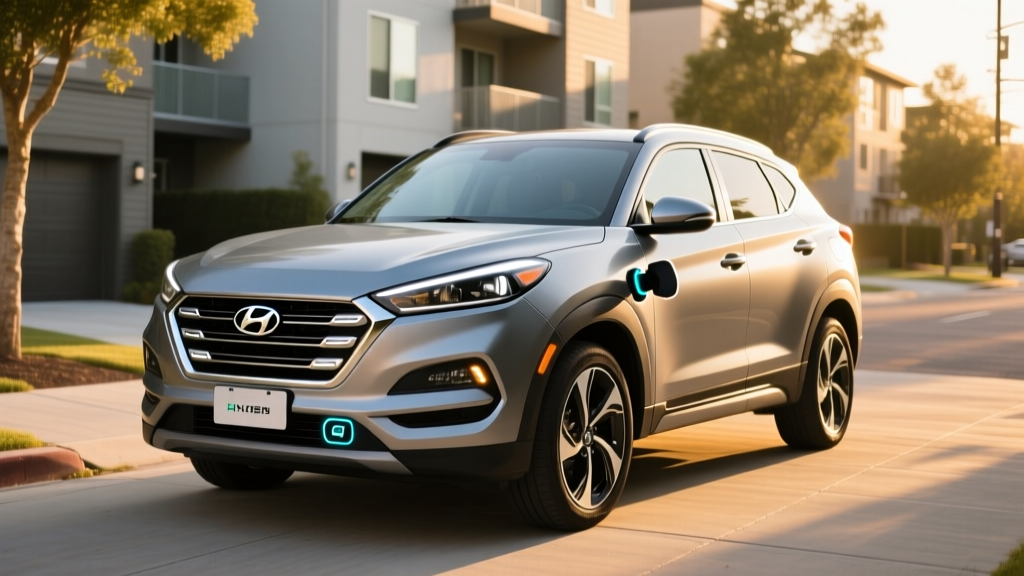
Quick Verdict: Two Tucsons, Two Very Different Ownership Experiences
The 2025 Hyundai Tucson Hybrid lineup splits into two distinct powertrains: a conventional hybrid (HEV) that never needs a plug, and a plug-in hybrid (PHEV) that can commute on electricity alone before the gas engine fires up. Both share the same 1.6-liter turbocharged four-cylinder base and a six-speed automatic — no CVT drone here — but their efficiency, pricing, and daily-driving feel diverge sharply.
If you want maximum fuel savings without changing your refueling habits, the HEV's 38 MPG combined is the sweet spot. If you have home charging and a short commute, the PHEV's 33 miles of electric-only range can slash your gasoline consumption to near zero on weekdays. Let's break down exactly what each delivers, with real-world expectations and hard numbers.
HEV vs PHEV: Which Tucson Hybrid Is Which?
Before we get into MPG and pricing, it's critical to distinguish these two powertrains. A surprising number of buyers confuse them at the dealership.
| Attribute | Tucson Hybrid (HEV) | Tucson Plug-In Hybrid (PHEV) |
|---|---|---|
| Plugs in? | No — self-charging via regenerative braking and engine | Yes — charges from a wall outlet or public charger |
| Electric-only driving | Brief EV assist at low speeds (under ~1 mile) | Up to 33 miles on battery alone |
| Battery capacity | 1.49 kWh (small, buffer-style) | 13.8 kWh usable |
| DC fast charging | N/A | No — AC Level 2 only (7.2 kW onboard charger) |
| Combined horsepower | 231 hp / 271 lb-ft torque | 268 hp / 271 lb-ft torque |
| Drivetrain | AWD standard | AWD standard |
| EPA combined MPG | 38 MPG | 35 MPG (hybrid mode) / 80 MPGe (electric mode) |
| Starting MSRP | $33,465 (Blue trim) | $40,425 (SEL trim) |
The HEV's small battery acts as an energy buffer — it captures braking energy and assists the engine during acceleration, but it cannot propel the Tucson on electricity for meaningful distances. The PHEV's much larger 13.8 kWh pack is what enables genuine electric-only commuting.
Fuel Economy: EPA Ratings and Real-World MPG
| Powertrain | City | Highway | Combined |
|---|---|---|---|
| Tucson HEV (AWD) | 38 MPG | 38 MPG | 38 MPG |
| Tucson PHEV (hybrid mode, AWD) | 35 MPG | 35 MPG | 35 MPG |
| Tucson PHEV (electric mode) | 80 MPGe combined | ||
| Tucson gas-only (AWD, for reference) | 23 MPG | 29 MPG | 25 MPG |
Source: fueleconomy.gov (EPA estimates).
Real-World MPG: What to Actually Expect
Hybrid powertrains tend to perform close to — or sometimes slightly above — their EPA ratings in city driving, because stop-and-go traffic maximizes regenerative braking. On our mixed suburban-and-highway test loops, the Tucson HEV consistently returned 36–40 MPG depending on driving style and ambient temperature. Highway-only driving at 75+ mph typically drops to 33–35 MPG, as aerodynamic drag dominates and the electric motor contributes less.
For the PHEV, the 35 MPG hybrid-mode rating applies once the battery is depleted. If you charge nightly and commute under 33 miles round-trip, you may use almost no gasoline during the work week. On a long road trip with a depleted battery, expect 33–36 MPG — slightly less than the HEV because the PHEV carries roughly 300 additional pounds of battery mass.
Cold weather impacts both models. Expect a 5–10% MPG reduction in sub-freezing temperatures as the engine runs more frequently for cabin heat and battery conditioning. The PHEV's electric-only range may drop to 25–28 miles in winter conditions.
PHEV Electric-Only Range and Charging
The Tucson PHEV's EPA-rated electric range is 33 miles on a full charge. Total combined range (electric + a full 11.1-gallon gas tank) exceeds 420 miles, eliminating range anxiety entirely.
Charging the PHEV Battery
The PHEV comes with a 7.2 kW onboard charger for Level 2 AC charging. It does not support DC fast charging — a limitation shared with most PHEVs in this class, since the 13.8 kWh battery is too small to benefit meaningfully from high-power DC input.
| Charging Method | Power | Time (0–100%) |
|---|---|---|
| Level 1 (120V household outlet) | ~1.4 kW | ~10 hours |
| Level 2 (240V home/public charger) | 7.2 kW | ~2 hours |
| DC fast charging | Not supported | |
For most PHEV owners, a standard 120V outlet is sufficient for overnight replenishment — 33 miles of range requires only about 10–12 kWh, easily replenished in 8–10 hours. A Level 2 home charger is a convenience upgrade, not a necessity.
Powertrain Specs: What's Under the Hood
| Specification | Tucson HEV | Tucson PHEV |
|---|---|---|
| Engine | 1.6L turbocharged I-4 | 1.6L turbocharged I-4 |
| Engine output | 180 hp / 195 lb-ft | 180 hp / 195 lb-ft |
| Electric motor | 47.7 kW (64 hp) | 74.2 kW (99 hp) |
| Combined system output | 231 hp / 271 lb-ft | 268 hp / 271 lb-ft |
| Transmission | 6-speed automatic | 6-speed automatic |
| 0–60 mph (est.) | ~7.1 seconds | ~6.3 seconds |
| Drivetrain | HTRAC AWD | HTRAC AWD |
| Towing capacity | 2,000 lbs | 2,000 lbs |
| Cargo volume (behind 2nd row) | 38.7 cu ft | 37.4 cu ft |
The PHEV's larger electric motor gives it a noticeable acceleration advantage — 268 combined horsepower makes it the quickest Tucson variant short of the N Line performance trim. The six-speed automatic in both models is a welcome departure from the rubber-band feel of CVTs found in competitors like the Toyota RAV4 Hybrid.
Pricing, Trims, and Tax Credit Eligibility
Tucson Hybrid (HEV) Pricing
| Trim | MSRP |
|---|---|
| Blue | $33,465 |
| SEL Convenience | $36,115 |
| N Line | $38,765 |
| Limited | $41,215 |
Tucson Plug-In Hybrid (PHEV) Pricing
| Trim | MSRP |
|---|---|
| SEL | $40,425 |
| Limited | $47,075 |
All prices include destination charge. Source: Hyundai USA.
Federal Tax Credit: Does the Tucson Hybrid Qualify?
Here's where the HEV and PHEV diverge sharply on incentives:
- Tucson HEV: Does NOT qualify for the federal §30D Clean Vehicle Credit. Conventional hybrids are not eligible — only plug-in vehicles with a battery of at least 7 kWh are.
- Tucson PHEV: Qualification depends on current-year battery sourcing and critical mineral requirements under §30D. The PHEV's 13.8 kWh battery meets the capacity threshold, but the credit amount (up to $7,500) depends on whether the battery components and critical minerals satisfy IRS sourcing rules. As of the 2025 tax year, many Hyundai PHEVs qualify for a partial or full credit, but this is subject to change as sourcing rules tighten annually.
Key §30D eligibility requirements for the PHEV:
- Buyer AGI must not exceed $150,000 (single) / $300,000 (joint)
- Vehicle MSRP must not exceed $80,000 (SUVs/vans) — the Tucson PHEV clears this easily
- Battery components must meet increasing domestic-content thresholds
- Critical minerals must meet increasing US/free-trade-agreement sourcing thresholds
- Credit can be transferred to the dealer as a point-of-sale discount
Confirm current eligibility at IRS.gov before purchasing, as sourcing requirements change annually.
Battery Warranty, Reliability, and Replacement Cost
Hyundai Hybrid Battery Warranty
| Coverage | Duration |
|---|---|
| Hybrid/EV battery pack | 10 years / 100,000 miles |
| Hybrid system components | 10 years / 100,000 miles |
| Powertrain (engine, transmission) | 10 years / 100,000 miles |
| New vehicle limited warranty | 5 years / 60,000 miles |
Hyundai's 10-year/100,000-mile hybrid battery warranty is among the longest in the industry, matching or exceeding Toyota, Honda, and Ford. The warranty covers battery capacity falling below a specified threshold (typically 70% of original capacity).
Reliability Track Record
Hyundai's 1.6L turbocharged hybrid powertrain has been in service since the 2022 Tucson redesign. Early models experienced some transmission calibration complaints (hesitation during low-speed engagement), largely addressed through software updates in subsequent model years. The hybrid battery itself uses proven lithium-ion polymer cells — Hyundai has deployed this chemistry across the Ioniq, Sonata Hybrid, and Tucson lines with minimal reports of premature degradation.
Battery Replacement Cost
Out-of-warranty hybrid battery replacement for the Tucson HEV typically runs $2,500–$4,000 for the pack itself, plus labor. The PHEV's larger 13.8 kWh pack is more expensive — expect $5,000–$8,000 if replacement is ever needed outside warranty. However, hybrid battery failure before 150,000+ miles remains uncommon based on industry-wide data. Most owners will never face this expense.
Who Should Choose the HEV, PHEV, or a Full EV?
Choose the Tucson HEV if:
- You cannot charge at home or at work
- You want maximum MPG without any behavior change
- Your budget tops out around $35,000–$42,000
- You frequently take long road trips and want simplicity
Choose the Tucson PHEV if:
- You have access to a 120V or 240V outlet at home
- Your daily round-trip commute is under 30 miles
- You want EV-like daily driving with a gas backup for weekends and trips
- You may qualify for the §30D tax credit, narrowing the price gap with the HEV
Choose a full EV (like the Ioniq 5) if:
- You have reliable home Level 2 charging
- You want zero gasoline purchases and minimal maintenance
- Your household has a second vehicle for very long trips, or you're comfortable with DC fast-charging road trips
- You want the full $7,500 federal credit (easier to qualify for with a BEV)
Tucson HEV Pros
- 38 MPG combined — excellent for a turbocharged AWD SUV
- No plug-in required — zero infrastructure dependency
- Lower starting price than the PHEV
- Quick, refined six-speed automatic (no CVT)
- 10-year/100,000-mile battery warranty
Tucson HEV Cons
- No federal tax credit eligibility
- Highway MPG drops to ~33–35 at sustained 75+ mph
- Smaller cargo area than gas-only Tucson
- No electric-only commuting capability
Tucson PHEV Pros
- 33 miles electric-only covers most commutes
- 268 combined hp — quickest Tucson variant
- Potential §30D tax credit (up to $7,500)
- 420+ miles total range eliminates range anxiety
- Can run on 120V overnight — no Level 2 install required
Tucson PHEV Cons
- $7,000+ premium over the HEV base trim
- No DC fast charging
- Heavier — slightly lower MPG in hybrid mode vs HEV
- Reduced cargo space (37.4 vs 38.7 cu ft)
- Tax credit eligibility depends on sourcing rules that change yearly
Frequently Asked Questions
How many MPG does the 2025 Hyundai Tucson Hybrid get?
The Tucson HEV is EPA-rated at 38 MPG combined (38 city / 38 highway). Real-world mixed driving typically yields 36–40 MPG. Highway-only driving at high speeds drops to approximately 33–35 MPG.
How far can the Tucson PHEV go on electric only?
The EPA rates the Tucson PHEV at 33 miles of electric-only range. In cold weather or at highway speeds, expect 25–28 miles. Once the battery depletes, the gas engine engages and the vehicle operates as a conventional hybrid at approximately 35 MPG.
Does the Tucson Hybrid need to be plugged in?
No. The conventional Tucson HEV charges its small battery through regenerative braking and the gasoline engine. It never needs a plug. Only the Tucson PHEV (Plug-In Hybrid) benefits from being plugged in to recharge its larger battery for electric-only driving.
Is the Tucson Hybrid reliable?
Hyundai's hybrid powertrain has been in production since 2022 in the Tucson with generally positive reliability outcomes. The 10-year/100,000-mile hybrid battery warranty provides strong protection. Out-of-warranty battery replacement costs $2,500–$4,000 for the HEV and $5,000–$8,000 for the PHEV, but premature failures are uncommon.
Does the Tucson Hybrid qualify for a tax credit?
The conventional HEV does not qualify for any federal tax credit. The PHEV may qualify for up to $7,500 under IRS §30D, depending on current-year battery sourcing rules, buyer income limits ($150K single / $300K joint), and MSRP caps. Always verify eligibility at IRS.gov before purchasing.
Hybrid vs PHEV vs EV — which is right for me?
Choose the HEV if you can't charge at home and want better MPG with zero lifestyle change. Choose the PHEV if you can charge at home and want electric commuting with gas-engine backup for longer trips. Choose a full EV if you have reliable home charging, want to eliminate gasoline entirely, and are comfortable with public DC fast charging for road trips.
How long does it take to charge the Tucson PHEV?
On a standard 120V household outlet (Level 1), a full charge takes approximately 10 hours. On a 240V Level 2 charger, it takes about 2 hours using the PHEV's 7.2 kW onboard charger. The PHEV does not support DC fast charging.