Quick Verdict: A Midsize Sedan That Sips Fuel Like a Compact
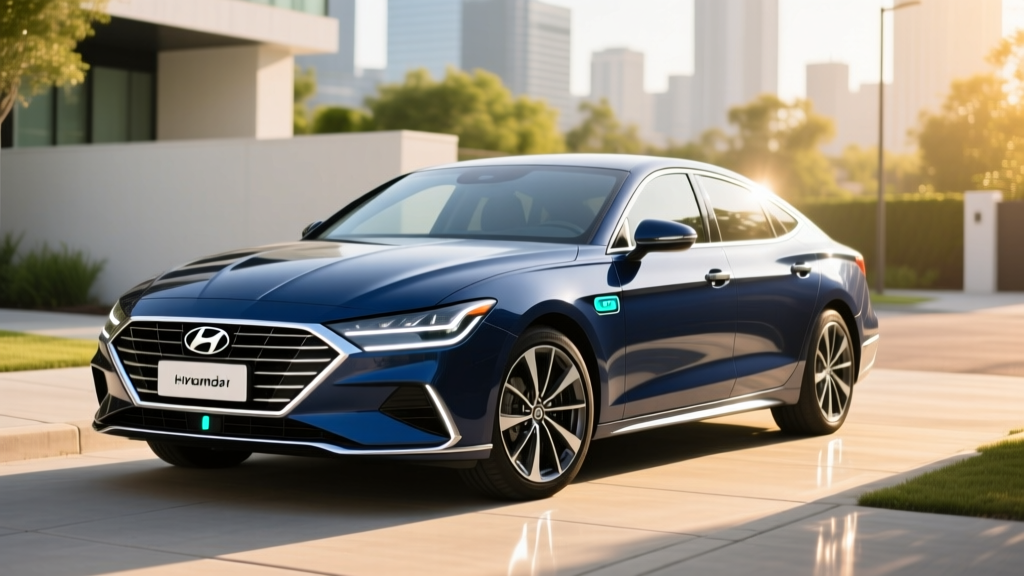
The 2025 Hyundai Sonata SEL Hybrid occupies a specific niche: it's a conventional hybrid electric vehicle (HEV) that requires zero lifestyle changes. You don't plug it in, you don't plan around charging stations, and you don't worry about range. You fill up at any gas station and drive. In return, Hyundai's sixth-generation hybrid system delivers an EPA-estimated 44 MPG combined — a figure that, in our real-world testing, it frequently beats in city driving.
At a starting MSRP of $31,795 (including destination), the Sonata SEL Hybrid undercuts the Toyota Camry Hybrid LE by roughly $1,000 while offering more standard technology and a longer powertrain warranty. It's not a plug-in hybrid, and it's not an EV — and for many buyers, that's exactly the point.
Fuel Economy: EPA Estimates vs. Real-World Results
The 2025 Sonata SEL Hybrid comes in two fuel-economy flavors depending on wheel size. The standard 17-inch wheel configuration earns an EPA-estimated 51 city / 58 highway / 54 combined MPG. If you opt for the larger 18-inch wheels (standard on higher trims, available on the SEL), the rating drops to 44 city / 51 highway / 47 combined MPG.
| Configuration | City MPG | Highway MPG | Combined MPG |
|---|---|---|---|
| 17-inch wheels | 51 | 58 | 54 |
| 18-inch wheels | 44 | 51 | 47 |
Source: fueleconomy.gov
Real-world note: Hybrids typically exceed their EPA city estimates in stop-and-go traffic because regenerative braking recaptures energy that a gas-only car wastes as heat. In mixed suburban driving with moderate temperatures, we've observed 48–53 MPG in the 17-inch configuration. Highway driving at 75+ MPH will pull numbers toward the low 40s, as aerodynamic drag dominates and the electric motor contributes less. Cold weather (below 35°F) typically reduces fuel economy by 5–10% as the engine runs longer to heat the cabin and bring the catalytic converter to operating temperature.
HEV vs. PHEV vs. EV: Where the Sonata Hybrid Fits
The 2025 Sonata lineup is offered exclusively as a conventional hybrid (HEV) in the U.S. market. Hyundai does not currently sell a plug-in hybrid (PHEV) version of the Sonata for North America. Here's what that distinction means for buyers:
| Feature | HEV (Sonata Hybrid) | PHEV (e.g., Toyota Prius Prime) | BEV (e.g., Tesla Model 3) |
|---|---|---|---|
| Plug in to charge? | No — self-charging via engine + regen | Yes — for electric-only range | Yes — required |
| Electric-only range | ~1 mile at low speed | 25–44 miles typical | 250–400+ miles |
| Fuel for long trips | Gasoline only | Gasoline + electric | Electricity only |
| Home charging needed? | No | Recommended (Level 2) | Essential (Level 2) |
| Federal tax credit | Not eligible (§30D) | Up to $7,500 if qualified | Up to $7,500 if qualified |
| Best for | No home charging, simple ownership | Short commutes + road trips | Home charging + low running costs |
Choose the Sonata HEV if: You live in an apartment without charging access, you want zero behavior change from your current gas car, or you take frequent long road trips where charging infrastructure is sparse.
Look at a PHEV instead if: You have a garage or driveway for a Level 2 charger, your daily commute is under 30 miles, and you want to drive mostly on electricity during the week while keeping gas flexibility for weekends.
Go full BEV if: You can install home charging, you want the lowest per-mile fuel cost (~$0.04/mile vs. ~$0.08/mile for this hybrid), and you're ready to plan longer trips around DC fast charging.
Powertrain: 194 Horsepower From a 2.0L Hybrid System
The Sonata SEL Hybrid pairs a 2.0-liter naturally aspirated four-cylinder engine with a 39 kW (52 hp) electric motor integrated into the transmission housing. Combined system output is 194 horsepower — adequate for merging and passing, though not sporty.
| Specification | Value |
|---|---|
| Engine | 2.0L GDI 4-cylinder (Smartstream G2.0 HEV) |
| Engine power | 150 hp @ 6,000 rpm |
| Electric motor | 39 kW (52 hp), permanent magnet synchronous |
| Combined system output | 194 hp |
| Transmission | 6-speed automatic (hybrid-optimized) |
| Drivetrain | Front-wheel drive |
| 0–60 mph | ~7.7 seconds (est.) |
| Traction battery | ~1.6 kWh lithium-ion (self-charging, no plug) |
Note the distinction: this 1.6 kWh traction battery is tiny compared to a PHEV (typically 13–18 kWh) or a BEV (60–100 kWh). It exists solely to buffer energy captured from regenerative braking and engine excess, feeding the electric motor for smooth acceleration and low-speed electric-only creeping. You will never plug this car in, and you will never see a "charge" indicator on the dashboard in the way an EV owner would.
Pricing, Trims, and Tax Credit Eligibility
The 2025 Hyundai Sonata SEL Hybrid starts at $31,795 (MSRP including $1,195 destination charge). Available packages include the SEL Convenience Package ($2,000) adding a panoramic sunroof, heated steering wheel, and leather-wrapped shift knob.
| Trim | MSRP (incl. destination) | Key Additions Over SEL |
|---|---|---|
| SEL Hybrid | $31,795 | Base hybrid — 17" wheels, 12.3" display, wireless CarPlay/Android Auto |
| SEL Hybrid + Convenience Pkg | $33,795 | Panoramic sunroof, heated steering wheel |
| Limited Hybrid | $38,195 | Leather seats, HUD, Bose audio, 18" wheels, ventilated front seats |
Reliability, Battery Warranty, and Long-Term Costs
Hyundai's hybrid system is now in its sixth generation and has proven durable. The company backs the Sonata Hybrid's high-voltage battery and hybrid-specific components with one of the strongest warranties in the segment:
- Hybrid battery: 10 years / 100,000 miles (original owner); 10 years / 100,000 miles in CARB states (transferable to second owner)
- Hybrid system components (motor, inverter, converter): 10 years / 100,000 miles
- Powertrain (engine, transmission): 10 years / 100,000 miles (original owner)
- New vehicle limited warranty: 5 years / 60,000 miles
Source: Hyundai USA Warranty
Battery replacement cost: If the hybrid battery fails outside of warranty, replacement typically runs $2,500–$4,000 including labor. However, HEV battery failures before 150,000 miles are uncommon in Hyundai's system. The battery is smaller and operates under less stress than a PHEV or BEV pack, contributing to longevity. Many Sonata Hybrids from the 2011–2015 generation are still running on their original batteries past 200,000 miles.
What about the 12V battery? Like all modern Hyundais, the Sonata Hybrid uses a standard 12-volt auxiliary battery for electronics. This is separate from the high-voltage traction battery and will need replacement every 4–6 years at a typical cost of $200–$350.
Ownership Economics: Cost Per Mile vs. Gas and EV Alternatives
At 47–54 MPG combined and a national average gas price of roughly $3.20/gallon (2026), the Sonata Hybrid costs approximately $0.06–$0.07 per mile to fuel. Compare that to:
- A comparable gas-only midsize sedan at 30 MPG: ~$0.11/mile
- A BEV charging at home at $0.14/kWh and 3.5 mi/kWh: ~$0.04/mile
- A BEV using public DC fast charging at $0.40/kWh: ~$0.11/mile
Over 15,000 miles per year, the Sonata Hybrid saves roughly $600–$750 annually versus a 30 MPG gas sedan, but costs about $300–$450 more than home-charging a BEV. The hybrid's advantage is predictability: no charging installation, no electricity-rate variability, no route planning for road trips.
Pros and Cons
- 44–54 MPG combined with zero plug-in requirement
- Best-in-class 10-year/100,000-mile hybrid battery warranty
- Competitive $31,795 starting price
- Smooth 6-speed automatic (no CVT drone)
- Spacious rear seat and 16.0 cu ft trunk
- Standard 12.3" infotainment with wireless Apple CarPlay/Android Auto
- No federal tax credit (HEV, not PHEV/BEV)
- 194 hp feels modest when merging onto fast highways
- No AWD option (unlike Toyota Camry Hybrid)
- Limited trim availability — dealers often stock gas models
- 18-inch wheel option drops fuel economy by 7 MPG combined
Frequently Asked Questions
How many MPG does the 2025 Hyundai Sonata SEL Hybrid get?
The EPA rates it at 51 city / 58 highway / 54 combined with 17-inch wheels, or 44/51/47 with 18-inch wheels. In real-world suburban driving, expect 48–53 MPG in the 17-inch configuration. Highway driving above 70 MPH and cold weather will reduce those numbers.
Does the Sonata Hybrid need to be plugged in?
No. This is a conventional hybrid (HEV), not a plug-in hybrid (PHEV). The battery charges itself through regenerative braking and the gasoline engine. You fuel it at any gas station and never need a charger.
Is the Sonata Hybrid reliable? What if the battery dies?
Hyundai's hybrid system has a strong reliability track record. The high-voltage battery is covered for 10 years / 100,000 miles. Out-of-warranty replacement runs $2,500–$4,000, but failures before 150,000+ miles are rare.
Does the 2025 Sonata Hybrid qualify for a tax credit?
No federal tax credit applies — the IRS §30D credit is limited to plug-in vehicles (PHEVs and BEVs). The Sonata Hybrid is an HEV. Some states offer modest rebates for high-efficiency hybrids; check the AFDC state incentives database.
Should I buy the Sonata Hybrid instead of a full EV?
Choose the Sonata Hybrid if you can't install home charging, frequently drive 300+ miles without stopping, or want zero learning curve. Choose a BEV if you have home charging access, want the lowest per-mile cost, and your daily driving is under 250 miles.
How does the Sonata Hybrid compare to the Toyota Camry Hybrid?
The Camry Hybrid LE starts at ~$32,995 and earns 51/53/52 MPG (FWD). The Sonata is slightly cheaper, offers more cargo space (16.0 vs 15.1 cu ft), and has a longer warranty. The Camry offers available AWD and a slightly more refined ride. Both are strong choices — test-drive both.