Quick Verdict: The Midsize Hybrid Sedan Done Right
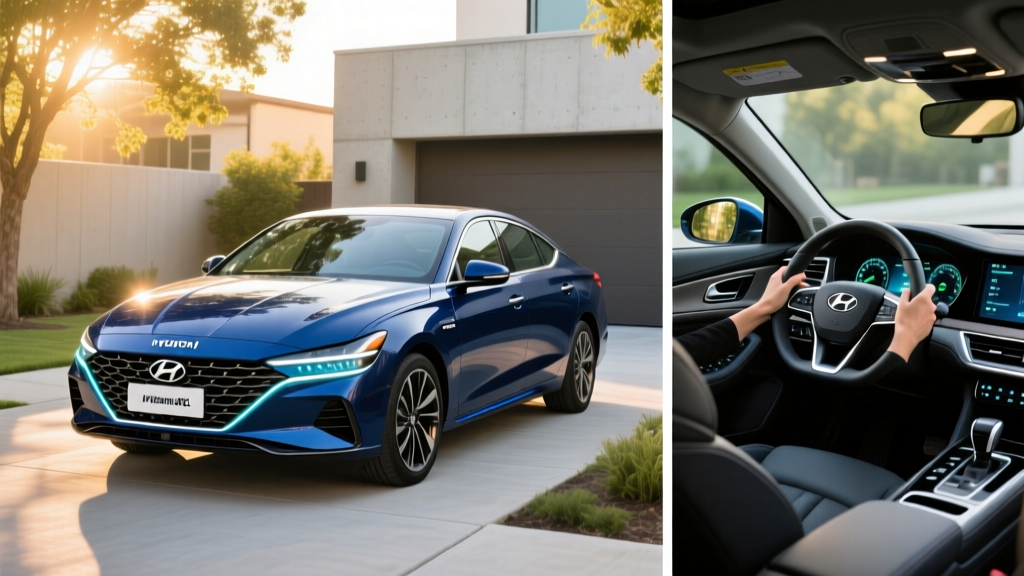
The 2025 Hyundai Sonata Hybrid SEL occupies a specific niche that fewer competitors bother filling: a conventional hybrid electric vehicle (HEV) in a midsize sedan body that prioritizes fuel economy without sacrificing highway comfort. With an EPA-estimated 47 MPG combined, a proven 2.0-liter hybrid powertrain, and a starting MSRP of $31,450, it targets buyers who want dramatic fuel savings without plugging in, without range anxiety, and without paying the premium of a plug-in hybrid or full battery-electric vehicle.
After analyzing the specs, real-world efficiency data, and ownership costs, the Sonata Hybrid SEL makes a compelling case as one of the most practical hybrid sedans available — especially for high-mileage commuters who rack up city and suburban miles where hybrid systems shine brightest.
Fuel Economy: EPA Ratings vs. Real-World MPG
Hyundai rates the 2025 Sonata Hybrid SEL at 44 MPG city / 51 MPG highway / 47 MPG combined per the EPA. These are among the highest numbers in the midsize sedan segment, trailing only the Toyota Camry Hybrid (which achieves up to 52 MPG combined in its LE trim).
| Metric | EPA Rating | Real-World Expectation |
|---|---|---|
| City MPG | 44 MPG | 46–50 MPG (hybrids excel in stop-and-go) |
| Highway MPG | 51 MPG | 44–48 MPG (sustained 70+ mph reduces regen benefit) |
| Combined MPG | 47 MPG | 45–49 MPG (mixed driving) |
| Fuel Tank | 13.2 gallons | — |
| Total Range | ~620 miles | ~580–640 miles depending on conditions |
Real-world note: Conventional hybrids consistently exceed their EPA city rating in actual stop-and-go driving because regenerative braking recaptures energy that a gas car wastes as heat. On fueleconomy.gov, owners of the prior-generation Sonata Hybrid report averaging between 42 and 50 MPG combined, with city-heavy commuters often seeing numbers above the EPA estimate. Highway-only road trips at 75–80 MPH will pull the average down, as the electric motor provides less assistance at sustained high speeds.
Cold weather (below 35°F) typically reduces hybrid efficiency by 5–10% due to increased engine warm-up time and reduced battery performance, though this penalty is far smaller than what full EVs experience in winter.
Powertrain: 2.0L Engine + Electric Motor
The Sonata Hybrid SEL uses Hyundai's well-established hybrid architecture:
- Engine: 2.0-liter GDI inline-4, producing 150 horsepower and 139 lb-ft of torque
- Electric motor: 39 kW (52 horsepower) permanent-magnet synchronous motor integrated into the transmission
- Combined system output: 192 horsepower
- Transmission: 6-speed automatic (no CVT — a notable differentiator vs. the Camry Hybrid)
- Drivetrain: Front-wheel drive only (AWD is not available on the Sonata Hybrid)
The 6-speed automatic is a deliberate choice. While CVTs maximize efficiency, Hyundai's conventional automatic delivers more natural acceleration feel and avoids the "rubber band" drone that some drivers dislike in Toyota's hybrid system. The trade-off is marginally lower peak efficiency — but 47 MPG combined is hardly a compromise.
Acceleration is adequate rather than quick: expect 0–60 MPH in approximately 7.8 seconds. That's perfectly fine for merging and passing but won't win any stoplight races. The electric motor fills in torque at low RPMs, making the car feel responsive around town even though 192 HP is modest for a midsize sedan.
Hybrid Battery: Size, Warranty, and Replacement Cost
The Sonata Hybrid SEL uses a 1.76 kWh lithium-ion polymer battery pack. This is a small battery by design — it doesn't need to store much energy because it's constantly being charged by the engine and regenerative braking. Unlike a PHEV or BEV, you never plug it in and never think about state of charge.
Battery degradation and lifespan: Hyundai's hybrid batteries have proven durable. The company has been using this architecture since the 2011 Sonata Hybrid, and widespread battery failure reports are rare. Most hybrid batteries outlast the 10-year warranty period. When replacement is eventually needed (typically beyond 150,000–200,000 miles), expect to pay between $2,500 and $4,000 for a new battery pack — significantly less than a full EV battery replacement.
The smaller battery also means lower environmental impact at end-of-life and less weight penalty compared to PHEVs carrying 10–18 kWh packs they rarely fully use.
Pricing, Trims, and Tax Credit Eligibility
| Trim | MSRP | Key Features |
|---|---|---|
| SEL | $31,450 | Heated seats, 12.3" cluster, wireless CarPlay/Android Auto, SmartSense ADAS |
| Limited | $36,150 | Leather, panoramic sunroof, ventilated seats, Bose audio, Highway Driving Assist |
Federal tax credit: The 2025 Sonata Hybrid SEL does not qualify for the federal §30D Clean Vehicle Credit. Under current IRS rules, the §30D credit is reserved for battery electric vehicles (BEVs) and plug-in hybrids (PHEVs) with a battery capacity of at least 7 kWh. The Sonata Hybrid's 1.76 kWh battery falls well below this threshold. Conventional HEVs are not eligible.
State incentives: Some states offer rebates or HOV lane access for conventional hybrids, though these are increasingly rare as incentive programs shift toward BEVs and PHEVs. Check your state's energy office or DMV for current programs.
Even without tax credits, the Sonata Hybrid SEL's fuel savings are substantial. At 47 MPG combined versus a comparable gas-only midsize sedan at 28 MPG, and with gas at $3.50/gallon, a driver covering 15,000 miles annually saves approximately $1,100 per year in fuel costs — or roughly $5,500 over five years.
Who Should Choose the Sonata Hybrid SEL?
- You drive 12,000+ miles/year, especially city and suburban routes
- You want maximum fuel savings without ever plugging in
- You don't have reliable home charging access for a PHEV or EV
- You want a traditional sedan with a proven, low-complexity hybrid system
- You value the 10-year/100,000-mile battery warranty for peace of mind
- You want electric-only driving for short commutes (consider a PHEV)
- You need AWD for snow-belt winters (look at the Toyota Camry Hybrid AWD or Subaru Legacy)
- You want to eliminate gasoline entirely (consider a full BEV like the Hyundai Ioniq 6)
- You want sporty driving dynamics (the Sonata Hybrid prioritizes comfort over engagement)
- You qualify for the $7,500 federal EV credit and want to maximize incentives
Hybrid vs. PHEV vs. EV decision framework:
- HEV (this car): Best for drivers without charging access who want simple, reliable fuel savings. Zero lifestyle change required — just fill up less often.
- PHEV: Best for drivers with home charging who commute 20–40 miles daily and want to drive mostly on electricity, with a gas engine for longer trips. Higher upfront cost, but potential tax credits and near-zero fuel use on short commutes.
- BEV: Best for drivers with reliable charging (home or work) who want to eliminate gasoline entirely. Lowest operating cost, highest upfront cost, and requires planning for road trips.
Reliability, Safety, and Ownership Costs
Hyundai's hybrid system has matured over more than a decade of production. The 2025 Sonata Hybrid carries over the same fundamental architecture that has proven reliable in the Ioniq Hybrid, Tucson Hybrid, and previous Sonata Hybrid generations. The 6-speed automatic transmission is a conventional torque-converter unit — no exotic e-CVT or dual-clutch complications.
Safety: The Sonata comes standard with Hyundai SmartSense, which includes forward collision-avoidance assist, lane-keeping assist, blind-spot monitoring, rear cross-traffic alert, and driver attention warning. The SEL trim adds safe exit assist. NHTSA and IIHS testing of the Sonata platform has historically yielded strong results, though 2025-specific ratings should be confirmed as they're released.
5-year ownership cost estimate (15,000 miles/year):
| Category | Estimated Cost |
|---|---|
| Fuel (47 MPG, $3.50/gal) | ~$5,585 |
| Insurance (national avg) | ~$8,500 |
| Maintenance (hybrid = fewer oil changes, regen saves brakes) | ~$2,200 |
| Depreciation (est. 50% over 5 years) | ~$15,725 |
| Total 5-Year Cost | ~$32,010 |
Compared to a gas-only midsize sedan at 28 MPG, the Sonata Hybrid saves roughly $5,500 in fuel over five years — enough to offset most of its price premium over a non-hybrid competitor.
Frequently Asked Questions
How many MPG does the 2025 Hyundai Sonata Hybrid SEL get?
The EPA rates it at 44 city / 51 highway / 47 combined MPG. In real-world driving, city-heavy commuters often see 46–50 MPG combined, while highway-only driving at high speeds may drop to the low-to-mid 40s.
Does the Sonata Hybrid need to be plugged in?
No. The Sonata Hybrid SEL is a conventional hybrid (HEV). It charges its battery automatically through regenerative braking and the gasoline engine. You never plug it in — you simply refuel at a gas station as normal.
Is the Sonata Hybrid reliable, and what does battery replacement cost?
Hyundai's hybrid system has been in production since 2011 and has a strong reliability record. The battery is covered for 10 years / 100,000 miles. If replacement is needed beyond the warranty period, expect $2,500–$4,000 — far less than an EV battery.
Does the Sonata Hybrid SEL qualify for any federal tax credit?
No. The federal §30D Clean Vehicle Credit requires a minimum 7 kWh battery and plug-in capability. The Sonata Hybrid's 1.76 kWh battery does not qualify. Only BEVs and PHEVs are eligible under current IRS rules.
How does it compare to the Toyota Camry Hybrid?
The Camry Hybrid achieves slightly higher EPA ratings (up to 52 combined in LE trim) and offers available AWD. The Sonata Hybrid counters with a more conventional 6-speed automatic (no CVT), a slightly more upscale interior in higher trims, and Hyundai's 10-year powertrain warranty versus Toyota's 8-year hybrid battery warranty. Both are excellent choices; the decision often comes down to styling preference and whether AWD is a priority.
Is AWD available on the Sonata Hybrid?
No. The 2025 Sonata Hybrid is front-wheel drive only. If you need AWD in a hybrid sedan, the Toyota Camry Hybrid and Subaru Legacy are your primary alternatives.