Quick Verdict: A Boxed-Out Family Hauler That Sips Fuel
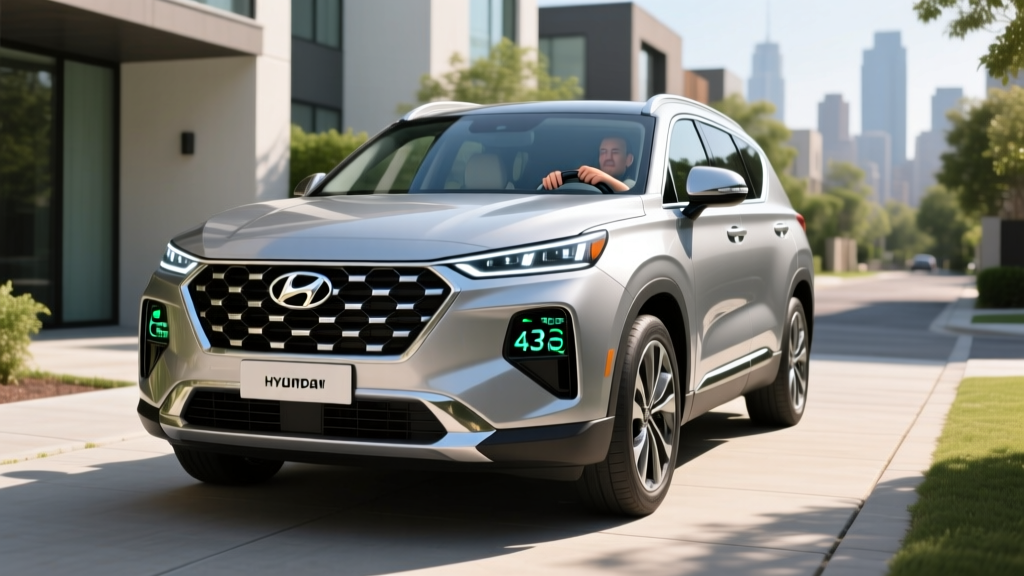
The fully redesigned 2025 Hyundai Santa Fe Hybrid is a three-row midsize SUV that trades the soft curves of its predecessor for a rugged, boxy silhouette — and pairs that bold look with a turbocharged hybrid powertrain that delivers up to 36 MPG combined. For families who need three rows, standard all-wheel drive, and genuinely low fuel bills without plugging in, the Santa Fe HEV is one of the most compelling packages in its class. Hyundai also offers a plug-in hybrid (PHEV) variant for buyers with short commutes and home charging access, which we'll break down in detail below.
This review covers both the conventional hybrid (HEV) and plug-in hybrid (PHEV) versions of the 2025 Santa Fe, because choosing between them is the single most important decision you'll make in the configurator.
HEV vs PHEV: Which Santa Fe Hybrid Is Which?
Before we get into the numbers, let's establish the fundamental difference between the two electrified Santa Fe models, because confusing them is the most common buyer mistake we see.
Santa Fe Hybrid (HEV)
- No plug required. The small battery recharges via regenerative braking and the gas engine.
- Fuel economy: 36 MPG city / 35 highway / 36 combined (EPA estimate for SEL and Limited trims, per fueleconomy.gov).
- Powertrain: 1.6L turbo 4-cylinder + electric motor, 230 combined horsepower.
- Battery: ~1.5 kWh lithium-ion (not user-serviceable, not plug-in).
- Best for: Drivers who want lower fuel bills without changing their routine.
Santa Fe Plug-In Hybrid (PHEV)
- Plugs in to charge. Has a larger battery you can charge at home or at public Level 2 stations.
- Electric-only range: 30 miles EPA on battery alone before the gas engine starts.
- Fuel economy after battery depletes: 33 MPG combined (hybrid mode).
- Powertrain: 1.6L turbo 4-cylinder + more powerful electric motor, 258 combined horsepower.
- Battery: 13.8 kWh usable lithium-ion.
- Best for: Drivers with short commutes (≤30 miles) who can charge at home.
Neither version requires you to change your driving habits. The HEV is a fill-up-and-go vehicle. The PHEV gives you the option to drive electric for short trips but works perfectly as a regular hybrid when the battery is depleted.
Fuel Economy: EPA Numbers vs Real-World MPG
Here's the official EPA breakdown for both powertrains, alongside what owners and testers typically observe on the road.
| Model | City MPG | Highway MPG | Combined MPG | Real-World Expectation |
|---|---|---|---|---|
| Santa Fe HEV (SEL/Limited AWD) | 36 | 35 | 36 | 33–37 combined; city often matches or exceeds EPA |
| Santa Fe HEV (Calligraphy AWD) | 35 | 34 | 35 | 32–36 combined; larger wheels cost ~1 MPG |
| Santa Fe PHEV (hybrid mode, battery depleted) | 33 | 33 | 33 | 30–34 combined once electric range is used |
Real-world context: Hyundai's turbocharged hybrid system excels in stop-and-go city driving, where regenerative braking recaptures energy constantly. Many owners report matching or slightly exceeding the EPA city estimate. Highway fuel economy is more variable — sustained 75+ mph cruising with a full load of passengers and cargo can drop the HEV to the low 30s. Cold weather (below freezing) typically costs hybrids 10–15% efficiency due to the engine running more often to provide cabin heat before the system can rely on waste heat.
For the PHEV, the 30-mile electric-only range is EPA-rated. In mild weather with moderate speeds, expect 28–32 miles. In winter or at highway speeds, plan on 22–26 miles before the engine fires up. Once the battery is depleted, the PHEV operates as a conventional hybrid at roughly 33 MPG — slightly less than the HEV due to the added weight of the larger battery pack.
Powertrain and Performance Specs
| Specification | Santa Fe HEV | Santa Fe PHEV |
|---|---|---|
| Engine | 1.6L turbocharged 4-cylinder | 1.6L turbocharged 4-cylinder |
| Electric Motor | 47.7 kW (64 hp) | 72 kW (97 hp) |
| Combined System Output | 230 hp / 271 lb-ft torque | 258 hp / 271 lb-ft torque |
| Transmission | 6-speed automatic | 6-speed automatic |
| Drivetrain | HTRAC AWD (standard) | HTRAC AWD (standard) |
| 0–60 mph (est.) | ~7.8 seconds | ~7.2 seconds |
| Towing Capacity | 2,000 lbs | 2,000 lbs |
| Battery Capacity | ~1.5 kWh (sealed) | 13.8 kWh usable |
| Electric-Only Range | N/A | 30 miles (EPA) |
| Charging (Level 2, 240V) | N/A | ~3.5 hours (7.2 kW onboard charger) |
| DC Fast Charging | N/A | Not available |
The PHEV's more powerful electric motor gives it a noticeable torque advantage off the line and in electric-only mode, where it feels genuinely peppy around town. Both models use a conventional 6-speed automatic rather than a CVT, which Hyundai's hybrid buyers tend to prefer for its natural shift feel. All-wheel drive is standard across the board — a significant advantage over competitors like the Toyota Highlander Hybrid, which offers AWD only on certain trims.
Charging note for PHEV buyers: The Santa Fe PHEV charges at up to 7.2 kW on a Level 2 (240V) home charger, meaning a full 0–100% charge takes roughly 3.5 hours. It does not support DC fast charging — this is common for PHEVs, as the battery is too small to benefit from high-power DC charging. A standard 120V household outlet (Level 1) will fully charge the PHEV in approximately 11 hours, which works fine for overnight replenishment.
Pricing, Trims, and Tax Credit Eligibility
The 2025 Santa Fe Hybrid lineup starts at $38,615 (including destination) for the HEV SEL trim and climbs to the mid-$40,000s for the Calligraphy. The PHEV is positioned higher, starting at $43,415 for the SEL Convenience PHEV.
| Trim | Powertrain | MSRP (incl. destination) |
|---|---|---|
| SEL Hybrid | HEV | $38,615 |
| Limited Hybrid | HEV | $41,215 |
| Calligraphy Hybrid | HEV | $44,415 |
| SEL Convenience PHEV | PHEV | $43,415 |
| Limited PHEV | PHEV | $47,115 |
| Calligraphy PHEV | PHEV | $49,415 |
Federal Tax Credit: What You Need to Know
Under current IRS §30D rules, the Santa Fe PHEV may qualify for a partial or full federal clean vehicle credit (up to $7,500), subject to several conditions:
- MSRP cap: SUVs must have an MSRP at or below $80,000 — all Santa Fe PHEV trims clear this easily.
- Buyer income cap: Modified AGI must not exceed $150,000 (single), $225,000 (head of household), or $300,000 (joint).
- Battery sourcing: The credit is split into two halves ($3,750 each) based on critical-mineral and battery-component sourcing requirements, which are tightening annually. The exact credit amount for the Santa Fe PHEV depends on the model year and production batch — verify with your dealer and a tax professional before purchasing.
- Point-of-sale transfer: Eligible buyers can transfer the credit to the dealer at purchase, reducing the out-of-pocket price immediately rather than waiting for a tax refund.
The Santa Fe HEV (conventional hybrid) does NOT qualify for the §30D federal EV credit. Conventional hybrids without plug-in capability are excluded. Some states offer separate hybrid incentives — check your state energy office or AFDC's state incentive database.
Battery Warranty, Reliability, and Replacement Cost
Hyundai Hybrid/PHEV Battery Warranty
- Hybrid battery: 10 years / 100,000 miles (whichever comes first)
- Hybrid system components (motor, inverter, converter): 10 years / 100,000 miles
- New vehicle limited warranty: 5 years / 60,000 miles
- Powertrain warranty: 10 years / 100,000 miles
Battery longevity is a top concern for hybrid shoppers, and Hyundai addresses it with one of the best warranties in the industry. The 10-year/100,000-mile hybrid battery coverage matches Toyota's and exceeds most competitors. Hyundai's hybrid batteries in the Tucson and Sonata families have shown minimal degradation in long-term testing — the smaller HEV battery rarely needs replacement, and the PHEV's 13.8 kWh pack is sized conservatively enough that significant capacity loss within the warranty period is uncommon.
Replacement cost if out of warranty: Based on current Hyundai parts pricing and independent shop data, a hybrid battery replacement runs approximately $2,500–$4,000 for the HEV and $5,000–$8,000 for the PHEV (parts and labor). These are ballpark figures; dealer pricing and regional labor rates vary. Given the 10-year warranty and the proven durability of Hyundai's hybrid systems, most owners will never face this expense.
Hyundai's overall reliability ratings have improved substantially in recent years. The Santa Fe earned a Top Safety Pick designation from the IIHS in prior model years, and the 2025 redesign includes standard forward-collision avoidance, lane-keeping assist, and blind-spot monitoring across all trims.
Who Should Buy the Santa Fe Hybrid — and Who Shouldn't?
Choose the Santa Fe HEV If:
- You want three rows and AWD with fuel costs near $1,600/year (at 15,000 miles and $3.50/gal).
- You don't have access to home or workplace charging and don't want to change your fueling routine.
- You drive 12,000–20,000 miles per year and want to maximize fuel savings on a per-mile basis.
- You want a lower purchase price (starting ~$38,600) without depending on tax credit eligibility.
Choose the Santa Fe PHEV If:
- Your daily commute is under 30 miles round-trip and you can charge at home overnight.
- You want near-silent, zero-tailpipe-emission driving for daily errands, with gas-engine backup for road trips.
- You qualify for the federal §30D credit, which can bring the effective price closer to the HEV.
- You value the extra 28 hp and stronger electric-mode acceleration.
Consider a Full EV (e.g., Kia EV9, Hyundai Ioniq 5) If:
- You have reliable home Level 2 charging and rarely drive more than 250 miles in a single day.
- You want the lowest possible per-mile energy cost (electricity at $0.13/kWh is roughly equivalent to $1.10/gallon gasoline).
- You're ready to eliminate oil changes, spark plugs, and transmission fluid entirely.
Pros and Cons at a Glance
Pros
- 36 MPG combined (HEV) is excellent for a three-row AWD SUV
- Standard HTRAC AWD on every trim — no two-wheel-drive compromise
- 10-year/100,000-mile hybrid battery warranty
- PHEV offers 30 miles of electric-only range for daily commuting
- Boxy design yields generous cargo room and third-row headroom
- 6-speed automatic (no CVT drone)
- Rich standard tech: dual 12.3-inch displays, wireless CarPlay/Android Auto
Cons
- 2,000-lb towing capacity trails V6 competitors (Highlander: 5,000 lbs)
- Third row is tight for adults on longer trips
- PHEV does not support DC fast charging
- HEV is ineligible for the federal §30D tax credit
- Calligraphy trim pushes pricing into luxury-SUV territory without luxury-badge prestige
- Hybrid powertrain can feel strained under hard acceleration with a full load
Frequently Asked Questions
How many MPG does the 2025 Hyundai Santa Fe Hybrid get?
The Santa Fe HEV achieves an EPA-estimated 36 MPG city / 35 highway / 36 combined on the SEL and Limited trims. The heavier Calligraphy trim drops to 35/34/35. In real-world driving, owners typically see 33–37 MPG combined, with city driving often matching or slightly exceeding the EPA estimate thanks to regenerative braking.
How far can the Santa Fe PHEV go on electric only?
The EPA rates the Santa Fe PHEV at 30 miles of electric-only range. In mild weather at moderate speeds, expect 28–32 miles. In cold weather or at sustained highway speeds, plan for 22–26 miles before the gasoline engine engages.
Do I need to plug in the Santa Fe Hybrid (HEV)?
No. The conventional Santa Fe HEV does not plug in. Its small battery charges automatically through regenerative braking and the gas engine. You fuel it exactly like a traditional gasoline vehicle — just with better MPG. Only the PHEV variant requires (or benefits from) plug-in charging.
Does the 2025 Santa Fe Hybrid qualify for a tax credit?
The Santa Fe PHEV may qualify for a federal clean vehicle credit of up to $7,500 under IRS §30D, subject to buyer income limits, battery sourcing requirements, and the $80,000 SUV MSRP cap (all PHEV trims are under this cap). The conventional HEV does not qualify for the federal credit. State incentives may be available for both — check AFDC's incentive database for your state.
Is the Santa Fe Hybrid reliable, and what does a battery replacement cost?
Hyundai covers the hybrid battery and system components for 10 years or 100,000 miles. Out-of-warranty replacement costs are estimated at $2,500–$4,000 for the HEV battery and $5,000–$8,000 for the PHEV battery. Given Hyundai's hybrid track record and the conservative battery sizing, most owners will not need a replacement within the vehicle's typical ownership period.
How does the Santa Fe Hybrid compare to the Toyota Highlander Hybrid?
The Highlander Hybrid achieves a similar 35–36 MPG combined and offers a higher 5,000-lb towing capacity. However, the Santa Fe Hybrid comes standard with AWD on every trim (the Highlander Hybrid's AWD availability varies), starts at a lower price, and offers a PHEV option that the Highlander does not. Cargo space and third-row comfort are competitive between the two.