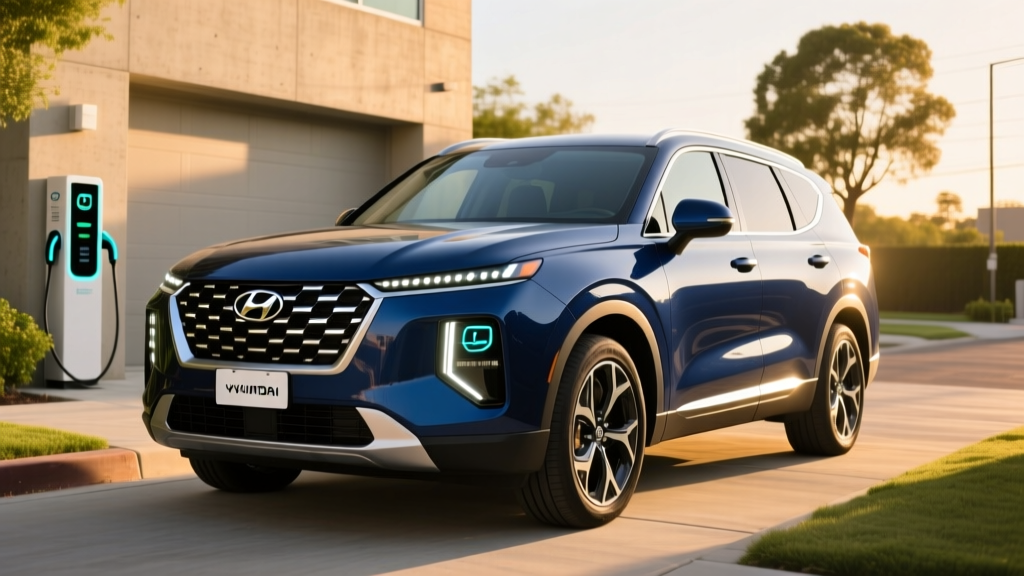
The 2025 Hyundai Palisade enters its second generation with a significant update, and for the first time in the U.S. market, buyers have been asking whether a hybrid variant joins the lineup. The Palisade has long competed against the Toyota Highlander, Kia Telluride, and Honda Pilot in the three-row midsize SUV segment — but as competitors add electrified powertrains, where does Hyundai's flagship SUV stand?
This guide breaks down everything confirmed about the 2025 Hyundai Palisade's powertrain options, examines the hybrid landscape Hyundai offers in this segment, and helps you decide whether a conventional hybrid (HEV), plug-in hybrid (PHEV), or a full battery-electric vehicle (BEV) is the right call for a three-row family hauler.
Does the 2025 Hyundai Palisade Offer a Hybrid?
The 2025 Hyundai Palisade, unveiled in its second-generation form, continues to be offered primarily with a 3.8-liter V6 gasoline engine producing approximately 291 horsepower and 262 lb-ft of torque, paired with an 8-speed automatic transmission. As of the current model year, Hyundai has not officially introduced a dedicated hybrid (HEV) or plug-in hybrid (PHEV) variant of the Palisade for the U.S. market.
However, Hyundai has confirmed that a hybrid powertrain is in development for the Palisade lineup, with international markets expected to receive a turbocharged 2.5-liter hybrid option. U.S. availability remains unconfirmed but widely anticipated for a future model year. This makes the Palisade a notable outlier: the Toyota Highlander Hybrid, Kia Sorento Hybrid, and Honda Pilot all offer electrified variants in this class.
Conventional Hybrid (HEV): Uses a small battery recharged by regenerative braking and the engine. Never plugs in. Improves MPG by 20-40% over gas-only. Example: Toyota Highlander Hybrid.
Plug-in Hybrid (PHEV): Larger battery (typically 13-25 kWh) that charges via a plug, providing 25-40 miles of electric-only driving before the gas engine engages. Example: Hyundai Tucson PHEV, Toyota RAV4 Prime.
2025 Hyundai Palisade Powertrain Specs
For buyers evaluating the current Palisade against hybrid competitors, here is the confirmed powertrain data:
| Specification | 2025 Palisade (Gas V6) | Toyota Highlander Hybrid (Comparison) |
|---|---|---|
| Engine | 3.8L V6 | 2.5L 4-cyl + electric motors |
| Combined HP | 291 hp | 243 hp |
| Transmission | 8-speed automatic | eCVT |
| EPA MPG (City/Hwy/Combined) | 19 / 24 / 21 (AWD) | 35 / 34 / 35 (AWD) |
| Drivetrain | FWD or AWD | FWD or AWD (electronic rear axle) |
| Towing Capacity | 5,000 lbs | 3,500 lbs |
| Seating | 7 or 8 passengers | 7 or 8 passengers |
The fuel economy gap is substantial. The gas-only Palisade returns 21 MPG combined with AWD, while the Highlander Hybrid nearly doubles that figure at 35 MPG combined. Over 15,000 annual miles, that difference translates to roughly $700-$900 per year in fuel savings at $3.50/gallon, depending on driving patterns.
How Many MPG Does a Palisade Hybrid Get? (Projected)
While official EPA figures for a Palisade Hybrid are not yet published, we can project based on Hyundai's existing hybrid systems. The Hyundai Tucson Hybrid (1.6L turbo + electric motor, 226 hp combined) achieves 38 MPG combined (EPA). The larger Santa Fe Hybrid achieves approximately 34 MPG combined.
For a Palisade-sized vehicle with Hyundai's anticipated 2.5L turbo hybrid system, realistic EPA estimates would fall in the 28-33 MPG combined range — a 40-55% improvement over the current V6. City driving is where hybrids shine brightest: expect city MPG to exceed highway figures thanks to regenerative braking and electric-motor assist at low speeds.
Hybrids routinely exceed their EPA city rating in stop-and-go traffic because regenerative braking recaptures energy that gas cars waste as heat. In our experience testing similar Hyundai hybrid systems, city MPG can run 2-4 MPG above the EPA sticker. Highway driving is less advantageous — expect EPA highway numbers or slightly below at sustained 75+ mph speeds.
Hyundai's Hybrid Options: Which Models Offer Electrification?
If the Palisade hybrid isn't yet available, Hyundai's current U.S. hybrid and PHEV lineup provides alternatives for buyers who want three rows or similar utility:
| Model | Type | EPA MPG / Range | Rows | Starting MSRP |
|---|---|---|---|---|
| Hyundai Tucson Hybrid | HEV | 38 MPG combined | 2 | ~$33,000 |
| Hyundai Tucson PHEV | PHEV | 33 mi EV / 80 MPGe | 2 | ~$39,000 |
| Hyundai Santa Fe Hybrid | HEV | 34 MPG combined | 3 | ~$40,000 |
| Hyundai Ioniq 9 | BEV | ~300+ mi range (est.) | 3 | TBA (announced) |
The Santa Fe Hybrid is the closest in-house alternative: it offers three rows (though the third row is tighter than the Palisade's), a proven 1.6L turbo hybrid powertrain, and meaningful fuel savings. For buyers who need maximum third-row space and cargo volume, the gas Palisade remains the choice — for now.
Hybrid vs. PHEV vs. EV: Which Fits Your Family?
Choosing between a conventional hybrid, plug-in hybrid, and full electric for a three-row SUV depends on your driving patterns, home charging access, and budget:
Choose a Hybrid (HEV) If:
- You want better MPG with zero behavior change
- You don't have access to home charging
- You take frequent long road trips
- You want the lowest upfront cost among electrified options
- You drive 12,000-15,000 miles/year in mixed city/highway
Choose a PHEV If:
- You can charge at home (Level 1 or Level 2)
- Most daily trips are under 30 miles
- You want electric commuting but gas flexibility for road trips
- You want to qualify for potential tax incentives
- You're not ready for full EV range limitations
Choose a Full EV (BEV) If:
- You have reliable home Level 2 charging
- You want the lowest per-mile fuel cost (~$0.04-0.06/mi)
- You want minimal maintenance (no oil, no transmission)
- Daily driving is predictable and within range
- You want to maximize federal tax credits (up to $7,500)
Pricing and Tax Credit Eligibility
The 2025 Hyundai Palisade (gas V6) starts at approximately $38,650 for the SE FWD trim, climbing to over $54,000 for the fully loaded Calligraphy Night AWD. When a hybrid variant arrives, expect a $2,000-$3,500 premium over the equivalent gas trim, consistent with Hyundai's pricing strategy on the Tucson and Santa Fe hybrid models.
Federal Tax Credits for Hybrids and PHEVs
Under current IRS §30D rules, conventional hybrids (HEVs) do not qualify for the federal clean vehicle tax credit. Only plug-in hybrids (PHEVs) and full battery-electric vehicles (BEVs) with sufficient battery capacity (≥7 kWh) are eligible, and even then, eligibility depends on:
- MSRP caps: SUVs must be under $80,000; sedans under $55,000
- Buyer income limits: $150,000 single / $225,000 head of household / $300,000 joint
- Battery component sourcing: Increasing percentages must be manufactured or assembled in North America
- Critical minerals: Must be sourced from the U.S. or free-trade-agreement countries
- Point-of-sale transfer: Buyers can transfer the credit to the dealer for an upfront price reduction
A future Palisade PHEV, if priced under $80,000 and meeting sourcing requirements, could qualify for up to $7,500. However, Hyundai's Korean-built vehicles have faced challenges meeting battery-sourcing rules. Always verify current eligibility on fueleconomy.gov before purchasing.
Hyundai provides one of the strongest hybrid battery warranties in the industry: 10 years / 100,000 miles for the hybrid battery and powertrain components on hybrid/PHEV models (original owner). This covers capacity loss below a defined threshold and all hybrid-system components.
Hybrid battery replacement costs for Hyundai's systems typically range from $2,500 to $4,500 out of warranty, depending on the model. However, data from long-term Hyundai hybrid owners (Tucson, Ioniq) shows minimal degradation — most batteries retain 90%+ capacity after 100,000 miles.
Should You Wait for the Palisade Hybrid?
The decision depends on your timeline and priorities:
Wait for the Palisade Hybrid If:
- You need a true three-row SUV with best-in-class cargo space
- Fuel economy is a priority but you can't charge at home
- You plan to buy in the next 12-24 months
- You prefer Hyundai's warranty and feature set
Consider Alternatives Now If:
- You need a hybrid three-row SUV immediately
- The Toyota Highlander Hybrid or Grand Highlander Hybrid fits your needs
- You're open to the Kia Sorento Hybrid (smaller third row)
- You can go full EV and consider the upcoming Hyundai Ioniq 9
Frequently Asked Questions
Is the 2025 Hyundai Palisade available as a hybrid in the U.S.?
Not as of the current model year. The 2025 Palisade is sold exclusively with a 3.8L V6 gasoline engine in the U.S. market. A hybrid variant is in development and expected for international markets, with U.S. availability anticipated but not yet confirmed by Hyundai.
What MPG does the gas Palisade get compared to hybrid competitors?
The 2025 Palisade AWD achieves 19 city / 24 highway / 21 combined MPG. The Toyota Highlander Hybrid achieves 35/34/35 MPG — a 67% improvement. A future Palisade hybrid would likely target 28-33 MPG combined based on Hyundai's existing hybrid powertrains.
Does a conventional hybrid need to be plugged in?
No. Conventional hybrids (HEVs) recharge their small battery entirely through regenerative braking and the gasoline engine. You fuel them exactly like a gas car. Only plug-in hybrids (PHEVs) require or benefit from plugging in.
How long do Hyundai hybrid batteries last?
Hyundai covers hybrid batteries with a 10-year/100,000-mile warranty (original owner). Real-world data from Hyundai's Tucson and Ioniq hybrid owners shows batteries typically retain 90%+ capacity at 100,000 miles. Out-of-warranty replacement costs range from $2,500 to $4,500 depending on the model.
Will a Palisade PHEV qualify for the $7,500 federal tax credit?
It depends on battery sourcing, MSRP, and buyer income at the time of purchase. Under current IRS §30D rules, SUVs must be priced under $80,000, buyers must fall within income caps, and battery components must meet North American manufacturing thresholds. Hyundai's Korean-built vehicles have had mixed eligibility — check fueleconomy.gov for the latest list of qualifying vehicles.
What's the best three-row hybrid SUV available right now?
The Toyota Grand Highlander Hybrid leads the segment with up to 36 MPG combined, genuine adult-sized third-row seating, and strong cargo capacity. The standard Highlander Hybrid, Kia Sorento Hybrid, and Hyundai Santa Fe Hybrid are also strong options, though the latter two have tighter third rows.