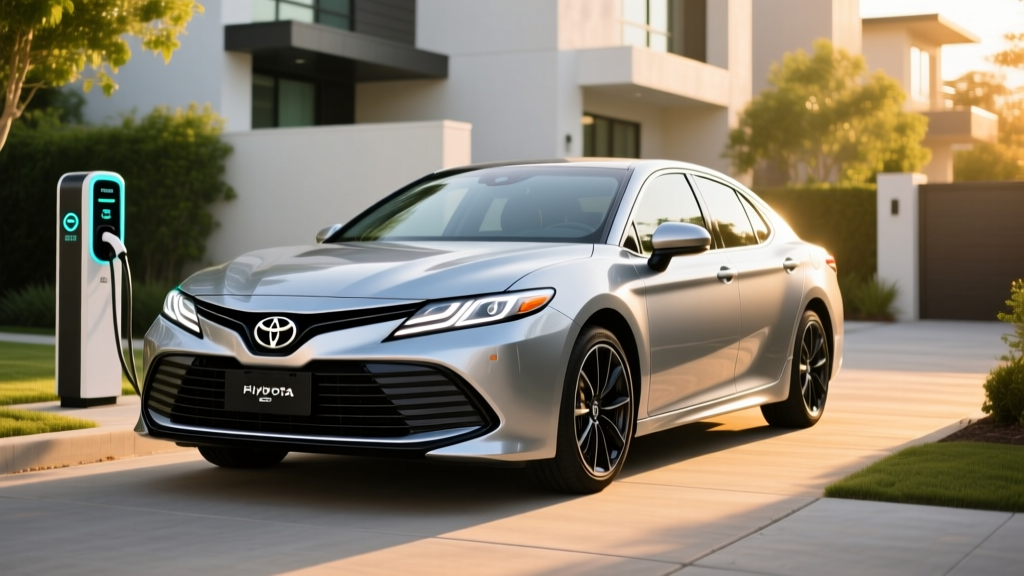
The 2025 Toyota Camry is now exclusively a hybrid. Toyota dropped the four-cylinder gas-only powertrain entirely for this ninth-generation redesign, betting that its fifth-generation Toyota Hybrid System (THS5) can satisfy the midsize sedan buyer who wants efficiency without plugging in. The result is a lineup that achieves up to 51 MPG combined, offers available electronic all-wheel drive, and starts under $30,000 — a compelling proposition in a segment where competitors still lean on turbocharged gas engines.
This guide covers every 2025 hybrid Toyota Camry trim, dissects the EPA fuel economy numbers against real-world driving patterns, and answers the questions that matter before you sign: battery longevity, warranty coverage, tax credit eligibility, and whether a conventional hybrid (HEV) or a plug-in hybrid (PHEV) is the better fit for your commute.
2025 Toyota Camry Hybrid Powertrain: What Changed
For 2025, the Camry rides on the TNGA-K platform and is powered by Toyota's latest fifth-generation hybrid system. Every trim pairs a 2.5-liter four-cylinder engine with one or two electric motors — one motor for front-wheel-drive (FWD) models and an additional rear motor for all-wheel-drive (AWD) trims.
| Specification | FWD Models | AWD Models |
|---|---|---|
| Engine | 2.5L 4-cylinder + 1 electric motor | 2.5L 4-cylinder + 2 electric motors |
| Combined Horsepower | 225 hp | 232 hp |
| Transmission | eCVT | eCVT |
| Drivetrain | Front-wheel drive | Electronic AWD (eAWD) |
| 0–60 mph (est.) | ~7.2 sec | ~6.9 sec |
| Hybrid Battery | Lithium-ion, ~1.0 kWh (self-charging HEV) | |
The AWD system is not a mechanical driveshaft setup. Instead, a dedicated rear-axle electric motor engages automatically when the car detects slip or when extra traction is needed, then disengages to preserve efficiency. It adds roughly 7 horsepower to the combined system output and a slight weight penalty, which is reflected in the fuel economy figures below.
Fuel Economy: EPA Ratings vs. Real-World MPG
The 2025 Camry Hybrid's headline number is 51 MPG combined on the LE trim with front-wheel drive. That figure places it among the most efficient midsize sedans sold in the United States, rivaling the Honda Accord Hybrid (48 MPG combined) and handily beating the Hyundai Sonata Hybrid (47 MPG combined).
| Trim | Drivetrain | City MPG | Highway MPG | Combined MPG |
|---|---|---|---|---|
| LE | FWD | 53 | 50 | 51 |
| LE | AWD | 51 | 49 | 49 |
| SE / XLE / XSE | FWD | 48 | 47 | 47 |
| SE / XLE / XSE | AWD | 46 | 46 | 46 |
Source: EPA Fuel Economy Guide (fueleconomy.gov)
Real-World MPG: What Owners Actually See
Toyota's hybrid system excels in stop-and-go city driving, where regenerative braking and electric-motor assist do the heavy lifting. Many owners report exceeding the EPA city estimate of 53 MPG on the LE FWD in urban commuting, with some drivers logging 55–58 MPG on routes with frequent stops and moderate speeds.
Highway driving tells a different story. At sustained speeds above 70 mph, aerodynamic drag dominates, and the gasoline engine carries most of the load. Expect real-world highway fuel economy to land in the 44–48 MPG range on FWD trims, depending on speed, terrain, and temperature. In cold weather (below 40°F), the engine runs more frequently to maintain cabin heat and battery temperature, which can reduce combined MPG by 5–10%.
EPA Combined: 51 MPG (LE FWD) | Expect 48–54 MPG in mixed real-world driving. City commuters may see 55+ MPG. Highway-heavy drivers at 75+ mph should budget for 44–48 MPG. Cold-weather penalty: ~3–5 MPG combined.
HEV vs. PHEV: Is the Camry Hybrid Right, or Should You Plug In?
The 2025 Camry is a conventional hybrid electric vehicle (HEV). It charges its small lithium-ion battery through regenerative braking and the gasoline engine — you never plug it in. This is fundamentally different from a plug-in hybrid electric vehicle (PHEV) like the Toyota RAV4 Prime or the discontinued Toyota Prius Prime, which carries a larger battery and offers 25–44 miles of electric-only driving before the gas engine takes over.
| Feature | HEV (2025 Camry Hybrid) | PHEV (e.g., RAV4 Prime, Prius Prime) |
|---|---|---|
| Plugs In? | No — self-charging | Yes — Level 1 or Level 2 |
| Battery Size | ~1.0 kWh | 13.6–18.1 kWh |
| Electric-Only Range | ~1 mile at low speed | 25–44 miles |
| Fuel Economy (gas mode) | 46–51 MPG | 35–44 MPG (after battery depletes) |
| Home Charging Needed? | No | Yes, for full benefit |
| Federal Tax Credit (§30D) | Not eligible | Up to $7,500 (varies) |
| Starting Price | ~$29,490 | ~$36,000–$44,000 |
Choose the Camry HEV if: You don't have reliable access to home or workplace charging, you want the lowest purchase price, or your commute is mostly highway driving where PHEV electric range offers minimal benefit.
Choose a PHEV if: You can charge at home, your daily commute is under 30 miles round-trip (meaning you could drive mostly on electricity), and you want the option of zero-emission local driving with a gas engine for road trips.
Toyota does not currently offer the Camry as a PHEV in the U.S. market. If you want a Toyota plug-in hybrid sedan, the closest option is the Prius Prime (up to 44 miles electric-only, 52 MPG combined in hybrid mode).
2025 Camry Hybrid Pricing by Trim
Toyota simplified the Camry lineup for 2025. The four available trims are LE, SE, XLE, and XSE. All are hybrid-only. Here is the MSRP breakdown including destination charge:
| Trim | FWD MSRP | AWD MSRP |
|---|---|---|
| LE | $29,490 | $30,990 |
| SE | $31,490 | $32,990 |
| XLE | $34,490 | $35,990 |
| XSE | $35,490 | $36,990 |
Source: Toyota.com Official Camry Page
Tax Credit Eligibility: What You Need to Know
The 2025 Camry Hybrid is a conventional HEV, which means it does not qualify for the federal §30D clean vehicle tax credit (up to $7,500). That credit is reserved for plug-in vehicles — battery electric vehicles (BEVs) and plug-in hybrids (PHEVs) — that meet specific battery sourcing, MSRP, and buyer income requirements as defined by the IRS.
However, some states offer their own incentives for hybrid vehicles, though these are increasingly rare as state programs shift focus to plug-in vehicles. Check your state energy office or department of environmental quality for current programs. A few states historically offered $500–$1,000 rebates for HEVs, but most have sunset these as hybrid adoption became mainstream.
- ❌ Vehicle type: HEV (not a plug-in) — does not qualify
- ❌ Must be a BEV or PHEV with ≥7 kWh battery capacity
- ❌ Buyer income caps, MSRP caps, and battery-sourcing rules apply to qualifying vehicles
- ✅ The Camry Hybrid may qualify for certain state-level efficiency rebates (varies by jurisdiction)
Hybrid Battery Warranty, Lifespan, and Replacement Cost
Battery longevity remains the single biggest concern for hybrid buyers, and Toyota addresses it with one of the strongest warranties in the industry.
Hybrid Battery: 10 years / 150,000 miles (whichever comes first), transferable to subsequent owners.
Hybrid System Components: 8 years / 100,000 miles — covers the inverter, electric motor(s), and related control electronics.
Capacity Retention Threshold: Toyota warrants the hybrid battery against defects and abnormal loss of capacity. In practice, Toyota's hybrid batteries rarely drop below 80% state of health within the warranty period under normal use.
How Long Will the Camry Hybrid Battery Actually Last?
Toyota has been refining its hybrid battery technology since the original 1997 Prius. The 2025 Camry uses a relatively small lithium-ion pack (~1.0 kWh usable). Because the hybrid system keeps the battery operating in a narrow state-of-charge window (roughly 40%–80%), the cells experience far less stress than a full EV battery that regularly cycles from 10% to 90%.
Based on fleet data and owner reports from Toyota's fourth-generation hybrid systems (which share the same operating principles), the battery should comfortably last 150,000–200,000+ miles before any meaningful capacity loss. Many Prius taxis have surpassed 300,000 miles on the original hybrid battery.
Battery Replacement Cost
If the hybrid battery does eventually need replacement out of warranty, expect to pay between $2,000 and $4,000 for a new OEM replacement at a Toyota dealer, including labor. Aftermarket and reconditioned options are available for $1,000–$2,000. This is dramatically less than EV traction battery replacements, which can run $8,000–$20,000+, because the Camry's hybrid battery is small and modular.
Driving Impressions: Performance and Daily Usability
The 225-hp FWD powertrain is adequate for daily driving but not thrilling. The eCVT delivers smooth, linear acceleration without the rubber-band sensation of older Toyota hybrids. Off-the-line response is brisk thanks to instant electric-motor torque, but highway passing at speed requires planning — the engine drones noticeably under hard acceleration, a characteristic of the planetary-gear eCVT design.
The AWD model's 232 hp and rear-motor torque fill give it slightly more confident launches, especially in wet or snowy conditions. The electronic AWD engages seamlessly and transparently — most drivers won't notice it working.
Ride quality on the LE and XLE trims is compliant and quiet, with well-isolated road noise. The SE and XSE trims get a sport-tuned suspension that firms up the ride without becoming harsh. The 12.3-inch touchscreen (standard on SE and above, available on LE via package) runs Toyota's latest multimedia system with wireless Apple CarPlay and Android Auto.
Cargo space measures 15.1 cubic feet in the trunk — unchanged from the gas Camry, since the compact hybrid battery is packaged under the rear seat and does not intrude on trunk volume.
Safety Ratings and Driver-Assistance Technology
Every 2025 Camry comes standard with Toyota Safety Sense 3.0 (TSS 3.0), which includes:
- Pre-Collision System with Pedestrian Detection
- Full-Speed Range Dynamic Radar Cruise Control
- Lane Departure Alert with Steering Assist
- Lane Tracing Assist
- Road Sign Assist
- Automatic High Beams
- Proactive Driving Assist (gentle braking/steering support in specific scenarios)
The 2025 Camry earned the IIHS Top Safety Pick+ designation (when equipped with specific headlights) and a 5-Star Overall Rating from NHTSA. This is a Level 2 driver-assistance system per SAE automation definitions — the driver must remain fully engaged and attentive at all times.
Who Should Buy the 2025 Camry Hybrid?
Choose the Camry Hybrid if:
- You want 47–51 MPG without changing your fueling habits (no plugs, no chargers)
- You don't have access to home or workplace EV charging
- Your budget is under $37,000 and you want a proven, reliable midsize sedan
- You drive 12,000–20,000 miles per year and want to minimize fuel costs
- You live in a region with extreme temperatures where EV range loss is a concern
Look at a PHEV or full EV instead if:
- You can install a Level 2 home charger and want zero-emission daily driving
- Your daily commute is under 30 miles and you want to avoid burning gas entirely on weekdays
- You want to take advantage of the federal §30D tax credit (up to $7,500 for qualifying plug-in vehicles)
- You're interested in lower per-mile energy costs — electricity at $0.14/kWh costs roughly $0.04/mile vs. $0.10–$0.12/mile for a 50-MPG hybrid on $3.50/gal gas
Pros and Cons at a Glance
- Up to 51 MPG combined (LE FWD) — class-leading efficiency
- No plug-in charging required — fuel like a conventional car
- 10-year / 150,000-mile hybrid battery warranty
- Available electronic AWD on every trim
- Strong safety ratings (IIHS TSP+, NHTSA 5-Star)
- Competitive starting price at $29,490
- Toyota's long-term reliability reputation
- No PHEV variant — cannot drive on electric-only for meaningful distances
- Not eligible for the federal §30D tax credit
- eCVT drone under hard acceleration
- AWD trims lose 2–3 MPG vs. FWD
- Upper trims (XSE AWD) push past $37,000
- No DC fast charging capability (not applicable to HEV)
2025 Camry Hybrid FAQ
How many MPG does the 2025 hybrid Toyota Camry get?
The EPA rates the 2025 Camry Hybrid LE FWD at 53 city / 50 highway / 51 combined MPG. The AWD version drops to 51/49/49. Higher trims (SE, XLE, XSE) are rated at 48/47/47 FWD and 46/46/46 AWD. In real-world driving, city commuters often exceed the EPA city estimate, while sustained highway driving at 75+ mph typically yields 44–48 MPG.
Does the 2025 Camry Hybrid need to be plugged in?
No. The 2025 Camry Hybrid is a conventional HEV (hybrid electric vehicle). It charges its battery entirely through regenerative braking and the gasoline engine. There is no plug, no charging port, and no electric-only driving range beyond very low-speed maneuvering. If you want plug-in capability, consider the Toyota Prius Prime (PHEV).
Does the 2025 Camry Hybrid qualify for a tax credit?
No. The federal §30D clean vehicle credit applies only to plug-in electric vehicles (BEVs and PHEVs). The Camry Hybrid, as a conventional HEV, does not qualify. Some states may offer minor efficiency rebates, but these vary by jurisdiction and are increasingly uncommon for non-plug-in vehicles.
How long will the hybrid battery last and what does replacement cost?
Toyota warranties the hybrid battery for 10 years / 150,000 miles. Based on historical data from Toyota's hybrid fleet, the battery typically lasts 150,000–200,000+ miles before significant degradation. Out-of-warranty replacement costs $2,000–$4,000 for a new OEM battery, or $1,000–$2,000 for a reconditioned unit.
Is the 2025 Camry Hybrid available with AWD?
Yes. Every trim (LE, SE, XLE, XSE) offers electronic AWD as an option for an additional ~$1,500. The system uses a rear-axle electric motor that engages automatically for traction and disengages during steady-state driving to preserve fuel economy. AWD trims sacrifice 2–3 MPG combined compared to their FWD counterparts.
Hybrid vs. PHEV vs. EV — which should I choose?
Choose the Camry Hybrid (HEV) if you want maximum simplicity, no charging infrastructure, and low cost. Choose a PHEV (like the Prius Prime) if you can charge at home and want 25–44 miles of electric commuting with a gas backup. Choose a full EV (like the Tesla Model 3 or Hyundai Ioniq 6) if you want zero tailpipe emissions, the lowest per-mile fuel cost, and have reliable home charging access.
What is the 0–60 mph time for the 2025 Camry Hybrid?
The FWD Camry Hybrid reaches 60 mph in approximately 7.2 seconds. The AWD model, with its additional 7 horsepower from the rear motor, is slightly quicker at roughly 6.9 seconds. These figures are competitive with turbocharged four-cylinder rivals in the midsize sedan segment.