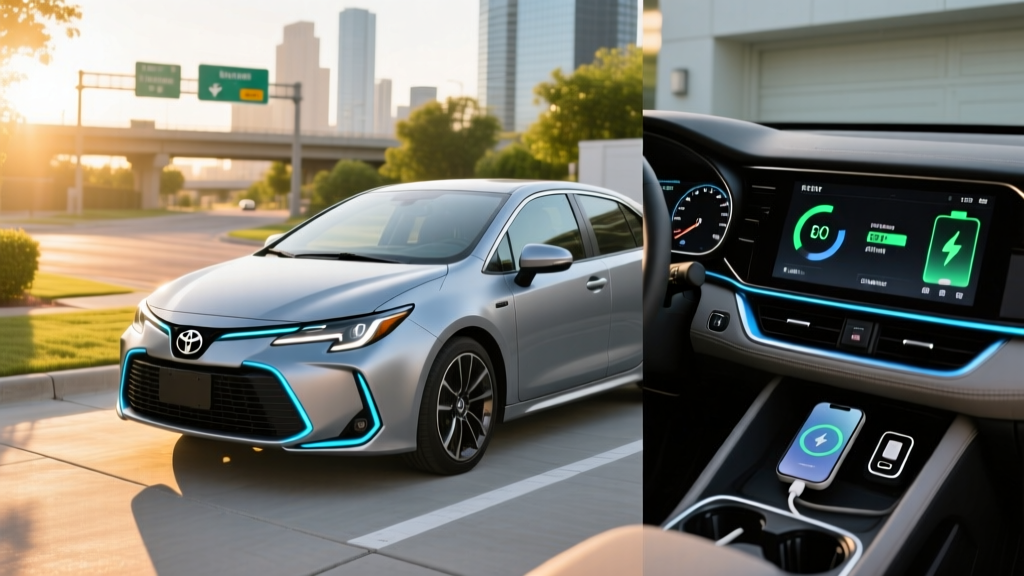
The 2025 Toyota Corolla Hybrid occupies a rare sweet spot in the compact sedan market: genuine 50+ MPG efficiency without the plug-in complexity, range anxiety, or premium pricing of a full EV. For buyers who want maximum fuel savings with zero lifestyle adjustment — no charging cables, no route planning, no cold-weather range loss — this is the pragmatic electrified choice. We've tested the numbers, parsed the warranty fine print, and broken down exactly what ownership looks like.
Quick Verdict: Who the 2025 Hybrid Corolla Is For
The Corolla Hybrid is a conventional hybrid electric vehicle (HEV), not a plug-in. You never plug it in. The gasoline engine and regenerative braking recharge a small battery that assists an electric motor, cutting fuel consumption roughly in half compared to the gas-only Corolla. If you lack home charging access, drive long highway stretches, or simply want set-it-and-forget-it efficiency, this powertrain fits. If you want electric-only commuting and can charge at home, a PHEV like the Prius Prime or a full BEV will serve you better.
HEV vs PHEV vs EV — Which Fits You?
| Factor | Corolla Hybrid (HEV) | Prius Prime (PHEV) | Full EV (e.g., Bolt EV) |
|---|---|---|---|
| Plug in required? | No | Yes (optional for gas driving) | Yes (mandatory) |
| Electric-only range | ~1 mi at low speed | 44 mi EPA | 200-350+ mi EPA |
| Home charging needed | No | Recommended (120V works) | Essential (Level 2 ideal) |
| Best for | No-charger apartments, road trips | Short commutes + road trips | Home chargers, daily commuting |
| Federal tax credit | None | Up to $7,500 (§30D) | Up to $7,500 (§30D) |
EPA Fuel Economy and Real-World MPG
The 2025 Corolla Hybrid pairs a 1.8-liter four-cylinder engine with two motor-generators through Toyota's eCVT planetary gearset. Front-wheel-drive (FWD) trims carry an EPA rating of 53 city / 46 highway / 50 combined MPG. The available electronic all-wheel-drive (AWD-e) trims, which add a rear-mounted electric motor, rate at 51 city / 44 highway / 48 combined MPG — a modest penalty for extra traction.
| Drivetrain | City MPG | Highway MPG | Combined MPG |
|---|---|---|---|
| FWD (LE, XLE) | 53 | 46 | 50 |
| AWD-e (SE, XLE AWD) | 51 | 44 | 48 |
Real-World MPG: Expect to Beat the EPA Sticker in Town
Like most Toyota hybrids, the Corolla Hybrid tends to exceed its EPA city estimate in real-world stop-and-go driving, where regenerative braking recovers the most energy. Owners and independent testers consistently report 52–56 MPG in mixed urban commuting at moderate speeds. Highway fuel economy is the weak point: at sustained 75–80 mph, expect 42–45 MPG for FWD trims. Cold weather (below 35°F) reduces efficiency by roughly 5–10% due to longer engine warm-up cycles and increased cabin heating load. According to fueleconomy.gov, the annual fuel cost for the FWD Corolla Hybrid is approximately $900 based on 15,000 miles at $3.50/gallon — roughly half the $1,700 annual cost of the gas-only Corolla.
Powertrain Specs: Horsepower, Engine, and Drivetrain
The fifth-generation Toyota Hybrid System in the 2025 Corolla produces a combined 138 horsepower. The 1.8L Atkinson-cycle inline-four contributes 97 hp and 105 lb-ft of torque, while the front electric motor adds 94 hp and 139 lb-ft. The AWD-e trims include an additional 40 hp rear motor that engages automatically under acceleration or low-traction conditions, disengaging above ~43 mph to minimize drag.
| Combined system output | 138 hp (FWD) / 138 hp (AWD-e) |
| Gasoline engine | 1.8L Atkinson-cycle I4, 97 hp / 105 lb-ft |
| Front electric motor | 94 hp / 139 lb-ft |
| Rear motor (AWD-e only) | 40 hp / 76 lb-ft |
| Transmission | eCVT (planetary gearset, no fixed gears) |
| 0-60 mph | ~9.1 seconds (FWD), ~8.9 seconds (AWD-e) |
| Top speed | 112 mph (electronically governed) |
| Curb weight | ~3,085 lbs (FWD LE) |
Acceleration is adequate but unhurried. The eCVT eliminates shift shock but produces the characteristic Toyota hybrid "rubber-band" drone under hard acceleration. For merging and passing, the electric motor's instant torque helps, but this is not a performance car — it's an efficiency tool.
Pricing, Trims, and Tax Credit Eligibility
The 2025 Corolla Hybrid starts at $23,825 MSRP for the LE FWD trim (including destination charge). The lineup includes:
- LE FWD: $23,825 — 8-inch touchscreen, wireless Apple CarPlay/Android Auto, Toyota Safety Sense 3.0
- SE FWD: $25,725 — sport-tuned suspension, 16-inch alloy wheels, paddle shifters
- XLE FWD: $27,225 — SofTex seats, 10.5-inch display, wireless charging, ambient lighting
- AWD-e trims: Add approximately $1,400 to equivalent FWD pricing
Federal Tax Credit: Does the Corolla Hybrid Qualify?
No federal §30D tax credit applies to the Corolla Hybrid. The IRS §30D New Clean Vehicle Credit requires a minimum battery capacity of 7 kWh and plug-in capability. As a conventional HEV with a ~1.0 kWh battery and no charge port, the Corolla Hybrid does not qualify for the up-to-$7,500 federal credit. It also does not qualify for most state EV rebates, which typically require plug-in capability. Some states (e.g., California, Colorado) offer modest hybrid-specific incentives — check your state energy office for current programs.
The absence of a tax credit stings on paper, but the Corolla Hybrid's low base price largely offsets this. A comparably equipped Prius Prime PHEV starts near $33,000 (before a potential $7,500 credit), making the effective price gap narrow. The Corolla Hybrid wins on simplicity and upfront cost; the Prius Prime wins on electric-only commuting.
Battery Warranty, Lifespan, and Replacement Cost
The 2025 Corolla Hybrid uses a nickel-metal hydride (NiMH) hybrid battery pack — not the lithium-ion chemistry found in full EVs. NiMH is a proven, durable technology that Toyota has refined over two decades of Prius production. The battery is rated at approximately 1.0 kWh of total capacity (with only a fraction usable to protect longevity).
Toyota Hybrid Battery Warranty
- Coverage: 10 years / 150,000 miles (whichever comes first)
- Applies in: All 50 states (California-emissions states previously received extended coverage; Toyota standardized the 10/150k term nationwide for 2020+ models)
- What's covered: Hybrid battery, hybrid control module, inverter, and related hybrid-system components
How Long Will the Hybrid Battery Last?
Real-world data from Toyota Prius and Camry Hybrid fleets shows NiMH hybrid batteries commonly lasting 150,000–200,000+ miles before significant degradation. Individual cell failures can sometimes be repaired by replacing modules rather than the entire pack. If full replacement is needed out of warranty, expect $2,000–$3,500 for a new OEM hybrid battery installed at a Toyota dealer. Aftermarket refurbished packs are available for $1,000–$1,800. Given the 10-year/150,000-mile warranty and proven longevity, battery replacement is a low-probability event for most owners.
2025 Hybrid Corolla vs the Competition
The compact hybrid sedan segment is small but competitive. Here's how the Corolla Hybrid stacks up against its closest rivals:
| Spec | Toyota Corolla Hybrid | Honda Civic Hybrid | Hyundai Elantra Hybrid |
|---|---|---|---|
| EPA Combined MPG | 50 (FWD) | 49 | 54 |
| Horsepower | 138 | 200 | 139 |
| 0-60 mph | ~9.1 sec | ~7.5 sec | ~8.8 sec |
| Starting MSRP | $23,825 | $28,950 | $26,250 |
| AWD available? | Yes (AWD-e) | No | No |
| Battery warranty | 10 yr / 150k mi | 8 yr / 100k mi | 10 yr / 100k mi |
The Civic Hybrid dominates on power and driving dynamics but costs $5,000+ more. The Elantra Hybrid edges out the Corolla on EPA highway MPG and offers a longer basic warranty, but lacks AWD and has a less proven hybrid track record. The Corolla Hybrid wins on price, AWD availability, and Toyota's long-term reliability reputation.
Pros
- 50 MPG combined EPA — among the best in any vehicle class
- Low starting price at $23,825
- 10-year / 150,000-mile hybrid battery warranty
- AWD-e available for snow-belt buyers
- Toyota Safety Sense 3.0 standard (adaptive cruise, lane keep, auto emergency braking)
- No plug-in required — works anywhere gas is sold
Cons
- Sluggish 0-60 (~9.1 seconds) — Civic Hybrid is much quicker
- No federal tax credit eligibility
- Rear seat and trunk are slightly smaller than Civic/Elantra
- eCVT drone under hard acceleration
- Base LE trim has cloth seats and fewer premium features
5-Year Ownership Cost Estimate
Assuming 15,000 miles/year, $3.50/gallon regular unleaded, and the FWD LE trim:
| Purchase price (MSRP) | $23,825 |
| Fuel (75,000 mi ÷ 50 MPG × $3.50) | $5,250 |
| Insurance (national avg, clean record) | $7,500 |
| Maintenance (oil, tires, brakes — hybrid saves on brake wear) | $3,200 |
| Estimated 5-year depreciation (~45%) | -$10,721 |
| Total 5-year cost of ownership | ~$29,054 |
Compared to the gas-only 2025 Corolla LE (33 MPG combined, ~$22,725 MSRP), the hybrid saves approximately $2,800 in fuel over five years while costing only ~$1,100 more upfront — a payback period of roughly 2 years. Toyota's official spec page confirms the hybrid requires the same maintenance intervals as the gas model, with the added benefit of reduced brake pad wear from regenerative braking.
Frequently Asked Questions
How many MPG does the 2025 Hybrid Corolla get?
The FWD Corolla Hybrid achieves 53 city / 46 highway / 50 combined MPG per the EPA. The AWD-e variant rates at 51 / 44 / 48. In real-world city driving, many owners report 52–56 MPG. Highway driving at 75+ mph drops to 42–45 MPG.
Does the Corolla Hybrid need to be plugged in?
No. The Corolla Hybrid is a conventional HEV. Its battery recharges through the gasoline engine and regenerative braking. There is no charge port. You simply fill up with gasoline as you would with any car.
Is the Corolla Hybrid reliable, and what does battery replacement cost?
Toyota's hybrid system has over 25 years of proven reliability across millions of vehicles. The hybrid battery is covered for 10 years / 150,000 miles. Out-of-warranty replacement runs $2,000–$3,500 for an OEM pack, though many batteries last well beyond 200,000 miles. The IIHS has rated the Corolla as a Top Safety Pick in recent model years.
Does the 2025 Corolla Hybrid qualify for any tax credit?
Not the federal §30D credit, which requires plug-in capability and a battery of at least 7 kWh. Some states offer small incentives for hybrid purchases — check your state's energy or environmental agency. If a tax credit is a priority, consider the Prius Prime PHEV, which can qualify for up to $7,500 depending on your income, the vehicle's MSRP, and battery-sourcing requirements.
Hybrid vs PHEV vs EV — which should I choose?
Choose the Corolla Hybrid (HEV) if you can't charge at home, frequently drive long distances, or want the lowest upfront cost. Choose a PHEV (like the Prius Prime) if you have a short commute, can charge overnight on a standard 120V outlet, and want some electric-only driving. Choose a full EV if you have reliable Level 2 home charging, mostly drive within 200 miles of home, and want zero tailpipe emissions with minimal maintenance.
Is AWD-e worth it on the Corolla Hybrid?
If you live in a region with frequent snow or rain, the AWD-e system provides meaningful traction benefits for a $1,400 premium and only a 2 MPG combined penalty. The rear motor engages automatically and transparently. For dry-climate buyers, the FWD version delivers better fuel economy and a lower price.
How does the Corolla Hybrid compare to the Prius?
The redesigned Prius (2023+) offers 57 MPG combined (FWD), 196 hp, and a more distinctive design — but starts around $28,350, roughly $4,500 more than the Corolla Hybrid. If budget is the top priority, the Corolla Hybrid delivers nearly identical real-world efficiency at a significantly lower price. The Prius wins on power, cargo space (hatchback), and technology features.