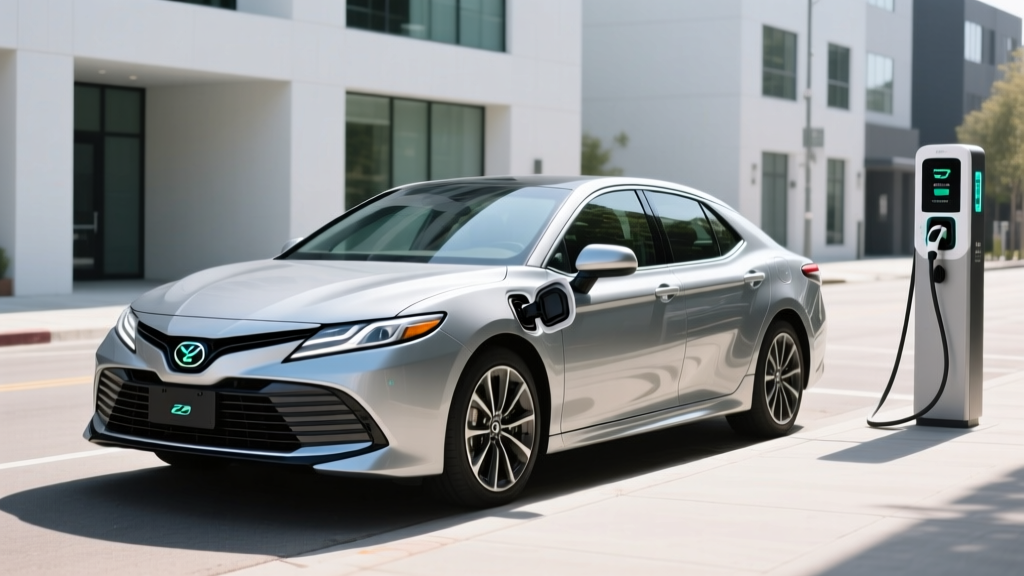
The Toyota Camry has been America's best-selling sedan for years, and for the 2025 model year, Toyota made a decisive move: every Camry is now a hybrid. Gone are the four-cylinder and V6 gas-only options. In their place sits Toyota's fifth-generation hybrid powertrain, pairing a 2.5-liter four-cylinder engine with electric motors to deliver up to 232 horsepower and an EPA-estimated 51 MPG combined. This isn't a mild electrification play — it's a full commitment to hybrid efficiency at a starting price of $28,400.
For buyers navigating the EV transition, the 2025 Hybrid Camry represents a pragmatic middle ground: no charging cables, no range anxiety, and fuel costs that undercut gas-only competitors by a wide margin. But how does it stack up against plug-in hybrids and full battery-electric vehicles? Let's break down the numbers.
HEV vs PHEV: Where the 2025 Camry Hybrid Fits
Conventional Hybrid (HEV) — The 2025 Camry Hybrid is a self-charging hybrid. It uses regenerative braking and the gas engine to keep a small battery (approximately 1.0 kWh) charged. You never plug it in. Electric-only driving is limited to very low speeds and short distances (under a mile). The benefit is simplicity: fuel it like a gas car, drive it like a gas car, but get dramatically better mileage.
Plug-in Hybrid (PHEV) — A PHEV like the Toyota RAV4 Prime or Hyundai Tucson PHEV carries a much larger battery (typically 13–22 kWh) that you plug in to charge. It can drive 25–45 miles on electricity alone before the gas engine kicks in. PHEVs cost more upfront and require access to charging to realize their full benefit, but they can handle daily commutes on electricity with the flexibility of a gas engine for longer trips.
Battery Electric Vehicle (BEV) — A full EV like the Tesla Model 3 or Hyundai Ioniq 6 has no gas engine. It runs entirely on a large battery pack (60–80+ kWh) and must be charged from the grid. BEVs offer the lowest per-mile fuel cost and zero tailpipe emissions, but require reliable charging access and involve range planning for long trips.
The 2025 Camry Hybrid is firmly in the HEV column. Toyota does not currently offer a Camry PHEV in the U.S. market. If you need plug-in capability in a Toyota sedan, you'd need to look at the Prius Prime or explore other brands.
Fuel Economy: EPA Ratings and Real-World MPG
The headline number for the 2025 Hybrid Camry is impressive, but EPA ratings vary by drivetrain. Front-wheel-drive models achieve the highest efficiency, while all-wheel-drive trims sacrifice a few MPG for added traction.
| Trim / Drivetrain | City MPG | Highway MPG | Combined MPG |
|---|---|---|---|
| LE (FWD) | 53 | 50 | 51 |
| SE / XLE / XSE (FWD) | 48 | 47 | 47 |
| LE / SE / XLE / XSE (AWD) | 49–51 | 44–47 | 44–48 |
Source: fueleconomy.gov (EPA estimates). Actual results vary with driving conditions, climate, and driving style.
Real-World MPG Expectations: Toyota's hybrid system excels in city driving, where regenerative braking and electric-only low-speed operation maximize efficiency. Many owners report exceeding the EPA city estimate in stop-and-go traffic — 55+ MPG is achievable on urban routes. Highway driving is less advantageous for hybrids since the gas engine carries more of the load at sustained speeds. Expect 42–47 MPG on the highway in real-world conditions. In cold weather (below 35°F), fuel economy can drop 5–10% as the engine runs more frequently to maintain cabin heat and battery temperature.
Compared to a typical gas-only midsize sedan averaging 30 MPG combined, the Camry Hybrid LE at 51 MPG combined cuts fuel consumption by roughly 41%. At $3.25 per gallon and 12,000 miles per year, that translates to approximately $560 in annual fuel savings over a 30 MPG gas sedan, or about $2,800 over five years.
Powertrain and Performance Specs
The 2025 Camry uses Toyota's fifth-generation Toyota Hybrid System (THS), which is lighter and more compact than the outgoing fourth-gen setup. The 2.5-liter Dynamic Force four-cylinder engine operates on the Atkinson cycle for maximum thermal efficiency, supplemented by electric motors integrated into the transaxle.
| Specification | 2025 Camry Hybrid |
|---|---|
| Engine | 2.5L 4-cylinder Atkinson cycle |
| Electric Motors | 2 (FWD) / 3 (AWD with rear motor) |
| Combined Horsepower | 225 hp (FWD) / 232 hp (AWD) |
| 0–60 mph (est.) | ~7.1 sec (FWD) / ~6.8 sec (AWD) |
| Drivetrain | FWD or electronic AWD |
| Hybrid Battery | ~1.0 kWh lithium-ion |
| Transmission | eCVT (electronically controlled) |
| Curb Weight | ~3,460–3,615 lbs |
The AWD system uses a separate rear-mounted electric motor (41 hp) that engages automatically when the front wheels slip. Unlike mechanical AWD systems, there's no driveshaft — it's purely electric. This adds roughly 100 lbs and costs about 3–4 MPG compared to FWD, but provides meaningful traction in rain and light snow.
The 232 hp AWD figure makes the 2025 Camry Hybrid competitive with turbocharged gas rivals, and the instant electric torque gives it responsive off-the-line acceleration. The eCVT operates without the shift shock of traditional automatics, though some drivers find the drone under hard acceleration less engaging than a stepped gearbox.
Pricing, Trims, and Tax Credit Eligibility
Toyota structured the 2025 Camry Hybrid lineup across four trims, all carrying the same hybrid powertrain:
| Trim | MSRP (FWD) | MSRP (AWD add) | Key Features |
|---|---|---|---|
| LE | $28,400 | +$1,525 | 8" touchscreen, wireless CarPlay/Android Auto, TSS 3.0 |
| SE | $30,000 | +$1,525 | Sport-tuned suspension, 18" alloy wheels, paddle shifters |
| XLE | $33,400 | +$1,525 | Leather-trimmed seats, 12.3" display, ambient lighting |
| XSE | $35,000 | +$1,525 | 19" wheels, sport styling, panoramic roof option |
Federal Tax Credit Status: The 2025 Camry Hybrid does not qualify for the federal §30D new clean vehicle tax credit (up to $7,500). Under current IRS rules, the §30D credit applies only to plug-in electric vehicles (BEVs and PHEVs) with a battery capacity of at least 7 kWh. Conventional hybrids like the Camry Hybrid — with a ~1.0 kWh battery — do not meet this threshold.
Some states offer rebates or incentives for hybrid purchases, but these vary by jurisdiction. Check your state's energy or environmental agency for current programs.
Even without a federal tax credit, the Camry Hybrid's sub-$29,000 starting price and fuel savings make it one of the most cost-efficient midsize sedans available. A five-year fuel cost analysis (12,000 miles/year, $3.25/gallon):
| Vehicle | EPA Combined MPG | 5-Year Fuel Cost | Difference vs. Camry Hybrid |
|---|---|---|---|
| 2025 Camry Hybrid LE | 51 | $3,824 | — |
| Honda Accord (1.5T Gas) | 33 | $5,909 | +$2,085 |
| Hyundai Sonata (2.5L Gas) | 30 | $6,500 | +$2,676 |
Battery Warranty, Reliability, and Replacement Cost
Hybrid battery longevity remains a top concern for buyers, particularly those who remember early-2000s hybrid reliability questions. The 2025 Camry Hybrid benefits from two decades of Toyota hybrid engineering refinement, and the company backs the system accordingly.
Hybrid Battery Warranty: Toyota covers the 2025 Camry Hybrid's battery pack and all hybrid system components (inverter, control module, electric motors) for 10 years or 150,000 miles, whichever comes first. This applies to all 50 states. The broader vehicle warranty is 3 years/36,000 miles basic and 5 years/60,000 miles powertrain.
Toyota's hybrid batteries have demonstrated exceptional longevity in real-world use. Data from Prius fleets and earlier Camry Hybrids show that most hybrid battery packs last 150,000–200,000+ miles before significant degradation. The 2025 model uses a lithium-ion pack (earlier Camry Hybrids used nickel-metal hydride), which offers better energy density and thermal management.
If a hybrid battery does need replacement outside of warranty, the cost for a Camry Hybrid battery pack typically ranges from $2,000 to $4,000 for the part, plus $500–$1,000 in labor. Refurbished or remanufactured packs are available for less. However, with the 10-year/150,000-mile warranty, most owners will never face this expense during their ownership.
Toyota's overall reliability reputation is strong. The Insurance Institute for Highway Safety (IIHS) rated the redesigned Camry a Top Safety Pick+ when equipped with specific headlights, and NHTSA testing confirms strong crash performance. Toyota Safety Sense 3.0 is standard on every trim, including pre-collision braking, lane departure alert, automatic high beams, and full-speed adaptive cruise control.
Who Should Buy the 2025 Camry Hybrid?
Choose the 2025 Camry Hybrid if:
- You want maximum fuel efficiency without changing your fueling habits — no plugs, no charging apps, no route planning.
- You drive 12,000+ miles per year and want to minimize fuel costs (the higher your mileage, the faster the hybrid premium pays for itself).
- You live in an apartment or home without reliable charging access, making a plug-in hybrid or EV impractical.
- You want the lowest total cost of ownership in a midsize sedan without relying on tax credits.
- You value Toyota's long-term reliability track record and strong resale values.
Consider a PHEV instead if:
- You have home charging access and a commute under 35 miles — a PHEV can handle daily driving on electricity alone.
- You want to reduce tailpipe emissions for local driving while keeping gas flexibility for road trips.
- You qualify for the federal §30D tax credit (income and sourcing rules apply) — this can offset the PHEV price premium.
Consider a full EV instead if:
- You have reliable home Level 2 charging and want the lowest per-mile energy cost (electricity at $0.12/kWh costs roughly 4 cents per mile vs. ~8 cents for the Camry Hybrid).
- Your state offers additional EV rebates or HOV lane access that make EVs more attractive.
- You want zero tailpipe emissions and don't regularly take trips exceeding 250 miles without charging stops.
Pros and Cons at a Glance
Pros
- Up to 51 MPG combined (EPA) — best in the midsize sedan class
- No behavioral change required — fuel it like any gas car
- AWD available on every trim for $1,525
- Standard Toyota Safety Sense 3.0 across all trims
- 10-year/150,000-mile hybrid battery warranty
- Starting under $29,000 — affordable entry point
- 225–232 hp provides adequate acceleration
Cons
- No federal tax credit eligibility (HEV, not PHEV)
- No plug-in variant available — can't drive on electric only for commutes
- eCVT drone under hard acceleration
- AWD trims drop to 44–48 MPG combined
- Rear seat doesn't fold flat on some trims (battery packaging)
- No spare tire — tire repair kit only
Frequently Asked Questions
How many MPG does the 2025 Hybrid Camry get?
The EPA rates the 2025 Camry Hybrid LE (FWD) at 53 city / 50 highway / 51 combined MPG. Sport trims and AWD models rate slightly lower, between 44 and 48 MPG combined. In real-world city driving, many owners report exceeding the EPA city estimate thanks to frequent regenerative braking.
Does the 2025 Camry Hybrid need to be plugged in?
No. The Camry Hybrid is a conventional hybrid (HEV), not a plug-in hybrid. It charges its own small battery through regenerative braking and the gas engine. You fuel it at any gas station like a conventional car.
Is the 2025 Camry Hybrid reliable?
Toyota's hybrid systems have a strong reliability record spanning over 20 years of production (since the original Prius in 1997). The fifth-generation THS in the 2025 Camry is the most refined version yet, with improved thermal management and a lighter, more compact design. The hybrid battery carries a 10-year/150,000-mile warranty.
What does it cost to replace the Camry Hybrid battery?
Out of warranty, a replacement hybrid battery for the Camry typically costs $2,000–$4,000 for the part plus $500–$1,000 in labor. However, most Toyota hybrid batteries last 150,000–200,000+ miles, and the 10-year warranty covers the vast majority of ownership periods.
Does the 2025 Camry Hybrid qualify for any tax credit?
The 2025 Camry Hybrid does not qualify for the federal §30D clean vehicle tax credit, which requires a plug-in vehicle with at least 7 kWh of battery capacity. Conventional hybrids are excluded. Some states offer separate incentives for hybrid vehicles — check your state's energy office for current programs.
Is the Camry Hybrid AWD system good in snow?
The electronic AWD system on the Camry Hybrid engages a 41-hp rear electric motor when front-wheel slip is detected. It's effective for rain, light snow, and icy starts, but it's not a substitute for winter tires in heavy snow. The system adds about 100 lbs and reduces fuel economy by 3–4 MPG compared to FWD.
How does the Camry Hybrid compare to the Prius?
The 2025 Prius achieves up to 57 MPG combined (FWD) and starts around $28,000, making it slightly more efficient. However, the Camry offers more rear-seat legroom, a larger trunk, a quieter cabin, and available AWD. The Camry Hybrid is the better choice if you prioritize comfort and space; the Prius wins on maximum efficiency and hatchback utility.