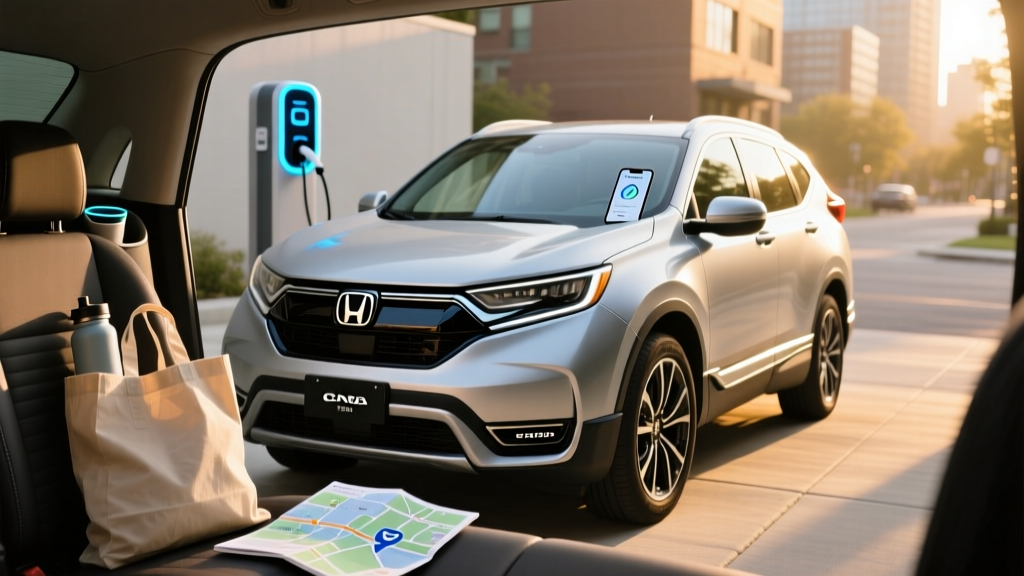
The 2025 Honda CR-V Sport Touring Hybrid sits at the top of Honda's compact SUV lineup, blending a two-motor hybrid system with premium features that rival luxury crossovers. For buyers who want electrified efficiency without plugging in, this conventional hybrid (HEV) delivers a compelling package — but it's important to understand exactly what you're getting before you sign the paperwork.
In this review, we break down the real-world fuel economy, powertrain behavior, ownership costs, and battery longevity data that Honda's marketing materials gloss over. We've cross-referenced EPA data, Honda's official specifications, and long-term hybrid reliability patterns to give you the full picture.
HEV vs. PHEV: What the CR-V Sport Touring Hybrid Actually Is
Before diving into specs, let's clear up a common point of confusion. The 2025 CR-V Sport Touring Hybrid is a conventional hybrid (HEV), not a plug-in hybrid (PHEV). That distinction matters enormously for your daily routine and your wallet.
| Feature | HEV (CR-V Sport Touring Hybrid) | PHEV (Plug-In Hybrid) | Full EV (BEV) |
|---|---|---|---|
| Plug-in charging required | No — charges via regenerative braking and engine | Yes — Level 1 or Level 2 | Yes — Level 2 or DC fast charging |
| Electric-only driving | Limited to low-speed, short bursts (~1 mi) | 20–45 miles typical | 200–400+ miles |
| Battery size | ~1.1 kWh (small buffer) | 12–20 kWh typical | 60–100+ kWh |
| Gas engine | Yes — primary power source | Yes — backup after EV range depletes | No |
| Federal tax credit (§30D) | Not eligible | Up to $7,500 (if eligible) | Up to $7,500 (if eligible) |
| Best for | No home charging, high-mileage commuters | Home chargers with short daily commutes | Home chargers willing to plan road trips |
The CR-V's hybrid system uses a small battery that charges itself through regenerative braking and the gasoline engine. You never plug it in. If you're looking for meaningful electric-only range — say, 30 miles of zero-emission commuting — you'd need to look at a PHEV like the Toyota RAV4 Prime or a full BEV. The CR-V Hybrid trades electric-only capability for simplicity: just fill up with gas and go.
Fuel Economy: EPA Ratings and Real-World MPG
Fuel efficiency is the headline reason most buyers consider the CR-V Hybrid over the gas-only CR-V. Here's what the EPA says you should expect, according to fueleconomy.gov:
| Driving Cycle | EPA Rating | Real-World Expectation |
|---|---|---|
| City | 43 MPG | 40–45 MPG (hybrids often exceed EPA in stop-and-go) |
| Highway | 36 MPG | 32–35 MPG (hybrid advantage diminishes at sustained speed) |
| Combined | 40 MPG | 37–41 MPG depending on driving mix |
Why city MPG beats highway: The CR-V's two-motor hybrid system recovers energy during braking and deceleration, then uses that stored electricity to assist acceleration. In stop-and-go traffic, this regenerative cycle runs constantly, making the hybrid significantly more efficient than a gas-only vehicle. On the highway, the gasoline engine does most of the work at a steady load, so the hybrid advantage narrows.
Cold-weather reality check: In temperatures below 35°F, expect a 5–10% drop in fuel economy. The engine runs more frequently to heat the cabin and warm the battery and catalytic converter. This penalty is far smaller than the 20–30% range loss a full EV experiences in cold weather, but it's measurable over a winter of commuting.
AWD note: The Sport Touring Hybrid comes exclusively with Honda's Real Time AWD system. Compared to FWD CR-V Hybrid trims (which achieve 43/36/40), the AWD penalty is minimal — roughly 1 MPG combined in mixed driving.
Powertrain: How the Two-Motor Hybrid System Works
The 2025 CR-V Sport Touring Hybrid uses Honda's fourth-generation two-motor hybrid system paired with a 2.0-liter Atkinson-cycle four-cylinder engine. Here's the spec breakdown:
| Specification | Detail |
|---|---|
| Engine | 2.0L Atkinson-cycle 4-cylinder (145 hp, 134 lb-ft) |
| Electric motors | Two-motor system (propulsion + generator) |
| Combined system output | 204 hp, 247 lb-ft torque |
| Transmission | Direct-drive (no traditional gearbox — e-CVT behavior) |
| Drivetrain | Real Time AWD (mechanical rear driveshaft from engine; electric front drive) |
| 0–60 mph | ~7.6 seconds |
| Towing capacity | 1,000 lbs |
| Fuel tank | 14.0 gallons |
| Total driving range | ~560 miles (at 40 MPG combined) |
The system operates in three modes, switching seamlessly based on speed and load:
- EV Drive: Battery powers the propulsion motor for low-speed starts and gentle acceleration (up to ~25 mph, very short distances)
- Hybrid Drive: Engine spins the generator motor, which feeds electricity to the propulsion motor. The engine doesn't directly turn the wheels — it acts as a generator
- Engine Drive: At highway cruising speeds, a lock-up clutch connects the engine directly to the front wheels for maximum efficiency
The 247 lb-ft of electric torque is available from near-zero RPM, giving the CR-V Hybrid a responsive feel in city driving that belies its 204-hp headline number. It's noticeably quicker off the line than the gas-only CR-V (190 hp, 179 lb-ft), particularly in the 0–30 mph range that matters for merging and intersection acceleration.
Pricing, Trim, and Tax Credit Eligibility
The 2025 Honda CR-V Sport Touring Hybrid is the top-tier trim, and it's priced accordingly:
| Cost Item | Amount |
|---|---|
| Base MSRP (Sport Touring Hybrid AWD) | $40,850 |
| Destination charge | $1,350 |
| Total sticker price | ~$42,200 |
| Federal §30D tax credit | $0 (not eligible — HEVs do not qualify) |
Tax credit reality: The IRS §30D clean vehicle credit applies only to plug-in electric vehicles — battery-electric vehicles (BEVs) and plug-in hybrids (PHEVs) with at least 7 kWh of battery capacity. The CR-V's ~1.1 kWh hybrid battery falls far below this threshold. No federal tax credit is available for any conventional hybrid, regardless of price or efficiency.
Some states offer modest hybrid incentives, but these are increasingly rare and vary by jurisdiction. Check your state's energy office or DMV for current programs. Do not count on any incentive when budgeting for this vehicle.
Value context: The Sport Touring Hybrid commands roughly a $5,600 premium over the gas-only CR-V EX-L AWD ($35,250 MSRP). At 40 MPG combined vs. 28 MPG combined for the gas version, and assuming $3.50/gallon fuel, the hybrid saves approximately $1,050 per year for a driver covering 15,000 miles annually. That puts the payback period at roughly 5.3 years — a reasonable timeframe, though the premium is steep.
Battery Longevity, Warranty, and Replacement Costs
Hybrid battery anxiety is the number-one concern we hear from prospective buyers. Here's what the data actually shows:
| Coverage Item | Honda Warranty Terms |
|---|---|
| Hybrid battery (IMA system) | 8 years / 100,000 miles (10 years / 150,000 miles in CARB states) |
| Hybrid system components | 8 years / 100,000 miles |
| Powertrain (engine, transmission) | 5 years / 60,000 miles |
| Bumper-to-bumper | 3 years / 36,000 miles |
Degradation reality: Honda's hybrid batteries are designed with a large operational buffer — the system never uses the full capacity or lets it drain completely. This shallow cycling strategy dramatically extends cell life. Based on long-term fleet data from Honda and Toyota hybrids, most hybrid batteries retain 85–90% of original capacity after 100,000 miles and 8–10 years of service. Complete failure before the warranty expires is uncommon.
Replacement cost if out of warranty: A replacement hybrid battery pack for the CR-V Hybrid runs approximately $2,000–$3,500 including labor at a Honda dealership. Independent hybrid specialists can often perform the replacement for $1,500–$2,500 using refurbished or aftermarket cells. This is a fraction of the $10,000–$20,000+ replacement cost for a full EV's traction battery, because the CR-V's hybrid battery is small (~1.1 kWh vs. 60–100 kWh in a BEV).
12V battery note: Like all modern vehicles, the CR-V Hybrid has a separate 12V auxiliary battery for electronics, lights, and starting logic. This battery typically lasts 3–5 years and costs $150–$250 to replace — it's unrelated to the hybrid system.
What You Get at the Sport Touring Level
The Sport Touring trim justifies its premium with features that the lower CR-V Hybrid trims (Sport, Sport-L) don't offer:
- Honda Sensing suite: Adaptive cruise control with low-speed follow, lane-keeping assist, collision mitigation braking, traffic sign recognition, and blind-spot monitoring
- Infotainment: 9-inch touchscreen with wireless Apple CarPlay and Android Auto, Bose 12-speaker premium audio
- Comfort: Heated front seats, heated steering wheel, leather-trimmed interior, dual-zone automatic climate control
- Convenience: Wireless phone charger, power tailgate with hands-free access, remote engine start
- Exterior: 19-inch alloy wheels, LED headlights with auto high-beam, gloss-black accent trim
The Honda Sensing ADAS features are SAE Level 2 driver assistance — they can manage steering, acceleration, and braking under certain conditions, but the driver must remain fully engaged and hands on the wheel at all times. This is not autonomous driving. The system works well on well-marked highways but can struggle in construction zones, heavy rain, and faded lane markings.
Who Should Choose the CR-V Sport Touring Hybrid?
Pros
- 40 MPG combined — real fuel savings vs. gas CR-V (28 MPG combined)
- No plug-in charging required — ideal for apartment dwellers or those without garage access
- Strong low-end electric torque for responsive city driving
- ~560-mile total range eliminates range anxiety entirely
- Top-tier Sport Touring trim well-equipped for the price
- Proven hybrid reliability with 8yr/100k battery warranty
Cons
- No federal tax credit eligibility — full $42K out of pocket
- Electric-only mode limited to very low speeds and short distances
- Highway MPG (36) less impressive than city (43)
- 1,000-lb towing capacity limits utility for trailers and boats
- Premium over gas CR-V takes ~5 years to recoup via fuel savings
- AWD system is mechanical (rear), not electric — less sophisticated than some competitors
The Decision Framework
Choose the CR-V Sport Touring Hybrid if: You drive 12,000–20,000 miles per year, mostly in mixed city/suburban conditions; you don't have access to home or workplace charging; and you want a well-equipped compact SUV with minimal ownership complexity.
Look at a PHEV (like the Toyota RAV4 Prime) if: You have home Level 2 charging, your daily commute is under 40 miles, and you want electric-only commuting with gas-engine backup for road trips. PHEVs do qualify for the §30D credit if they meet sourcing and income requirements.
Look at a full EV (like the Hyundai Ioniq 5 or Tesla Model Y) if: You have reliable home charging, your daily driving is under 250 miles, and you want to eliminate gasoline entirely. EVs qualify for the federal credit (subject to IRS §30D eligibility rules including MSRP caps, buyer income limits, and battery sourcing requirements).
Stick with the gas CR-V if: You drive fewer than 8,000 miles per year, making the hybrid premium difficult to recoup, or you need the CR-V's maximum towing capacity (1,500 lbs on gas models vs. 1,000 lbs on hybrid).
Frequently Asked Questions
How many MPG does the 2025 Honda CR-V Sport Touring Hybrid get?
The EPA rates the 2025 CR-V Sport Touring Hybrid AWD at 43 MPG city, 36 MPG highway, and 40 MPG combined. In real-world driving, city-heavy commuters often see 41–44 MPG, while highway-dominant driving drops to 33–36 MPG. Cold weather reduces these figures by 5–10%.
Does the CR-V Hybrid need to be plugged in?
No. The CR-V Hybrid is a conventional hybrid (HEV) that charges its small battery through regenerative braking and the gasoline engine. You never plug it in — just refuel at a gas station as you would any conventional vehicle.
How far can the CR-V Hybrid drive on electric power alone?
The CR-V Hybrid can travel roughly 1 mile at very low speeds (under 25 mph) on battery power alone before the engine engages. This is not a meaningful electric-only range — the system is designed to assist the engine, not replace it. If you want 30+ miles of electric-only driving, you need a PHEV or BEV.
Does the 2025 CR-V Hybrid qualify for a federal tax credit?
No. The IRS §30D clean vehicle credit is available only for plug-in electric vehicles (BEVs and qualifying PHEVs). Conventional hybrids like the CR-V Hybrid are not eligible. Some states may offer small hybrid incentives, but these vary widely — check your state's official energy or DMV website.
How long will the CR-V Hybrid battery last, and what does replacement cost?
Honda warranties the hybrid battery for 8 years/100,000 miles (10 years/150,000 miles in CARB states including California, New York, and others). Based on long-term fleet data, most Honda hybrid batteries retain 85–90% capacity at 100,000 miles. Out-of-warranty replacement costs approximately $2,000–$3,500 at a dealership, or $1,500–$2,500 at an independent hybrid specialist.
Is the CR-V Sport Touring Hybrid more reliable than the gas CR-V?
Honda's hybrid powertrain has an excellent reliability track record spanning two decades (the Insight and Accord Hybrid preceded the CR-V Hybrid). The hybrid system actually reduces wear on the gasoline engine and brake pads (regenerative braking reduces friction brake usage). The main risk factor is the hybrid battery itself, but the 8–10 year warranty provides substantial protection.
How does the CR-V Hybrid compare to the Toyota RAV4 Hybrid?
The Toyota RAV4 Hybrid (XSE or Limited trims) achieves 41 MPG combined EPA — 1 MPG better than the CR-V Hybrid. The RAV4 Hybrid also uses an electronic AWD system (separate rear electric motor) vs. the CR-V's mechanical AWD. However, the CR-V Sport Touring offers a more premium interior with the Bose audio system and slightly more cargo volume. Both are strong choices; the decision often comes down to styling preference and dealer pricing in your area.