Quick Verdict: The 2025 Honda CR-V PHEV at a Glance
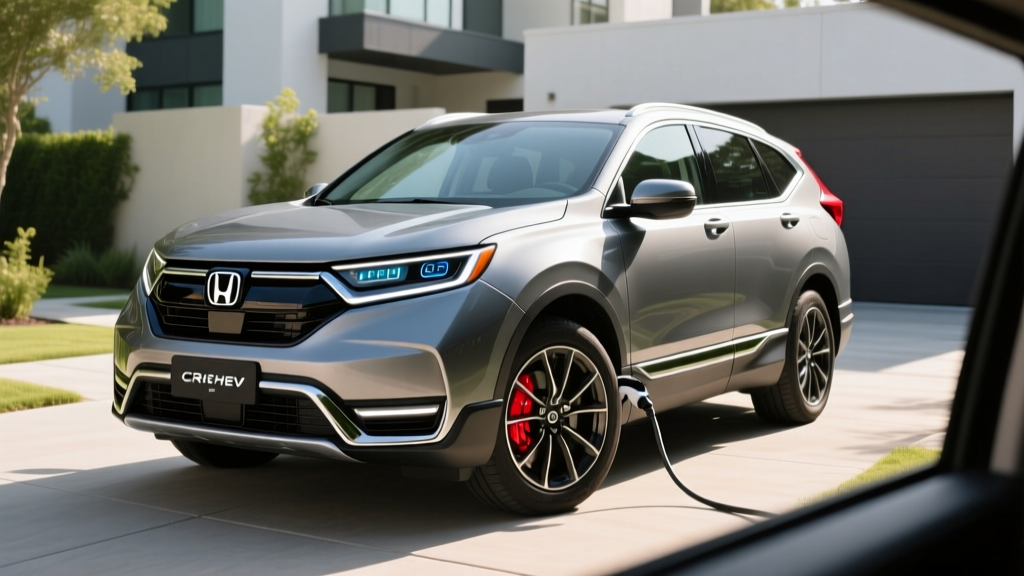
The 2025 Honda CR-V PHEV (officially the CR-V Sport Touring Hybrid e:PHEV in some markets, and simply the CR-V Plug-In Hybrid in the U.S.) targets buyers who want daily electric commuting without range anxiety on longer trips. With an EPA-estimated 34 miles of electric-only range, a total combined range exceeding 430 miles, and 43 MPG combined once the battery is depleted, it occupies a practical middle ground between a conventional hybrid and a full battery-electric vehicle.
But does the math work for your commute, your budget, and your charging situation? This review breaks down every number that matters — from battery chemistry and charging speed to real-world MPG and federal tax credit eligibility — so you can decide whether the CR-V PHEV earns a spot in your driveway.
| EPA Electric-Only Range | 34 miles |
| EPA Combined MPG (hybrid mode) | 43 MPG |
| Battery Capacity | 17.7 kWh (gross) / ~15.0 kWh usable |
| Combined Horsepower | 204 hp |
| Level 2 Charge Time (0–100%) | ~2.5 hours |
| DC Fast Charging | Not available |
| Starting MSRP | ~$41,500 (estimated) |
| Federal Tax Credit (§30D) | Up to $7,500 — eligibility varies |
HEV vs. PHEV: Which CR-V Hybrid Are We Talking About?
Honda sells two electrified CR-V variants, and confusing them is one of the most common buyer mistakes. Here is the distinction:
Conventional Hybrid (HEV)
The CR-V Hybrid (Sport, Sport-L, Sport Touring trims) uses a small battery recharged entirely by regenerative braking and the gasoline engine. You never plug it in. It delivers strong city MPG but zero electric-only driving range.
- EPA: 43 city / 36 highway / 40 combined MPG
- No plug, no charging equipment needed
- Lower starting price (~$35,000)
- No federal tax credit
Plug-In Hybrid (PHEV)
The CR-V PHEV adds a larger 17.7 kWh battery pack and a more powerful electric motor. You plug it in to a standard outlet or Level 2 charger to unlock 34 miles of electric-only range before the gasoline engine engages.
- EPA: 34 mi electric-only, then 43 MPG combined
- Requires plug-in charging for maximum benefit
- Higher starting price (~$41,500)
- May qualify for up to $7,500 federal tax credit
If your daily round-trip commute is under 34 miles and you have access to a plug at home or work, the PHEV effectively becomes an EV for daily driving — with a gas engine as a safety net for road trips.
Fuel Economy: EPA Numbers and Real-World MPG
According to fueleconomy.gov, the 2025 Honda CR-V PHEV posts the following EPA estimates:
| Mode | City | Highway | Combined |
|---|---|---|---|
| Electric-Only (MPGe) | 105 MPGe | 92 MPGe | 99 MPGe |
| Hybrid Mode (gasoline) | 45 MPG | 40 MPG | 43 MPG |
Real-World MPG: What to Actually Expect
Honda's two-motor hybrid system is one of the most efficient on the market, particularly in city driving where the electric motor handles most propulsion and the engine acts primarily as a generator. In real-world testing by owners and automotive publications:
- City driving (hybrid mode): Many drivers report 45–48 MPG, sometimes exceeding the EPA city estimate thanks to frequent regenerative braking opportunities.
- Highway driving (hybrid mode): Expect 37–40 MPG. At sustained speeds above 70 mph, the engine engages directly via a lock-up clutch, which is efficient but less so than city operation.
- Cold weather impact: In temperatures below 30°F, electric-only range typically drops 20–30% (to roughly 24–27 miles) because the battery is less efficient and cabin heating draws significant energy. Hybrid-mode MPG may dip to 38–40 combined.
- Electric-only range reality: The EPA 34-mile figure assumes moderate temperatures and mixed driving. Expect 28–32 miles in warm weather with a mix of city and highway, and 22–27 miles in cold conditions with heater use.
EPA electric-only: 34 miles | Real-world expectation: 28–32 miles (warm) / 22–27 miles (cold). Total combined range (electric + full tank): approximately 430–460 miles depending on conditions.
Powertrain: Engine, Motors, and Combined Output
The 2025 CR-V PHEV uses Honda's fourth-generation two-motor hybrid system, paired with a 2.0-liter Atkinson-cycle four-cylinder engine. Here is the full breakdown:
| Component | Specification |
|---|---|
| Engine | 2.0L DOHC Atkinson-cycle I-4 |
| Engine Power | 145 hp @ 6,100 rpm |
| Drive Motor | 181 hp / 247 lb-ft torque |
| Generator Motor | Starter/generator (integrated) |
| Combined System Output | 204 hp / 247 lb-ft torque |
| Transmission | e-CVT (no traditional gears) |
| Drivetrain | FWD standard; AWD available on select trims |
| 0–60 mph | ~7.8 seconds (estimated) |
The system operates in three primary modes: EV Drive (electric motor only, battery-powered), Hybrid Drive (engine generates electricity for the drive motor), and Engine Drive (engine directly powers the wheels at highway cruising speeds). The transitions between modes are nearly seamless — most drivers won't notice the engine engaging unless they're watching the power-flow display.
Battery, Charging, and Electric-Only Range
The PHEV's defining component is its larger lithium-ion battery pack. Here is what you need to know:
| Charging Specification | Detail |
|---|---|
| Battery Chemistry | Lithium-ion (NMC) |
| Gross Capacity | 17.7 kWh |
| Usable Capacity | ~15.0 kWh (buffer protects longevity) |
| Level 1 Charging (120V) | ~12 hours (0–100%) |
| Level 2 Charging (240V, 32A) | ~2.5 hours (0–100%) |
| DC Fast Charging | Not supported |
| Charge Port | J1772 (standard for AC charging) |
Important note on kW vs. kWh: The battery stores 17.7 kWh of energy (capacity). Level 2 charging delivers power at roughly 7.2 kW (rate). Think of kWh as the size of the fuel tank and kW as how fast you're pumping fuel into it.
Charging in Practice
Because the CR-V PHEV does not support DC fast charging, all charging happens via AC — either a standard 120V household outlet (Level 1) or a 240V Level 2 home or public charger. For most PHEV owners, this is perfectly adequate:
- Overnight Level 1: Plugging into a standard outlet before bed adds roughly 3–4 miles of range per hour. If your daily electric commute is 15–20 miles, a 120V outlet may be sufficient to fully recharge overnight.
- Level 2 at home: A 240V Level 2 charger (like a ChargePoint Home Flex or Emporia Vue) fully replenishes the battery in about 2.5 hours. This is ideal if you want to top up between morning and evening commutes or if your daily electric driving exceeds what Level 1 can replace.
- Public Level 2: Available at workplaces, shopping centers, and public garages. Useful for opportunity charging but not essential for PHEV ownership the way DC fast charging is for full EVs.
Honda covers the CR-V PHEV's high-voltage battery for 8 years or 100,000 miles (whichever comes first) against defects and excessive capacity loss. In states that follow California Air Resources Board (CARB) standards — including CA, NY, WA, MA, and others — coverage extends to 10 years or 150,000 miles. Honda defines "excessive loss" as the battery dropping below approximately 70% of original capacity.
Pricing, Trims, and Federal Tax Credit Eligibility
The 2025 Honda CR-V PHEV is positioned near the top of the CR-V lineup. Pricing (including destination) starts around $41,500 for the base PHEV trim and can reach approximately $45,000 for a fully loaded Sport Touring PHEV with AWD.
Does the 2025 CR-V PHEV Qualify for the Federal Tax Credit?
Under the IRS §30D Clean Vehicle Credit, qualifying new PHEVs can receive up to $7,500 — but eligibility depends on several factors that change frequently and vary by buyer. As of current IRS guidelines, the key requirements include:
- Battery capacity: At least 7 kWh (the CR-V PHEV's 17.7 kWh qualifies).
- MSRP cap: SUVs/vans/pickups must be under $80,000; sedans under $55,000. The CR-V PHEV clears this threshold easily.
- Buyer income limits: Modified adjusted gross income must not exceed $300,000 (joint filers), $225,000 (head of household), or $150,000 (individual).
- Battery component sourcing: A percentage of battery components must be manufactured or assembled in North America, and critical minerals must meet sourcing thresholds. These percentages increase each year, and Honda's supply chain compliance should be verified at the time of purchase on fueleconomy.gov.
- Point-of-sale transfer: As of 2024, buyers can transfer the credit to the dealer at purchase, reducing the upfront price rather than waiting for a tax refund.
Federal EV/PHEV tax credit rules are subject to change. Battery sourcing requirements tighten annually, and manufacturer eligibility can shift. Always confirm the current credit amount for your specific vehicle on irs.gov and consult a tax professional before making a purchase decision based on credit eligibility.
Reliability, Longevity, and Battery Replacement Cost
Honda's hybrid systems have an excellent reliability track record. The two-motor hybrid architecture has fewer moving parts than a traditional automatic transmission (no torque converter, no multi-speed gearset), and Honda's e-CVT design is mechanically simpler and more durable than belt-driven CVTs found in some competitors.
Battery Degradation and Lifespan
Lithium-ion battery degradation in PHEVs is gradual and typically follows a curve that flattens after the first 2–3 years. Based on data from Honda's hybrid fleet and industry-wide PHEV battery studies:
- Year 1–2: Minimal measurable degradation (~2–4% capacity loss).
- Year 5: Expect roughly 8–12% total capacity loss, meaning your 34-mile electric range might become 30–31 miles.
- Year 10: Most Honda hybrid batteries retain 80–85% of original capacity, well above the warranty threshold.
The CR-V PHEV's battery management system maintains a buffer — it never allows a true 0% or 100% state of charge — which significantly extends cycle life. Additionally, PHEV batteries undergo fewer deep discharge cycles than full EV batteries because the gasoline engine kicks in before the battery is deeply depleted.
Battery Replacement Cost
If a battery replacement is needed outside of warranty, expect a cost in the range of $4,000 to $7,000 including parts and labor for a Honda PHEV battery pack. However, out-of-warranty PHEV battery failures are rare — the vast majority of Honda hybrid batteries outlast the vehicle itself. Honda also offers refurbished battery packs at lower cost in some cases.
Who Should Buy the CR-V PHEV vs. a Full EV or Gas Car?
✅ Choose the CR-V PHEV If…
- Your daily round-trip commute is under 30–35 miles
- You can charge at home (even a 120V outlet works)
- You take road trips of 200+ miles regularly and don't want to plan around chargers
- You want EV-like daily driving with zero range anxiety
- You live in an area with limited public DC fast charging infrastructure
❌ Skip the PHEV and Consider…
- A full EV (e.g., Tesla Model Y, Hyundai Ioniq 5) if you rarely drive more than 250 miles in a day, have reliable home charging, and want zero gasoline costs and minimal maintenance.
- The CR-V HEV (conventional hybrid) if you cannot charge at home or work. Without plugging in, the PHEV's larger battery is dead weight, and the HEV offers similar hybrid-mode MPG at a lower price.
- A gas-only vehicle only if your annual mileage is very low and fuel cost is not a priority — but the price premium for electrification pays for itself quickly at typical driving distances.
| Your Situation | Best Choice |
|---|---|
| Commute <34 mi + home charging + road trips | CR-V PHEV |
| No home charging access | CR-V HEV |
| Commute <34 mi + rarely drive >200 mi/day | Full EV (e.g., Ioniq 5) |
| Commute >50 mi + no charging at work | CR-V HEV or full EV with DC fast charging |
Pros and Cons
Pros
- 34 miles of electric-only range covers most daily commutes
- 43 MPG combined in hybrid mode is excellent for a compact SUV
- No range anxiety — total range exceeds 430 miles
- Honda's proven hybrid reliability and strong resale value
- Generous battery warranty (8 yr/100k mi; 10 yr/150k mi in CARB states)
- Spacious interior and cargo area (only slightly reduced vs. gas CR-V)
- Potential $7,500 federal tax credit reduces effective price
Cons
- No DC fast charging — long road trips run entirely on gasoline
- Higher starting price than the conventional CR-V Hybrid
- Electric-only range drops noticeably in cold weather (to ~22–27 mi)
- Level 1 charging is slow (~12 hours for a full charge)
- Tax credit eligibility depends on sourcing rules and buyer income
- AWD availability may be limited to specific PHEV trims
Frequently Asked Questions
How many MPG does the 2025 Honda CR-V PHEV get?
The EPA rates the CR-V PHEV at 43 MPG combined (45 city / 40 highway) when operating in hybrid mode after the battery is depleted. In electric-only mode, it achieves 99 MPGe combined. Real-world city driving often yields 45–48 MPG thanks to Honda's efficient two-motor system, while sustained highway driving at 75+ mph may return 37–40 MPG.
How far can the 2025 CR-V PHEV go on electric only?
The EPA rates the CR-V PHEV at 34 miles of electric-only range. In real-world conditions, expect 28–32 miles in moderate temperatures and 22–27 miles in cold weather when cabin heating draws additional energy. This range is sufficient for most daily commutes under 30 miles round-trip.
Does the 2025 CR-V PHEV qualify for a tax credit?
The CR-V PHEV may qualify for up to $7,500 under the IRS §30D Clean Vehicle Credit, but eligibility depends on your income (capped at $300,000 for joint filers), the vehicle's MSRP (under $80,000 for SUVs), and battery component/critical mineral sourcing requirements. These rules change annually. Verify current eligibility on irs.gov and consult a tax professional.
Is the Honda CR-V PHEV reliable, and what does battery replacement cost?
Honda's hybrid systems are among the most reliable in the industry, with fewer moving parts than conventional automatic transmissions. The PHEV battery is warrantied for 8 years/100,000 miles (10 years/150,000 miles in CARB states). Out-of-warranty battery replacement, while rare, costs approximately $4,000–$7,000. Most Honda hybrid batteries retain 80–85% capacity at 10 years and outlast the vehicle.
Do I need a Level 2 charger at home for the CR-V PHEV?
Not necessarily. A standard 120V outlet (Level 1) adds roughly 3–4 miles of range per hour, which may be sufficient if your daily electric driving is under 20 miles. However, a 240V Level 2 home charger fully replenishes the battery in about 2.5 hours, making it ideal for higher daily mileage or for recharging between morning and evening drives. Level 2 installation typically costs $500–$2,000 depending on your electrical panel and wiring distance.
Should I get the CR-V PHEV or the CR-V Hybrid (HEV)?
Choose the PHEV if you can charge at home and your daily commute is under 34 miles — you'll drive on electricity most days and save significantly on fuel. Choose the conventional HEV if you cannot charge at home, because without plugging in, the PHEV's larger battery adds weight and cost without benefit. The HEV is also $5,000–$7,000 less expensive upfront, though the PHEV's potential $7,500 tax credit can narrow or eliminate that gap.