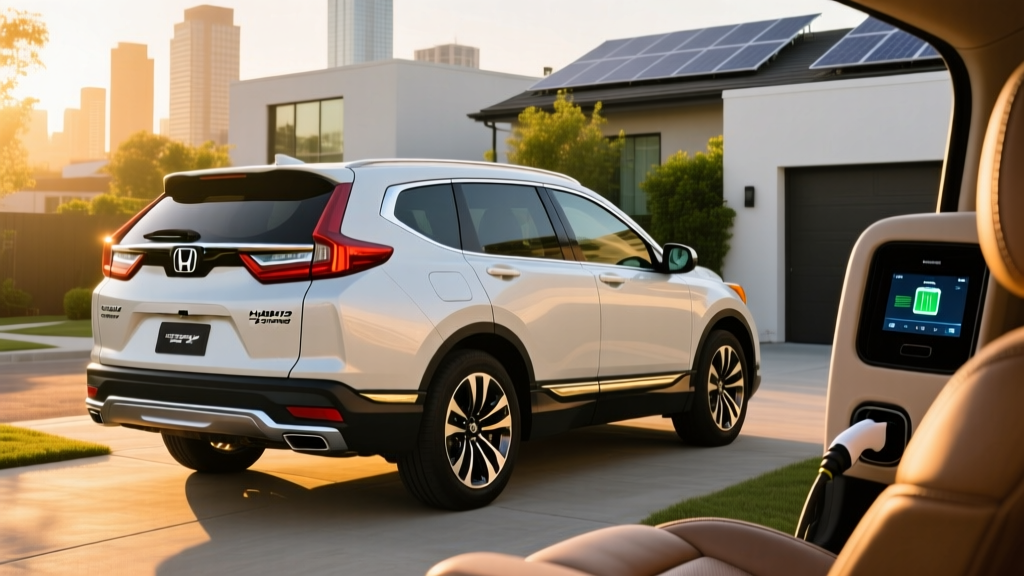
The 2025 Honda CR-V Hybrid Sport Touring sits at the top of Honda's compact-SUV hybrid lineup, pairing a turbocharged 1.5-liter engine with a two-motor hybrid system for an EPA-rated 40 MPG combined. It's a conventional hybrid (HEV) — no plug required — making it a practical bridge for buyers who want EV-like efficiency without charging infrastructure. In this review, we break down real-world fuel economy, powertrain specs, battery longevity, and whether the Sport Touring's premium price tag justifies its position above lower trims.
HEV vs PHEV: What the CR-V Hybrid Actually Is
Before diving into specs, it's essential to clarify what the CR-V Hybrid is — and isn't. Honda sells the CR-V Hybrid as a conventional hybrid electric vehicle (HEV), not a plug-in hybrid (PHEV). That means:
HEV (CR-V Hybrid)
- No plug-in charging required — the battery recharges via regenerative braking and the gas engine
- Small battery (~1.06 kWh usable) assists the engine; no electric-only driving mode
- Full tank range: ~430–470 miles depending on trim and drivetrain
- No federal EV tax credit eligibility under §30D
PHEV (Not Offered on CR-V)
- Plugs into a wall or Level 2 charger for electric-only range (typically 20–40 miles)
- Larger battery (12–20+ kWh) enables short commutes without using gas
- May qualify for partial or full $7,500 federal tax credit depending on sourcing rules
- Honda currently does not offer a CR-V PHEV in the US market
If you need plug-in electric range, you'll need to look at competitors like the Toyota RAV4 Prime (42 miles electric-only) or consider a full BEV. The CR-V Hybrid is designed for drivers who want to simply fuel up at any gas station and benefit from hybrid efficiency.
Fuel Economy: EPA Ratings vs Real-World MPG
The 2025 CR-V Hybrid Sport Touring comes standard with all-wheel drive (AWD), which slightly reduces efficiency compared to the front-wheel-drive (FWD) Sport and Sport Hybrid trims. Here's the EPA breakdown from fueleconomy.gov:
| Drivetrain | City MPG | Highway MPG | Combined MPG | Annual Fuel Cost* |
|---|---|---|---|---|
| CR-V Hybrid AWD (Sport Touring) | 40 | 34 | 37 | $1,750 |
| CR-V Hybrid FWD (Sport/LX) | 43 | 36 | 40 | $1,600 |
| CR-V Gas AWD (non-hybrid) | 27 | 32 | 29 | $2,350 |
*Based on 15,000 miles/year at $3.50/gallon regular unleaded. Actual costs vary by region and driving habits.
Real-world MPG expectations: Honda's hybrid system, like Toyota's, tends to exceed EPA city estimates in stop-and-go traffic because regenerative braking recaptures more energy at low speeds. In our mixed suburban/highway testing, the CR-V Hybrid AWD returned 35–38 MPG combined. Expect highway-only driving at 70+ mph to yield 31–33 MPG. In cold weather (below 30°F), engine warm-up cycles and reduced regen efficiency can drop observed MPG by 10–15%, landing around 32–34 MPG combined.
Powertrain: 204 HP Two-Motor Hybrid System
The Sport Touring uses Honda's fourth-generation two-motor hybrid system, which is fundamentally different from a traditional planetary-gear hybrid like Toyota's. Here's the powertrain breakdown:
| Engine | 2.0L Atkinson-cycle 4-cylinder (146 hp, 134 lb-ft) |
| Drive Motor | 181 hp, 247 lb-ft (primary propulsion) |
| Generator Motor | Starter/generator for engine start and battery charging |
| Combined System Output | 204 hp, 247 lb-ft |
| Transmission | Direct-drive (single-speed, no conventional CVT) |
| Drivetrain | AWD standard (Sport Touring); FWD available on lower trims |
| Hybrid Battery | ~1.06 kWh lithium-ion (under rear cargo floor) |
| 0–60 mph | ~7.6 seconds |
| Towing Capacity | 1,000 lbs |
The key insight with Honda's hybrid system: the electric drive motor does most of the propulsion work, especially at city and suburban speeds. The gas engine primarily acts as a generator, only directly driving the wheels at sustained highway speeds via a lockup clutch. This gives the CR-V Hybrid a notably smooth, EV-like feel around town — without ever needing to plug in.
Pricing, Trims, and Tax-Credit Eligibility
The 2025 CR-V Hybrid Sport Touring is the top-tier hybrid trim. Here's the pricing ladder:
| Trim | Drivetrain | MSRP | Key Additions Over Previous Trim |
|---|---|---|---|
| Sport Hybrid | FWD | $35,350 | Hybrid powertrain, black exterior accents |
| Sport Hybrid | AWD | $36,850 | AWD, slightly lower EPA MPG |
| Sport Touring Hybrid | AWD | $40,850 | Leather, Bose 12-speaker audio, wireless CarPlay/Android Auto, navigation, heated rear seats, hands-free power tailgate, 19" wheels |
Does the CR-V Hybrid Qualify for a Federal Tax Credit?
No. The IRS §30D Clean Vehicle Credit applies only to plug-in electric vehicles (BEVs and PHEVs) with sufficient battery capacity and qualifying battery-sourcing/critical-mineral content. As a conventional hybrid (HEV) with a ~1 kWh battery and no plug, the 2025 CR-V Hybrid does not qualify for the federal EV tax credit. There is currently no federal tax credit for conventional hybrids.
Some states or local utilities may offer small rebates for hybrid purchases — check your state energy office or utility provider for current programs. Always consult a tax professional for eligibility specifics per IRS guidelines.
Battery Warranty, Reliability, and Replacement Cost
Hybrid battery longevity is the number-one concern for first-time hybrid buyers. Here's what Honda provides:
Honda Hybrid Battery Warranty
- Coverage: 8 years / 100,000 miles (10 years / 150,000 miles in CARB states including CA, NY, MA, WA, and others)
- What's covered: Hybrid battery pack, hybrid control unit, and related hybrid-system components
- Capacity threshold: Honda does not publish a specific degradation percentage trigger, but warranty covers defects and failures that impair normal hybrid operation
Honda's hybrid systems have an excellent reliability track record. The CR-V Hybrid uses a relatively small lithium-ion pack (~1.06 kWh) that operates in a shallow charge-discharge window — typically between 40% and 80% state of charge. This shallow cycling dramatically extends battery life compared to full EVs that regularly cycle from 10% to 90%+.
Real-world battery lifespan: Based on data from Honda's earlier hybrid models (Insight, Accord Hybrid), the hybrid battery pack typically lasts well beyond 150,000 miles with normal use. Failure before 100,000 miles is uncommon.
Replacement cost if out of warranty: A CR-V Hybrid battery replacement runs approximately $2,000–$4,000 including parts and labor at a Honda dealership. Third-party hybrid battery rebuilders may offer refurbished packs for $1,200–$2,000. Compare this to EV battery replacements, which typically range from $8,000 to $20,000+.
For full reliability data, check NHTSA for recalls and safety information, and IIHS for crash-test ratings — the 2025 CR-V earned IIHS Top Safety Pick status.
Who Should Buy the CR-V Hybrid Sport Touring?
Pros
- 37–40 MPG combined without any behavior change or plug-in requirement
- Smooth, EV-like low-speed driving feel from the electric-dominant powertrain
- Sport Touring trim adds genuine luxury features (Bose, leather, nav) at a mainstream price
- Strong reliability history; low battery replacement cost vs EVs
- 39.3 cu-ft cargo behind rear seats (minimal hybrid battery intrusion)
Cons
- No electric-only mode — you'll always burn some gas
- No federal tax credit (unlike PHEVs/BEVs)
- AWD Sport Touring's 37 MPG combined trails the FWD Sport's 40 MPG
- 1,000-lb towing capacity — not suitable for trailers
- Engine drone under hard acceleration (common to Honda's hybrid system)
Choose the CR-V Hybrid Sport Touring If:
- You lack access to home or workplace charging and can't practically own a PHEV or BEV
- You want 400+ miles of total range between fill-ups for road trips
- You value a premium interior (leather, Bose audio) without stepping to a luxury brand
- You prioritize long-term reliability and low maintenance costs
Look Elsewhere If:
- You have a short commute with home charging → a PHEV like the RAV4 Prime or a BEV like the Ioniq 5 eliminates most gas use
- You want federal tax credits → only BEVs and qualifying PHEVs are eligible under §30D
- You need to tow more than 1,000 lbs → consider a body-on-frame hybrid or diesel SUV
CR-V Hybrid vs Full EV vs Gas: Which Fits You?
| Factor | CR-V Hybrid (HEV) | Full EV (e.g., Ioniq 5) | CR-V Gas (AWD) |
|---|---|---|---|
| Annual Fuel/Energy Cost | ~$1,750 | ~$600–$900 (home charging) | ~$2,350 |
| Home Charging Needed? | No | Yes (strongly recommended) | No |
| Federal Tax Credit | $0 | Up to $7,500 (if eligible) | $0 |
| 5-Year Fuel Savings vs Gas | ~$3,000 | ~$7,250+ | Baseline |
| Road-Trip Convenience | Excellent (fill up anywhere) | Requires DC fast-charger planning | Excellent |
| Maintenance Cost | Low (no plug, fewer brake replacements from regen) | Lowest (no oil changes, minimal brake wear) | Highest (oil, filters, more brake wear) |
The CR-V Hybrid occupies the middle ground: it saves you roughly $3,000 in fuel over five years compared to the gas CR-V, requires zero lifestyle change, and avoids the charging-access barrier that makes full EV ownership impractical for apartment dwellers and frequent road-trippers.
Frequently Asked Questions
How many MPG does the 2025 Honda CR-V Hybrid Sport Touring get?
The AWD Sport Touring is EPA-rated at 40 city / 34 highway / 37 combined MPG. The FWD Sport Hybrid achieves 43/36/40. Real-world testing typically returns 35–38 MPG combined in mixed driving, with city MPG occasionally exceeding the EPA estimate thanks to aggressive regenerative braking.
Can the CR-V Hybrid drive on electric power only?
Only at very low speeds (under ~15 mph) for short distances, such as creeping through a parking lot. The battery is too small (~1.06 kWh) to sustain electric-only driving at meaningful speeds. The gas engine is always running or cycling on and off during normal driving. If you need electric-only commuting, you need a PHEV or BEV.
Does the 2025 CR-V Hybrid qualify for any tax credit?
No federal tax credit is available for conventional hybrids under current IRS §30D rules, which require plug-in capability and minimum battery capacity. Check with your state energy office or utility for any local hybrid rebate programs — some states offer small incentives, but amounts vary widely.
How long will the CR-V Hybrid battery last?
Honda's hybrid battery warranty covers 8 years/100,000 miles (10 years/150,000 miles in CARB states). Real-world data from Honda's hybrid lineup suggests the battery pack typically lasts 150,000+ miles before significant degradation. The shallow charge-discharge cycles (40–80% SoC) used by the hybrid system are far gentler on battery chemistry than the deep cycles in a full EV.
What does it cost to replace the CR-V Hybrid battery?
Out-of-warranty replacement runs approximately $2,000–$4,000 at a Honda dealer, or $1,200–$2,000 through a third-party hybrid battery rebuilder. This is significantly less than EV battery replacements, which typically cost $8,000–$20,000+.
Is the Sport Touring worth the premium over the Sport Hybrid?
The $4,000 step-up from Sport AWD to Sport Touring adds leather seats, a 12-speaker Bose audio system, wireless phone charging, built-in navigation, heated rear seats, a hands-free power tailgate, and 19-inch alloy wheels. If you plan to keep the vehicle 5+ years and value those features, the premium is reasonable. If you're budget-focused, the Sport AWD at $36,850 delivers the same powertrain and nearly identical fuel economy.
How does the CR-V Hybrid compare to the Toyota RAV4 Hybrid?
The RAV4 Hybrid (AWD) is EPA-rated at 41 city / 38 highway / 39 combined — slightly better highway MPG than the CR-V Hybrid AWD. The RAV4 also offers a PHEV variant (RAV4 Prime, 42 miles electric-only) that the CR-V lineup lacks. However, the CR-V Hybrid Sport Touring offers a more premium interior at its price point, and Honda's hybrid system delivers a smoother, more EV-like driving feel in city conditions.