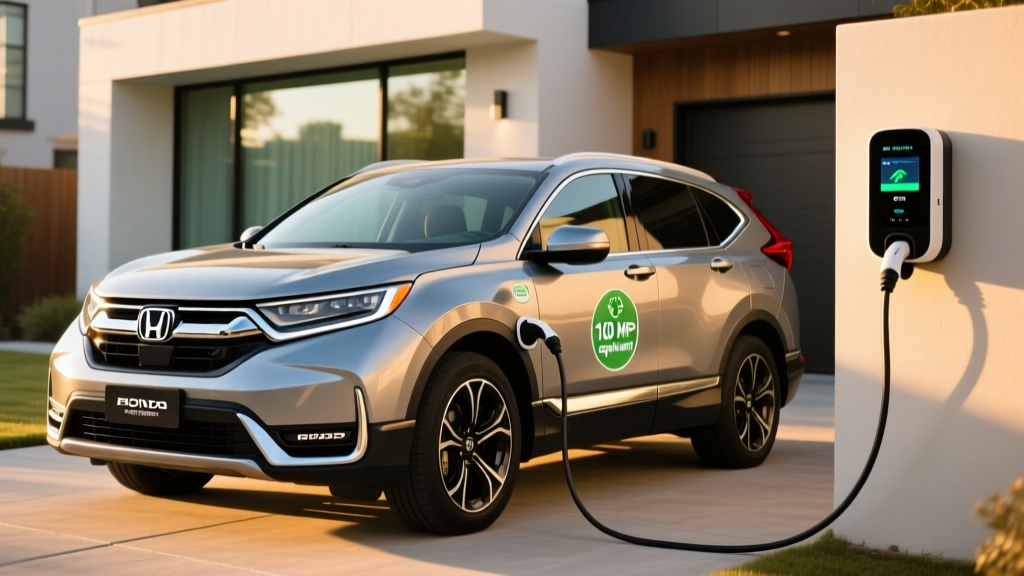
The Honda CR-V Hybrid has quietly become one of the best-selling electrified vehicles in America, and the Sport-L trim sits in a sweet spot: leather-trimmed interior, hands-free power tailgate, and the full hybrid powertrain without stepping all the way up to the top-tier Sport Touring. If you've been searching for the 2025 Honda CR-V Hybrid Sport-L MSRP and wondering whether the fuel savings justify the premium over the gas model, this guide gives you every number that matters.
We'll cover the exact window-sticker price, EPA fuel economy versus what you'll actually see at the pump, the hybrid battery warranty that protects your investment long-term, and how this conventional hybrid (HEV) stacks up against plug-in hybrids and full battery-electric SUVs in this price range.
2025 Honda CR-V Hybrid Sport-L: Price and Trim Positioning
The 2025 Honda CR-V Hybrid Sport-L carries a starting MSRP of $39,695 (including the $1,395 destination charge). That puts it roughly $2,500 above the mid-range Sport Hybrid trim and about $1,800 below the loaded Sport Touring Hybrid. All-wheel drive is standard on every CR-V Hybrid trim — there's no front-wheel-drive option, which simplifies the buying decision.
| Trim | Starting MSRP | Key Additions Over Sport |
|---|---|---|
| Sport Hybrid | $37,295 | Base hybrid trim, cloth seats, 18" wheels |
| Sport-L Hybrid | $39,695 | Leather-trimmed seats, power tailgate, wireless CarPlay/Android Auto |
| Sport Touring Hybrid | $41,495 | Bose audio, heated rear seats, navigation, rain-sensing wipers |
For context, the non-hybrid CR-V EX-L AWD starts around $38,695, meaning the Sport-L Hybrid's premium over a comparably equipped gas model is roughly $1,000. At current fuel prices, that payback takes approximately 18 to 24 months for a driver covering 12,000 miles per year.
Fuel Economy: EPA Ratings vs. Real-World MPG
The 2025 CR-V Hybrid AWD earns EPA ratings of 40 city / 34 highway / 37 combined MPG, according to fueleconomy.gov. Those numbers place it near the top of the compact hybrid SUV segment, trailing the Toyota RAV4 Hybrid (41/38/39) slightly on the highway but matching or beating most competitors in city driving.
| Vehicle | City MPG | Highway MPG | Combined MPG |
|---|---|---|---|
| Honda CR-V Hybrid AWD | 40 | 34 | 37 |
| Toyota RAV4 Hybrid AWD | 41 | 38 | 39 |
| Hyundai Tucson Hybrid AWD | 37 | 36 | 37 |
| Ford Escape Hybrid AWD | 42 | 36 | 39 |
Real-World MPG: What Owners Actually Report
Honda's hybrid system excels in stop-and-go traffic, where the electric motors handle low-speed propulsion and regenerative braking recaptures energy. In real-world city and suburban driving, many owners report 38–43 MPG, occasionally exceeding the EPA city rating. Highway driving at 75+ MPH tends to drop fuel economy to 30–33 MPG, since the 2.0-liter Atkinson-cycle engine does more of the work at sustained high speeds.
In cold weather (below 30°F), expect a 5–10% reduction in fuel economy due to increased engine idling for cabin heat and reduced battery efficiency. That still leaves the CR-V Hybrid well ahead of the gas-only CR-V AWD, which rates at 27 city / 32 highway / 29 combined.
Powertrain: How the CR-V Hybrid System Works
The CR-V Hybrid uses Honda's two-motor hybrid system, pairing a 2.0-liter Atkinson-cycle four-cylinder engine with two electric motors and a lithium-ion battery pack. Combined system output is 204 horsepower and 247 lb-ft of torque.
| Component | Specification |
|---|---|
| Engine | 2.0L DOHC Atkinson-cycle 4-cylinder |
| Engine Power | 146 hp @ 6,100 rpm |
| Electric Motors | Dual-motor system (propulsion + generation) |
| Combined System Output | 204 hp / 247 lb-ft torque |
| Transmission | Electronic CVT (e-CVT) |
| Drivetrain | AWD (standard, rear motor-driven) |
| Battery Type | Lithium-ion (self-charging, no plug) |
| 0–60 MPH | ~7.6 seconds (est.) |
Unlike Toyota's mechanical AWD system, the CR-V Hybrid uses the electric motor to power the rear axle, eliminating the driveshaft. This means lighter weight and packaging efficiency, though the rear motor provides modest torque — this is an on-demand traction system, not a performance AWD setup.
Hybrid Battery Warranty and Long-Term Reliability
One of the most common questions from hybrid shoppers: what happens when the battery degrades? Honda backs the CR-V Hybrid's lithium-ion battery pack with a warranty of 8 years or 100,000 miles (whichever comes first). In states that follow California Air Resources Board (CARB) emissions standards — including California, New York, Massachusetts, and several others — that coverage extends to 10 years or 150,000 miles.
- Federal (all states): 8 years / 100,000 miles
- CARB states (CA, NY, MA, and others): 10 years / 150,000 miles
- Powertrain warranty: 5 years / 60,000 miles
- Bumper-to-bumper: 3 years / 36,000 miles
Battery Degradation and Replacement Cost
Honda's hybrid battery packs are smaller than those in full EVs — typically around 1.1 kWh of usable capacity — so degradation is less of a concern for daily range. The battery assists with acceleration and captures regenerative braking energy; it doesn't drive the vehicle on electric power alone for meaningful distances.
Based on long-term data from Honda hybrids (Accord, Insight, earlier CR-V Hybrids), these battery packs commonly last 150,000–200,000+ miles before significant degradation occurs. If replacement is needed out of warranty, expect a cost of approximately $2,000–$4,000 for the battery pack, plus labor — significantly less than an EV battery replacement, which can exceed $10,000.
Honda's overall reliability record for the CR-V line is strong. The sixth-generation CR-V (2023–present) has earned top marks from IIHS, including the Top Safety Pick+ designation when equipped with the right headlights.
Tax Credits and Incentives: What You Need to Know
Here's a critical point that catches many buyers off guard: the 2025 Honda CR-V Hybrid does not qualify for the federal §30D Clean Vehicle Tax Credit. That credit — up to $7,500 — is reserved for battery electric vehicles (BEVs) and plug-in hybrids (PHEVs) that meet specific battery sourcing, critical mineral, and MSRP requirements. Conventional hybrids like the CR-V Hybrid are excluded under current IRS rules.
However, some states and local utilities offer their own rebates for hybrid purchases. These vary widely by jurisdiction and change frequently, so check your state energy office or utility provider for current programs. A few states with aggressive emissions-reduction targets have offered $500–$1,500 rebates on hybrids, but these are not guaranteed.
- ❌ Federal §30D credit ($7,500): Not eligible (conventional HEV)
- ❌ Federal used-EV credit ($4,000): Not eligible
- ⚠️ State/utility rebates: Varies by location — check local programs
- ✅ No home charging equipment needed — zero installation cost
CR-V Hybrid vs. PHEV vs. Full EV: Which Is Right for You?
Choosing between a conventional hybrid, a plug-in hybrid, and a full battery-electric vehicle depends on your driving habits, home charging access, and budget. Here's a practical framework:
| Factor | HEV (CR-V Hybrid) | PHEV (e.g., RAV4 Prime) | BEV (e.g., Tesla Model Y) |
|---|---|---|---|
| Plug-in required? | No | Yes (for EV range) | Yes |
| Electric-only range | N/A (~1 mi at low speed) | 35–42 miles | 260–330 miles |
| Fuel/energy cost per mile | ~$0.12 | ~$0.04 (EV) / $0.12 (gas) | ~$0.04–$0.06 |
| Home charging install | $0 | $500–$2,000 | $500–$2,500 |
| Federal tax credit | $0 | Up to $7,500* | Up to $7,500* |
| Best for | Apt/condo dwellers, no plug access | Home chargers, short commutes | Home chargers, long-term savings |
| Starting price range | ~$37,000–$42,000 | ~$43,000–$47,000 | ~$38,000–$55,000 |
*PHEV and BEV federal tax credit eligibility depends on MSRP caps, buyer income limits, and battery mineral sourcing requirements. Consult a tax professional and review current IRS §30D guidelines before purchasing.
Choose the CR-V Hybrid if: You live in an apartment or condo without charging access, you want zero lifestyle change from a gas car, and you value predictable fuel costs without the complexity of plugging in.
Choose a PHEV if: You can install a Level 2 charger at home, your daily commute is under 40 miles round-trip, and you want to drive on electricity most days while keeping a gas engine for road trips.
Choose a full EV if: You have reliable home charging, you drive more than 10,000 miles per year (maximizing fuel savings), and you want the lowest per-mile operating cost with minimal maintenance.
Pros, Cons, and the Bottom Line
Pros
- 37 MPG combined, frequently beaten in city driving
- No plug-in required — zero charging infrastructure needed
- Standard AWD across all hybrid trims
- Spacious cargo area (39.3 cu ft behind rear seats)
- Top Safety Pick+ from IIHS
- Strong 8yr/100k-mi battery warranty (10yr/150k in CARB states)
Cons
- Highway MPG drops to ~30–33 at 75+ MPH
- No federal tax credit eligibility
- e-CVT can drone under hard acceleration
- Hybrid premium over gas model (~$1,000) takes 18–24 months to recoup
- No PHEV variant available in the US market
- Rear-seat USB-C ports only on Sport Touring trim
Frequently Asked Questions
How many MPG does the 2025 Honda CR-V Hybrid actually get?
The EPA rates it at 40 city / 34 highway / 37 combined. In real-world city driving, many owners see 38–43 MPG. Highway driving at 75+ MPH typically yields 30–33 MPG. Cold weather can reduce economy by 5–10%.
Does the CR-V Hybrid need to be plugged in?
No. The CR-V Hybrid is a conventional hybrid (HEV). It charges its own battery through regenerative braking and the gas engine. You fuel it like any other car — just fill up with regular unleaded gasoline.
Is the Honda CR-V Hybrid reliable, and what does battery replacement cost?
Honda's hybrid system has a strong reliability track record. The hybrid battery is warrantied for 8 years/100,000 miles (10 years/150,000 miles in CARB states). Real-world data suggests these packs last 150,000–200,000+ miles. Out-of-warranty replacement runs approximately $2,000–$4,000.
Does the 2025 CR-V Hybrid qualify for any tax credit?
Not at the federal level. The IRS §30D Clean Vehicle Tax Credit applies only to plug-in hybrids and battery electric vehicles. Some state and utility programs may offer smaller rebates for hybrids — check your local programs.
What's the difference between the CR-V Hybrid Sport-L and the Sport Touring?
The Sport-L ($39,695) adds leather-trimmed seats, a hands-free power tailgate, and wireless Apple CarPlay/Android Auto over the base Sport trim. The Sport Touring ($41,495) adds a Bose premium audio system, heated rear seats, built-in navigation, and rain-sensing wipers. For most buyers, the Sport-L offers the best balance of features and value.
Should I buy the CR-V Hybrid or wait for a PHEV version?
Honda has not announced a CR-V PHEV for the US market as of the 2025 model year. If plug-in capability is a priority, consider the Toyota RAV4 Prime (PHEV, ~42 mi electric range, ~$43,000 MSRP) or a full EV like the Hyundai Ioniq 5. If you want a no-compromise hybrid with no plug-in hassle, the CR-V Hybrid is one of the strongest options available now.