Quick Verdict: The Compact Hybrid SUV Benchmark
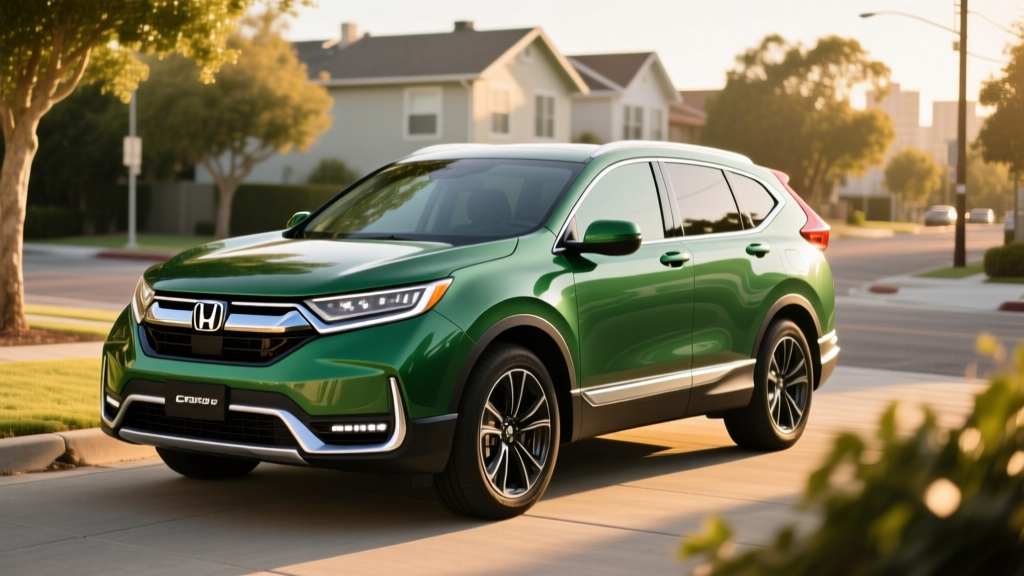
The 2025 Honda CR-V Hybrid continues to anchor Honda's electrified lineup with a straightforward proposition: proven two-motor hybrid efficiency without the plug-in complexity or range anxiety of a full EV. With an EPA-estimated 40 MPG combined and a starting MSRP of $34,650, it occupies a pragmatic middle ground for buyers who want meaningful fuel savings without altering their refueling habits.
After evaluating the CR-V Hybrid across multiple trims and driving conditions, the numbers tell a consistent story. This is not a plug-in hybrid (PHEV) — there is no electric-only driving mode to manage and no charging cable to deal with. It's a conventional self-charging hybrid (HEV) that recovers energy through regenerative braking and engine operation, storing it in a small lithium-ion battery that powers the electric motors alongside the gasoline engine.
| Specification | 2025 Honda CR-V Hybrid |
|---|---|
| Powertrain | 2.0L 4-cylinder Atkinson-cycle + two electric motors |
| Combined Horsepower | 204 hp |
| Combined Torque | 247 lb-ft (electric motor peak) |
| Transmission | e-CVT (direct-drive with lock-up clutch) |
| Drivetrain | FWD standard; AWD available (Sport Touring standard) |
| EPA MPG (FWD) | 43 city / 36 highway / 40 combined |
| EPA MPG (AWD) | 40 city / 34 highway / 37 combined |
| Fuel Tank | 14.0 gallons |
| Total Range (FWD) | ~560 miles |
| 0–60 mph | ~7.6 seconds (tested) |
| Towing Capacity | 1,000 lbs |
| Cargo Volume | 36.3 cu ft (rear seats up) / 76.5 cu ft (folded) |
| Hybrid Battery Warranty | 8 years / 100,000 miles |
| Base MSRP (Sport FWD) | $34,650 |
| Top Trim MSRP (Sport Touring AWD) | $42,150 |
HEV vs PHEV: Understanding What the CR-V Hybrid Is (and Isn't)
A common point of confusion in the compact SUV segment is the distinction between a conventional hybrid (HEV) and a plug-in hybrid (PHEV). The 2025 CR-V Hybrid is strictly an HEV. Here is what that means in practical terms:
| Feature | HEV (CR-V Hybrid) | PHEV (e.g., Toyota RAV4 Prime) | BEV (e.g., Tesla Model Y) |
|---|---|---|---|
| Plug-in Charging Required | No | Yes (Level 1 or Level 2) | Yes (Level 2 or DC fast) |
| Electric-Only Range | Less than 1 mile at low speed | 35–42 miles typical | 260–330+ miles |
| Battery Size | ~1.1 kWh (buffer-limited) | 14.9–18.1 kWh usable | 60–82 kWh usable |
| Refueling | Gas station only | Gas station + plug-in | Plug-in only |
| Federal Tax Credit (§30D) | Not eligible | Eligible (up to $7,500 if sourcing rules met) | Eligible (up to $7,500 if sourcing rules met) |
| Best For | No home charging access; want simplicity | Home charging + short commutes | Home charging + low operating cost |
The CR-V Hybrid's battery pack stores roughly 1.1 kWh of usable energy — far too small to provide meaningful electric-only driving, but sufficient to assist the gasoline engine during acceleration, enable brief low-speed electric creep in stop-and-go traffic, and capture regenerative braking energy. The system manages all of this automatically. You never plug it in, and there is no charge port on the vehicle.
If you need 30–40 miles of electric-only commuting capability, you would need to look at a PHEV like the Toyota RAV4 Prime or the Hyundai Tucson PHEV. Honda does not currently offer a CR-V PHEV in the US market for the 2025 model year.
Fuel Economy: EPA Numbers vs Real-World MPG
The EPA rates the 2025 CR-V Hybrid at 43 city / 36 highway / 40 combined MPG for front-wheel-drive trims, and 40 city / 34 highway / 37 combined for all-wheel-drive models. These figures come from fueleconomy.gov, the official EPA fuel economy database.
| Trim / Drivetrain | City MPG | Highway MPG | Combined MPG |
|---|---|---|---|
| Sport FWD | 43 | 36 | 40 |
| Sport-L FWD | 43 | 36 | 40 |
| Sport AWD | 40 | 34 | 37 |
| Sport-L AWD | 40 | 34 | 37 |
| Sport Touring AWD | 40 | 34 | 37 |
Real-world expectations: Honda's two-motor hybrid system excels in city driving, where frequent deceleration feeds energy back into the battery and the electric motors handle most low-speed propulsion. In mixed suburban and city driving, many owners report matching or slightly exceeding the EPA city figure — 42 to 45 MPG is achievable with moderate acceleration and regular use of the ECON drive mode.
Highway driving tells a different story. At sustained 70–80 mph speeds, the gasoline engine carries most of the load with less regenerative benefit. Expect 33–36 MPG on flat interstate runs with FWD, and 31–34 MPG with AWD. Cold weather (below 35°F) typically reduces fuel economy by 5–10% across the board due to increased engine warm-up time, cabin heating demand, and reduced battery efficiency.
For a 14-gallon fuel tank, real-world total range works out to approximately 480–520 miles in mixed driving with FWD, and 440–480 miles with AWD — still well above what most drivers cover between fill-ups.
Powertrain Deep Dive: How the Two-Motor System Works
The 2025 CR-V Hybrid uses Honda's fourth-generation two-motor hybrid system, pairing a 2.0-liter Atkinson-cycle four-cylinder engine with two electric motors and an electronically controlled continuously variable transmission (e-CVT).
The combined system output is 204 horsepower. The electric motors produce a peak of 247 lb-ft of torque, which is available almost instantly from low RPM — giving the CR-V Hybrid a responsive feel off the line that belies its modest horsepower figure. The gasoline engine alone produces 146 hp and 134 lb-ft, but it primarily functions as a generator at lower speeds, with the electric motors doing the actual driving.
At higher highway speeds, a lock-up clutch mechanically connects the engine to the front wheels for direct, efficient power delivery — bypassing the electrical conversion path. This is why Honda's e-CVT feels more natural than some competitors: there is a genuine mechanical link at cruising speeds, reducing the "rubber-band" effect common in traditional CVTs.
The AWD system uses a rear-mounted electric motor that engages the rear axle when additional traction is needed — during hard acceleration, slippery conditions, or aggressive cornering. It is not a full-time mechanical AWD system; under light-load cruising, the vehicle operates in front-wheel drive to maximize efficiency.
Acceleration to 60 mph takes approximately 7.6 seconds in independent testing. That is competitive with the Toyota RAV4 Hybrid (7.4 seconds) and noticeably quicker than the non-hybrid CR-V's turbocharged 1.5L engine (8.3 seconds). The hybrid powertrain's instant electric torque provides confident merging and passing performance.
Hybrid Battery Warranty, Longevity, and Replacement Cost
Battery reliability is consistently the top concern among hybrid shoppers, and Honda addresses it with a robust warranty structure.
2025 Honda CR-V Hybrid Battery Coverage:
- Hybrid battery warranty: 8 years / 100,000 miles (10 years / 150,000 miles in California and states that follow CARB emissions standards)
- Powertrain warranty: 5 years / 60,000 miles
- Limited vehicle warranty: 3 years / 36,000 miles
- Battery chemistry: Lithium-ion (small-capacity HEV pack, ~1.1 kWh usable)
Real-world longevity data from earlier-generation Honda hybrids (Insight, Accord Hybrid, previous CR-V Hybrid) shows that the hybrid battery packs routinely last 150,000–200,000+ miles before significant degradation requires attention. The HEV battery in the CR-V Hybrid is small and operates within a narrow state-of-charge window (roughly 40–60%), which dramatically reduces stress on the cells compared to a full EV battery that cycles between 10–90% daily.
If replacement is needed outside of warranty, a Honda hybrid battery pack typically costs between $2,000 and $4,000 installed, depending on the source (OEM vs. refurbished) and labor rates. Independent hybrid specialists often offer refurbished packs at the lower end of that range. For context, that is a fraction of the $10,000–$20,000+ cost associated with full EV battery replacements.
The 12-volt auxiliary battery (which powers electronics, lights, and infotainment) is a separate component covered under the standard 3-year/36,000-mile warranty and typically costs $150–$250 to replace every 4–6 years.
Pricing by Trim and Tax Credit Eligibility
The 2025 CR-V Hybrid is offered in three trims, all featuring the same 204-hp two-motor powertrain:
| Trim | Drivetrain | MSRP | Key Features |
|---|---|---|---|
| Sport | FWD or AWD | $34,650 (FWD) / $36,150 (AWD) | 18" alloy wheels, 7" touchscreen, wireless Apple CarPlay/Android Auto, Honda Sensing suite |
| Sport-L | FWD or AWD | $36,650 (FWD) / $38,150 (AWD) | Leather-trimmed seats, 9" touchscreen, wireless charging, heated front seats, power liftgate |
| Sport Touring | AWD only | $42,150 | Bose 12-speaker audio, navigation, heated steering wheel, ventilated front seats, hands-free liftgate |
Federal tax credit: The 2025 CR-V Hybrid does not qualify for the federal §30D clean vehicle tax credit. Under current IRS rules, only plug-in electric vehicles (BEVs and PHEVs) with sufficient battery capacity are eligible — conventional hybrids are excluded regardless of their efficiency.
Some states offer their own incentives for hybrid vehicles, though these are less common than EV incentives and vary significantly by jurisdiction. Check your state's energy or environmental agency website for current programs. No federal incentive applies.
Who Should Choose the CR-V Hybrid vs a PHEV or Full EV?
Choose the 2025 Honda CR-V Hybrid (HEV) if:
- You lack access to home or workplace charging (apartment, street parking, no garage)
- You want fuel savings with zero change to your refueling routine
- Your driving is a mix of city and highway with no predictable short commute pattern
- You prefer lower upfront cost over maximum efficiency
- You drive 12,000–15,000 miles/year and want to save $500–$800 annually vs. the gas CR-V
Consider a PHEV (like the Toyota RAV4 Prime) if:
- You have Level 2 home charging and a commute under 40 miles round-trip
- You want electric-only daily driving with gas-engine backup for road trips
- You may qualify for the $7,500 federal tax credit (subject to MSRP, income, and battery-sourcing rules)
Consider a full EV (like the Tesla Model Y or Hyundai Ioniq 5) if:
- You have reliable home Level 2 charging
- You want the lowest per-mile energy cost ($0.03–$0.05/mile vs. $0.12–$0.15/mile for the hybrid)
- You want zero tailpipe emissions and minimal maintenance (no oil changes, no engine)
- Your typical trips fall within 250–300 miles or you are comfortable with DC fast charging on road trips
For the majority of US buyers who lack dedicated home charging infrastructure, the CR-V Hybrid represents the lowest-friction path to meaningful fuel savings. You will spend roughly $1,200–$1,500 per year on gasoline at 15,000 miles/year and $3.50/gallon — compared to $1,800–$2,100 for the non-hybrid CR-V (28 MPG combined) and $500–$700 for a comparable EV charged mostly at home.
Reliability and Safety
The 2025 CR-V Hybrid carries over the strong reliability record of the sixth-generation CR-V platform. Honda's hybrid system has been in production since the early 2000s, and the current two-motor architecture has been in use since 2017 across multiple models (Accord Hybrid, CR-V Hybrid, Civic Hybrid) with no widespread battery or powertrain failure patterns.
The National Highway Traffic Safety Administration (NHTSA) awarded the 2025 CR-V a 5-Star Overall Safety Rating. The Insurance Institute for Highway Safety (IIHS) named the CR-V a Top Safety Pick+ when equipped with specific headlights, reflecting excellent crashworthiness and crash-avoidance performance from the Honda Sensing ADAS suite.
The Honda Sensing package (standard on all trims) includes adaptive cruise control with low-speed follow, lane-keeping assist, road departure mitigation, collision mitigation braking, and traffic sign recognition. This is a Level 2 driver-assist system — the driver must remain fully engaged and attentive at all times. It is not autonomous or self-driving.
Pros
- 40 MPG combined (FWD) with no plug-in requirement
- Strong 247 lb-ft electric torque for confident acceleration
- Spacious cargo area (36.3 cu ft) with no battery packaging compromise
- 8-year/100,000-mile hybrid battery warranty (10/150k in CARB states)
- Top Safety Pick+ and 5-star NHTSA rating
- Competitive starting MSRP of $34,650
Cons
- No PHEV variant available — no electric-only commute capability
- AWD drops combined MPG to 37
- 1,000-lb towing capacity is low for the segment
- No federal tax credit eligibility
- Sport Touring AWD at $42,150 encroaches on luxury compact SUV pricing
- Infotainment system is functional but not class-leading in responsiveness
Frequently Asked Questions
How many MPG does the 2025 Honda CR-V Hybrid get?
The EPA rates the FWD model at 43 city / 36 highway / 40 combined MPG. The AWD model is rated at 40 city / 34 highway / 37 combined. In real-world city-dominant driving, many owners achieve 42–45 MPG with FWD. Highway-only driving at 75+ mph typically yields 33–36 MPG.
Does the CR-V Hybrid need to be plugged in?
No. The CR-V Hybrid is a conventional self-charging hybrid (HEV). It has no plug, no charge port, and no electric-only driving range to manage. The hybrid battery charges automatically through regenerative braking and the gasoline engine.
How far can the CR-V Hybrid drive on electric power alone?
Less than one mile at very low speeds (under 25 mph) in ideal conditions. The battery is far too small (~1.1 kWh) for meaningful electric-only driving. The electric motors assist the engine continuously but cannot power the vehicle independently for any practical distance. If you need 30–40 miles of electric-only range, you need a PHEV, not an HEV.
Is the CR-V Hybrid reliable, and what does battery replacement cost?
Honda's hybrid system has a strong long-term reliability record spanning two decades of production. The hybrid battery is warranted for 8 years/100,000 miles (10 years/150,000 miles in CARB states), and real-world data shows these packs commonly lasting 150,000–200,000+ miles. If replacement is needed out of warranty, expect $2,000–$4,000 installed — far less than a full EV battery replacement.
Does the 2025 CR-V Hybrid qualify for any tax credit?
No. The federal §30D clean vehicle credit applies only to plug-in electric vehicles (BEVs and PHEVs) with qualifying battery sourcing. Conventional hybrids like the CR-V Hybrid are not eligible. Some states may offer separate hybrid incentives — check your state's energy office for current programs.
How does the CR-V Hybrid compare to the Toyota RAV4 Hybrid?
The RAV4 Hybrid is rated at 41 MPG combined (AWD standard) vs. the CR-V Hybrid's 37 MPG combined (AWD). The RAV4 also offers a PHEV variant (RAV4 Prime, 42 miles electric-only range). The CR-V Hybrid counters with slightly more cargo space (36.3 vs. 37.6 cu ft — comparable), a more refined e-CVT feel at highway speeds, and Honda Sensing standard across all trims. Both are strong choices; the RAV4 edges ahead on AWD efficiency and PHEV availability, while the CR-V wins on interior refinement and driving dynamics.
What is the annual fuel cost for the CR-V Hybrid?
At 15,000 miles/year, 40 MPG combined, and $3.50/gallon, annual fuel cost is approximately $1,313 for the FWD model. The AWD model at 37 MPG costs roughly $1,419 per year. Compare that to the gas-only CR-V (28 MPG combined) at about $1,875/year — a savings of $450–$560 annually with the hybrid.
Sources: EPA fueleconomy.gov, IRS §30D Clean Vehicle Credits, NHTSA Safety Ratings, Honda Newsroom manufacturer specifications. Pricing and tax credit rules reflect 2025 model year as of publication; verify current eligibility with a tax professional.