The Honda CR-V Hybrid has become one of the best-selling electrified compact SUVs in America, and for the 2025 model year it continues with the sixth-generation platform introduced for 2023. While much of the attention goes to its powertrain efficiency, buyers searching for 2025 Honda CR-V Hybrid interior details will find a cabin that balances practicality with incremental tech upgrades — paired with a hybrid system that delivers strong real-world fuel economy without ever needing a plug.
This guide breaks down everything that matters: the interior layout and cargo dimensions, the EPA MPG numbers and how they translate to real-world driving, the two-motor hybrid powertrain, battery longevity and warranty coverage, pricing across trims, and whether the CR-V Hybrid is the right electrified choice versus a PHEV or full battery-electric vehicle.
2025 Honda CR-V Hybrid Interior: Space, Materials, and Tech
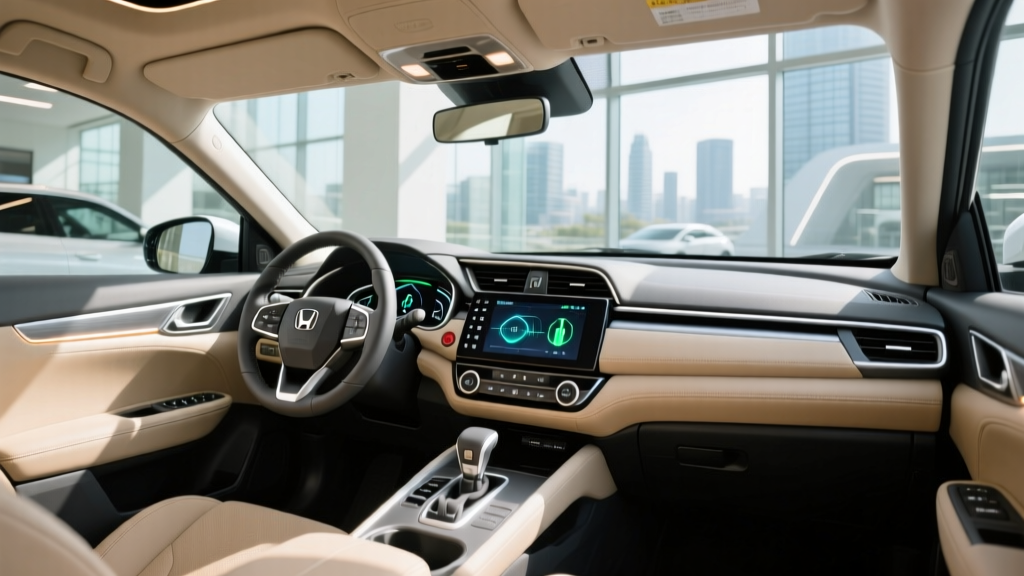
The 2025 CR-V Hybrid is available in Sport, Sport-L, and Sport Touring trims, and the interior carries over the clean, horizontal-dashboard design Honda introduced with this generation. The cabin uses a mix of soft-touch materials on the upper dash and door panels with harder plastics lower down — typical for the segment, though the Sport Touring trim upgrades with leather-trimmed seats and a leather-wrapped steering wheel that elevate the feel.
Front passengers get 41.3 inches of legroom, while rear-seat riders have 41.0 inches — numbers that beat many competitors and make the CR-V Hybrid a genuinely comfortable five-seater for adults on longer trips. The rear seats recline and offer a 60/40 split fold, which is essential for maximizing cargo flexibility.
Cargo volume is a strong suit: 36.3 cubic feet behind the rear seats and 76.5 cubic feet with the rear seats folded flat. That's slightly less than the gas-only CR-V (which doesn't package hybrid electronics under the cargo floor) but still competitive with the Toyota RAV4 Hybrid and Hyundai Tucson Hybrid.
| Spec | 2025 CR-V Hybrid |
|---|---|
| Front Legroom | 41.3 in |
| Rear Legroom | 41.0 in |
| Cargo (rear seats up) | 36.3 cu ft |
| Cargo (rear seats folded) | 76.5 cu ft |
| Infotainment Screen | 7-inch (Sport) / 9-inch (Sport-L, Sport Touring) |
| Wireless Apple CarPlay / Android Auto | Yes (Sport-L, Sport Touring) |
| Wireless Phone Charger | Standard (Sport Touring) |
| Honda Sensing Suite | Standard on all trims |
The infotainment system is a 7-inch touchscreen on the base Sport trim, stepping up to a 9-inch unit on Sport-L and Sport Touring. The larger screen includes wireless Apple CarPlay and Android Auto, embedded navigation on the Sport Touring, and a cleaner interface with physical volume and tuning knobs — a practical choice that many buyers prefer over fully touch-based systems. A 10.2-inch digital driver display is standard on Sport-L and Sport Touring trims, replacing the analog-digital mix on the Sport.
The Honda Sensing suite is standard across all trims and includes adaptive cruise control with low-speed follow, lane-keeping assist, forward collision warning with automatic emergency braking, and traffic sign recognition. This is a Level 2 driver-assist system under SAE classification — it supports the driver but requires full attention and hands-on-wheel engagement at all times. It is not autonomous or "self-driving."
EPA MPG and Real-World Fuel Economy
The 2025 CR-V Hybrid uses Honda's fourth-generation two-motor hybrid system, and the EPA rates it at 43 MPG city / 36 MPG highway / 40 MPG combined for front-wheel-drive trims. The available all-wheel-drive (AWD) versions drop slightly to 40 MPG city / 34 MPG highway / 37 MPG combined, according to fueleconomy.gov.
| Drivetrain | City | Highway | Combined |
|---|---|---|---|
| FWD | 43 MPG | 36 MPG | 40 MPG |
| AWD | 40 MPG | 34 MPG | 37 MPG |
These are strong numbers, but real-world results depend heavily on driving conditions. In city and suburban driving — where the hybrid system can maximize regenerative braking and electric-motor assist — many owners report exceeding the EPA city estimate, hitting 44–46 MPG in moderate weather. Highway driving at sustained 70+ MPH speeds is where hybrids lose their advantage; expect 32–35 MPG from the AWD version on flat interstate runs.
Cold weather also takes a bite. In sub-freezing temperatures, the gasoline engine runs more frequently to provide cabin heat and maintain battery temperature, reducing observed economy by roughly 10–15%. A driver who sees 40 MPG combined in summer might see 34–36 MPG in January. This is a characteristic of all hybrids, not a CR-V-specific flaw, but it matters if you commute in cold climates.
HEV vs PHEV: Where the CR-V Hybrid Fits
The 2025 CR-V Hybrid is a conventional hybrid electric vehicle (HEV). It cannot be plugged in. It charges its small lithium-ion battery pack entirely through regenerative braking and engine-driven generation. You fuel it like any gas car and never think about charging infrastructure.
| Factor | CR-V Hybrid (HEV) | Typical Compact PHEV | Battery EV (BEV) |
|---|---|---|---|
| Plug-in Required? | No | Yes (for EV range) | Yes |
| Electric-Only Range | ~1 mi (low-speed) | 25–42 mi | 230–350+ mi |
| Total Range | ~470 mi | ~400–520 mi | 230–350+ mi |
| Fueling / Charging | Gas station only | Gas + Level 1/2 plug | Plug only (Level 1/2/DC) |
| Federal Tax Credit (§30D) | Not eligible | Up to $7,500* | Up to $7,500* |
| Starting MSRP Range | $34,395–$40,495 | $38,000–$50,000+ | $38,000–$60,000+ |
* §30D credit eligibility depends on MSRP caps, buyer income limits, battery component sourcing, and critical mineral requirements per current IRS rules. Many PHEVs do not qualify for the full credit.
Honda does not currently offer a CR-V Plug-In Hybrid in the US market. The CR-V e:PHEV is sold in China and Europe, but American buyers looking for a plug-in Honda SUV are out of luck for now. If plug-in capability is a priority, competitors like the Toyota RAV4 Prime (42 miles electric-only) or Hyundai Tucson PHEV (33 miles) are the segment benchmarks.
Powertrain Specs: Two-Motor Hybrid System
The 2025 CR-V Hybrid pairs a 2.0-liter Atkinson-cycle four-cylinder engine with two electric motors in Honda's e:HEV architecture. The system produces a combined 204 horsepower and 247 lb-ft of torque. The gasoline engine itself makes 146 hp and 134 lb-ft, while the primary drive motor contributes 181 hp and 247 lb-ft — the system combined output is managed by the power control unit and doesn't simply add the two together.
Unlike Toyota's planetary-gear hybrid system, Honda's setup uses the electric motor as the primary drive force in most conditions. The engine acts mainly as a generator at low and moderate speeds, only engaging a lock-up clutch to drive the wheels directly at sustained highway speeds where it's most efficient. This gives the CR-V Hybrid a more EV-like driving feel around town — smooth, linear torque delivery without the rubber-band sensation some older hybrids exhibit.
The AWD system is a mechanical setup with a driveshaft to the rear axle, not a dedicated rear electric motor. This is simpler and lighter but means rear-wheel torque isn't as instantaneous as an electric AWD system. For most buyers in rain and light snow, it's adequate; for serious off-road or heavy towing, the CR-V Hybrid's 1,000-pound towing capacity is a limitation regardless.
Battery Warranty, Longevity, and Replacement Cost
Honda Hybrid Battery Warranty: 8 years / 100,000 miles (10 years / 150,000 miles in CARB states including California, New York, Massachusetts, and others that follow California emissions standards). The warranty covers capacity loss below a specified threshold and defects.
The CR-V Hybrid uses a relatively small lithium-ion battery pack — roughly 1.06 kWh of total capacity — because it's a conventional hybrid that never needs to store large amounts of energy. This small size actually works in favor of longevity: the battery operates within a narrow state-of-charge window (roughly 40–60%), which is the sweet spot for lithium-ion chemistry and minimizes degradation stress.
Honda's hybrid battery track record is strong. Third-generation CR-V Hybrids (2020–2022 model years) are still early in their lifecycle, but Honda's hybrid batteries in the Accord and Insight have shown excellent durability, with most lasting well beyond 150,000 miles without significant capacity loss. The IIHS has rated the current CR-V highly for safety, and Consumer Reports data shows above-average reliability for the hybrid powertrain.
If a battery replacement is needed out of warranty, expect a cost in the range of $2,000–$4,000 for the pack itself plus labor. This is substantially less than a full EV battery replacement ($10,000–$20,000+) because the pack is small. However, given Honda's track record and the mild operating conditions, most owners will never face this expense.
Pricing, Trims, and Tax Credit Eligibility
The 2025 Honda CR-V Hybrid is offered in three trims, all with the option of FWD or AWD (AWD adds $1,500):
| Trim | FWD MSRP | AWD MSRP |
|---|---|---|
| Sport Hybrid | $34,395 | $35,895 |
| Sport-L Hybrid | $36,695 | $38,195 |
| Sport Touring Hybrid | $38,995 | $40,495 |
Federal tax credit: The CR-V Hybrid does not qualify for the federal §30D New Clean Vehicle Credit. That credit is reserved for plug-in electric vehicles (PHEVs and BEVs) with a minimum battery capacity of 7 kWh. As a conventional hybrid with a ~1 kWh pack, the CR-V Hybrid is ineligible.
Some states and local utilities offer modest incentives for hybrid purchases — typically $250–$1,000 rebates — but these vary widely by jurisdiction. Check your state energy office or utility provider for current programs. For federal incentive details, consult the IRS §30D guidance or a qualified tax professional.
Pros
- 40 MPG combined EPA (FWD) — strong real-world city efficiency
- Spacious interior with 41 inches of rear legroom
- EV-like low-speed driving feel from two-motor system
- Standard Honda Sensing ADAS across all trims
- Proven hybrid reliability; excellent battery warranty
- No plug-in required — zero charging infrastructure dependency
Cons
- AWD fuel economy drops to 37 MPG combined
- No plug-in hybrid variant available in the US
- No federal tax credit eligibility
- Base Sport trim has smaller 7-inch screen
- 1,000-lb towing capacity limits utility
- Highway MPG trails city MPG significantly
Who Should Choose the CR-V Hybrid vs a PHEV or Full EV?
Choose the CR-V Hybrid (HEV) if:
- You lack access to home or workplace charging (apartment, street parking, no garage outlet)
- Your budget is under $40,000 and you want electrified efficiency without the PHEV/BEV price premium
- You drive a mix of city and highway and want 470+ miles of total range without planning stops
- You want a proven, low-complexity hybrid with no behavioral changes required
Consider a PHEV (RAV4 Prime, Tucson PHEV) if:
- You can charge at home (Level 1 or 2) and want 25–42 miles of electric-only commuting
- Your daily commute is under 40 miles round-trip and you want to rarely burn gas
- You want potential federal tax credit eligibility (subject to sourcing and income rules)
Consider a full BEV (Ioniq 5, Model Y, Equinox EV) if:
- You have reliable home Level 2 charging
- You want zero tailpipe emissions and the lowest per-mile fuel cost
- You drive under 300 miles daily or are comfortable with DC fast charging on road trips
The CR-V Hybrid occupies a practical middle ground: it's the lowest-friction path to meaningful fuel savings. You don't change any habits — no plugging in, no range planning, no charging-app accounts. You just drive and spend roughly 30% less on fuel than a gas-only CR-V AWD (28 MPG combined). Over five years at 15,000 miles annually and $3.40/gallon gas, that's approximately $3,200 in fuel savings versus the gas model, which largely offsets the hybrid's modest price premium.
Frequently Asked Questions
How many MPG does the 2025 Honda CR-V Hybrid get?
The EPA rates the FWD CR-V Hybrid at 43 city / 36 highway / 40 combined MPG. The AWD version is rated at 40 city / 34 highway / 37 combined. Real-world city driving often exceeds EPA estimates, while sustained highway speeds and cold weather reduce them by 10–15%.
Does the CR-V Hybrid need to be plugged in?
No. The CR-V Hybrid is a conventional hybrid (HEV). It charges its battery through regenerative braking and the gasoline engine. You simply fill it with gas at any station — no plug, no charging cable, no home charger needed.
Is there a plug-in hybrid CR-V available in the US?
Not for the 2025 model year. Honda sells a CR-V e:PHEV in China and Europe, but it is not offered in the US market. American buyers seeking a compact PHEV SUV should look at the Toyota RAV4 Prime or Hyundai Tucson PHEV.
Is the CR-V Hybrid reliable, and what does battery replacement cost?
Honda's hybrid systems have a strong reliability track record, and the CR-V Hybrid battery is warranted for 8 years/100,000 miles (10 years/150,000 miles in CARB states). Out-of-warranty battery replacement is estimated at $2,000–$4,000, though most packs last well beyond the warranty period given the mild operating conditions of a small HEV battery.
Does the 2025 CR-V Hybrid qualify for a federal tax credit?
No. The federal §30D New Clean Vehicle Credit applies only to plug-in vehicles (PHEVs and BEVs) with a battery capacity of at least 7 kWh. The CR-V Hybrid's ~1 kWh pack does not meet this threshold. Some state or utility rebates may apply — check local programs.
What's the difference between the Sport, Sport-L, and Sport Touring trims?
The Sport is the base hybrid trim with a 7-inch screen and cloth seats. The Sport-L adds a 9-inch touchscreen with wireless CarPlay/Android Auto, leather-trimmed seats, and a power liftgate. The Sport Touring is the top trim with navigation, Bose premium audio, wireless phone charging, a hands-free power tailgate, and heated rear seats.
How does the CR-V Hybrid compare to the Toyota RAV4 Hybrid?
The RAV4 Hybrid is rated at 41 MPG combined (AWD standard) vs the CR-V Hybrid's 37 MPG combined with AWD. The RAV4 also offers a plug-in variant (RAV4 Prime, 42 miles electric-only). However, the CR-V Hybrid offers more rear legroom (41.0 vs 37.8 inches) and a more car-like driving feel from Honda's two-motor system. Both are strong choices — the RAV4 wins on fuel economy and PHEV availability, while the CR-V wins on interior space and refinement.