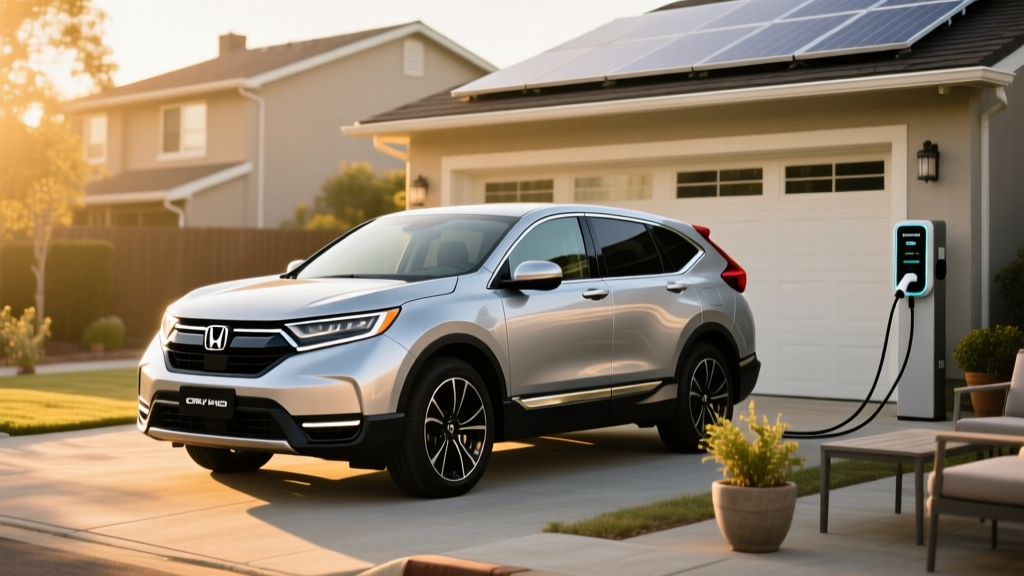
The Honda CR-V Hybrid has become one of the best-selling electrified SUVs in America, and for good reason: it delivers meaningful fuel savings over its gas-only sibling without requiring you to plug in, change your driving habits, or install a home charger. If you're researching the 2025 Honda CR-V Hybrid specs, you're likely weighing whether the hybrid powertrain justifies its price premium over the conventional CR-V — and whether a hybrid, plug-in hybrid, or full EV better fits your lifestyle.
This guide breaks down every critical number: EPA MPG by trim, the two-motor hybrid powertrain, real-world fuel economy expectations, battery warranty coverage, and how the CR-V Hybrid stacks up against PHEV and BEV alternatives.
2025 Honda CR-V Hybrid Powertrain and Performance Specs
The 2025 CR-V Hybrid uses Honda's fourth-generation two-motor hybrid system, which pairs a 2.0-liter Atkinson-cycle four-cylinder engine with two electric motors. Unlike simpler mild-hybrid setups, this is a full series-parallel hybrid — the vehicle can drive on electric power alone at low speeds, engine power alone at highway cruising, or a combination of both under hard acceleration.
| Specification | Value |
|---|---|
| Engine | 2.0L Atkinson-cycle DOHC i-VTEC 4-cylinder |
| Engine Output | 145 hp @ 6,100 rpm / 134 lb-ft torque |
| Drive Motor Output | 184 hp / 247 lb-ft torque |
| Combined System Horsepower | 204 hp |
| Combined System Torque | 247 lb-ft (motor-driven) |
| Transmission | e-CVT (direct-drive, no traditional belt/chain) |
| Drivetrain (Sport/LX) | FWD standard, AWD optional |
| Drivetrain (Sport Touring) | AWD standard |
| 0–60 mph (est.) | ~7.6 seconds |
| Towing Capacity | 1,000 lbs |
| Hybrid Battery | ~1.06 kWh lithium-ion (propulsion assist) |
| Regenerative Braking | 4-level adjustable via paddle shifters |
The combined 204 hp is a meaningful step up from the gas-only CR-V's 190 hp turbocharged 1.5L, and the electric motor's instant 247 lb-ft of torque gives the hybrid noticeably stronger off-the-line acceleration in city driving. The e-CVT is a direct-drive unit — not a traditional belt-and-pulley CVT — which eliminates the "rubber band" drone effect that plagues some hybrid competitors.
One note: the 1,000-lb towing capacity is lower than the gas CR-V's 1,500-lb rating. If you regularly tow a small trailer, the gas model has the edge. For bike racks and cargo carriers, 1,000 lbs is sufficient.
Fuel Economy: EPA MPG and Real-World Expectations
The headline reason buyers choose the CR-V Hybrid is fuel economy. Here's the EPA breakdown by configuration, sourced from fueleconomy.gov:
| Configuration | City MPG | Highway MPG | Combined MPG |
|---|---|---|---|
| FWD (Sport, Sport Touring) | 43 | 36 | 40 |
| AWD (Sport, Sport Touring, LX Hybrid) | 40 | 34 | 37 |
For comparison, the gas-only 2025 CR-V AWD earns 27 city / 32 highway / 29 combined MPG. The hybrid's 8 MPG combined advantage translates to roughly 120–150 fewer gallons per year for a driver covering 15,000 miles — saving approximately $400–$550 annually at $3.50/gallon.
HEV vs. PHEV vs. EV: Which CR-V Powertrain Fits You?
Honda does not currently offer a plug-in hybrid (PHEV) version of the CR-V in the United States. The CR-V Hybrid is a conventional HEV — it generates all its electricity onboard through regenerative braking and the gasoline engine. You never plug it in.
| Factor | CR-V Hybrid (HEV) | Typical PHEV SUV | Full EV (BEV) |
|---|---|---|---|
| Plug-in Required? | No | Yes (for EV range) | Yes (always) |
| Electric-Only Range | ~1 mile at low speed | 25–40 miles | 230–350+ miles |
| Home Charging Needed? | No | Recommended (Level 2) | Essential |
| Fuel Cost (per mile) | ~$0.09 | ~$0.04–0.08 | ~$0.03–0.05 |
| Gas Station Stops | Regular (fewer than gas car) | Reduced | None |
| Federal Tax Credit | None | Up to $7,500 (varies) | Up to $7,500 (varies) |
| Upfront Price Premium | ~$1,500 over gas | ~$5,000–8,000 over gas | ~$8,000–15,000 over gas |
- You don't have access to home or workplace charging
- You want better fuel economy with zero lifestyle changes
- You take frequent long road trips and don't want to plan charging stops
- You want a lower upfront price than a PHEV or BEV
- You can install a Level 2 charger at home
- Your daily commute is under 40 miles (coverable on electric-only)
- You want to drive mostly electric on weekdays but gas-free on road trips
- You have reliable home charging
- You want the lowest per-mile fuel cost and zero tailpipe emissions
- You want to qualify for the full $7,500 federal tax credit (subject to eligibility)
Pricing, Trims, and Tax Credit Eligibility
The 2025 CR-V Hybrid is available across four trims. Pricing below reflects MSRP including destination charge:
| Trim | Drivetrain | MSRP |
|---|---|---|
| Sport Hybrid | FWD | $36,395 |
| Sport Hybrid | AWD | $37,895 |
| Sport-L Hybrid | FWD | $38,795 |
| Sport-L Hybrid | AWD | $40,295 |
| Sport Touring Hybrid | AWD (std) | $42,395 |
Federal tax credit: The CR-V Hybrid does not qualify for the federal §30D new clean vehicle credit. Under current IRS rules, only plug-in electric vehicles (PHEVs and BEVs) with sufficient battery capacity are eligible. Conventional hybrids like the CR-V Hybrid are excluded regardless of fuel economy.
Some states and local utilities offer rebates for hybrid purchases, but these vary widely by jurisdiction. Check your state's energy office or utility provider for current programs. A few states offer modest hybrid incentives ($250–$500), but these are far smaller than the up-to-$7,500 federal credit available on qualifying PHEVs and BEVs.
Hybrid Battery Warranty, Lifespan, and Replacement Cost
Battery longevity is the single most common concern among hybrid shoppers. Honda addresses this with robust warranty coverage:
- Hybrid Battery (IPU): 8 years / 100,000 miles (10 years / 150,000 miles in CARB states — CA, NY, MA, CT, ME, MD, NJ, OR, RI, VT, WA, CO, and others adopting California emissions standards)
- Hybrid System Components: 8 years / 100,000 miles (includes inverter, DC-DC converter, electric motors)
- Powertrain Warranty: 5 years / 60,000 miles
- Limited Vehicle Warranty: 3 years / 36,000 miles
Honda's hybrid battery pack is relatively small (~1.06 kWh) compared to PHEV or BEV batteries, which means it undergoes shallower charge/discharge cycles. This is a key longevity advantage: the battery management system keeps the state of charge in a narrow, battery-friendly window (typically 40–80%), minimizing degradation.
Real-world lifespan data: Honda's hybrid systems have proven highly durable. Third-generation CR-V Hybrids (2020–2022) and earlier Accord Hybrids with similar architectures have shown minimal capacity loss at 100,000+ miles. Out-of-warranty hybrid battery replacement for the CR-V Hybrid typically costs $2,000–$4,000 including labor at a Honda dealer — far less than a BEV battery replacement ($10,000–$20,000+). Independent hybrid shops may offer refurbished replacements for $1,200–$2,500.
The 12-volt auxiliary battery (a standard AGM unit) is a separate maintenance item and typically needs replacement every 4–6 years at a cost of $150–$250 — same as any conventional vehicle.
Reliability Ratings and Safety
The CR-V platform has a long-standing reputation for reliability, and the hybrid variant benefits from a simpler powertrain in some respects — the e-CVT direct-drive unit has fewer wear components than a traditional automatic transmission, and regenerative braking reduces brake pad wear (many owners report 60,000–80,000 miles on original brake pads).
For safety, the 2025 CR-V comes standard with Honda Sensing, which includes:
- Adaptive Cruise Control (ACC) with Low-Speed Follow
- Collision Mitigation Braking System (CMBS)
- Lane Keeping Assist System (LKAS)
- Road Departure Mitigation (RDM)
- Traffic Sign Recognition
- Blind Spot Information (BSI) — Sport Touring standard, available on lower trims
The CR-V has earned top marks from both the NHTSA (5-Star Overall Safety Rating) and the IIHS (Top Safety Pick+ when equipped with specific headlights). Note that Honda Sensing is an SAE Level 1 driver-assistance system — it supports the driver but does not provide hands-free or self-driving capability. You must remain fully engaged at all times.
Interior, Cargo, and Practicality
The hybrid powertrain does not compromise cargo space. The CR-V Hybrid's battery pack is mounted beneath the rear seats, preserving the full cargo area:
- Cargo volume (behind rear seats): 36.3 cu ft
- Cargo volume (rear seats folded): 76.5 cu ft
- Rear legroom: 41.0 inches
These figures are identical to the gas-only CR-V, which is a significant advantage over some competing hybrids that sacrifice cargo room for battery placement. The Sport Touring Hybrid adds a hands-free power tailgate, heated rear seats, a 9-inch touchscreen with wireless Apple CarPlay/Android Auto, a Bose premium audio system, and a wireless phone charger.
- 40 MPG combined (FWD) — among the best in compact SUV class
- 204 hp with strong electric torque for confident city driving
- No plug-in required — zero lifestyle change from gas car
- Full cargo capacity preserved (no battery intrusion)
- 10-year/150,000-mile hybrid battery warranty in CARB states
- Top Safety Pick+ from IIHS
- Adjustable regen via paddles for one-pedal-like driving
- AWD drops combined MPG to 37
- No federal tax credit eligibility (HEV, not PHEV/BEV)
- 1,000-lb towing capacity (500 lbs less than gas model)
- Hybrid premium of ~$1,500 over equivalent gas trim
- No plug-in hybrid option in Honda's US CR-V lineup
- Highway MPG trails city MPG significantly
Frequently Asked Questions
How many MPG does the 2025 Honda CR-V Hybrid get?
The FWD CR-V Hybrid earns an EPA-estimated 43 city / 36 highway / 40 combined MPG. The AWD version gets 40 city / 34 highway / 37 combined. In real-world city driving, many owners exceed the EPA city estimate by 2–6 MPG thanks to the electric motor's dominance at low speeds. Highway driving at 70+ mph typically yields 33–35 MPG.
Does the CR-V Hybrid need to be plugged in?
No. The CR-V Hybrid is a conventional HEV (hybrid electric vehicle). Its small battery recharges through regenerative braking and the gasoline engine. You fuel it exactly like a gas car — at the gas station. If you want plug-in capability with electric-only range, you'd need to look at a PHEV like the Toyota RAV4 Prime.
How far can the CR-V Hybrid drive on electric power alone?
Less than one mile at very low speeds (under 25 mph). The hybrid system uses electric-only mode for initial acceleration from a stop and low-speed crawling, but the small ~1.06 kWh battery isn't designed for sustained electric-only driving. This is normal for conventional hybrids — the efficiency gains come from the seamless blending of electric and gas power, not from electric-only range.
Is the CR-V Hybrid reliable, and what does battery replacement cost?
Honda's hybrid systems have demonstrated strong long-term reliability. The hybrid battery is warrantied for 8 years/100,000 miles (10 years/150,000 miles in CARB states). Out-of-warranty replacement costs approximately $2,000–$4,000 at a dealer, or $1,200–$2,500 from an independent hybrid specialist. Given the shallow cycling of the battery, most owners will never need a replacement during typical ownership.
Does the 2025 CR-V Hybrid qualify for a federal tax credit?
No. Under current IRS §30D rules, only plug-in electric vehicles (PHEVs and BEVs) with a minimum battery capacity of 7 kWh qualify for the federal clean vehicle credit. The CR-V Hybrid's ~1.06 kWh battery disqualifies it. Check your state and local utility programs for any hybrid-specific rebates, though these are typically modest ($250–$500).
Hybrid vs. PHEV vs. EV — which should I choose?
Choose the CR-V Hybrid if you want better fuel economy without changing your routine — no plugging in, no charging infrastructure needed, and a lower purchase price than a PHEV or EV. Choose a PHEV (like the RAV4 Prime or Hyundai Tucson PHEV) if you can charge at home and want 30–40 miles of electric-only commuting with gas-engine backup. Choose a full EV (like the Tesla Model Y or Hyundai Ioniq 5) if you have home charging, want the lowest running costs, and are ready to commit to electric driving full-time.
How does the CR-V Hybrid compare to the Toyota RAV4 Hybrid?
The RAV4 Hybrid (219 hp combined, 41/38/39 MPG AWD, ~$33,500 starting MSRP) is the CR-V Hybrid's closest competitor. The RAV4 Hybrid offers standard AWD with slightly better highway MPG, while the CR-V Hybrid FWD edges ahead in city MPG. Both have strong reliability records and similar cargo capacity. The CR-V Hybrid's Sport Touring trim offers a more premium interior, while the RAV4 offers a PHEV variant (RAV4 Prime) that the CR-V lineup lacks.