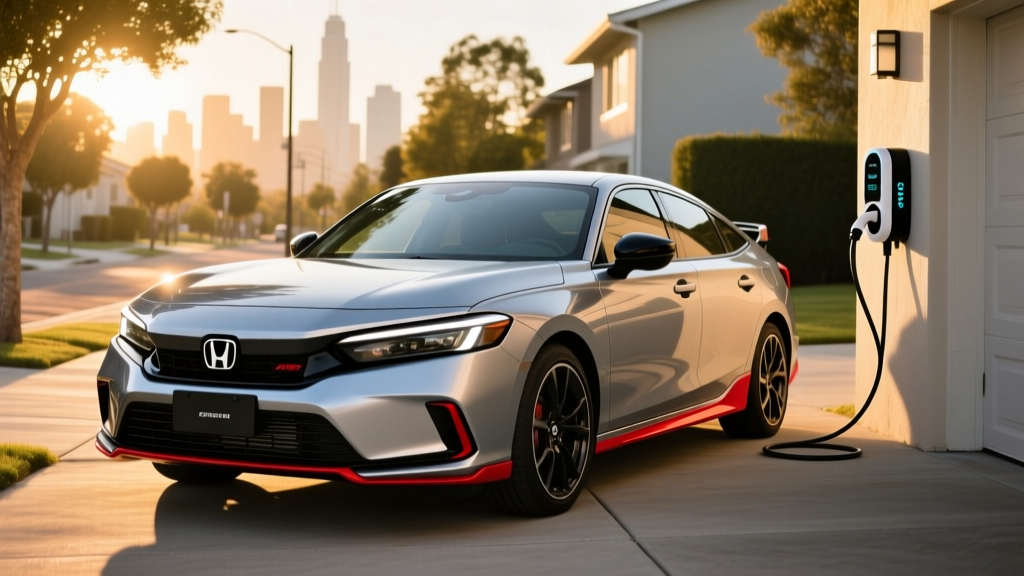
The 2025 Honda Civic Sport Hybrid occupies a specific niche: it's the compact sedan for buyers who want electric-motor efficiency without ever plugging in. Honda's two-motor hybrid system pairs a 2.0-liter Atkinson-cycle engine with an electric drive motor to deliver 200 horsepower and an EPA-estimated 49 MPG combined. For 2025, the Civic Hybrid returns with updated styling, a refreshed interior, and Honda's latest suite of driver-assistance features — all without the range anxiety, charging logistics, or upfront premium of a full battery-electric vehicle.
But how does that EPA sticker translate to real-world commuting? And where does the Civic Sport Hybrid fit among plug-in hybrids and full EVs? This guide covers the exact numbers you need to decide.
HEV vs. PHEV: Where the Civic Sport Hybrid Fits
Conventional Hybrid (HEV): The 2025 Civic Sport Hybrid is a self-charging hybrid. It uses regenerative braking and its gasoline engine to charge a small lithium-ion battery (approximately 1.0 kWh usable). You never plug it in. The electric motor assists the engine at low speeds and during acceleration, but the car cannot drive on electricity alone for meaningful distances.
Plug-In Hybrid (PHEV): Vehicles like the Toyota Prius Prime or Hyundai Tucson PHEV carry a larger battery (typically 10–18 kWh) that can be charged from a wall outlet. They offer 25–45 miles of electric-only driving before the gas engine engages. PHEVs qualify for federal tax credits under IRS §30D; conventional HEVs like the Civic Sport Hybrid do not.
The Civic Sport Hybrid is strictly an HEV. If you're looking for electric-only commuting, you'll need to look at PHEV alternatives or a full BEV. But if your goal is maximum fuel efficiency with zero behavior change — no plugging in, no route planning around chargers — the Civic Hybrid delivers.
Fuel Economy: EPA Ratings vs. Real-World MPG
| Metric | EPA Estimate | Real-World Expectation |
|---|---|---|
| City MPG | 50 MPG | 48–53 MPG (hybrids often exceed EPA in stop-and-go) |
| Highway MPG | 47 MPG | 42–46 MPG (sustained 75+ mph reduces hybrid advantage) |
| Combined MPG | 49 MPG | 45–50 MPG (mixed driving) |
| Fuel Tank Capacity | 12.4 gallons | — |
| Total Range | ~607 miles | ~540–610 miles |
Honda's hybrid system shines in city driving, where the electric motor handles low-speed propulsion and the engine operates primarily as a generator. According to fueleconomy.gov, the 2025 Civic Hybrid achieves 50 MPG city — a number many owners match or slightly exceed in real-world urban commuting thanks to aggressive regenerative braking.
Highway efficiency is the hybrid's relative weak spot. At sustained 75–80 mph speeds, the gasoline engine does most of the work, and the aerodynamic drag penalty applies equally to hybrids and conventional cars. Expect highway trips to yield 42–46 MPG depending on terrain, temperature, and speed. In cold weather (below 40°F), anticipate a 5–10% drop in overall efficiency as the engine runs more frequently to maintain cabin heat and battery temperature.
Powertrain and Performance Specs
| Specification | 2025 Civic Sport Hybrid |
|---|---|
| Engine | 2.0L 4-cylinder Atkinson-cycle |
| Electric Motor | Two-motor hybrid system (drive + generator) |
| Combined Horsepower | 200 HP |
| Combined Torque | 232 lb-ft (electric motor peak) |
| Transmission | e-CVT (no traditional gears) |
| Drivetrain | Front-wheel drive |
| 0–60 MPH | ~7.2 seconds (est.) |
| Battery (Traction) | ~1.0 kWh lithium-ion |
| Plug-In Charging | Not applicable (self-charging HEV) |
Honda's e-CVT isn't a belt-driven CVT like those in older hybrids. Instead, it uses the two-motor system to seamlessly blend engine and electric power. Under light acceleration, the car launches on electric torque alone, giving it a responsive, EV-like feel from a stop. Under hard acceleration, the engine engages directly via a lock-up clutch at higher speeds, eliminating the "rubber band" drone associated with traditional CVTs.
The 200-horsepower combined output makes the Civic Sport Hybrid noticeably quicker than the non-hybrid Civic (158 HP on the 2.0L naturally aspirated). It's not a performance car, but it merges onto highways and passes with confidence.
Pricing, Trims, and Tax Credit Eligibility
The 2025 Honda Civic Sport Hybrid starts at an MSRP of approximately $29,845 (including destination charge). Higher trims — the Sport Touring Hybrid — push toward $33,000 with additional features like leather upholstery, a Bose audio system, and wireless Apple CarPlay/Android Auto.
Federal Tax Credit: The 2025 Civic Sport Hybrid does not qualify for the IRS §30D Clean Vehicle Credit (up to $7,500). That credit applies only to plug-in electric vehicles (BEVs and PHEVs) that meet battery sourcing, critical mineral, MSRP cap, and buyer income requirements. Conventional hybrids like the Civic Sport Hybrid are excluded under current law.
State Incentives: Some states offer rebates or HOV-lane access for hybrids, but these vary widely and change frequently. Check your state's energy or DMV website for current programs. Consult a tax professional for eligibility details.
Without the federal credit, the Civic Hybrid's value proposition rests on fuel savings and lower upfront cost compared to PHEVs and BEVs. At 49 MPG combined versus a gas-only Civic at ~35 MPG combined, the hybrid saves roughly $400–$550 per year in fuel (based on 15,000 miles driven and $3.50/gallon). That pays back the hybrid's ~$1,500 premium over a gas Civic in approximately 3 years.
Battery Warranty, Reliability, and Replacement Cost
Honda Hybrid Battery Warranty: Honda covers the Civic Sport Hybrid's lithium-ion traction battery for 8 years or 100,000 miles (whichever comes first). In states that follow California Air Resources Board (CARB) standards — including CA, NY, MA, WA, and others — that coverage extends to 10 years or 150,000 miles.
Hybrid Battery Replacement Cost: Out-of-warranty replacement for a Civic Hybrid battery pack typically ranges from $2,000 to $3,500 including labor. However, Honda's hybrid batteries have demonstrated strong longevity, with many first-generation Insight and Civic Hybrid owners reporting 150,000+ miles on original packs.
Honda's hybrid system is among the most proven in the industry. The brand has been refining its two-motor architecture since the 2014 Accord Hybrid. The traction battery is relatively small (~1.0 kWh), which means less thermal stress and fewer degradation concerns compared to the 60–100 kWh packs in full EVs. According to IIHS, the 2025 Civic sedan carries top safety ratings, and Honda's overall brand reliability ratings from Consumer Reports and J.D. Power remain strong.
The powertrain warranty covers the engine, electric motors, and e-CVT for 5 years/60,000 miles. Regular maintenance is minimal — no transmission fluid changes on the e-CVT at typical intervals, and regenerative braking significantly extends brake pad life.
Driving Experience and Technology
The 2025 Civic Sport Hybrid comes equipped with Honda Sensing, the brand's Level 2 driver-assistance suite. Per SAE automation standards, Level 2 means the system can manage steering, acceleration, and braking under certain conditions, but the driver must remain fully engaged with hands on the wheel and eyes on the road. This is not autonomous driving.
Honda Sensing includes:
- Adaptive Cruise Control (ACC) with Low-Speed Follow
- Lane Keeping Assist System (LKAS)
- Road Departure Mitigation (RDM)
- Collision Mitigation Braking System (CMBS)
- Traffic Sign Recognition
The 7-inch digital instrument cluster displays real-time energy flow — showing when the car is operating on electric power, when the engine is generating electricity, and when regenerative braking is recapturing energy. A 7-inch touchscreen (9-inch on Sport Touring) handles infotainment, with physical knobs for volume and tuning that make it more usable while driving than touch-only interfaces.
Civic Sport Hybrid vs. Alternatives: Which Should You Choose?
Pros
- 49 MPG combined with no plug-in required
- 200 HP — quickest non-Si Civic in the lineup
- Low starting price (~$29,845) vs. PHEVs and EVs
- Strong 8 yr/100k mi battery warranty (10/150k in CARB states)
- Proven Honda reliability and resale value
- Excellent city MPG (50 EPA) often exceeded in real driving
Cons
- No federal tax credit (HEV, not PHEV/BEV)
- Cannot drive on electric-only power
- Highway MPG drops to low 40s at sustained speed
- FWD only — no AWD option (unlike Toyota Prius)
- Smaller trunk than gas Civic (battery packaging)
Choose the 2025 Civic Sport Hybrid if:
- You want 45+ MPG without ever plugging in
- Your budget is under $35,000 and you don't qualify for or want to navigate EV tax credits
- You live in an apartment or lack home-charging access
- You want a proven, reliable commuter with low maintenance costs
Choose a PHEV (e.g., Prius Prime) if:
- You can charge at home and want 25–45 miles of electric-only commuting
- You want to qualify for the federal §30D tax credit (up to $7,500)
Choose a full EV (e.g., Chevy Equinox EV, Tesla Model 3) if:
- You want zero tailpipe emissions and the lowest per-mile fuel cost
- You have reliable home Level 2 charging and your daily commute is under 250 miles
Frequently Asked Questions
How many MPG does the 2025 Honda Civic Sport Hybrid get?
The EPA rates the 2025 Civic Sport Hybrid at 50 MPG city, 47 MPG highway, and 49 MPG combined. In real-world city driving, many owners report matching or slightly exceeding the 50 MPG city figure thanks to regenerative braking. Highway driving at 75+ mph typically yields 42–46 MPG.
Does the Civic Sport Hybrid need to be plugged in?
No. The Civic Sport Hybrid is a conventional hybrid (HEV), not a plug-in hybrid (PHEV). It charges its battery through regenerative braking and the gasoline engine. You fuel it like any other car at a gas station.
Does the 2025 Civic Sport Hybrid qualify for a federal tax credit?
No. Under current IRS §30D rules, only plug-in electric vehicles (BEVs and PHEVs) with qualifying battery sourcing are eligible for the federal Clean Vehicle Credit. Conventional hybrids like the Civic Sport Hybrid do not qualify. Some states may offer separate hybrid incentives — check your local programs.
How long will the Civic Hybrid battery last, and what does replacement cost?
Honda warranties the hybrid battery for 8 years/100,000 miles (10 years/150,000 miles in CARB states). Real-world data from Honda's hybrid lineup suggests these batteries routinely last 150,000+ miles. Out-of-warranty replacement costs approximately $2,000–$3,500 including labor.
Hybrid vs. PHEV vs. EV — which fits my lifestyle?
Choose the Civic Sport Hybrid (HEV) if you can't plug in at home and want maximum MPG with zero behavior change. Choose a PHEV if you can charge at home and want electric-only commuting plus gas flexibility for road trips. Choose a full EV if you want the lowest operating cost, have home charging, and your daily driving is within the vehicle's range.
Is the Civic Sport Hybrid faster than the gas Civic?
Yes. The Sport Hybrid produces 200 combined horsepower versus 158 HP for the standard 2.0L gas Civic. The hybrid's electric motor delivers instant torque from a stop, making it feel quicker in city driving. Estimated 0–60 MPH is approximately 7.2 seconds for the hybrid versus roughly 8.0 seconds for the gas model.