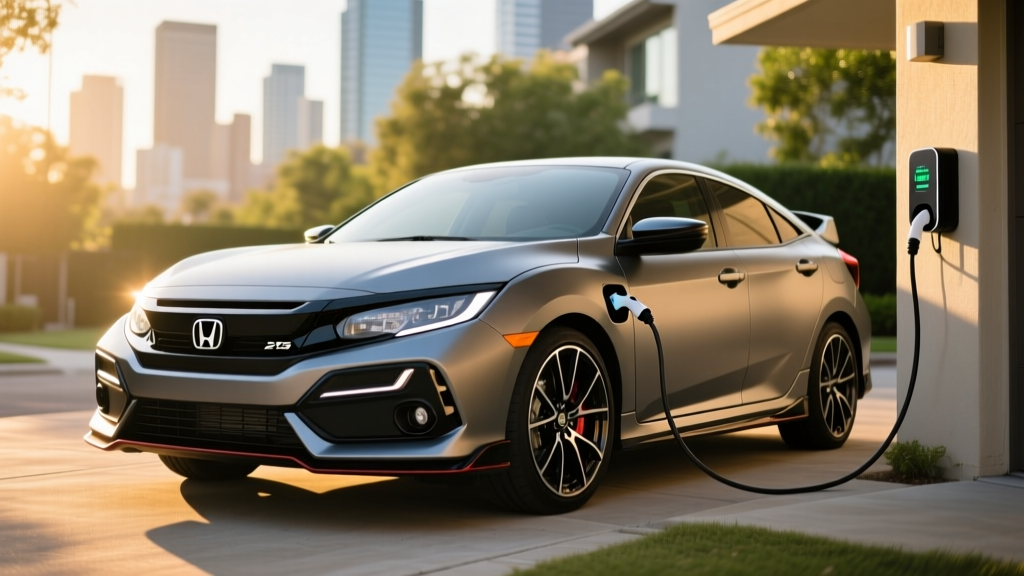
The 2025 Honda Civic Hybrid returns after a long hiatus from the U.S. lineup, and the Sport trim sits at the center of the range. Honda pairs its proven 2.0-liter Atkinson-cycle engine with a dual-motor hybrid system to deliver 200 horsepower and an EPA-estimated 50 MPG combined. For buyers weighing a hybrid against a plug-in hybrid (PHEV) or a full battery-electric vehicle (BEV), the Civic Hybrid Sport makes a compelling case — no charging cables, no range anxiety, and a starting MSRP of $29,995.
But how does it actually perform in the real world? And how does the hybrid system hold up over time? Here's everything you need to know about the 2025 Honda Civic Hybrid Sport trim before you buy.
2025 Honda Civic Hybrid Sport Trim: Quick Specs at a Glance
| Specification | 2025 Civic Hybrid Sport Sedan | 2025 Civic Hybrid Sport Touring Sedan |
|---|---|---|
| Base MSRP | $29,995 | $32,995 |
| Powertrain | 2.0L 4-cyl + dual-motor hybrid | 2.0L 4-cyl + dual-motor hybrid |
| Combined Horsepower | 200 hp | 200 hp |
| Combined Torque | 232 lb-ft | 232 lb-ft |
| EPA Combined MPG | 50 MPG | 49 MPG |
| EPA City MPG | 50 MPG | 49 MPG |
| EPA Highway MPG | 49 MPG | 47 MPG |
| Drivetrain | FWD | FWD |
| 0–60 mph (est.) | ~7.2 sec | ~7.2 sec |
| Hybrid Battery Warranty | 8 yr / 100,000 mi | 8 yr / 100,000 mi |
| Federal Tax Credit (§30D) | Not eligible | Not eligible |
How Many MPG Does the 2025 Civic Hybrid Actually Get?
The EPA rates the 2025 Honda Civic Hybrid Sport sedan at 50 MPG combined (50 city / 49 highway). The Sport Touring trim drops slightly to 49 combined due to larger 18-inch wheels and added equipment weight. According to fueleconomy.gov, these figures place the Civic Hybrid among the most efficient non-plug-in compact sedans on the market, rivaling the Toyota Corolla Hybrid (50 combined) and beating the Hyundai Elantra Hybrid Blue (54 combined) only slightly in highway driving.
| Trim | City MPG | Highway MPG | Combined MPG |
|---|---|---|---|
| Civic Hybrid Sport | 50 | 49 | 50 |
| Civic Hybrid Sport Touring | 49 | 47 | 49 |
| Toyota Corolla Hybrid LE (AWD) | 47 | 41 | 44 |
| Toyota Corolla Hybrid LE (FWD) | 53 | 46 | 50 |
| Hyundai Elantra Hybrid Blue | 51 | 58 | 54 |
Real-World MPG: What to Expect Beyond the EPA Sticker
Honda's hybrid system uses an e-CVT and spends significant time in EV-only mode during city driving, which is why the city and combined numbers are so strong. In real-world mixed driving, owners and reviewers consistently report 46–52 MPG, with city-heavy commutes occasionally exceeding the EPA estimate — a common trait of series-parallel hybrids that recapture energy through regenerative braking.
On sustained highway trips at 70–75 mph, expect closer to 43–47 MPG. Hybrids lose some of their city advantage at high constant speeds because the engine runs more directly. Cold weather (below 32°F) can reduce fuel economy by 5–10% due to longer engine warm-up cycles and increased cabin-heating demands. If you live in a cold climate, plan on winter averages in the low-to-mid 40s.
Hybrid vs. Plug-In Hybrid vs. Full EV: Which Fits Your Life?
The 2025 Civic Hybrid is a conventional hybrid (HEV). That means it has no plug, no electric-only driving range to manage, and no need for home or public charging infrastructure. The small lithium-ion battery (approximately 1.06 kWh usable) recharges through regenerative braking and the gasoline engine.
This is fundamentally different from a plug-in hybrid (PHEV) like the Toyota Prius Prime, which offers 44 miles of electric-only range and requires plug-in charging to realize its full efficiency benefit. And it's different from a full BEV like the Chevrolet Equus EV or Tesla Model 3, which runs entirely on electricity.
| Feature | HEV (Civic Hybrid) | PHEV (Prius Prime) | BEV (Tesla Model 3) |
|---|---|---|---|
| Plug-in required? | No | Yes (for max efficiency) | Yes (always) |
| Electric-only range | ~1 mile at low speed | 44 miles | 341 miles (EPA) |
| Home charging needed? | No | Recommended (Level 2) | Essential (Level 2) |
| Fuel/energy cost per mile | ~$0.10 (gas) | ~$0.04 (electric) / ~$0.10 (gas) | ~$0.04 (electric) |
| Federal tax credit (§30D) | Not eligible | Up to $7,500* | Up to $7,500* |
| Maintenance | Standard ICE + hybrid | Standard ICE + hybrid | Minimal (no oil, filters) |
| Best for | No home charging, high miles | Short commutes + road trips | Home charging + daily driving |
* Federal §30D tax credit eligibility depends on MSRP caps, buyer income limits, battery sourcing requirements, and point-of-sale transfer rules. See IRS.gov for current-year rules. Consult a tax professional.
- You don't have access to home or workplace charging
- You drive 15,000+ miles per year and want maximum fuel savings without lifestyle changes
- You want a proven, low-complexity powertrain with strong resale value
- You take frequent long road trips and don't want to plan around charging stops
- You have Level 2 home charging and a short daily commute (<40 miles for PHEV)
- You want to minimize or eliminate gasoline use
- You qualify for the federal tax credit and want to offset a higher purchase price
Powertrain Deep Dive: 200 HP from Honda's Dual-Motor System
The Civic Hybrid's powertrain is Honda's fourth-generation two-motor hybrid system, the same architecture found in the Accord Hybrid and CR-V Hybrid. Here's how it works:
- Engine: 2.0-liter Atkinson-cycle inline-4, producing 143 hp and 134 lb-ft of torque on its own
- Drive motor: 184 hp, 247 lb-ft — this is the primary propulsion source at low and moderate speeds
- Generator motor: Acts as a starter, generator, and regenerative-braking unit
- Combined output: 200 hp and 232 lb-ft of torque
Unlike a traditional CVT that uses belts and pulleys, Honda's e-CVT uses the two electric motors to manage power delivery. At low speeds, the car runs almost entirely on the electric drive motor, with the gas engine acting as a generator. At highway speeds, a lock-up clutch connects the engine directly to the wheels for efficiency. This setup feels smoother and more linear than the rubber-band sensation of older CVTs.
The result is a 0–60 mph time of approximately 7.2 seconds — about 1.5 seconds quicker than the non-hybrid Civic Sport (the turbocharged 1.5T model). The instant torque from the electric motor also makes the Civic Hybrid feel noticeably punchier in stop-and-go traffic, even if the peak horsepower number is modest.
Battery Warranty, Reliability, and Replacement Cost
The Civic Hybrid's lithium-ion battery pack is compact (~1.06 kWh usable) and operates within a tightly managed state-of-charge window, meaning it never fully charges or fully depletes. This partial-cycling strategy dramatically extends battery lifespan compared to a BEV battery that cycles through larger depth-of-discharge ranges.
How Long Will the Hybrid Battery Last?
Honda's hybrid battery systems in the Accord Hybrid, Insight, and CR-V Hybrid have demonstrated strong longevity. Many owners report 150,000–200,000+ miles with minimal capacity degradation. The battery isn't a wear item the way brake pads are — it's designed to outlast the vehicle in most cases.
If the battery does fail out of warranty, replacement costs for Honda's compact hybrid battery packs typically range from $2,000 to $4,000 including labor, based on current Accord Hybrid and Insight replacement pricing. This is substantially less than a BEV traction battery replacement, which can exceed $10,000–$15,000.
Overall Reliability
Honda's hybrid powertrains have consistently earned above-average reliability ratings. The Civic platform itself carries strong predicted-reliability scores from major automotive evaluators. The hybrid system adds complexity (two motors, power electronics, a lithium-ion pack) but eliminates the traditional automatic transmission — a common failure point in conventional vehicles. According to NHTSA, check for current safety ratings and any open recalls before purchasing.
Pricing, Trims, and Tax Credit Eligibility
The 2025 Honda Civic Hybrid is available in two trims for the sedan body style:
- Civic Hybrid Sport: $29,995 MSRP (includes $1,095 destination charge)
- Civic Hybrid Sport Touring: $32,995 MSRP (includes destination)
The Sport trim comes well-equipped: 18-inch alloy wheels, a 7-inch touchscreen with wireless Apple CarPlay and Android Auto, Honda Sensing ADAS suite (adaptive cruise control, lane-keeping assist, automatic emergency braking), dual-zone climate control, and a leather-wrapped steering wheel.
The Sport Touring adds: a 9-inch touchscreen with built-in navigation, wireless phone charging, Bose premium audio (12 speakers), heated front seats, a power moonroof, leather-trimmed seats, and blind-spot monitoring with rear cross-traffic alert.
Does the Civic Hybrid Qualify for a Federal Tax Credit?
No. The 2025 Honda Civic Hybrid is a conventional hybrid (HEV), not a plug-in vehicle. The federal §30D Clean Vehicle Credit applies only to battery-electric vehicles (BEVs) and plug-in hybrids (PHEVs) that meet specific battery capacity, MSRP, buyer income, and critical-mineral sourcing requirements. Since the Civic Hybrid cannot be plugged in, it does not qualify for any federal purchase incentive.
Some states offer their own incentives for hybrids, but these are uncommon and vary by jurisdiction. Check your state's energy office or department of environmental quality for local programs.
Who Should Buy the 2025 Civic Hybrid Sport?
Pros
- 50 MPG combined — among the best in the compact sedan class
- 200 hp provides quick, confident acceleration
- No plug-in charging required — seamless ownership
- Honda Sensing ADAS standard on all trims
- Strong predicted reliability and 8–10 yr battery warranty
- Competitive pricing under $30K for the Sport trim
Cons
- No federal tax credit eligibility (HEV, not PHEV/BEV)
- FWD only — no AWD option (Corolla Hybrid offers AWD)
- Sport Touring 18-inch wheels reduce highway MPG by 2–3 MPG
- 7-inch screen on Sport trim feels dated vs. competitors
- No hatchback hybrid variant available for 2025
The 2025 Civic Hybrid Sport is ideal for high-mileage commuters, rideshare drivers, and anyone who wants maximum fuel efficiency without changing their refueling habits. If you drive 15,000–20,000 miles per year, the fuel savings over a gas-only Civic (33 MPG combined) add up to roughly $500–$700 per year at $3.40/gallon, depending on your driving mix.
It's less ideal for buyers who have home charging and want to minimize gasoline use entirely — those shoppers should consider a PHEV like the Toyota Prius Prime or a BEV like the Hyundai Ioniq 6 or Tesla Model 3.
Frequently Asked Questions
How many MPG does the 2025 Honda Civic Hybrid Sport get?
The EPA rates the Civic Hybrid Sport at 50 MPG city, 49 MPG highway, and 50 MPG combined. Real-world results typically range from 46–52 MPG in mixed driving, with city-heavy routes occasionally exceeding the EPA estimate and sustained highway driving yielding 43–47 MPG.
Does the Civic Hybrid need to be plugged in?
No. The Civic Hybrid is a conventional hybrid (HEV). Its small battery recharges through regenerative braking and the gasoline engine. You never need to plug it in — just fill up at any gas station as you would with a regular car.
Is the 2025 Civic Hybrid reliable?
Honda's dual-motor hybrid system has a strong track record across the Accord Hybrid, Insight, and CR-V Hybrid. The hybrid battery is covered by an 8-year/100,000-mile warranty (10 years/150,000 miles in CARB states). Replacement cost, if needed out of warranty, is typically $2,000–$4,000.
Does the Civic Hybrid qualify for any tax credits?
The Civic Hybrid does not qualify for the federal §30D Clean Vehicle Credit because it is not a plug-in vehicle. It is also not eligible for most state EV incentives. Some states may offer minor hybrid incentives — check your local energy office for details.
How does the Civic Hybrid compare to the Toyota Prius?
The Toyota Prius (57 MPG combined, FWD LE) is more fuel-efficient but produces only 194 hp and has a more polarizing design. The Civic Hybrid trades a few MPG for stronger acceleration (200 hp), a more conventional driving feel, and Honda's interior quality. The Prius also offers an AWD option that the Civic does not.
Is there an AWD version of the Civic Hybrid?
No. The 2025 Civic Hybrid is front-wheel drive only across all trims. If AWD is a priority, the Toyota Corolla Hybrid and Toyota Prius both offer all-wheel-drive variants.